Species · Flowering plants
Muttonbird Poa Poa foliosa
The scientific name of the Muttonbird Poa is Poa foliosa. It is a species of flowering plant in the family Poaceae (turf), order Poales.
- Scientific name
- Poa foliosa (Hook.f.) Hook.f.
- Common name
- Muttonbird Poa
- Genus
- Poa
- Family
- Poaceae (Turf)
- Order
- Poales
- Class
- Liliopsida
- Recorded in
- 2 countries
- Name status
- accepted in the Catalogue of Life

Overview
Muttonbird poa is a perennial grass that grows in densely clustered tussocks. It occurs on the north-eastern Tītī or Muttonbird Islands of New Zealand, several other New Zealand islands, and Macquarie Island, Australia. It has separate male and female plants.
Written 27 November 2026 from the sources listed below. Each statement was checked against the passage it cites; statements that could not be supported were removed.
Appearance
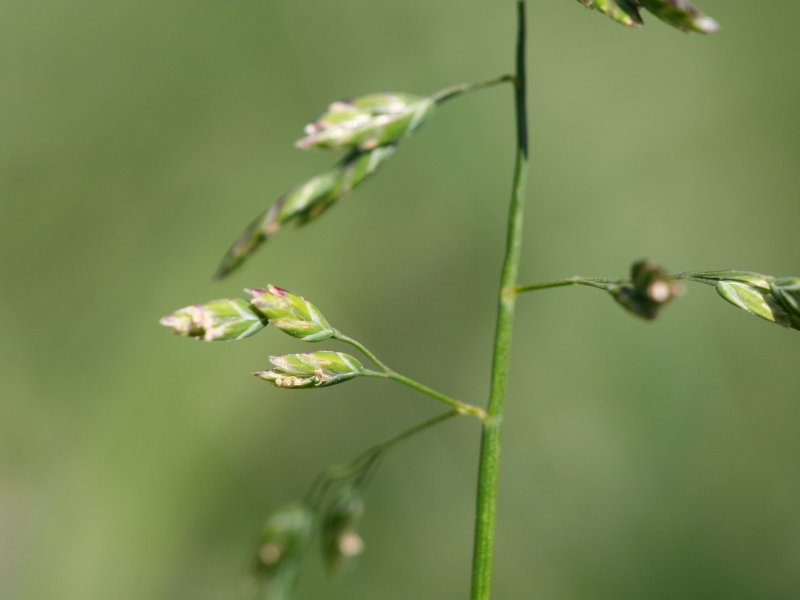
Muttonbird poa grows in densely clustered tussocks that can reach 2 metres in height. The tussocks develop from short, woody stolons.[1][2][3]
The shoots have fibrous remnants of leaf sheaths covering their bases. The leaf blades measure 150–400 mm in length.[4][5]
Habitat
Muttonbird poa inhabits coastal and subcoastal environments, often near seabird colonies. It forms tall tussock grassland on Macquarie Island beaches above the high-water mark.[6][7]
On Macquarie Island, it grows in mixed stands with Stilbocarpa polaris on coastal terraces and slopes with good drainage. It also grows along stream borders.[8][9]
On Macquarie Island, the species occurs patchily on the plateau in both sheltered and relatively exposed locations. Its upland grasslands provide important habitat for burrow-nesting petrels.[10][11]
Reproduction and life cycle
Muttonbird poa has separate male and female plants. It flowers between October and December and produces fruit between November and April.[12][13][14]
Conservation
Muttonbird poa was classified as At Risk - Naturally Uncommon under New Zealand's threat classification system in 2009 and 2012. New Zealand reaffirmed this classification in 2018.[15][16][17]
The 2018 conservation classification was based on the species' restricted range. The assessment included the comment that the species was safe overseas.[18][19]
Classification of the Muttonbird Poa
| Kingdom | Plantae |
|---|---|
| Subkingdom | Pteridobiotina |
| Phylum | Tracheophyta |
| Class | Liliopsida |
| Order | Poales |
| Family | Poaceae (Turf) |
| Genus | Poa (Bluegrass) |
| Species | Poa foliosa (Hook.f.) Hook.f. |
Where the Muttonbird Poa is found
Checklists and occurrence records place Poa foliosa in 2 countries across Oceania. GBIF holds 491 georeferenced records of it.
Countries
Regions and cities with the most records
A number beside a place is its count of GBIF occurrence records. A place without a number comes from a checklist alone. Records show where a species has been observed or collected, which can include escapes and vagrants.
Common names
English
- Muttonbird Poa
Synonyms
One other scientific name has been used for this species and is now treated as a synonym of Poa foliosa.
- Festuca foliosa Hook.f.
Related species
-
 Kentucky BluegrassPoa pratensis
-
 Annual BluegrassPoa annua
-
 Rough BluegrassPoa trivialis
-
 Common Tussock-grassPoa labillardierei
-
 Bulbous BluegrassPoa bulbosa
-
 Alpine Meadow GrassPoa alpina
-
 Tussac GrassPoa flabellata
-
 Sandberg BluegrassPoa secunda
Compare
Questions and answers
What is the scientific name of the Muttonbird Poa?
The scientific name of the Muttonbird Poa is Poa foliosa. Written with its author, the full name is Poa foliosa (Hook.f.) Hook.f..
Which family does the Muttonbird Poa belong to?
Poa foliosa belongs to the family Poaceae, in the order Poales and the class Liliopsida.
Where is the Muttonbird Poa found?
Checklists and occurrence records place Poa foliosa in 2 countries: Australia and New Zealand.
Sources
Passages the profile rests on
- Poa foliosa is a perennial grass that grows in densely clustered tussocks. Source passage: “Poa foliosa is a perennial, dioecious grass growing as densely clumped tussocks up to 2 m in height.” — English Wikipedia
- The tussocks can reach 2 metres in height. Source passage: “densely clumped tussocks up to 2 m in height.” — English Wikipedia
- The tussocks develop from short, woody stolons. Source passage: “The tussocks arise from short, woody stolons” — English Wikipedia
- The shoots have fibrous remnants of leaf sheaths covering their bases. Source passage: “the shoots covered at the base by the fibrous remnants of sheaths.” — English Wikipedia
- The leaf blades measure 150–400 mm in length. Source passage: “The leaf-blades are 150–400 mm long” — English Wikipedia
- The species inhabits coastal and subcoastal environments, often near seabird colonies. Source passage: “The habitat is coastal and subcoastal, often near seabird colonies.” — English Wikipedia
- The species forms tall tussock grassland on Macquarie Island beaches above the high-water mark. Source passage: “It forms a tall tussock grassland along the beaches above the high-water mark” — English Wikipedia
- On Macquarie Island, the species grows in mixed stands with Stilbocarpa polaris on coastal terraces and slopes with good drainage. Source passage: “On Macquarie Island's coastal terraces and slopes it grows in mixed stands with Stilbocarpa polaris where the drainage is good” — English Wikipedia
- On Macquarie Island, the species also grows along stream borders. Source passage: “and along the borders of streams.” — English Wikipedia
- On Macquarie Island, the species occurs patchily on the plateau in both sheltered and relatively exposed locations. Source passage: “as well as patchily on the island's plateau in sheltered and relatively exposed sites.” — English Wikipedia
- The upland grasslands formed by this species provide important habitat for burrow-nesting petrels. Source passage: “The upland grasslands are an important habitat for burrow-nesting petrels.” — English Wikipedia
- The species has separate male and female plants. Source passage: “Poa foliosa is a perennial, dioecious grass” — English Wikipedia
- The species flowers between October and December. Source passage: “The plant flowers from October to December” — English Wikipedia
- The species produces fruit between November and April. Source passage: “and fruits from November to April.” — English Wikipedia
- Poa foliosa was classified as At Risk - Naturally Uncommon under New Zealand's threat classification system in 2009. Source passage: “In both 2009 and 2012 it was deemed to be "At Risk - Naturally Uncommon"” — English Wikipedia
- Poa foliosa was classified as At Risk - Naturally Uncommon in New Zealand in 2012. Source passage: “In both 2009 and 2012 it was deemed to be "At Risk - Naturally Uncommon"” — English Wikipedia
- New Zealand reaffirmed the species' At Risk - Naturally Uncommon classification in 2018. Source passage: “this New Zealand classification was reaffirmed in 2018” — English Wikipedia
- The 2018 conservation classification was based on the species' restricted range. Source passage: “due to its restricted range” — English Wikipedia
- The 2018 assessment included the comment that the species was safe overseas. Source passage: “with a further comment that it was safe overseas.” — English Wikipedia
Data
- Catalogue of Life, 2026-10-16 XR cc by
- Global Biodiversity Information Facility CC BY 4.0
- Wikidata CC0
- GeoNames CC BY 4.0
- Wikimedia Commons per image; credit shown with each image
- Within the Catalogue of Life, this name comes from The World Checklist of Vascular Plants (WCVP) cc by
References
- Handb. N. Zeal. Fl. 1: 338 (1864) where the name was published
This species in other databases
Page built on 27 November 2026. See how the catalog is made and all sources and licences.
Cite this page
ScientificNames.org. (2026). Poa foliosa (Muttonbird Poa). Retrieved November 27, 2026, from https://scientificnames.org/species/poa-foliosa
“Poa foliosa (Muttonbird Poa).” ScientificNames.org, 2026, scientificnames.org/species/poa-foliosa. Accessed 27 Nov. 2026.
ScientificNames.org. “Poa foliosa (Muttonbird Poa).” Accessed November 27, 2026. https://scientificnames.org/species/poa-foliosa.
@misc{scientificnames_poa_foliosa_muttonbird_poa,
  author = {{ScientificNames.org}},
  title = {Poa foliosa (Muttonbird Poa)},
  year = {2026},
  url = {https://scientificnames.org/species/poa-foliosa},
  note = {Accessed 2026-11-27}
}