Species · Flowering plants
Napa Bluegrass Poa napensis
The scientific name of the Napa Bluegrass is Poa napensis. It is a species of flowering plant in the family Poaceae (turf), order Poales.
- Scientific name
- Poa napensis Beetle
- Common name
- Napa Bluegrass
- Genus
- Poa
- Family
- Poaceae (Turf)
- Order
- Poales
- Class
- Liliopsida
- Recorded in
- 1 country
- Name status
- accepted in the Catalogue of Life

Overview
Napa bluegrass is a perennial grass belonging to the genus Poa and the family Poaceae. It grows in moist, mineral-rich soil surrounding hot springs, in habitats including meadows, seeps, and valley and foothill grasslands. It forms dense clumps of somewhat waxy stems and bears flattened spikelets that range from greenish to purple.
Written 27 November 2026 from the sources listed below. Each statement was checked against the passage it cites; statements that could not be supported were removed.
Appearance
Napa bluegrass forms dense clumps of somewhat waxy stems. Its stems can reach approximately one meter in maximum height.[1][2]
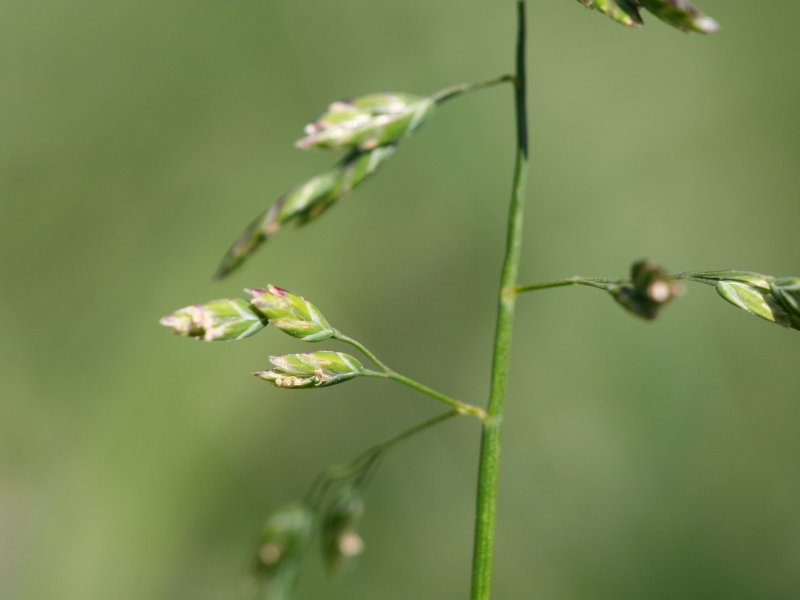
Its inflorescence consists of an open arrangement of thin branches bearing rough-haired, flattened, lance-shaped spikelets. The spikelets range in color from greenish to purple.[3][4]
Habitat
Napa bluegrass grows in moist, mineral-rich soil surrounding hot springs and occurs in moist alkaline substrates near hot springs.[5][6]
Its recorded habitat types include meadows, seeps, and valley and foothill grasslands.[7]
Reproduction and life cycle
Napa bluegrass is a perennial grass that grows as a perennial bunch grass.[8][9]
Conservation
Napa bluegrass was federally listed as an endangered species in 1997. The California Department of Fish and Wildlife identifies it as an endangered plant species in California.[10][11]
The species is known from only two occurrences near Calistoga, California, and occurs exclusively on private, unprotected land.[12][13]
Napa bluegrass depends on water supplied by hot springs. Changes to the local water regime or other characteristics of its specific habitat could affect the species.[14][15]
Classification of the Napa Bluegrass
| Kingdom | Plantae |
|---|---|
| Subkingdom | Pteridobiotina |
| Phylum | Tracheophyta |
| Class | Liliopsida |
| Order | Poales |
| Family | Poaceae (Turf) |
| Genus | Poa (Bluegrass) |
| Species | Poa napensis Beetle |
Where the Napa Bluegrass is found
Checklists and occurrence records place Poa napensis in 1 country across North America. GBIF holds 51 georeferenced records of it.
Countries
Regions and cities with the most records
- California, United States 25
- Windsor, United States 12
- Santa Rosa, United States 11
- Agua Caliente, United States 4
A number beside a place is its count of GBIF occurrence records. A place without a number comes from a checklist alone. Records show where a species has been observed or collected, which can include escapes and vagrants.
Common names
English
- Napa Bluegrass
Related species
-
 Kentucky BluegrassPoa pratensis
-
 Annual BluegrassPoa annua
-
 Rough BluegrassPoa trivialis
-
 Common Tussock-grassPoa labillardierei
-
 Bulbous BluegrassPoa bulbosa
-
 Alpine Meadow GrassPoa alpina
-
 Tussac GrassPoa flabellata
-
 Sandberg BluegrassPoa secunda
Compare
Questions and answers
What is the scientific name of the Napa Bluegrass?
The scientific name of the Napa Bluegrass is Poa napensis. Written with its author, the full name is Poa napensis Beetle.
Which family does the Napa Bluegrass belong to?
Poa napensis belongs to the family Poaceae, in the order Poales and the class Liliopsida.
Where is the Napa Bluegrass found?
Checklists and occurrence records place Poa napensis in 1 country: United States.
Sources
Passages the profile rests on
- Poa napensis forms dense clumps of somewhat waxy stems. Source passage: “forming dense clumps of somewhat waxy stems” — English Wikipedia
- Its stems can reach approximately one meter in maximum height. Source passage: “stems up to about a meter in maximum height.” — English Wikipedia
- Its inflorescence consists of an open arrangement of thin branches bearing rough-haired, flattened, lance-shaped spikelets. Source passage: “The inflorescence is an open array of thin branches bearing rough-haired, flattened, lance-shaped spikelets.” — English Wikipedia
- Its spikelets can range in color from greenish to purple. Source passage: “The spikelets may be greenish to purple in color.” — English Wikipedia
- The species grows in moist, mineral-rich soil surrounding hot springs. Source passage: “It grows in moist, mineral-rich soil around hot springs.” — English Wikipedia
- The species occurs in moist alkaline substrates near hot springs. Source passage: “located in moist alkaline substrate near hot springs.” — ceqanet.lci.ca.gov
- Its recorded habitat types include meadows, seeps, and valley and foothill grasslands. Source passage: “Meadows and seeps, valley and foothill grassland” — ceqanet.lci.ca.gov
- Poa napensis is a perennial grass. Source passage: “This is a perennial grass” — English Wikipedia
- The species grows as a perennial bunch grass. Source passage: “a perennial bunch grass” — wildlife.ca.gov
- Poa napensis was federally listed as an endangered species in 1997. Source passage: “This grass was federally listed as an endangered species in 1997” — English Wikipedia
- The California Department of Fish and Wildlife identifies Napa bluegrass as an endangered plant species in California. Source passage: “Napa blue grass is a California endangered plant species” — wildlife.ca.gov
- The species is known from only two occurrences near Calistoga, California. Source passage: “where it is known from only two occurrences near Calistoga.” — English Wikipedia
- The species occurs exclusively on private, unprotected land. Source passage: “The rare grass only occurs on private, unprotected land” — English Wikipedia
- The species depends on water supplied by hot springs. Source passage: “depends on water from the hot springs” — English Wikipedia
- Changes to the local water regime or other characteristics of its specific habitat could affect the species. Source passage: “changes to the local water regime or any other aspects of its specific habitat type would affect the plant.” — English Wikipedia
Data
- Catalogue of Life, 2026-10-16 XR cc by
- Global Biodiversity Information Facility CC BY 4.0
- Wikidata CC0
- GeoNames CC BY 4.0
- Wikimedia Commons per image; credit shown with each image
- Within the Catalogue of Life, this name comes from The World Checklist of Vascular Plants (WCVP) cc by
References
- Leafl. W. Bot. 4: 289 (1946) where the name was published
This species in other databases
- Catalogue of Life 4KMBF
- Wikidata Q7206147
- iNaturalist 78648
- World Flora Online wfo-0000893059
- GRIN 416393
Page built on 27 November 2026. See how the catalog is made and all sources and licences.
Cite this page
ScientificNames.org. (2026). Poa napensis (Napa Bluegrass). Retrieved November 27, 2026, from https://scientificnames.org/species/poa-napensis
“Poa napensis (Napa Bluegrass).” ScientificNames.org, 2026, scientificnames.org/species/poa-napensis. Accessed 27 Nov. 2026.
ScientificNames.org. “Poa napensis (Napa Bluegrass).” Accessed November 27, 2026. https://scientificnames.org/species/poa-napensis.
@misc{scientificnames_poa_napensis_napa_bluegrass,
  author = {{ScientificNames.org}},
  title = {Poa napensis (Napa Bluegrass)},
  year = {2026},
  url = {https://scientificnames.org/species/poa-napensis},
  note = {Accessed 2026-11-27}
}