Species · Flowering plants
Swamp Meadow-Grass Poa palustris
The scientific name of the Swamp Meadow-Grass is Poa palustris. It is a species of flowering plant in the family Poaceae (turf), order Poales.
- Scientific name
- Poa palustris L.
- Common name
- Swamp Meadow-Grass
- Genus
- Poa
- Family
- Poaceae (Turf)
- Order
- Poales
- Class
- Liliopsida
- Red List category
- LC Least Concern
- Recorded in
- 57 countries
- Name status
- accepted in the Catalogue of Life

Overview
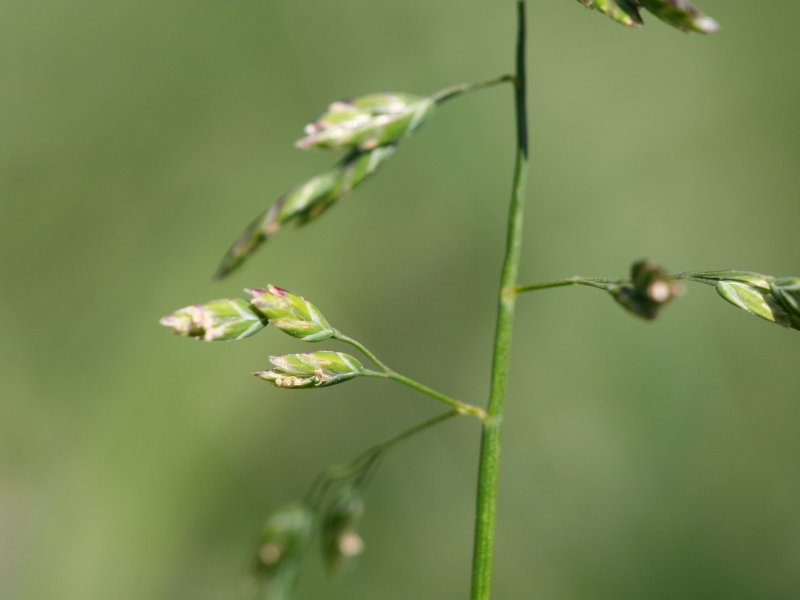
Swamp Meadow-Grass is a perennial that behaves like a weak perennial. It is more commonly found in wet areas and taller meadows than in lawns. It produces a characteristically pyramidal-shaped seedhead.
Written 26 November 2026 from the sources listed below. Each statement was checked against the passage it cites; statements that could not be supported were removed.
Appearance
Swamp Meadow-Grass has a mainly bunch-forming growth habit but can also produce stolons. Its base is purplish in coloration.[1][2]
Its leaves have folded vernation, a keeled leaf sheath, and an open or split sheath. The leaf blades measure 1–8 mm in width, and the leaf tip is boat-shaped and more tapered than those of Kentucky bluegrass and annual bluegrass.[3][4][5][6]
Its membranous ligule measures 3–6 mm long and has a tapering shape that ends in a slender point.[7][8]
Habitat
Swamp Meadow-Grass is more commonly found in wet areas and taller meadows than in lawns. Plants found in lawns may originate from nearby wooded areas, meadows, pastures, or wet areas.[9][10]
Behaviour
Swamp Meadow-Grass is classified as a perennial but behaves like a weak perennial. It grows vigorously in spring but may die or become dormant during summer because of its poor heat and drought tolerance.[11][12]
It grows taller in spring than other bluegrass species.[13]
Reproduction and life cycle
Swamp Meadow-Grass produces seed when it is left unmown. Its seeds may remain dormant in the soil before germinating.[14][15]
Uses
Swamp Meadow-Grass is used as fodder and forage. It is also used for erosion control and revegetation.[16][17]
Similar species
Its ligule is longer and more pointed than those of Kentucky bluegrass and rough bluegrass. It also has a longer ligule than annual bluegrass.[18][19]
Swamp Meadow-Grass, Kentucky bluegrass, annual bluegrass, and rough bluegrass have boat-shaped leaf tips and produce seedheads at approximately the same time of year.[20]
Classification of the Swamp Meadow-Grass
| Kingdom | Plantae |
|---|---|
| Subkingdom | Pteridobiotina |
| Phylum | Tracheophyta |
| Class | Liliopsida |
| Order | Poales |
| Family | Poaceae (Turf) |
| Genus | Poa (Bluegrass) |
| Species | Poa palustris L. |
Where the Swamp Meadow-Grass is found
Checklists and occurrence records place Poa palustris in 57 countries across Antarctica, Asia, Europe, North America, Oceania and South America. GBIF holds 103,907 georeferenced records of it.
Countries where it is native or its origin is not stated
- Aland Islands 208
- Albania 1
- Armenia 7
- Austria 1,498
- Belarus 90
- Belgium 2,588
- Bulgaria 7
- Canada 4,299
- China 196
- Czechia 4,694
- Denmark 1,874
- Estonia 2,222
- Finland 13,049
- France 7,066
- Germany 15,438
- Greece 10
- Greenland 3
- Hungary 27
- Iran
- Isle of Man 28
- Italy 59
- Kazakhstan 75
- Kyrgyzstan 14
- Latvia 147
- Liechtenstein 5
- Lithuania 13
- Luxembourg 132
- Moldova 4
- Mongolia 18
- North Korea 4
- Norway 3,082
- Poland 5,687
- Romania 24
- Russia 5,220
- Saint Pierre and Miquelon 8
- Slovakia 2,891
- Slovenia 35
- South Korea 34
- Spain 6
- Svalbard and Jan Mayen 3
- Sweden 13,864
- Switzerland 2,000
- Tajikistan 3
- The Netherlands 6,395
- Turkey 8
- Turkmenistan
- Ukraine 1,171
- United States 8,141
- Uzbekistan 15
Countries where it has been introduced
- Argentina 5
- Chile 2
- French Southern Territories 2
- India 3
- Ireland 17
- Japan 389
- New Zealand 17
- United Kingdom 1,109
Regions and cities with the most records
- Bavaria, Germany 7,739
- Auvergne-Rhône-Alpes, France 3,209
- Gelderland, The Netherlands 1,777
- Skåne, Sweden 1,702
- Västra Götaland, Sweden 1,578
- Södermanland, Sweden 1,488
- Lower Saxony, Germany 1,324
- Myyrmäki, Finland 1,298
- Grand Est, France 1,234
- Helsinki, Finland 1,175
- Stockholm, Sweden 1,165
- Overijssel, The Netherlands 1,153
- Quebec, Canada 1,151
- North Rhine-Westphalia, Germany 1,101
- Montbrison, France 1,096
- Vantaa, Finland 996
- Beuningen, The Netherlands 965
- Uppsala, Sweden 963
- Elst, The Netherlands 950
- Östergötland, Sweden 907
- Nijmegen, The Netherlands 895
- Bourgogne-Franche-Comté, France 889
- Espoo, Finland 885
- Regensburg, Germany 883
- Mecklenburg-Vorpommern, Germany 846
- Lapland, Finland 838
- Upper Austria, Austria 838
- Wijchen, The Netherlands 806
- Huissen, The Netherlands 761
- Gävleborg, Sweden 734
- Arnhem, The Netherlands 720
- Groesbeek, The Netherlands 692
- Wageningen, The Netherlands 691
- Zurich, Switzerland 666
- Duiven, The Netherlands 652
- Malacky, Slovakia 646
1 more country has a few records outside this range
These countries hold a few records of Poa palustris but lie outside the range the checklists give for it. Such records are often zoo or garden specimens, museum material or vagrants, so the species is not counted as occurring there.
A number beside a place is its count of GBIF occurrence records. A place without a number comes from a checklist alone. Records show where a species has been observed or collected, which can include escapes and vagrants.
Common names
English
- Swamp Meadow-Grass
- Fowl Bluegrass
- Fowl Meadowgrass
- Swamp Bluegrass
- Swamp Meadow Grass
Names in 16 other languages
- Chinese
- ze di zao shu he
- Danish
- Stortoppet rapgræs, Sump-rapgræs
- Dutch
- Moerasbeemdgras
- Finnish
- rantanurmikka
- French
- pâturin de la baie d'Hudson, pâturin des marais, pâturin palustre, pâturin tardif
- German
- Sumpf-Rispengras, Sumpfrispengras
- Italian
- fienarola delle paludi
- Japanese
- numa-ichigo-tsunagi
- Korean
- nunpoapul
- Northern Sami
- gáddesuoidni
- Norwegian Bokmål
- myrrapp
- Portuguese
- poa-paludosa
- Russian
- mjatlik bolotnyj
- Spanish
- poa de los pantanos
- Swedish
- höstgröe, sengröe, sumpgröe
- Welsh
- Gweunwellt y Gors, Gweunwellt yr Afon
Synonyms
80 other scientific names have been used for this species and are now treated as synonyms of Poa palustris.
- Paneion triflorum Lunell
- Poa abietina Schur
- Poa adspersa Drejer
- Poa angustifolia f. effusa (Kit. ex Schult.) Rchb.
- Poa angustifolia f. fertilis (Host) Rchb.
- Poa angustifolia var. effusa Rchb.
- Poa angustifolia var. effusa (Kit.) Schur
- Poa angustifolia var. fertilis (Host) Rchb.
- Poa angustifolia var. fertilis Schur
- Poa angustifolia var. serotina Schur
- Poa crocata Michx.
- Poa ehrhartiana E.Mey.
- Poa ehrhartiana B.D.Jacks.
- Poa fertilis f. coarctata Peterm.
- Poa fertilis f. pauciflora Peterm.
- Poa fertilis f. turfosa Peterm.
- Poa fertilis subsp. exigua Dumort.
- Poa fertilis var. coarctata Peterm.
- Poa fertilis var. exigua Dumort.
- Poa fertilis var. gigantea Fuckel
- Poa fertilis var. glabra Döll
- Poa fertilis var. major Peterm.
- Poa fertilis var. muralis Döll
- Poa fertilis var. palustris Peterm.
- Poa fertilis var. pauciflora Peterm.
- Poa fertilis var. scabriuscula Döll
- Poa fertilis var. turfosa Peterm.
- Poa glauca var. crocata (Michx.) M.E.Jones
- Poa hydrophila Pers.
- Poa hydrophyla Thuill. ex Steud.
- Poa jamalinensis Prob.
- Poa janczewskii Zapał.
- Poa kamtschatica Fisch. ex Roshev.
- Poa nemoralis subsp. kitaibelii K.Richt.
- Poa nemoralis subsp. palustris (L.) Čelak.
- Poa nemoralis var. fertilis (Host) Wimm.
- Poa palustris f. coarctata (Peterm.) Soó
- Poa palustris f. effusa (Kit.) Werner Christ.
- Poa palustris f. pauciflora (Peterm.) Soó
- Poa palustris f. turfosa (Peterm.) Soó
Showing 40 of 80.
Related species
-
 Kentucky BluegrassPoa pratensis
-
 Annual BluegrassPoa annua
-
 Rough BluegrassPoa trivialis
-
 Common Tussock-grassPoa labillardierei
-
 Bulbous BluegrassPoa bulbosa
-
 Alpine Meadow GrassPoa alpina
-
 Tussac GrassPoa flabellata
-
 Sandberg BluegrassPoa secunda
Compare
Questions and answers
What is the scientific name of the Swamp Meadow-Grass?
The scientific name of the Swamp Meadow-Grass is Poa palustris. Written with its author, the full name is Poa palustris L..
Which family does the Swamp Meadow-Grass belong to?
Poa palustris belongs to the family Poaceae, in the order Poales and the class Liliopsida.
Where is the Swamp Meadow-Grass found?
Checklists and occurrence records place Poa palustris in 57 countries, including Germany, Sweden, Finland, United States, France and The Netherlands.
What is the conservation status of the Swamp Meadow-Grass?
The IUCN Red List category recorded for Poa palustris is Least Concern (LC).
What other names does the Swamp Meadow-Grass have?
Poa palustris is also known in English as Fowl Bluegrass, Fowl Meadowgrass, Swamp Bluegrass and Swamp Meadow Grass.
Sources
Passages the profile rests on
- Fowl bluegrass has a mainly bunch-forming growth habit, although it can also produce stolons. Source passage: “Mainly bunch-type in growth habit but can have stolons” — turf.purdue.edu
- The base of fowl bluegrass is purplish in coloration. Source passage: “Purplish base coloration” — turf.purdue.edu
- Fowl bluegrass has folded vernation and a keeled leaf sheath. Source passage: “Folded vernation (keeled sheath)” — turf.purdue.edu
- Its leaf blades measure 1–8 mm in width. Source passage: “1 to 8 mm wide leaf blades” — turf.purdue.edu
- Its leaf sheath is open or split. Source passage: “The leaf sheath is open or split” — turf.purdue.edu
- Its leaf tip is boat-shaped and more tapered than those of Kentucky bluegrass and annual bluegrass. Source passage: “The leaf tip is boat shaped similar to other bluegrasses although the tip is more tapered than in Kentucky bluegrass or annual bluegrass.” — turf.purdue.edu
- Fowl bluegrass has a membranous ligule measuring 3–6 mm long. Source passage: “Long membranous ligule (3 to 6 mm)” — turf.purdue.edu
- The ligule of fowl bluegrass has a tapering shape that ends in a slender point. Source passage: “The ligule has an acuminate (tapering to a slender point) ligule” — turf.purdue.edu
- Fowl bluegrass is more commonly found in wet areas and taller meadows than in lawns. Source passage: “This plant is more common in wet areas and taller meadows than in lawns” — turf.purdue.edu
- Fowl bluegrass found in lawns may originate from nearby wooded areas, meadows, pastures, or wet areas. Source passage: “They could have come from a nearby wooded area, meadow, pasture, or wet area.” — turf.purdue.edu
- Fowl bluegrass is classified as a perennial but behaves like a weak perennial. Source passage: “It is classified as a perennial, but acts like a weak perennial” — turf.purdue.edu
- Fowl bluegrass grows vigorously in spring but may die or become dormant during summer because of its poor heat and drought tolerance. Source passage: “This plant will have vigorous growth in spring but should die or go dormant in summer due to poor heat and drought tolerance.” — turf.purdue.edu
- Fowl bluegrass grows taller in spring than other bluegrass species. Source passage: “Fowl bluegrass plants will grow taller than other bluegrasses in spring.” — turf.purdue.edu
- Fowl bluegrass produces seed when it is left unmown. Source passage: “However, it will produce seed if unmown” — turf.purdue.edu
- Seeds of fowl bluegrass may remain dormant in the soil before germinating. Source passage: “Further, the seed could have been dormant in the soil” — turf.purdue.edu
- Poa palustris is used as fodder and forage. Source passage: “This plant is used as fodder and forage” — English Wikipedia
- Poa palustris is used for erosion control and revegetation. Source passage: “it also used for erosion control or revegetation.” — English Wikipedia
- Fowl bluegrass has a longer, more pointed ligule than Kentucky bluegrass and rough bluegrass. Source passage: “Fowl bluegrass has a long, pointed ligule which distinguishes it from Kentucky bluegrass or rough bluegrass.” — turf.purdue.edu
- The ligule of fowl bluegrass is longer than that of annual bluegrass. Source passage: “The ligule on annual bluegrass is long, but not as long as fowl bluegrass.” — turf.purdue.edu
- Fowl bluegrass, Kentucky bluegrass, annual bluegrass, and rough bluegrass have boat-shaped leaf tips and produce seedheads at approximately the same time of year. Source passage: “They all have a boat-shaped leaf tip and flower (produce seedheads) at a similar time of year” — turf.purdue.edu
Data
- Catalogue of Life, 2026-10-16 XR cc by
- Global Biodiversity Information Facility CC BY 4.0
- Wikidata CC0
- GeoNames CC BY 4.0
- Wikimedia Commons per image; credit shown with each image
- Within the Catalogue of Life, this name comes from The World Checklist of Vascular Plants (WCVP) cc by
References
- Syst. Nat., ed. 10. 2: 874 (1759) where the name was published
This species in other databases
Page built on 28 November 2026. See how the catalog is made and all sources and licences.
Cite this page
ScientificNames.org. (2026). Poa palustris (Swamp Meadow-Grass). Retrieved November 28, 2026, from https://scientificnames.org/species/poa-palustris
“Poa palustris (Swamp Meadow-Grass).” ScientificNames.org, 2026, scientificnames.org/species/poa-palustris. Accessed 28 Nov. 2026.
ScientificNames.org. “Poa palustris (Swamp Meadow-Grass).” Accessed November 28, 2026. https://scientificnames.org/species/poa-palustris.
@misc{scientificnames_poa_palustris_swamp_meadow_grass,
  author = {{ScientificNames.org}},
  title = {Poa palustris (Swamp Meadow-Grass)},
  year = {2026},
  url = {https://scientificnames.org/species/poa-palustris},
  note = {Accessed 2026-11-28}
}