Species · Insects
Owyhee Harvester Ant Pogonomyrmex salinus
The scientific name of the Owyhee Harvester Ant is Pogonomyrmex salinus. It is a species of insect in the family Formicidae (ant), order Hymenoptera. The name dates from 1934.
- Scientific name
- Pogonomyrmex salinus Olsen, 1934
- Common name
- Owyhee Harvester Ant
- Genus
- Pogonomyrmex
- Family
- Formicidae (Ant)
- Order
- Hymenoptera
- Class
- Insecta
- Recorded in
- 2 countries
- Name status
- accepted in the Catalogue of Life

Overview
Pogonomyrmex salinus primarily collects seeds and can prey heavily on slickspot peppergrass seeds where it shares habitat with the plant.
Written 27 November 2026 from the sources listed below. Each statement was checked against the passage it cites; statements that could not be supported were removed.
Diet
The Owyhee Harvester Ant primarily collects seeds and exhibits preferences among available seed species. It largely avoids cheatgrass seeds (Bromus tectorum), which form only a small part of its diet.[1][2]
Slickspot peppergrass seeds have greater energy and protein content than the other seed types examined and may contribute to their selection. The ant can prey heavily on these seeds where it shares habitat with the plant.[3][4]
Behaviour
The Owyhee Harvester Ant exhibits distinct seasonal patterns in its use of food resources. It changes its foraging behaviour when preferred Poa secunda seeds are removed from the area surrounding its nest.[5][6]
Individual workers typically forage within 12 metres of their colony. When preferred seeds are experimentally removed nearby, workers establish trunk trails extending beyond 12 metres from the nest.[7][8]
Classification of the Owyhee Harvester Ant
| Kingdom | Animalia |
|---|---|
| Phylum | Arthropoda |
| Subphylum | Hexapoda |
| Class | Insecta (Insect) |
| Order | Hymenoptera (Ants) |
| Suborder | Apocrita (Ants) |
| Infraorder | Aculeata |
| Superfamily | Formicoidea |
| Family | Formicidae (Ant) |
| Subfamily | Myrmicinae |
| Tribe | Pogonomyrmecini |
| Genus | Pogonomyrmex (Harvester Ants) |
| Species | Pogonomyrmex salinus Olsen, 1934 |
Where the Owyhee Harvester Ant is found
Checklists and occurrence records place Pogonomyrmex salinus in 2 countries. GBIF holds 719 georeferenced records of it.
Countries
Regions and cities with the most records
- Idaho, United States 157
- Washington, United States 144
- Nevada, United States 113
- Wyoming, United States 99
- Utah, United States 85
- California, United States 45
- Boulder City, United States 38
- Henderson, United States 38
- Oregon, United States 30
- Richland, United States 17
- British Columbia, Canada 15
- Tri-Cities, United States 11
- Kennewick, United States 10
- Pasco, United States 10
- Clifton, United States 9
- Colorado, United States 9
- Grand Junction, United States 9
- Caldwell, United States 7
- Carson City, United States 7
- Montana, United States 7
- Bend, United States 5
- Nampa, United States 4
- Twin Falls, United States 4
- Washington, United States 4
- Lewiston, United States 3
- Lewiston Orchards, United States 3
- Meridian, United States 3
- Saint George, United States 3
- Spokane, United States 3
- Spokane Valley, United States 3
A number beside a place is its count of GBIF occurrence records. A place without a number comes from a checklist alone. Records show where a species has been observed or collected, which can include escapes and vagrants.
Common names
English
- Owyhee Harvester Ant
Synonyms
2 other scientific names have been used for this species and are now treated as synonyms of Pogonomyrmex salinus.
- Pogonomyrmex occidentalis owyheei Cole, 1938
- Pogonomyrmex owyheei Cole, 1938
Related species
-
 Maricopa Harvester AntPogonomyrmex maricopa
-
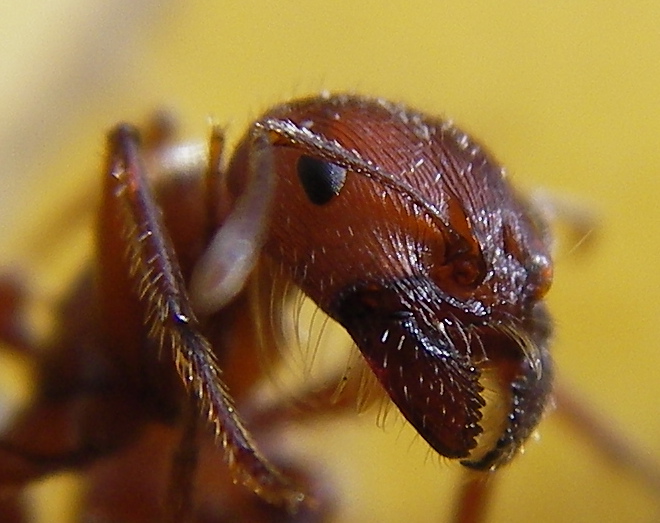 Red Harvester AntPogonomyrmex barbatus
-
 Florida Harvester AntPogonomyrmex badius
-
 Western Harvester AntPogonomyrmex occidentalis
-
 California Harvester AntPogonomyrmex californicus
-
 Rough Harvester AntPogonomyrmex rugosus
-
 Comanche Harvester AntPogonomyrmex comanche
-
 Bicolored Harvester AntPogonomyrmex bicolor
Compare
Questions and answers
What is the scientific name of the Owyhee Harvester Ant?
The scientific name of the Owyhee Harvester Ant is Pogonomyrmex salinus. Written with its author, the full name is Pogonomyrmex salinus Olsen, 1934.
Which family does the Owyhee Harvester Ant belong to?
Pogonomyrmex salinus belongs to the family Formicidae, in the order Hymenoptera and the class Insecta.
Where is the Owyhee Harvester Ant found?
Checklists and occurrence records place Pogonomyrmex salinus in 2 countries: United States and Canada.
What food do harvester ants eat?
The Owyhee Harvester Ant primarily collects seeds and exhibits preferences among available seed species. It largely avoids cheatgrass seeds (Bromus tectorum), while slickspot peppergrass seeds can be a major food resource where the ant and plant share habitat.[1][2][4]
Sources
Passages the profile rests on
- Pogonomyrmex salinus primarily collects seeds and exhibits preferences among available seed species. Source passage: “In general, small seeded species (i.e., P. secunda, S. altissimum and L. papilliferum) were overrepresented in the diet of ants relative to their availability” — scholarworks.boisestate.edu
- The species largely avoids cheatgrass seeds (Bromus tectorum), which form only a small part of its diet. Source passage: “B. tectorum (despite being abundant throughout the study) was largely avoided and a small component of the diet of P. salinus.” — scholarworks.boisestate.edu
- Slickspot peppergrass seeds have greater energy and protein content than the other seed types examined and may contribute to their selection. Source passage: “the greater energy and protein content of L. papilliferum relative to other seed types may play a role in its selection by P. salinus.” — scholarworks.boisestate.edu
- The species can prey heavily on slickspot peppergrass seeds where the ant and plant share habitat. Source passage: “P. salinus can be a voracious seed predator of slickspot peppergrass in areas where their habitats overlap” — scholarworks.boisestate.edu
- The species exhibits distinct seasonal patterns in its use of food resources. Source passage: “harvester ants exhibited distinct seasonal patterns in resource use each year of the study.” — scholarworks.boisestate.edu
- The species changes its foraging behaviour when preferred Poa secunda seeds are removed from the area surrounding its nest. Source passage: “My removal technique at treatment colonies significantly reduced P. secunda seeds on the ground relative to the controls and altered the foraging behavior of ants at those colonies.” — scholarworks.boisestate.edu
- The species establishes trunk trails extending beyond 12 metres from the nest when preferred seeds are experimentally removed nearby. Source passage: “a significant increase in the establishment of trunk trails at distances beyond 12 m from the nest in treatment colonies.” — scholarworks.boisestate.edu
- Individual workers typically forage within 12 metres of their colony. Source passage: “within 12 m of ant colonies, a typical foraging range for individual ants” — scholarworks.boisestate.edu
Data
- Catalogue of Life, 2026-10-16 XR cc by
- Global Biodiversity Information Facility CC BY 4.0
- Wikidata CC0
- GeoNames CC BY 4.0
- Wikimedia Commons per image; credit shown with each image
- Within the Catalogue of Life, this name comes from An Online Catalog of the Ants of the World cc by
References
- Olsen, O. W. (1934). Notes on the North American harvesting ants of the genus Pogonomyrmex Mayr. Bulletin of the Museum of Comparative Zoology, 77, 493–514. https://antcat.org/documents/2298/4218.pdf Link where the name was published
This species in other databases
Page built on 28 November 2026. See how the catalog is made and all sources and licences.
Cite this page
ScientificNames.org. (2026). Pogonomyrmex salinus (Owyhee Harvester Ant). Retrieved November 28, 2026, from https://scientificnames.org/species/pogonomyrmex-salinus
“Pogonomyrmex salinus (Owyhee Harvester Ant).” ScientificNames.org, 2026, scientificnames.org/species/pogonomyrmex-salinus. Accessed 28 Nov. 2026.
ScientificNames.org. “Pogonomyrmex salinus (Owyhee Harvester Ant).” Accessed November 28, 2026. https://scientificnames.org/species/pogonomyrmex-salinus.
@misc{scientificnames_pogonomyrmex_salinus_owyhee_harvester_ant,
  author = {{ScientificNames.org}},
  title = {Pogonomyrmex salinus (Owyhee Harvester Ant)},
  year = {2026},
  url = {https://scientificnames.org/species/pogonomyrmex-salinus},
  note = {Accessed 2026-11-28}
}