Species · Flowering plants
Grass-Wrack Pondweed Potamogeton compressus
The scientific name of the Grass-Wrack Pondweed is Potamogeton compressus. It is a species of flowering plant in the family Potamogetonaceae (pondweed family), order Alismatales.
- Scientific name
- Potamogeton compressus L.
- Common name
- Grass-Wrack Pondweed
- Genus
- Potamogeton
- Family
- Potamogetonaceae (Pondweed Family)
- Order
- Alismatales
- Class
- Liliopsida
- Recorded in
- 28 countries
- Name status
- accepted in the Catalogue of Life

Overview
Potamogeton compressus inhabits still or slow-flowing, lowland waters in Europe and Asia. Its strongly flattened stems and relatively opaque leaves containing sclerenchymatous strands distinguish it from most other pondweeds.
Written 27 November 2026 from the sources listed below. Each statement was checked against the passage it cites; statements that could not be supported were removed.
Appearance
Its long, grass-like leaves are olive-green or dark green and sometimes develop a reddish tinge near the water surface. They measure 85–240 mm in length and 3–6 mm in width.[1][2]
The leaves have two veins on each side of the midrib and bluntly pointed tips. They appear relatively opaque because they contain sclerenchymatous strands.[3][4]
The species does not produce rhizomes or floating leaves. Its inflorescences reach up to 6 mm in length and contain four to six flowers.[5][6]
Its flower stalks are generally 5–20 mm long. Its fruits measure 3.1–4 mm long and 2.1–3 mm wide.[7][8]
Habitat
Grass-Wrack Pondweed inhabits still or slow-flowing, lowland, calcareous and often nutrient-rich waters. Its habitats include river backwaters, ponds and slow-moving streams.[9][10]
It generally grows on fine substrates including sand, silt, clay and peat. It usually occurs at water depths below 1.5 metres, although Japanese populations have been recorded at a depth of five metres.[11][12][13]
The species can colonise artificial waterways such as canals and drainage ditches when boating activity is not heavy. It rarely grows in lakes.[14][15]
It is intolerant of turbid water and prefers partially shaded habitats.[16]
Reproduction and life cycle
Grass-Wrack Pondweed can grow annually from turions and seeds. Wild populations reproduce predominantly asexually through turions, and wild plants typically produce only four to five turions.[17][18][19]
Flowering and fruiting appear to occur more frequently in shallow water habitats with fluctuating water levels, including ditches.[20]
The species is diploid and has 28 chromosomes.[21]
Behaviour
Populations are often transient. Reliance on asexual reproduction may limit the species' ability to recolonise habitats after local population loss.[22][23]
Conservation
Grass-Wrack Pondweed is extinct in the Czech Republic and classified as Critically Endangered in Flanders. It is classified as Endangered in Germany and England, Vulnerable in the Carpathian region and Wales, and Near Threatened in the Netherlands.[24][25][26][27][28]
In North America, the species is listed as Endangered in Maryland and New Jersey, Threatened in New Hampshire and Rare in Pennsylvania.[29]
In Britain, Grass-Wrack Pondweed is a Biodiversity Action Plan priority species and is subject to conservation measures that include translocation.[30]
Uses
Grass-Wrack Pondweed is not currently cultivated. Plants have been successfully grown to maturity for conservation experiments from turions planted in late winter.[31][32]
Snail predation caused high mortality among plants grown in cultivation experiments.[33]
Classification of the Grass-Wrack Pondweed
| Kingdom | Plantae |
|---|---|
| Subkingdom | Pteridobiotina |
| Phylum | Tracheophyta |
| Class | Liliopsida |
| Order | Alismatales |
| Family | Potamogetonaceae (Pondweed Family) |
| Genus | Potamogeton (Pondweed) |
| Species | Potamogeton compressus L. |
Where the Grass-Wrack Pondweed is found
Checklists and occurrence records place Potamogeton compressus in 28 countries across Asia and Europe. GBIF holds 13,364 georeferenced records of it.
Countries where it is native or its origin is not stated
- Aland Islands 9
- Austria 3
- Belarus 18
- Belgium 189
- China 16
- Denmark 366
- Estonia 239
- Finland 991
- France 470
- Germany 914
- Greece
- Italy 4
- Japan 187
- Kazakhstan 13
- Latvia 118
- Lithuania 13
- Luxembourg 3
- Mongolia 2
- Norway 28
- Poland 418
- Russia 1,197
- Spain
- Sweden 2,597
- Switzerland 29
- The Netherlands 2,734
- Ukraine 30
- United Kingdom 2,776
Countries where it has been introduced
Regions and cities with the most records
- England, United Kingdom 2,249
- Friesland, The Netherlands 1,020
- Steenwijk, The Netherlands 618
- Heerenveen, The Netherlands 590
- Drachten, The Netherlands 583
- Stockholm, Sweden 563
- De Meern, The Netherlands 516
- Leeuwarden, The Netherlands 500
- Östergötland, Sweden 497
- IJsselstein, The Netherlands 470
- Woerden, The Netherlands 455
- Maarssen, The Netherlands 447
- Mijdrecht, The Netherlands 438
- Nieuwegein, The Netherlands 427
- Vianen, The Netherlands 373
- Utrecht, The Netherlands 371
- Utrecht, The Netherlands 367
- Overijssel, The Netherlands 357
- Meppel, The Netherlands 317
- Derby, United Kingdom 313
- Glen Parva, United Kingdom 305
- Gouda, The Netherlands 305
- Lapland, Finland 304
- Bilthoven, The Netherlands 302
- Evington, United Kingdom 295
- Wigston Magna, United Kingdom 291
- Hilversum, The Netherlands 289
- Coalville, United Kingdom 287
- Zeist, The Netherlands 287
- Gorinchem, The Netherlands 286
- Jakobsberg, Sweden 285
- Oadby, United Kingdom 284
- Bussum, The Netherlands 282
- Baarn, The Netherlands 281
- Heanor, United Kingdom 280
- Staphorst, The Netherlands 280
2 more countries have a few records outside this range
These countries hold a few records of Potamogeton compressus but lie outside the range the checklists give for it. Such records are often zoo or garden specimens, museum material or vagrants, so the species is not counted as occurring there.
A number beside a place is its count of GBIF occurrence records. A place without a number comes from a checklist alone. Records show where a species has been observed or collected, which can include escapes and vagrants.
Common names
English
- Grass-Wrack Pondweed
- Wrack-Like Pondweed
Names in 19 other languages
- Czech
- rdest smáčknutý
- Danish
- Bændel-vandaks
- Dutch
- Plat fonteinkruid
- Estonian
- Lapik penikeel
- Finnish
- litteävita
- French
- Potamot compressé, Potamot comprimé, Potamot à tige comprimée
- German
- Flachstängeliges Laichkraut, Flachstängliges Laichkraut
- Japanese
- エゾヤナギモ
- Lithuanian
- Plokščioji plūdė
- Northern Sami
- deaškevihti
- Norwegian Bokmål
- bendeltjernaks
- Norwegian Nynorsk
- bendeltjønnaks, bendeltjørnaks
- Polish
- rdestnica ściśniona
- Russian
- Рдест сплюснутый
- Slovak
- červenavec stlačený
- Slovenian
- stisnjeni dristavec
- Swedish
- bandnate
- Ukrainian
- Рдесник стиснутий
- Welsh
- Dyfrllys Camlaswellt, Dyfrllys Cywasg
Synonyms
23 other scientific names have been used for this species and are now treated as synonyms of Potamogeton compressus.
- Potamogeton acutifolius f. major (Fieber) Rchb.
- Potamogeton acutifolius var. major Fieber
- Potamogeton complanatus Willd.
- Potamogeton compressus subsp. compressus
- Potamogeton compressus var. acutus Schltdl.
- Potamogeton compressus var. dimidius Crép.
- Potamogeton compressus var. obtusus Schltdl.
- Potamogeton crispus var. major Gray
- Potamogeton crispus var. oppositifolius Gray
- Potamogeton cuspidatus Schrad.
- Potamogeton monoginus Miki
- Potamogeton pusillus var. compressus (L.) Macreight
- Potamogeton reflexus A.Benn.
- Potamogeton zosteraefolius Schumach.
- Potamogeton zosterifolius Schumach.
- Potamogeton zosterifolius f. magnus Tiselius
- Potamogeton zosterifolius f. selenocarpus Hagstr.
- Potamogeton zosterifolius subsp. zosterifolius
- Potamogeton zosterifolius var. americanus A.Benn.
- Potamogeton zosterifolius var. minor Hook.
- Potamogeton zosterophyllus Dumort.
- Spirillus zosterifolius (Schumach.) Nieuwl.
- Potamogeton acutifolius Hornem. ambiguous synonym
Related species
-
 Curly PondweedPotamogeton crispus
-
 Floating PondweedPotamogeton natans
-
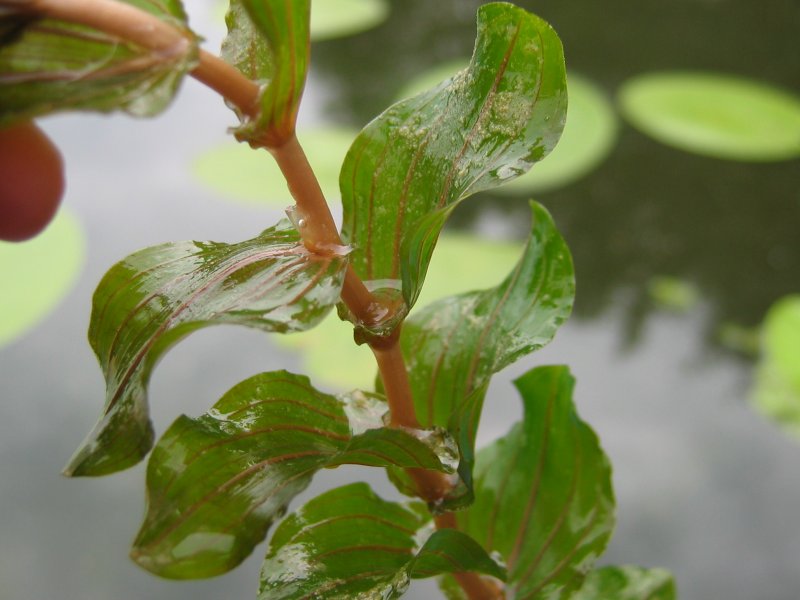 Clasping-leaf PondweedPotamogeton perfoliatus
-
 Small PondweedPotamogeton pusillus
-
 Shining PondweedPotamogeton lucens
-
 Longleaf PondweedPotamogeton nodosus
-
 Various-Leaved PondweedPotamogeton gramineus
-
 Bog PondweedPotamogeton polygonifolius
Compare
Questions and answers
What is the scientific name of the Grass-Wrack Pondweed?
The scientific name of the Grass-Wrack Pondweed is Potamogeton compressus. Written with its author, the full name is Potamogeton compressus L..
Which family does the Grass-Wrack Pondweed belong to?
Potamogeton compressus belongs to the family Potamogetonaceae, in the order Alismatales and the class Liliopsida.
Where is the Grass-Wrack Pondweed found?
Checklists and occurrence records place Potamogeton compressus in 28 countries, including United Kingdom, The Netherlands, Sweden, Russia, Finland and Germany.
What other names does the Grass-Wrack Pondweed have?
Potamogeton compressus is also known in English as Wrack-Like Pondweed.
What are the plants near ponds called?
Grass-Wrack Pondweed is a plant that inhabits ponds and other still or slow-flowing waters.[9][10]
Sources
Passages the profile rests on
- Its leaves are long, grass-like and olive-green or dark green, sometimes developing a reddish tinge near the water surface. Source passage: “olive-green or dark green, sometimes with a reddish tinge near the surface” — English Wikipedia
- Its leaves measure 85–240 mm in length and 3–6 mm in width. Source passage: “leaves that are 85–240 mm long and 3–6 mm wide” — English Wikipedia
- Its leaves have two veins on each side of the midrib and bluntly pointed tips. Source passage: “Each leaf has two veins either side of the midrib and is bluntly pointed.” — English Wikipedia
- Its leaves appear relatively opaque because they contain sclerenchymatous strands. Source passage: “The leaves have a rather opaque appearance compared to the transparent leaves of most pondweeds due to the presence of fibres called sclerenchymatous strands.” — English Wikipedia
- The species does not produce rhizomes or floating leaves. Source passage: “There are no rhizomes or floating leaves.” — English Wikipedia
- Its inflorescences reach up to 6 mm in length and contain four to six flowers. Source passage: “The inflorescences are up to 6 mm long with 4–6 flowers” — English Wikipedia
- Its flower stalks are generally 5–20 mm long. Source passage: “a short peduncle (5–20 mm long, occasionally more)” — English Wikipedia
- Its fruits measure 3.1–4 mm long and 2.1–3 mm wide. Source passage: “The fruits are 3.1–4 x 2.1–3 mm.” — English Wikipedia
- The species inhabits still or slow-flowing, lowland, calcareous and often nutrient-rich waters. Source passage: “still or slow-flowing, lowland, calcareous and often rather nutrient-rich water bodies” — English Wikipedia
- Its habitats include river backwaters, ponds and slow-moving streams. Source passage: “such as backwaters in rivers, ponds and slow-moving streams” — English Wikipedia
- It generally grows on fine substrates including sand, silt, clay and peat. Source passage: “usually on fine substrates such as sand, silt, clay or peat” — English Wikipedia
- The species usually occurs at water depths below 1.5 metres. Source passage: “usually in less than 1.5 m water depth.” — English Wikipedia
- Japanese populations have been recorded growing at a depth of five metres. Source passage: “Japanese populations have been reported growing in 5 m of water.” — English Wikipedia
- It can colonise artificial waterways such as canals and drainage ditches when boating activity is not heavy. Source passage: “capable of colonising artificial habitats such as canals and drainage ditches, so long as these are not heavily boated.” — English Wikipedia
- It rarely grows in lakes. Source passage: “it rarely grows in lakes” — English Wikipedia
- The species is intolerant of turbid water and prefers partially shaded habitats. Source passage: “intolerant of turbid water and prefers some shade.” — English Wikipedia
- The species can grow annually from turions and seeds. Source passage: “It grows annually from turions and seed” — English Wikipedia
- Wild populations reproduce predominantly asexually through turions. Source passage: “Most reproduction in the wild appears to be asexual via turions” — English Wikipedia
- Wild plants typically produce only four to five turions. Source passage: “wild plants typically producing only 4-5 turions.” — English Wikipedia
- Flowering and fruiting appear to occur more frequently in shallow water habitats with fluctuating water levels, including ditches. Source passage: “Flowering and fruiting seems to be more frequent in shallow water environments with fluctuating water levels, such as ditches.” — English Wikipedia
- The species is diploid and has 28 chromosomes. Source passage: “This is a diploid species, with 2n=28.” — English Wikipedia
- Populations of the species are often transient. Source passage: “As a result, populations are often transient.” — English Wikipedia
- The species' reliance on asexual reproduction may limit its ability to recolonise habitats after local population loss. Source passage: “which is likely to mean that populations have limited ability to recolonise if lost.” — English Wikipedia
- The species is extinct in the Czech Republic. Source passage: “it is Extinct in the Czech Republic” — English Wikipedia
- The species is classified as Critically Endangered in Flanders. Source passage: “Critically Endangered in Flanders” — English Wikipedia
- The species is classified as Endangered in Germany and England. Source passage: “Endangered in Germany, England” — English Wikipedia
- The species is classified as Vulnerable in the Carpathian region and Wales. Source passage: “Vulnerable in the Carpathian region, Wales” — English Wikipedia
- The species is classified as Near Threatened in the Netherlands. Source passage: “Near Threatened in the Netherlands.” — English Wikipedia
- In North America, the species is listed as Endangered in Maryland and New Jersey, Threatened in New Hampshire and Rare in Pennsylvania. Source passage: “In North America it is listed as Endangered in Maryland and New Jersey, Threatened in New Hampshire and Rare in Pennsylvania.” — English Wikipedia
- In Britain, the species is a Biodiversity Action Plan priority species and is subject to conservation measures that include translocation. Source passage: “In Britain P. compressus is a Biodiversity Action Plan priority species and is subject to conservation action including translocation efforts.” — English Wikipedia
- The species is not currently cultivated. Source passage: “Potamogeton compressus is not in cultivation.” — English Wikipedia
- Plants have been successfully grown to maturity for conservation experiments from turions planted in late winter. Source passage: “successfully grown plants to maturity from turions planted in late winter” — English Wikipedia
- Snail predation caused high mortality among plants grown in cultivation experiments. Source passage: “High mortality was also observed due to snail predation in culture.” — English Wikipedia
Data
- Catalogue of Life, 2026-10-16 XR cc by
- Global Biodiversity Information Facility CC BY 4.0
- Wikidata CC0
- GeoNames CC BY 4.0
- Wikimedia Commons per image; credit shown with each image
- Within the Catalogue of Life, this name comes from The World Checklist of Vascular Plants (WCVP) cc by
References
- Sp. Pl.: 127 (1753) where the name was published
This species in other databases
- Catalogue of Life 4M3N2
- Wikidata Q625395
- iNaturalist 978354
- World Flora Online wfo-0000769769
- GRIN 509757
Page built on 28 November 2026. See how the catalog is made and all sources and licences.
Cite this page
ScientificNames.org. (2026). Potamogeton compressus (Grass-Wrack Pondweed). Retrieved November 28, 2026, from https://scientificnames.org/species/potamogeton-compressus
“Potamogeton compressus (Grass-Wrack Pondweed).” ScientificNames.org, 2026, scientificnames.org/species/potamogeton-compressus. Accessed 28 Nov. 2026.
ScientificNames.org. “Potamogeton compressus (Grass-Wrack Pondweed).” Accessed November 28, 2026. https://scientificnames.org/species/potamogeton-compressus.
@misc{scientificnames_potamogeton_compressus_grass_wrack_pondweed,
  author = {{ScientificNames.org}},
  title = {Potamogeton compressus (Grass-Wrack Pondweed)},
  year = {2026},
  url = {https://scientificnames.org/species/potamogeton-compressus},
  note = {Accessed 2026-11-28}
}