Species · Flowering plants
Water-thread Pondweed Potamogeton diversifolius
The scientific name of the Water-thread Pondweed is Potamogeton diversifolius. It is a species of flowering plant in the family Potamogetonaceae (pondweed family), order Alismatales.
- Scientific name
- Potamogeton diversifolius Raf.
- Common name
- Water-thread Pondweed
- Genus
- Potamogeton
- Family
- Potamogetonaceae (Pondweed Family)
- Order
- Alismatales
- Class
- Liliopsida
- Recorded in
- 4 countries
- Name status
- accepted in the Catalogue of Life

Overview
Water-thread pondweed (Potamogeton diversifolius Raf.) is a flowering plant in the family Potamogetonaceae and order Alismatales. It grows in ponds, lakes, ditches, pools, and slow-moving streams, including shallow freshwater bodies. It has a thread-like form with dimorphic floating and submerged leaves and produces flowers and fruits from June through December.
Written 27 November 2026 from the sources listed below. Each statement was checked against the passage it cites; statements that could not be supported were removed.
Appearance
Water-thread pondweed is pale green and has a horizontal, thread-like, cylindrical stem. Its form includes floating and submerged leaves of different sizes.[1][2][3]
The floating leaves are elliptic or oval and usually have 7–11 distinct veins. The alternate submerged leaves are smaller and usually have three veins.[4][5]
The submerged leaves have stipules at the base of their petioles that form sheaths around the stem. These stipules are 4–10 mm long.[6][7]
Flowers emerge above the water in small spikes, while submerged inflorescences are smaller and spherical. The fruits are nearly disk-shaped and curve inward toward one another.[8][9]
The plant is reported to be 0.78–2.5 inches long and 0.02–0.06 inches wide. Its multi-branched stems are reported to extend 40–80 cm in length and are also described as reaching approximately 35 cm in maximum length.[10][11][12]
Its fruits are 0.9–2.0 mm in diameter.[13]
Habitat
Water-thread pondweed grows in ponds, lakes, pools, ditches, and slow-moving streams. It occurs in shallow freshwater bodies and still-water environments.[14][15][16]
The species has been recorded in newly excavated ditches containing clay-like soil and at elevations up to 2,744 m. It occurs in both full sunlight and partial shade.[17][18][19]
Diet
Waterfowl consume the plant's seeds, while fish and invertebrates consume its leaves. Bacteria and fungi decompose the plant, providing food for invertebrates.[20][21][22]
Behaviour
Water-thread pondweed roots at its stem nodes.[23]
Reproduction and life cycle
The species produces flowers and fruits from June through December. Its flowers occur in spikes containing between 1 and 15 flowers.[24][25]
Seeds form in clusters of 1–15 on the stalks of submerged leaves. Floating leaves bear cylindrical spikes containing 5–120 seeds in their axils.[26][27]
The species can be propagated using seeds or by transplanting roots in early spring into shallow, clear water.[28]
Conservation
Water-thread pondweed is listed as globally secure with a G5 conservation status rank. The document reports no current threats to the species.[29][30]
The species is reported as invasive in Cuba and sensitive to water quality. It requires high water levels and sunlight.[31][32][33]
The Idaho species catalog assigns the species a state conservation rank of S2.[34]
Uses
Water-thread pondweed serves as food for approximately 124 animal species. Its seeds are consumed by waterfowl, and its leaves are consumed by fish and invertebrates.[35][20][21]
The plant provides habitat for microinvertebrates and macroinvertebrates and serves as a host for aquatic fungi.[36][37]
The species accounted for 11.04% of game ducks' recorded food across 247 locations in the United States and Canada.[38]
Classification of the Water-thread Pondweed
| Kingdom | Plantae |
|---|---|
| Subkingdom | Pteridobiotina |
| Phylum | Tracheophyta |
| Class | Liliopsida |
| Order | Alismatales |
| Family | Potamogetonaceae (Pondweed Family) |
| Genus | Potamogeton (Pondweed) |
| Species | Potamogeton diversifolius Raf. |
Where the Water-thread Pondweed is found
Checklists and occurrence records place Potamogeton diversifolius in 4 countries across North America. GBIF holds 5,515 georeferenced records of it.
Countries
Regions and cities with the most records
- North Carolina, United States 196
- Texas, United States 193
- Pennsylvania, United States 182
- Missouri, United States 110
- California, United States 99
- Alabama, United States 88
- Arizona, United States 87
- Kansas, United States 77
- Virginia, United States 69
- Mississippi, United States 67
- Arkansas, United States 64
- Querétaro, Mexico 64
- Maryland, United States 59
- Florida, United States 58
- Indiana, United States 55
- Oklahoma, United States 55
- Ohio, United States 50
- South Carolina, United States 39
- Illinois, United States 30
- Georgia, United States 29
- Raleigh, United States 28
- Tennessee, United States 28
- Garner, United States 27
- Nebraska, United States 27
- Wisconsin, United States 27
- Cary, United States 26
- Iowa, United States 26
- Oregon, United States 26
- Bethesda, United States 25
- Morrisville, United States 25
- Apex, United States 23
- North Bethesda, United States 23
- Silver Spring, United States 22
- West Virginia, United States 21
- Flagstaff, United States 20
- Idaho, United States 20
A number beside a place is its count of GBIF occurrence records. A place without a number comes from a checklist alone. Records show where a species has been observed or collected, which can include escapes and vagrants.
Common names
English
- Water-thread Pondweed
Synonyms
16 other scientific names have been used for this species and are now treated as synonyms of Potamogeton diversifolius.
- Peperomia alsinoides (Lam.) A.Dietr.
- Piper alsinoides Lam.
- Potamogeton capillaceus Poir.
- Potamogeton capillaceus var. atripes Fernald
- Potamogeton conjungens Hagstr.
- Potamogeton dimorphoides Hagstr.
- Potamogeton diversifolius f. limosus Hagstr.
- Potamogeton diversifolius var. capitatus Engelm.
- Potamogeton diversifolius var. diversifolius
- Potamogeton diversifolius var. multidenticulatus Morong
- Potamogeton diversifolius var. spicatus Engelm.
- Potamogeton hybridus var. multidenticulatus (Morong) Graebn.
- Potamogeton hybridus var. spicatus (Engelm.) J.W.Robbins
- Potamogeton porcatus Muhl.
- Potamogeton zetterstedtii Wallman
- Spirillus diversifolius (Raf.) Nieuwl.
Related species
-
 Curly PondweedPotamogeton crispus
-
 Floating PondweedPotamogeton natans
-
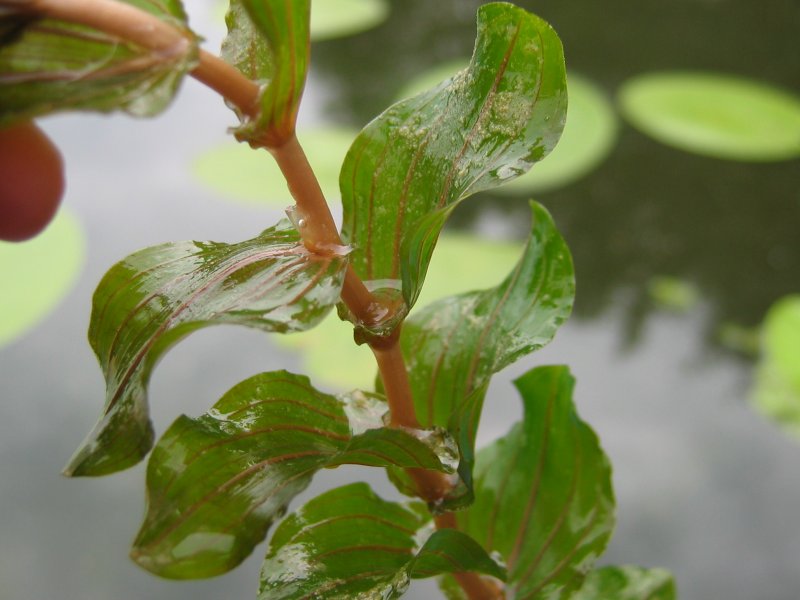 Clasping-leaf PondweedPotamogeton perfoliatus
-
 Small PondweedPotamogeton pusillus
-
 Shining PondweedPotamogeton lucens
-
 Longleaf PondweedPotamogeton nodosus
-
 Various-Leaved PondweedPotamogeton gramineus
-
 Bog PondweedPotamogeton polygonifolius
Compare
Questions and answers
What is the scientific name of the Water-thread Pondweed?
The scientific name of the Water-thread Pondweed is Potamogeton diversifolius. Written with its author, the full name is Potamogeton diversifolius Raf..
Which family does the Water-thread Pondweed belong to?
Potamogeton diversifolius belongs to the family Potamogetonaceae, in the order Alismatales and the class Liliopsida.
Where is the Water-thread Pondweed found?
Checklists and occurrence records place Potamogeton diversifolius in 4 countries: United States, Mexico, Canada and Cuba.
Is pondweed good for ponds?
Water-thread pondweed provides habitat for microinvertebrates and macroinvertebrates and serves as food for approximately 124 animal species.[35][36]
Is Potamogeton an aquatic plant?
Water-thread pondweed is an aquatic flowering plant that grows in ponds, lakes, ditches, pools, and slow-moving streams.[14][15][16][39]
Sources
Passages the profile rests on
- The plant has a thread-like form with dimorphic floating and submerged leaves. Source passage: “The plant has dimorphic leaves and is thread like.” — English Wikipedia
- The plant is pale green. Source passage: “The plant is pale green” — English Wikipedia
- Its stem is horizontal, thread-like, and cylindrical. Source passage: “The waterthread pondweed has a stem that is horizontal, threadlike and cylindrical” — English Wikipedia
- Its floating leaves are elliptic or oval and usually have 7–11 distinct veins. Source passage: “The floating leaves tend to usually have 7-11 distinct veins, are elliptic and oval in outline.” — English Wikipedia
- Its submerged leaves are alternate, smaller than the floating leaves, and usually have three veins. Source passage: “They submerged leaves are alternating, smaller and only usually have 3 veins.” — English Wikipedia
- The submerged leaves have stipules at the base of their petioles that form sheaths around the stem. Source passage: “Submersed leaves have stipules at the base of the leaf petiole that forms a sheath around the stem.” — English Wikipedia
- Its submerged-leaf stipules are 4–10 mm long. Source passage: “Stipules of the submersed leaves are fused at the base of the leaf blade and 4–10 mm long” — English Wikipedia
- Its flowers emerge above the water in small spikes, while submerged inflorescences are smaller and spherical. Source passage: “The inflorescence is a small spike of flowers emerging from the water surface. Inflorescences also grow on submersed sections of the stem; these are smaller and spherical.” — English Wikipedia
- Its fruits are nearly disk-shaped and curve inward toward one another. Source passage: “The fruits are almost disk-shaped and tend to curve inward towards each other.” — English Wikipedia
- The plant is reported to be 0.78–2.5 inches long and 0.02–0.06 inches wide. Source passage: “The plant is pale green is in total 0.78-2.5 inches long and 0.02-0.06 inches wide.” — English Wikipedia
- Its multi-branched stems are reported to extend 40–80 cm in length. Source passage: “The plant is a perennial with multi-branched stems extending between 40 and 80 cm long.” — English Wikipedia
- Its stems are also described as reaching approximately 35 cm in maximum length. Source passage: “This is a perennial herb producing a very narrow, compressed stem branching to a maximum length around 35 centimeters.” — English Wikipedia
- Its fruits are 0.9–2.0 mm in diameter. Source passage: “they also usually have lateral keels and are 0.9 to 2.0 mm in diameter.” — English Wikipedia
- The species grows in ponds, lakes, ditches, and slow-moving streams. Source passage: “where it grows in water bodies such as ponds, lakes, ditches, and slow-moving streams.” — English Wikipedia
- The species occurs in shallow freshwater bodies, including streams, ponds, and shallow lake sections. Source passage: “Potamogeton diversifolius can be found in shallow bodies of water including streams, ponds and shallow sections of the lakes.” — English Wikipedia
- The species occurs in still-water environments such as pools, ponds, and lakes. Source passage: “This pondweed is in different types of still waters such as pools, ponds, lakes, and even some streams.” — English Wikipedia
- The species has been recorded in newly excavated ditches containing clay-like soil. Source passage: “In recent years the species has been found in newly excavated ditches that contain clay like soil.” — English Wikipedia
- The species has been recorded at elevations up to 2,744 m. Source passage: “The species has been found at elevations as high as 2744 m” — English Wikipedia
- The species has been recorded in both full sunlight and partial shade. Source passage: “Potamogeton diversifolius has been found in both full sunlight and partial shade.” — English Wikipedia
- The plant's seeds are consumed by waterfowl. Source passage: “The seeds are eaten by waterfowl.” — English Wikipedia
- The plant's leaves are consumed by fish and invertebrates. Source passage: “Leaves are eaten by fish and invertebrates.” — English Wikipedia
- Decomposition of the plant by bacteria and fungi provides food for invertebrates. Source passage: “After the plant dies decomposition by bacteria and fungi provides food invertebrates.” — English Wikipedia
- The plant roots at its stem nodes. Source passage: “Rooting occurs at the nodes of the plants.” — English Wikipedia
- The species produces flowers and fruits from June through December. Source passage: “The plant blooms red with flowers and fruits throughout June to December.” — English Wikipedia
- Its flowers occur in spikes containing between 1 and 15 flowers. Source passage: “Flowers range between 1-15 with spikes that are dimorphic.” — English Wikipedia
- Its seeds form in clusters of 1–15 on the stalks of submerged leaves. Source passage: “Seeds are formed in clusters. The clusters range from 1-15 and on the stalks of submersed leaves.” — English Wikipedia
- Its floating leaves bear cylindrical spikes containing 5–120 seeds in their axils. Source passage: “The floating leaves have lindrical spikes that contain seeds ranging from 5-120 in the axils.” — English Wikipedia
- The species can be propagated using seeds or by transplanting roots in early spring into shallow, clear water. Source passage: “Water thread pondweed can be propagated by either seeds or transplanting of the roots during early spring into shallow, clear water.” — English Wikipedia
- The species is listed as globally secure with a G5 conservation status rank. Source passage: “the global conservation status rank of this species is G5.” — English Wikipedia
- The document reports no current threats to the species. Source passage: “There currently are no threats to this plant” — English Wikipedia
- The species is reported as invasive in Cuba. Source passage: “The plant is currently listed as invasive in Cuba.” — English Wikipedia
- The species is sensitive to water quality. Source passage: “This species is sensitive to water quality.” — English Wikipedia
- The species requires high water levels and sunlight. Source passage: “Potamogeton diversifolius requires both high water levels and sunlight.” — English Wikipedia
- The Idaho species catalog assigns the species a state conservation rank of S2. Source passage: “Potamogeton diversifolius (Water-thread Pondweed) Plantae/Anthophyta/Monocotyledoneae/Najadales/Potamogetonaceae/Potamogeton diversifolius State Rank: S2” — idfg.idaho.gov
- The species serves as food for approximately 124 animal species. Source passage: “Potamogeton diversifolius is known to be used as food for at least approximately 124 animals.” — English Wikipedia
- The plant provides habitat for microinvertebrates and macroinvertebrates. Source passage: “The plant provides a habitat for many micro- and macroinvertebrates.” — English Wikipedia
- The species is a host for aquatic fungi. Source passage: “Potamogeton diversifolius is known to be a host of aquatic fungi.” — English Wikipedia
- The species accounted for 11.04% of game ducks' recorded food across 247 locations in the United States and Canada. Source passage: “11.04% of their food was Potamogeton diversifolius within 247 locations in the United States and Canada.” — English Wikipedia
- The species has been classified in the order Alismatales and family Potamogetonaceae. Source passage: “The order of the plant is Alismatales, the family is Potamogetonaceae” — English Wikipedia
Data
- Catalogue of Life, 2026-10-16 XR cc by
- Global Biodiversity Information Facility CC BY 4.0
- Wikidata CC0
- GeoNames CC BY 4.0
- Wikimedia Commons per image; credit shown with each image
- Within the Catalogue of Life, this name comes from The World Checklist of Vascular Plants (WCVP) cc by
References
- Med. Repos., ser. 2, 5: 354 (1808) where the name was published
This species in other databases
Page built on 30 November 2026. See how the catalog is made and all sources and licences.
Cite this page
ScientificNames.org. (2026). Potamogeton diversifolius (Water-thread Pondweed). Retrieved November 30, 2026, from https://scientificnames.org/species/potamogeton-diversifolius
“Potamogeton diversifolius (Water-thread Pondweed).” ScientificNames.org, 2026, scientificnames.org/species/potamogeton-diversifolius. Accessed 30 Nov. 2026.
ScientificNames.org. “Potamogeton diversifolius (Water-thread Pondweed).” Accessed November 30, 2026. https://scientificnames.org/species/potamogeton-diversifolius.
@misc{scientificnames_potamogeton_diversifolius_water_thread_pondweed,
  author = {{ScientificNames.org}},
  title = {Potamogeton diversifolius (Water-thread Pondweed)},
  year = {2026},
  url = {https://scientificnames.org/species/potamogeton-diversifolius},
  note = {Accessed 2026-11-30}
}