Species · Flowering plants
Hairlike Pondweed Potamogeton trichoides
The scientific name of the Hairlike Pondweed is Potamogeton trichoides. It is a species of flowering plant in the family Potamogetonaceae (pondweed family), order Alismatales.
- Scientific name
- Potamogeton trichoides Cham. & Schltdl.
- Common name
- Hairlike Pondweed
- Genus
- Potamogeton
- Family
- Potamogetonaceae (Pondweed Family)
- Order
- Alismatales
- Class
- Liliopsida
- Red List category
- LC Least Concern
- Recorded in
- 48 countries
- Name status
- accepted in the Catalogue of Life

Overview
Potamogeton trichoides predominantly inhabits standing water, including ponds, lakes, ditches and canals, and also occurs in slow-flowing rivers and streams.
Written 27 November 2026 from the sources listed below. Each statement was checked against the passage it cites; statements that could not be supported were removed.
Appearance
Hairlike Pondweed has slender, cylindrical or slightly compressed branching stems. These are usually less than one metre long but can occasionally reach two metres.[1][2]
Its submerged leaves are long and narrow, measuring 16–80 mm in length and 0.3–1 mm in width. The midrib occupies as much as 70% of the leaf width near its base.[3][4]
The leaves are rigid and green, becoming darker as they age. The species does not produce floating leaves.[5][6]
Its inflorescence consists of a short spike containing three to five flowers. The flower spike emerges above the water on a slender peduncle.[7][8]
The species does not have rhizomes.[9]
Reproduction and life cycle
Hairlike Pondweed produces numerous asexual resting bodies called turions. The species is diploid and has 26 chromosomes.[10][11]
Habitat
Hairlike Pondweed predominantly inhabits standing water, including ponds, lakes, ditches and canals. It also occurs in slow-flowing rivers and streams.[12][13]
The species is usually restricted to calcareous water with relatively high conductivity. It tolerates water with high nutrient levels.[14][15]
Hairlike Pondweed frequently grows alongside Myriophyllum spicatum, Potamogeton crispus, Potamogeton pusillus and Ranunculus circinatus.[16]
It frequently grows in mixed beds with Potamogeton pusillus and Zannichellia palustris.[17]
Behaviour
Hairlike Pondweed is a perennial plant that dies back each winter. It often acts as an early-successional colonizer of newly created aquatic habitats.[18][19]
Similar species
Hairlike Pondweed readily hybridizes with Potamogeton berchtoldii and Potamogeton compressus. Potamogeton pusillus is a related species within the fine-leaved pondweed group.[20][21][22]
Conservation
Hairlike Pondweed is considered stable or potentially increasing in Britain.[23]
The species is classified as Vulnerable in the Czech Republic and Germany, although it remains widespread along its major river systems in Germany.[24][25]
It is classified as Critically Endangered in Switzerland.[26]
Uses
Hairlike Pondweed is not generally cultivated and has little value as an ornamental garden plant.[27][28]
Classification of the Hairlike Pondweed
| Kingdom | Plantae |
|---|---|
| Subkingdom | Pteridobiotina |
| Phylum | Tracheophyta |
| Class | Liliopsida |
| Order | Alismatales |
| Family | Potamogetonaceae (Pondweed Family) |
| Genus | Potamogeton (Pondweed) |
| Species | Potamogeton trichoides Cham. & Schltdl. |
Where the Hairlike Pondweed is found
Checklists and occurrence records place Potamogeton trichoides in 48 countries across Africa, Asia and Europe. GBIF holds 24,396 georeferenced records of it.
Countries
- Algeria 9
- Armenia 6
- Austria 70
- Belarus 6
- Belgium 1,771
- Botswana 5
- Bulgaria 6
- Croatia 7
- Czechia 393
- Democratic Republic of the Congo 1
- Denmark 217
- Egypt 2
- Estonia 37
- France 3,655
- Georgia 3
- Germany 2,110
- Greece 2
- Hungary 9
- Iran 1
- Ireland 5
- Israel 22
- Italy 51
- Japan 9
- Kazakhstan 9
- Kenya
- Latvia 15
- Libya
- Luxembourg 51
- Morocco 15
- Norway 9
- Poland 126
- Portugal 105
- Romania 6
- Russia 577
- Slovakia 62
- Slovenia 4
- South Africa 36
- Spain 896
- Sweden 470
- Switzerland 156
- Tanzania
- The Netherlands 9,903
- Turkey 10
- Uganda 7
- Ukraine 22
- United Kingdom 3,512
- Uzbekistan
- Zimbabwe 8
Regions and cities with the most records
- England, United Kingdom 2,799
- Mijdrecht, The Netherlands 2,194
- De Meern, The Netherlands 2,074
- Woerden, The Netherlands 2,023
- Maarssen, The Netherlands 1,974
- IJsselstein, The Netherlands 1,968
- Nieuwegein, The Netherlands 1,874
- Utrecht, The Netherlands 1,873
- Gouda, The Netherlands 1,819
- Waddinxveen, The Netherlands 1,790
- Uithoorn, The Netherlands 1,786
- Gorinchem, The Netherlands 1,743
- Boskoop, The Netherlands 1,734
- Bodegraven, The Netherlands 1,697
- Alphen aan den Rijn, The Netherlands 1,672
- Vianen, The Netherlands 1,662
- Benthuizen, The Netherlands 1,545
- Utrecht, The Netherlands 1,541
- Leerdam, The Netherlands 1,479
- Leiderdorp, The Netherlands 1,386
- Weesp, The Netherlands 1,370
- Hilversum, The Netherlands 1,354
- Bussum, The Netherlands 1,339
- Naarden, The Netherlands 1,325
- Sliedrecht, The Netherlands 1,270
- Huizen, The Netherlands 1,262
- Culemborg, The Netherlands 1,258
- Zoetermeer, The Netherlands 1,255
- Alblasserdam, The Netherlands 1,232
- Amstelveen, The Netherlands 1,231
- Krimpen aan den IJssel, The Netherlands 1,212
- Baarn, The Netherlands 1,188
- Ridderkerk, The Netherlands 1,170
- Papendrecht, The Netherlands 1,161
- Leiden, The Netherlands 1,147
- Hendrik-Ido-Ambacht, The Netherlands 1,146
1 more country has a few records outside this range
These countries hold a few records of Potamogeton trichoides but lie outside the range the checklists give for it. Such records are often zoo or garden specimens, museum material or vagrants, so the species is not counted as occurring there.
A number beside a place is its count of GBIF occurrence records. A place without a number comes from a checklist alone. Records show where a species has been observed or collected, which can include escapes and vagrants.
Common names
English
- Hairlike Pondweed
Names in 9 other languages
- Danish
- Hårfin vandaks
- Dutch
- Haarfonteinkruid
- French
- Potamot capillaire
- German
- Haarförmiges Laichkraut
- Italian
- Brasca capillare
- Norwegian Bokmål
- knortetjernaks
- Norwegian Nynorsk
- knortetjønnaks, knortetjørnaks
- Swedish
- knölnate
- Welsh
- Dyfrllys Blewynnaidd, Dyfrllys Gwalltog
Synonyms
17 other scientific names have been used for this species and are now treated as synonyms of Potamogeton trichoides.
- Potamogeton baenitzii Gand.
- Potamogeton condylocarpus Tausch
- Potamogeton danicus Gand.
- Potamogeton monogynus J.Gay
- Potamogeton orthorrhynchus Gand.
- Potamogeton perneglectus Gand.
- Potamogeton phialae Post
- Potamogeton pusillus subsp. trichoides (Cham. & Schltdl.) Bonnier & Layens
- Potamogeton pusillus var. trichoides (Cham. & Schltdl.) Bolzon
- Potamogeton trichoides condylocarpus (Tausch) Asch. & Graebn.
- Potamogeton trichoides var. leiocarpus Asch.
- Potamogeton trichoides var. liocarpus Asch.
- Potamogeton trichoides var. monogynus (J.Gay) Magnin
- Potamogeton trichoides var. tuberculatus (Ten. & Guss.) Nyman
- Potamogeton trichoides var. tuberculatus (Ten.) Asch.
- Potamogeton trichoides var. tuberculosus Rchb.
- Potamogeton tuberculatus Ten. & Guss.
Related species
-
 Curly PondweedPotamogeton crispus
-
 Floating PondweedPotamogeton natans
-
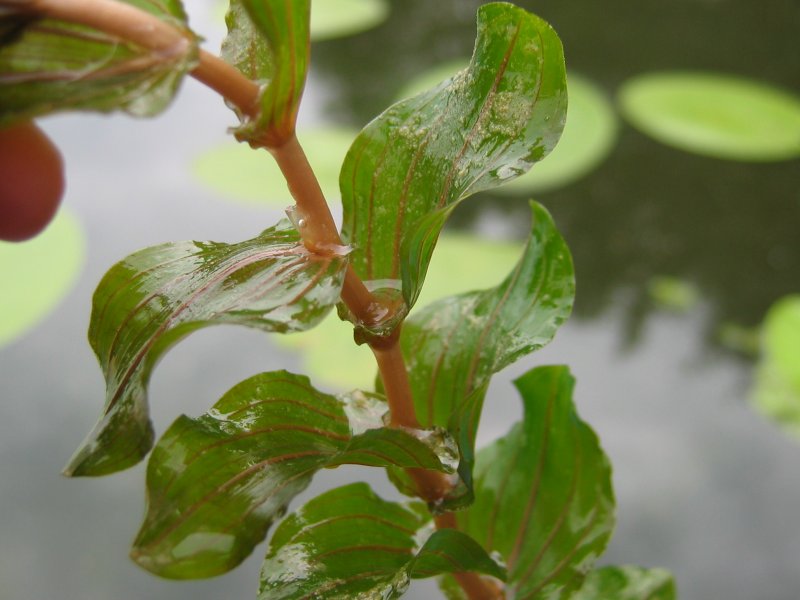 Clasping-leaf PondweedPotamogeton perfoliatus
-
 Small PondweedPotamogeton pusillus
-
 Shining PondweedPotamogeton lucens
-
 Longleaf PondweedPotamogeton nodosus
-
 Various-Leaved PondweedPotamogeton gramineus
-
 Bog PondweedPotamogeton polygonifolius
Compare
Questions and answers
What is the scientific name of the Hairlike Pondweed?
The scientific name of the Hairlike Pondweed is Potamogeton trichoides. Written with its author, the full name is Potamogeton trichoides Cham. & Schltdl..
Which family does the Hairlike Pondweed belong to?
Potamogeton trichoides belongs to the family Potamogetonaceae, in the order Alismatales and the class Liliopsida.
Where is the Hairlike Pondweed found?
Checklists and occurrence records place Potamogeton trichoides in 48 countries, including The Netherlands, France, United Kingdom, Germany, Belgium and Spain.
What is the conservation status of the Hairlike Pondweed?
The IUCN Red List category recorded for Potamogeton trichoides is Least Concern (LC).
Sources
Passages the profile rests on
- The plant has slender, cylindrical or slightly compressed branching stems. Source passage: “It produces slender, cylindrical or slightly compressed, branching stems” — English Wikipedia
- Its stems are usually less than one metre long but can occasionally reach two metres. Source passage: “usually less than a metre in length but occasionally up to 2 m.” — English Wikipedia
- Its submerged leaves are long and narrow, with lengths of 16–80 mm and widths of 0.3–1 mm. Source passage: “typically 16–80 mm long and 0.3–1 mm wide” — English Wikipedia
- The leaf midrib occupies as much as 70% of the leaf width near its base. Source passage: “with the midrib occupying up to 70% of the width of the leaf near the base.” — English Wikipedia
- Its leaves are rigid and green, becoming darker as they age. Source passage: “They are rigid and green turning darker with age.” — English Wikipedia
- The species does not produce floating leaves. Source passage: “There are no floating leaves.” — English Wikipedia
- Its inflorescence consists of a short spike containing three to five flowers. Source passage: “The inflorescence is a short spike of 3–5 flowers” — English Wikipedia
- Its flower spike emerges above the water on a slender peduncle. Source passage: “arising from the water on a slender peduncle.” — English Wikipedia
- The species does not have rhizomes. Source passage: “There are no rhizomes.” — English Wikipedia
- The plant produces numerous asexual resting bodies called turions. Source passage: “a large number of asexually produced resting bodies called turions.” — English Wikipedia
- The species is diploid and has 26 chromosomes. Source passage: “Hairlike pondweed is diploid, with 2n=26 chromosomes.” — English Wikipedia
- The species predominantly inhabits standing water, including ponds, lakes, ditches and canals. Source passage: “Hairlike pondweed grows predominantly in standing water including ponds, lakes, ditches, canals” — English Wikipedia
- The species also occurs in slow-flowing rivers and streams. Source passage: “and slow-flowing rivers and streams.” — English Wikipedia
- The species is usually restricted to calcareous water with relatively high conductivity. Source passage: “It is usually restricted to calcareous water of rather high conductivity” — English Wikipedia
- The species tolerates water with high nutrient levels. Source passage: “and is tolerant of high nutrient levels.” — English Wikipedia
- The species frequently grows alongside Myriophyllum spicatum, Potamogeton crispus, Potamogeton pusillus and Ranunculus circinatus. Source passage: “It often grows with other nutrient tolerant macrophytes such as Myriophyllum spicatum, Potamogeton crispus, P. pusillus and Ranunculus circinatus.” — English Wikipedia
- The species frequently grows in mixed beds with Potamogeton pusillus and Zannichellia palustris. Source passage: “often grows in mixed beds with other fine-leaved water plants such as P. pusillus and Zannichellia palustris” — English Wikipedia
- The perennial plant dies back each winter. Source passage: “Hairlike pondweed is an aquatic perennial that dies back each winter” — English Wikipedia
- The species often acts as an early-successional colonizer of newly created aquatic habitats. Source passage: “It is often an early succession species, colonising newly created habitats” — English Wikipedia
- The species readily hybridizes with Potamogeton berchtoldii. Source passage: “This species readily hybridizes with several other species of Potamogeton including P. berchtoldii” — English Wikipedia
- The species readily hybridizes with Potamogeton compressus. Source passage: “and P. compressus (P. × ripoides Baagøe).” — English Wikipedia
- Potamogeton pusillus is identified as a related species within the fine-leaved pondweed group. Source passage: “and related to similar species such as P. pusillus.” — English Wikipedia
- The species is considered stable or potentially increasing in Britain. Source passage: “In Britain, hairlike pondweed is thought to be stable or possibly increasing.” — English Wikipedia
- The species is classified as Vulnerable in the Czech Republic. Source passage: “it is Vulnerable in the Czech Republic” — English Wikipedia
- The species is classified as Vulnerable in Germany despite remaining widespread along its major river systems. Source passage: “and Germany (although still widespread along all major river systems there)” — English Wikipedia
- The species is classified as Critically Endangered in Switzerland. Source passage: “and Critically Endangered in Switzerland.” — English Wikipedia
- The species is not generally cultivated. Source passage: “Potamogeton trichoides is not in general cultivation” — English Wikipedia
- The species has little value as an ornamental garden plant. Source passage: “and is of little garden merit.” — English Wikipedia
Data
- Catalogue of Life, 2026-10-16 XR cc by
- Global Biodiversity Information Facility CC BY 4.0
- Wikidata CC0
- GeoNames CC BY 4.0
- Wikimedia Commons per image; credit shown with each image
- Within the Catalogue of Life, this name comes from The World Checklist of Vascular Plants (WCVP) cc by
References
- Linnaea 2: 175 (1827) where the name was published
This species in other databases
Page built on 27 November 2026. See how the catalog is made and all sources and licences.
Cite this page
ScientificNames.org. (2026). Potamogeton trichoides (Hairlike Pondweed). Retrieved November 27, 2026, from https://scientificnames.org/species/potamogeton-trichoides
“Potamogeton trichoides (Hairlike Pondweed).” ScientificNames.org, 2026, scientificnames.org/species/potamogeton-trichoides. Accessed 27 Nov. 2026.
ScientificNames.org. “Potamogeton trichoides (Hairlike Pondweed).” Accessed November 27, 2026. https://scientificnames.org/species/potamogeton-trichoides.
@misc{scientificnames_potamogeton_trichoides_hairlike_pondweed,
  author = {{ScientificNames.org}},
  title = {Potamogeton trichoides (Hairlike Pondweed)},
  year = {2026},
  url = {https://scientificnames.org/species/potamogeton-trichoides},
  note = {Accessed 2026-11-27}
}