Species · Reptiles
Two-striped Garter Snake Thamnophis hammondii
The scientific name of the Two-striped Garter Snake is Thamnophis hammondii. It is a species of reptile in the family Colubridae (colubrid), order Squamata. The name dates from 1860.
- Scientific name
- Thamnophis hammondii (Kennicott, 1860)
- Common name
- Two-striped Garter Snake
- Genus
- Thamnophis
- Family
- Colubridae (Colubrid)
- Order
- Squamata
- Class
- Reptilia
- Red List category
- LC Least Concern
- Recorded in
- 2 countries
- Name status
- accepted in the Catalogue of Life

Overview
The geographic range extends from central California to Baja California, Mexico. It occurs in striped and checkered color variations and lacks a middorsal stripe.
Written 26 November 2026 from the sources listed below. Each statement was checked against the passage it cites; statements that could not be supported were removed.
Appearance
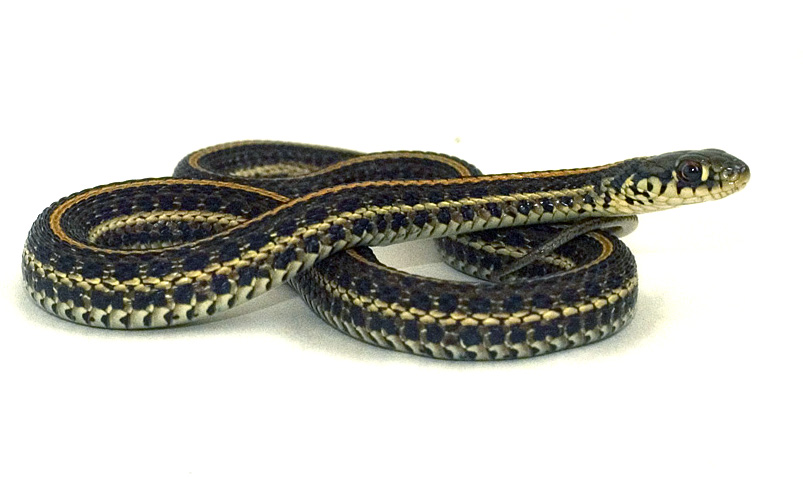
The head is only slightly wider than the neck. The species occurs in two common color variations: striped and checkered.[1][2]
The striped variation has a yellowish lateral stripe on each side and relatively uniform dorsal coloration. The checkered variation lacks lateral stripes and has two rows of small dark spots on each side.[3][4]
The species lacks a middorsal stripe, distinguishing it from other garter snakes occurring in the same areas. Adults measure 18–30 inches (46–76 cm) in total length, including the tail.[5][6]
Habitat
The Two-striped Garter Snake is highly aquatic and prefers habitats adjacent to permanent or semi-permanent bodies of water.[7]
Diet
The Two-striped Garter Snake feeds primarily on fishes and amphibians.[8]
Reproduction and life cycle
The Two-striped Garter Snake is ovoviviparous.[9]
Classification of the Two-striped Garter Snake
| Kingdom | Animalia |
|---|---|
| Phylum | Chordata |
| Subphylum | Vertebrata |
| Infraphylum | Gnathostomata |
| Parvphylum | Osteichthyes |
| Megaclass | Tetrapoda |
| Class | Reptilia (Reptile) |
| Order | Squamata (Snakes) |
| Suborder | Serpentes (Snakes) |
| Infraorder | Alethinophidia |
| Family | Colubridae (Colubrid) |
| Subfamily | Natricinae |
| Genus | Thamnophis (Garter Snake) |
| Species | Thamnophis hammondii (Kennicott, 1860) |
Where the Two-striped Garter Snake is found
Checklists and occurrence records place Thamnophis hammondii in 2 countries across North America. GBIF holds 4,968 georeferenced records of it.
Countries
Regions and cities with the most records
- California, United States 3,351
- Baja California, Mexico 479
- El Cajon, United States 352
- La Mesa, United States 345
- Lemon Grove, United States 341
- Santee, United States 340
- Bostonia, United States 326
- Poway, United States 326
- Winter Gardens, United States 321
- Casa de Oro-Mount Helix, United States 319
- Spring Valley, United States 317
- Lakeside, United States 281
- Rancho San Diego, United States 250
- Thousand Oaks, United States 250
- Agoura Hills, United States 242
- Altadena, United States 237
- La Presa, United States 237
- Baja California Sur, Mexico 227
- La Cañada Flintridge, United States 218
- Agoura, United States 208
- Monrovia, United States 206
- Arcadia, United States 203
- Pasadena, United States 197
- La Crescenta-Montrose, United States 194
- Duarte, United States 177
- Temple City, United States 165
- Ramona, United States 163
- South Pasadena, United States 160
- San Diego, United States 157
- Encinitas, United States 155
- Moorpark, United States 154
- San Gabriel, United States 151
- Alhambra, United States 145
- Rosemead, United States 141
- Simi Valley, United States 140
- San Marcos, United States 138
Range as the checklists state it
USA (S California), Mexico (Baja California)
A number beside a place is its count of GBIF occurrence records. A place without a number comes from a checklist alone. Records show where a species has been observed or collected, which can include escapes and vagrants.
Common names
English
- Two-striped Garter Snake
Names in 5 other languages
- Chinese
- 雙條帶蛇
- French
- Serpent-jarretiere, Serpent-jarretiere À Deux Raies
- German
- Zweistreifen-Strumpfbandnatter
- Portuguese
- Cobra-liga-de-duas-listras
- Spanish
- Culebra de agua de dos rayas, Jarretera de Hammond, Serpiente Jarretera, Serpiente jarretera de la Sierra
Synonyms
4 other scientific names have been used for this species and are now treated as synonyms of Thamnophis hammondii.
- Eutaenia hammondii Kennicott, 1860
- Thamnophis digueti (Mocquard, 1899)
- Thamnophis elegans hammondii (Kennicott, 1860)
- Tropidonotus digueti Mocquard, 1899
Related species
-
 Common Garter SnakeThamnophis sirtalis
-
 Common Ribbon SnakeThamnophis saurita
-
 Checkered Garter SnakeThamnophis marcianus
-
 Plains Garter SnakeThamnophis radix
-
 Western Ribbon SnakeThamnophis proximus
-
 Western Terrestrial Garter SnakeThamnophis elegans
-
 Giant Garter SnakeThamnophis gigas
-
 Mexican Garter SnakeThamnophis eques
Compare
Questions and answers
What is the scientific name of the Two-striped Garter Snake?
The scientific name of the Two-striped Garter Snake is Thamnophis hammondii. Written with its author, the full name is Thamnophis hammondii (Kennicott, 1860).
Which family does the Two-striped Garter Snake belong to?
Thamnophis hammondii belongs to the family Colubridae, in the order Squamata and the class Reptilia.
Where is the Two-striped Garter Snake found?
Checklists and occurrence records place Thamnophis hammondii in 2 countries: United States and Mexico.
What is the conservation status of the Two-striped Garter Snake?
The IUCN Red List category recorded for Thamnophis hammondii is Least Concern (LC).
What is the diet of a garter snake?
The Two-striped Garter Snake feeds primarily on fishes and amphibians.[8]
What type of habitat do garter snakes live in?
The Two-striped Garter Snake is highly aquatic and prefers habitats adjacent to permanent or semi-permanent bodies of water.[7]
Sources
Passages the profile rests on
- The species has a head that is only slightly wider than its neck. Source passage: “with a head barely wider than the neck.” — English Wikipedia
- The species occurs in two common color variations: striped and checkered. Source passage: “Two common color variations occur in the wild, a striped variant and a checkered variant.” — English Wikipedia
- The striped variation has a yellowish lateral stripe on each side and relatively uniform dorsal coloration. Source passage: “The striped variant has a yellowish lateral stripe on each side, and a fairly uniform dorsal coloring.” — English Wikipedia
- The checkered variation lacks lateral stripes and has two rows of small dark spots on each side. Source passage: “The checkered variant lacks the lateral stripes and has two rows of small dark spots on each side.” — English Wikipedia
- The species lacks a middorsal stripe, distinguishing it from other garter snakes occurring in the same areas. Source passage: “Differs from other sympatric garter snakes in lacking a middorsal stripe.” — fieldguide.mt.gov
- Adults measure 18–30 inches (46–76 cm) in total length, including the tail. Source passage: “18–30 in (46–76 cm) in total length (including tail)” — English Wikipedia
- The species is highly aquatic and prefers habitats adjacent to permanent or semi-permanent bodies of water. Source passage: “It is a highly aquatic species, and prefers habitat adjacent to permanent or semi-permanent bodies of water.” — English Wikipedia
- The species feeds primarily on fishes and amphibians. Source passage: “This species feeds primarily on fishes and amphibians.” — English Wikipedia
- The species is ovoviviparous. Source passage: “T. hammondii is ovoviviparous.” — English Wikipedia
Data
- Catalogue of Life, 2026-10-16 XR cc by
- Global Biodiversity Information Facility CC BY 4.0
- Wikidata CC0
- GeoNames CC BY 4.0
- Wikimedia Commons per image; credit shown with each image
- Within the Catalogue of Life, this name comes from The Reptile Database cc by
References
- Kennicott, R. (1860). Descriptions of new species of North American serpents in the museum of the Smithsonian Institution, Washington. Proc. Acad. Nat. Sci. Philadelphia 12: 328-338.
- Stejneger, L. H. (1893). Annotated list of the reptiles and batrachians collected by the Death Valley Expedition in 1891, with descriptions of new species. North American Fauna, No. 7: 159-228 (+ 14 Plates + 4 Maps).
- Van Denburgh, & John. (1896). Additional notes on the herpetology of Lower California. Proc. Cal. Acad. Sci. (2) 5: 1004-1008.
- Mocquard, F. (1899). Contribution a la faune herpétologique de la Basse-Californie. Nouv. Arch. Mus. Hist. Natur.Paris, 4th Series, Vol. 1: 297-343 + Plates XI-XIII.
- Fitch, H. C. (1940). A biogeographical study of the ordinoides artenkreis of garter snakes (genus Thamnophis). Univ. California Publ. Zool. 44: 1-150.
- Tevis, lloyd, Jr. (1944). Herpetological notes from lower California. Copeia 1944 (1): 6-18.
- Malnate, Edmond V. (1971). A catalogue of primary types in the Herpetological Collections of the Academy of Natural Sciences, Philadelphia (ANSP). Proccedings of the Academy of Natural Sciences of Philadelphia 123 (9): 345-375.
- Brown, Timothy W. (1980). The Present Status of the Garter Snake on Santa Catalina Island, California. 2nd California Islands Multidisciplinary Symposium 1978: 585-595.
- Seib, R. L. (1980). Baja California: A Peninsula for Rodents But Not for Reptiles. [reply to Taylor & Regal 1978]. American Naturalist 115(4): 613–620.
- Stebbins, R. C. (1985). A Field Guide to Western Reptiles and Amphibians, 2nd ed. Houghton Mifflin, Boston.
- Mehrtens, J. M. (1987). Living snakes of the world in color. Sterling Publ. Co., Hic., New York, NY: 480 Pp.
- Mcguire J A. GRISMER L L. (1993). The taxonomy and biogeography of Thamnophis hammondii and Thamnophis digueti (Reptilia: Squamata: Colubridae) in Baja California, Mexico. Herpetologica 49 (3): 354-365.
- Grismer, L. L., & McGuire, J. A. (1993). The oases of central Baja California, Mexico. Part I. A preliminary account of the relict mesophilic herpetofauna and the status of the oases. Bull. Southern California Acad. Sci. 92 (1): 2-24.
- Rossman, Douglas A.; Ford, Neil B. & Seigel, Richard A. (1996). The Garter Snakes: Evolution and Ecology. University of Oklahoma Press, Norman, OK, Xx + 332 + Pp.
- Hallmen, M., & Chlebowy, J. (2001). Strumpfbandnattern. Natur Und Tier Verlag (Münster), 192 Pp.
- Bourguignon, T. (2002). Strumpfbandnattern: Herkunft - Pflege - Arten. E. Ulmer Verlag, 125 Pp.
- Queiroz, Alan de; Robin Lawson and Julio A. Lemos-Espinal. (2002). Phylogenetic Relationships of North American Garter Snakes (Thamnophis) Based on Four Mitochondrial Genes: How Much DNA Sequence Is Enough? Molecular Phylogenetics and Evolution 22: 315-329.
- Fontenot Jr, Clifford L. (2008). Variation in pupil diameter in North American Gartersnakes (Thamnophis) is regulated by immersion in water, not by light intensity. Vision Research 48: 1663–1669.
- Beolens, B., & Michael Watkins, a. M. G. (2011). The Eponym Dictionary of Reptiles. Johns Hopkins University Press, Baltimore, USA.
- Sleijpen, & Fons. (2013). Pictures: Thamnophis hammondii, adult, female, Thamnophis melanogaster canescens, adult, female en Thamnophis sirtalis infernalis, juvenile, male. Litteratura Serpentium 33 (4): 334-335.
- Wallach, Van; Kenneth L. Williams, Jeff Boundy. (2014). Snakes of the World: A Catalogue of Living and Extinct Species. [type catalogue]. Taylor and Francis, CRC Press, 1237 Pp.
- Thomson, Robert C.; Amber N. Wright & H. Bradley Shaffer. (2016). California Amphibian and Reptile Species of Special Concern. University of California Press.
- Heimes, P. (2016). Snakes of Mexico. Chimaira, Frankfurt, 572 Pp.
- Burbrink FT, Futterman I. (2019). Female‐ biased gape and body-size dimorphism in the New World watersnakes (tribe: Thamnophiini) oppose predictions from Rensch’s rule. Ecol Evol. 00:1–10.
- HALLAS, JOSHUA M.; THOMAS L. PARCHMAN & CHRIS R. FELDMAN. (2021). Phylogenomic analyses resolve relationships among garter snakes (Thamnophis: Natricinae: Colubridae) and elucidate biogeographic history and morphological evolution. Molecular Phylogenetics and Evolution 107374. [2022 in Print].
This species in other databases
Page built on 27 November 2026. See how the catalog is made and all sources and licences.
Cite this page
ScientificNames.org. (2026). Thamnophis hammondii (Two-striped Garter Snake). Retrieved November 27, 2026, from https://scientificnames.org/species/thamnophis-hammondii
“Thamnophis hammondii (Two-striped Garter Snake).” ScientificNames.org, 2026, scientificnames.org/species/thamnophis-hammondii. Accessed 27 Nov. 2026.
ScientificNames.org. “Thamnophis hammondii (Two-striped Garter Snake).” Accessed November 27, 2026. https://scientificnames.org/species/thamnophis-hammondii.
@misc{scientificnames_thamnophis_hammondii_two_striped_garter_snake,
  author = {{ScientificNames.org}},
  title = {Thamnophis hammondii (Two-striped Garter Snake)},
  year = {2026},
  url = {https://scientificnames.org/species/thamnophis-hammondii},
  note = {Accessed 2026-11-27}
}