Species · Flowering plants
Pacific Poison-oak Toxicodendron diversilobum
The scientific name of the Pacific Poison-oak is Toxicodendron diversilobum. It is a species of flowering plant in the family Anacardiaceae (sumac family), order Sapindales.
- Scientific name
- Toxicodendron diversilobum (Torr. & A.Gray) Greene
- Common name
- Pacific Poison-oak
- Genus
- Toxicodendron
- Family
- Anacardiaceae (Sumac Family)
- Order
- Sapindales
- Class
- Magnoliopsida
- Recorded in
- 3 countries
- Name status
- accepted in the Catalogue of Life

Overview
Toxicodendron diversilobum is distributed from Baja California northward to British Columbia and occurs west of the Cascade Range in Washington, Oregon, and California. It grows as a shrub or woody vine and typically has three leaflets with scalloped, toothed, or lobed margins.
Written 26 November 2026 from the sources listed below. Each statement was checked against the passage it cites; statements that could not be supported were removed.
Appearance
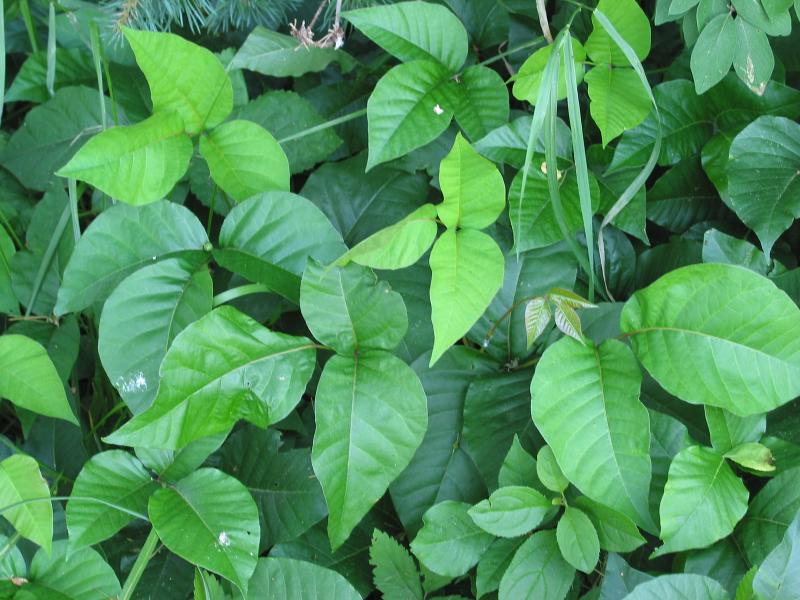
Pacific poison-oak grows as either a shrub or a woody vine. Its leaves typically have three leaflets, although they occasionally have five, seven, or nine, with scalloped, toothed, or lobed margins.[1][2][3]
Newly unfolding leaves are generally bronze-colored, while mature spring leaves are bright green. During summer, the leaves become yellow-green to reddish and turn bright red or pink from late July through October.[4][5][6][7]
The species produces white flowers in spring. Fertilized flowers develop into greenish-white or tan drupes, and the plant loses its leaves during winter.[8][9][10]
Habitat
Pacific poison-oak occurs in conifer and mixed broadleaf forests, woodlands, grasslands, chaparral, coastal sage scrub, and oak woodlands. It also grows in Douglas-fir and coast redwood forests.[11][12][13][14]
The species inhabits both mesic riparian zones and xeric chaparral and occurs on well-drained slopes and in riparian zones. It grows in conditions ranging from shade to full direct sunlight and generally grows in acidic soils.[15][16][17][18]
The species occurs at elevations below 1,500 metres. West of the Sierra Nevada, it grows on all slope aspects below 1,524 metres.[19][20]
Diet
Black-tailed deer, mule deer, and California ground squirrels consume the leaves of Pacific poison-oak. Bird species consume its fruits.[21][22][23][24]
Livestock and horses can browse the species without demonstrating reactions to urushiol.[25]
Behaviour
The vine form climbs shrubs and trees to reach their canopies. It can smother or break the plants that support it.[26][27]
Reproduction and life cycle
Pacific poison-oak reproduces through rhizome growth and seed production. Male and female flowers occur on separate plants.[28][29]
The species can sprout from rhizomes and the root crown after disturbances remove aboveground growth. It can also reproduce through layering when vine stems touch the ground.[30][31]
Birds disperse the seeds, which have a gummy seed coat that leaches away slowly and delays germination. The fruits disperse during summer and autumn.[32][33][34]
The species flowers from March through June.[35]
Uses
Native Californians used the stems and shoots of Pacific poison-oak to make baskets and its sap to treat ringworm. Its juice or soot was used as a black dye for basket elements, tattoos, and skin darkening.[36][37][38]
The Chumash used the sap to remove warts, corns, and calluses. They also used a root decoction to treat dysentery.[39][40]
Pacific poison-oak is used in habitat restoration projects and can serve as a nurse plant during early woodland succession. Its blossoms provide a source of honey.[41][42][43]
Similar species
Pacific poison-oak hybridizes with western poison-ivy in the Columbia River Gorge.[44]
Classification of the Pacific Poison-oak
| Kingdom | Plantae |
|---|---|
| Subkingdom | Pteridobiotina |
| Phylum | Tracheophyta |
| Class | Magnoliopsida |
| Order | Sapindales |
| Family | Anacardiaceae (Sumac Family) |
| Tribe | Rhoeae |
| Genus | Toxicodendron (Poison Ivy) |
| Species | Toxicodendron diversilobum (Torr. & A.Gray) Greene |
Where the Pacific Poison-oak is found
Checklists and occurrence records place Toxicodendron diversilobum in 3 countries across North America. GBIF holds 51,579 georeferenced records of it.
Countries
Regions and cities with the most records
- California, United States 44,495
- Oregon, United States 4,181
- Richmond, United States 3,276
- Oakland, United States 3,161
- Campbell, United States 3,130
- El Cerrito, United States 3,117
- Albany, United States 3,074
- Los Altos, United States 3,023
- Alameda, United States 2,957
- Lafayette, United States 2,956
- Los Gatos, United States 2,956
- San Jose, United States 2,920
- Saratoga, United States 2,897
- San Rafael, United States 2,896
- Palo Alto, United States 2,830
- Moraga, United States 2,827
- Berkeley, United States 2,806
- Santa Clara, United States 2,778
- Mountain View, United States 2,764
- Menlo Park, United States 2,733
- Walnut Creek, United States 2,724
- Glendale, United States 2,698
- San Pablo, United States 2,697
- La Cañada Flintridge, United States 2,662
- Pasadena, United States 2,656
- South Pasadena, United States 2,656
- Altadena, United States 2,641
- La Crescenta-Montrose, United States 2,636
- Arcadia, United States 2,602
- Alhambra, United States 2,596
- Burbank, United States 2,575
- Orinda, United States 2,551
- San Gabriel, United States 2,549
- Pleasant Hill, United States 2,548
- Monrovia, United States 2,537
- East Palo Alto, United States 2,534
Range as the checklists state it
Canada (British Columbia); USA (California, Nevada, Oregon, Washington State); Mexico (Baja California Norte, Chihuahua, Michoacán, Sonora)
A number beside a place is its count of GBIF occurrence records. A place without a number comes from a checklist alone. Records show where a species has been observed or collected, which can include escapes and vagrants.
Common names
English
- Pacific Poison-oak
- Pacific Poison Oak
- Poison Oak
- Western Poison Oak
- Western Poison-oak
Names in 10 other languages
- Chinese
- 太平洋毒漆
- Czech
- Škumpa různolaločná
- Finnish
- lännenmyrkkysumakki
- French
- sumac de l'Ouest, sumac de l’Ouest
- Russian
- Западный ядовитый дуб, Токсикодендрон разнолопастный
- Slovak
- sumachovec rôznolaločnatý
- Spanish
- Roble venenoso del pacífico, Roble venenoso pacífico
- Swedish
- giftsumak
- Ukrainian
- Отруйник різнолопатевий
- xgf
- oar
Synonyms
11 other scientific names have been used for this species and are now treated as synonyms of Toxicodendron diversilobum.
- Rhus diversiloba Torr. & A.Gray
- Rhus diversiloba f. quinquifolia McNair
- Rhus diversiloba f. radicans McNair
- Rhus toxicodendron subsp. diversiloba (Torr. & A.Gray) Engl.
- Toxicodendron comarophyllum Greene
- Toxicodendron dryophilum Greene
- Toxicodendron isophyllum Greene
- Toxicodendron oxycarpum Greene
- Toxicodendron radicans subsp. diversiloba (Torr. & A.Gray) Thorne
- Toxicodendron vaccarum Greene
- Rhus lobata Hook. ambiguous synonym
Related species
-
 Poison IvyToxicodendron radicans
-
 Poison SumacToxicodendron vernix
-
 Chinese LacquertreeToxicodendron vernicifluum
-
 Atlantic Poison OakToxicodendron pubescens
-
 Western Poison IvyToxicodendron rydbergii
-
 Japanese Wax TreeToxicodendron succedaneum
-
 Asian Poison IvyToxicodendron orientale
-
 Western Poison IvyToxicodendron striatum
Compare
Questions and answers
What is the scientific name of the Pacific Poison-oak?
The scientific name of the Pacific Poison-oak is Toxicodendron diversilobum. Written with its author, the full name is Toxicodendron diversilobum (Torr. & A.Gray) Greene.
Which family does the Pacific Poison-oak belong to?
Toxicodendron diversilobum belongs to the family Anacardiaceae, in the order Sapindales and the class Magnoliopsida.
Where is the Pacific Poison-oak found?
Checklists and occurrence records place Toxicodendron diversilobum in 3 countries: United States, Mexico and Canada.
What other names does the Pacific Poison-oak have?
Toxicodendron diversilobum is also known in English as Pacific Poison Oak, Poison Oak, Western Poison Oak and Western Poison-oak.
How bad is Pacific poison oak?
Contact with Pacific poison-oak can cause allergic contact dermatitis in humans. Its leaves and twigs contain urushiol oil on their surfaces, and smoke from burning the plant can cause hazardous human exposure to urushiol.[45][46][47]
Sources
Passages the profile rests on
- The species grows as either a shrub or a woody vine. Source passage: “It grows as a dense 0.5–4 metres (1+1⁄2–13 feet) tall shrub in open sunlight, a treelike vine 3–9 m (10–30 ft)” — English Wikipedia
- The species typically has three leaflets, although leaves occasionally have five, seven, or nine. Source passage: “The leaves are divided into three (rarely 5, 7, or 9) leaflets” — English Wikipedia
- Its leaflets have scalloped, toothed, or lobed margins. Source passage: “with scalloped, toothed, or lobed edges.” — English Wikipedia
- Newly unfolding leaves are generally bronze-colored. Source passage: “Leaves are typically bronze when first unfolding in February to March” — English Wikipedia
- Mature spring leaves are bright green. Source passage: “bright green in the spring” — English Wikipedia
- The leaves become yellow-green to reddish during summer. Source passage: “yellow-green to reddish in the summer” — English Wikipedia
- The leaves turn bright red or pink from late July through October. Source passage: “bright red or pink from late July to October.” — English Wikipedia
- The species produces white flowers in spring. Source passage: “White flowers form in the spring, from March to June.” — English Wikipedia
- Fertilized flowers develop into greenish-white or tan drupes. Source passage: “If they are fertilized, they develop into greenish-white or tan drupes.” — English Wikipedia
- The species is deciduous and loses its leaves during winter. Source passage: “The plant is winter deciduous” — English Wikipedia
- The species occurs in conifer and mixed broadleaf forests. Source passage: “inhabiting conifer and mixed broadleaf forests” — English Wikipedia
- The species inhabits woodlands, grasslands, and chaparral. Source passage: “woodlands, grasslands, and chaparral biomes.” — English Wikipedia
- The species occurs in coastal sage scrub and oak woodlands. Source passage: “The plant often occurs in chaparral and woodlands, coastal sage scrub, grasslands, and oak woodlands” — English Wikipedia
- The species grows in Douglas-fir and coast redwood forests. Source passage: “and Douglas-fir (Pseudotsuga menzesii), hemlock–Sitka spruce, Sequoia sempervirens (coast redwood)” — English Wikipedia
- The species occurs in both mesic riparian zones and xeric chaparral. Source passage: “common in various habitats, from mesic riparian zones to xeric chaparral.” — English Wikipedia
- The species grows in conditions ranging from shade to full direct sunlight. Source passage: “It thrives in shady and dappled light through full and direct sunlight conditions” — English Wikipedia
- The species generally grows in acidic soils. Source passage: “Pacific poison-oak generally grows in acid soils” — research.fs.usda.gov
- The species occurs on well-drained slopes and in riparian zones. Source passage: “It occurs on well-drained slopes and in riparian zones” — research.fs.usda.gov
- The species occurs at elevations below 1,500 metres. Source passage: “at elevations below 1,500 m (5,000 ft).” — English Wikipedia
- The species grows on all slope aspects west of the Sierra Nevada below 1,524 metres. Source passage: “It is found at elevations of less than 5,000 feet (1,524 m) west of the Sierra Nevada, growing on all aspects” — research.fs.usda.gov
- Black-tailed deer feed on the leaves of the species. Source passage: “Black-tailed deer, mule deer, California ground squirrels, western gray squirrels, and other indigenous fauna feed on the leaves of the plant.” — English Wikipedia
- Mule deer consume the species' leaves. Source passage: “Black-tailed deer, mule deer, California ground squirrels, western gray squirrels, and other indigenous fauna feed on the leaves of the plant.” — English Wikipedia
- California ground squirrels consume the species' leaves. Source passage: “Black-tailed deer, mule deer, California ground squirrels, western gray squirrels, and other indigenous fauna feed on the leaves of the plant.” — English Wikipedia
- Bird species consume the fruits of the plant. Source passage: “Bird species use the berries for food” — English Wikipedia
- Livestock and horses can browse the species without demonstrating reactions to urushiol. Source passage: “Neither native animals nor horses, livestock, or dogs demonstrate reactions to urushiol.” — English Wikipedia
- The vine form climbs shrubs and trees to reach their canopies. Source passage: “The vining form can climb up large shrub and tree trunks into their canopies.” — English Wikipedia
- The species can smother or break supporting plants. Source passage: “Sometimes it kills the support plant by smothering or breaking it.” — English Wikipedia
- The species reproduces through rhizome growth and seed production. Source passage: “It reproduces by spreading rhizomes and by seeds.” — English Wikipedia
- Male and female flowers occur on separate plants. Source passage: “Small flowers occur in leaf axils, with male and female flowers on separate plants” — research.fs.usda.gov
- The species reproduces vegetatively by sprouting from rhizomes and the root crown after disturbances remove aboveground growth. Source passage: “Pacific poison-oak reproduces vegetatively by sprouting from the rhizomes and root crown after disturbance such as fire or browsing has removed topgrowth” — research.fs.usda.gov
- The species can reproduce through layering when its vine stems touch the ground. Source passage: “It also reproduces by layering when vine stems contact the ground.” — research.fs.usda.gov
- Birds disperse the seeds of the species. Source passage: “Pacific poison-oak seeds are dispersed by birds” — research.fs.usda.gov
- The seeds have a gummy seed coat that leaches away slowly and delays germination. Source passage: “The seeds have a gummy seedcoat which leaches off very slowly, resulting in delayed germination” — research.fs.usda.gov
- The species' fruits disperse during summer and autumn. Source passage: “fruits disperse in summer and fall” — research.fs.usda.gov
- The species flowers from March through June. Source passage: “Flowering occurs from March to June” — research.fs.usda.gov
- Native Californians used the stems and shoots of the species to make baskets. Source passage: “Californian Native Americans used the plant's stems and shoots to make baskets” — English Wikipedia
- Native Californians used the sap to treat ringworm. Source passage: “the sap to cure ringworm” — English Wikipedia
- The plant's juice or soot was used as a black dye for basket elements, tattoos, and skin darkening. Source passage: “The juice or soot was used as a black dye for sedge basket elements, tattoos, and skin darkening.” — English Wikipedia
- The Chumash used the sap to remove warts, corns, and calluses. Source passage: “Chumash peoples used T. diversilobum sap to remove warts, corns, and calluses” — English Wikipedia
- The Chumash used a root decoction to treat dysentery. Source passage: “They drank a decoction made from the roots to treat dysentery.” — English Wikipedia
- The species is used in habitat restoration projects. Source passage: “The plant is used in habitat restoration projects.” — English Wikipedia
- The species can serve as a nurse plant during early woodland succession. Source passage: “It can be early stage succession where woodlands have been burned or removed, serving as a nurse plant for other species.” — English Wikipedia
- The species' blossoms provide a source of honey. Source passage: “Pacific poison-oak blossoms are a source of good honey” — fs.usda.gov
- The species hybridizes with western poison-ivy in the Columbia River Gorge. Source passage: “Pacific poison-oak and western poison-ivy (Toxicodendron rydbergii) hybridize in the Columbia River Gorge area” — research.fs.usda.gov
- Contact with the species can cause allergic contact dermatitis in humans. Source passage: “It causes contact dermatitis – an immune-mediated skin inflammation – in four-fifths of humans.” — English Wikipedia
- The plant's leaves and twigs contain urushiol oil on their surfaces. Source passage: “Toxicodendron diversilobum leaves and twigs have a surface oil, urushiol” — English Wikipedia
- Smoke from burning the species can cause hazardous human exposure to urushiol. Source passage: “Urushiol volatilizes when burned, and human exposure to T. diversilobum smoke is extremely hazardous” — English Wikipedia
- The species is distributed from Baja California northward to British Columbia. Source passage: “Pacific poison-oak is distributed from Baja California north to British Columbia” — research.fs.usda.gov
- The species occurs west of the Cascade Range in Washington, Oregon, and California. Source passage: “It occurs west of the Cascade Range in Washington, Oregon, and California” — research.fs.usda.gov
Data
- Catalogue of Life, 2026-10-16 XR cc by
- Global Biodiversity Information Facility CC BY 4.0
- Wikidata CC0
- GeoNames CC BY 4.0
- Wikimedia Commons per image; credit shown with each image
- Within the Catalogue of Life, this name comes from Synonymic Checklists of the Vascular Plants of the World cc by
References
- Greene. (1905). Leafl. Bot. Observ. Crit. 1: 119 (1905). where the name was published
This species in other databases
- Catalogue of Life 57LFS
- Wikidata Q5399841
- iNaturalist 51080
- World Flora Online wfo-0000409273
- GRIN 101865
Page built on 27 November 2026. See how the catalog is made and all sources and licences.
Cite this page
ScientificNames.org. (2026). Toxicodendron diversilobum (Pacific Poison-oak). Retrieved November 27, 2026, from https://scientificnames.org/species/toxicodendron-diversilobum
“Toxicodendron diversilobum (Pacific Poison-oak).” ScientificNames.org, 2026, scientificnames.org/species/toxicodendron-diversilobum. Accessed 27 Nov. 2026.
ScientificNames.org. “Toxicodendron diversilobum (Pacific Poison-oak).” Accessed November 27, 2026. https://scientificnames.org/species/toxicodendron-diversilobum.
@misc{scientificnames_toxicodendron_diversilobum_pacific_poison_oak,
  author = {{ScientificNames.org}},
  title = {Toxicodendron diversilobum (Pacific Poison-oak)},
  year = {2026},
  url = {https://scientificnames.org/species/toxicodendron-diversilobum},
  note = {Accessed 2026-11-27}
}