Species · Flowering plants
Atlantic Poison Oak Toxicodendron pubescens
The scientific name of the Atlantic Poison Oak is Toxicodendron pubescens. It is a species of flowering plant in the family Anacardiaceae (sumac family), order Sapindales.
- Scientific name
- Toxicodendron pubescens Mill.
- Common name
- Atlantic Poison Oak
- Genus
- Toxicodendron
- Family
- Anacardiaceae (Sumac Family)
- Order
- Sapindales
- Class
- Magnoliopsida
- Recorded in
- 6 countries
- Name status
- accepted in the Catalogue of Life

Overview
Atlantic poison oak is a flowering shrub in the family Anacardiaceae, order Sapindales and class Magnoliopsida. It grows in forests and is native to the southeastern United States, extending from Virginia westward to Texas and Oklahoma. It has alternate, three-lobed leaves, and all parts of the plant contain urushiol.
Written 26 November 2026 from the sources listed below. Each statement was checked against the passage it cites; statements that could not be supported were removed.
Habitat
Atlantic poison oak grows in forests. It is native to the southeastern United States, extending from Virginia westward to Texas and Oklahoma.[1][2]
Appearance
The shrub reaches a height of 0.6–1.2 metres. Its leaves measure approximately 15 centimetres in length.[3][4]
Its leaves are alternate and each has three lobes. The lobes are usually hairy and vary in size and shape.[5][6]
The leaves most often resemble those of white oak and usually turn yellow or orange during autumn.[7][8]
Its yellow flowers bloom from March through April. Its fruit is greenish white and approximately 6.4 millimetres wide.[9][10]
Similar species
The effects of exposure to Atlantic poison oak are similar to those caused by poison ivy. Other Toxicodendron species containing urushiol include poison ivy, poison sumac, western poison oak and the lacquer tree.[11][12]
Atlantic poison oak is not closely related to true oaks in the beech family. It belongs to the sumac family.[13][14]
Classification of the Atlantic Poison Oak
| Kingdom | Plantae |
|---|---|
| Subkingdom | Pteridobiotina |
| Phylum | Tracheophyta |
| Class | Magnoliopsida |
| Order | Sapindales |
| Family | Anacardiaceae (Sumac Family) |
| Tribe | Rhoeae |
| Genus | Toxicodendron (Poison Ivy) |
| Species | Toxicodendron pubescens Mill. |
Where the Atlantic Poison Oak is found
Checklists and occurrence records place Toxicodendron pubescens in 6 countries across Asia, Europe and North America. GBIF holds 4,091 georeferenced records of it.
Countries where it is native or its origin is not stated
Countries where it has been introduced
Regions and cities with the most records
- North Carolina, United States 466
- Texas, United States 424
- South Carolina, United States 256
- Florida, United States 222
- Alabama, United States 180
- Georgia, United States 179
- Pinehurst, United States 127
- Virginia, United States 108
- Haltom City, United States 85
- Fort Worth, United States 84
- Arkansas, United States 79
- Arlington, United States 73
- Mansfield, United States 73
- Hurst, United States 72
- Mississippi, United States 72
- North Richland Hills, United States 72
- Oklahoma, United States 71
- Fort Bragg, United States 57
- Maryland, United States 57
- Louisiana, United States 56
- Fayetteville, United States 47
- Burleson, United States 45
- Missouri, United States 43
- Tallahassee, United States 41
- Lexington, United States 38
- Ocala, United States 37
- Watauga, United States 37
- Leland, United States 33
- Marion Oaks, United States 33
- Wilmington, United States 33
- Troy, United States 31
- Columbia, United States 29
- Bedford, United States 28
- Euless, United States 28
- Grand Prairie, United States 28
- West Columbia, United States 28
8 more countries have a few records outside this range
These countries hold a few records of Toxicodendron pubescens but lie outside the range the checklists give for it. Such records are often zoo or garden specimens, museum material or vagrants, so the species is not counted as occurring there.
Range as the checklists state it
Germany [I]; Czech Republic [I]; Taiwan [I]; USA (Alabama, Arkansas, District of Columbia, Delaware, Florida, Georgia, Illinois, Kansas, Louisiana, Maryland, Missouri, Mississippi, North Carolina, New Jersey, Oklahoma, South Carolina, Tennessee, Texas, Virginia, West Virginia)
A number beside a place is its count of GBIF occurrence records. A place without a number comes from a checklist alone. Records show where a species has been observed or collected, which can include escapes and vagrants.
Common names
English
- Atlantic Poison Oak
- Eastern Poison Oak
- Eastern Poison-oak
- Pizen-oak
- Poison Oak
- Poison-ivy
- Poison-oak
Names in 11 other languages
- Chinese
- 大西洋毒漆, 野毒葛
- Czech
- škumpovník dubolistý
- Finnish
- amerikanmyrkkysumakki, myrkkysumakki
- French
- Sumac vénéneux
- German
- Eichenblättriger Giftsumach, behaarter Gift-Sumach
- Polish
- sumak jadowity
- Russian
- Токсикодендрон пушистый
- Slovak
- sumachovec jedovatý
- Swedish
- giftsumak
- Turkish
- sumak
- oji
- Maanzhi-mitigominzh (Anîmîki'bûg)
Synonyms
25 other scientific names have been used for this species and are now treated as synonyms of Toxicodendron pubescens.
- Cotinus toxicodendron (L.) Borkh.
- Philostemon toxicodendron (L.) Raf.
- Rhus acutiloba Turcz.
- Rhus pubescens (Mill.) Farw.
- Rhus quercifolia (Michx.) Steud.
- Rhus radicans var. pubescens (Mill.) Farw.
- Rhus radicans var. toxicodendron (L.) Pers.
- Rhus toxicarium Salisb.
- Rhus toxicodendra St.-Lag.
- Rhus toxicodendron L.
- Rhus toxicodendron f. elobata Fernald
- Rhus toxicodendron f. leiocarpa Fernald
- Rhus toxicodendron var. quercifolia Michx.
- Rhus toxicodendron var. quercifolium Hayne
- Rhus toxicodendron var. toxicodendron
- Toxicodendron compactum Greene
- Toxicodendron monticola Greene
- Toxicodendron quercifolium (Michx.) Greene
- Toxicodendron toxicarium Gillis
- Toxicodendron toxicarium (Salisb.) Gillis
- Toxicodendron toxicarium f. elobatum (Fernald) C.F.Reed
- Toxicodendron toxicarium f. leiocarpum (Fernald) C.F.Reed
- Toxicodendron toxicodendron (L.) Britton
- Toxicodendrum pubescens Moench
- Rhus microcarpa Steud. ambiguous synonym
Related species
-
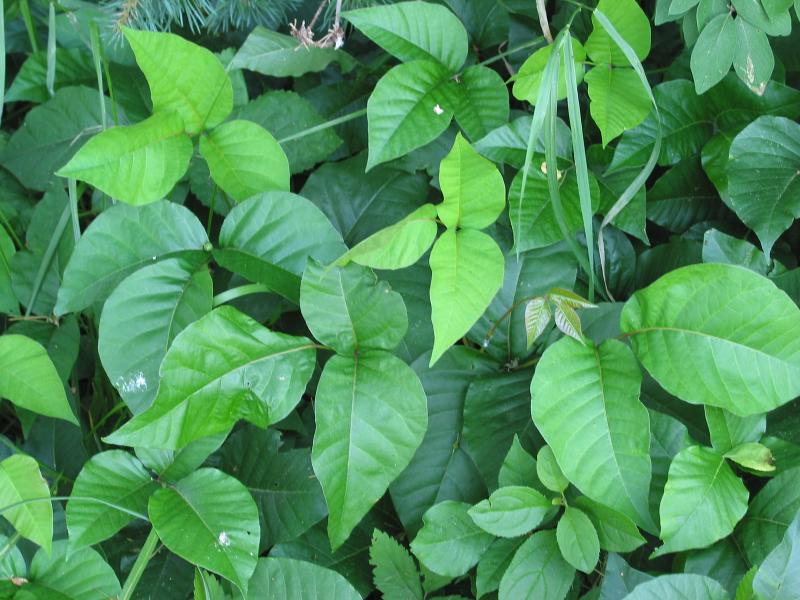 Poison IvyToxicodendron radicans
-
 Poison SumacToxicodendron vernix
-
 Chinese LacquertreeToxicodendron vernicifluum
-
 Pacific Poison-oakToxicodendron diversilobum
-
 Western Poison IvyToxicodendron rydbergii
-
 Japanese Wax TreeToxicodendron succedaneum
-
 Asian Poison IvyToxicodendron orientale
-
 Western Poison IvyToxicodendron striatum
Compare
Questions and answers
What is the scientific name of the Atlantic Poison Oak?
The scientific name of the Atlantic Poison Oak is Toxicodendron pubescens. Written with its author, the full name is Toxicodendron pubescens Mill..
Which family does the Atlantic Poison Oak belong to?
Toxicodendron pubescens belongs to the family Anacardiaceae, in the order Sapindales and the class Magnoliopsida.
Where is the Atlantic Poison Oak found?
Checklists and occurrence records place Toxicodendron pubescens in 6 countries, including United States, Canada and Mexico.
What other names does the Atlantic Poison Oak have?
Toxicodendron pubescens is also known in English as Eastern Poison Oak, Eastern Poison-oak, Pizen-oak, Poison Oak, Poison-ivy and Poison-oak.
How to identify poison oak, ivy, and sumac?
Atlantic poison oak has alternate leaves, each with three lobes that are usually hairy and vary in size and shape. Its leaves most often resemble those of white oak and usually turn yellow or orange during autumn. All parts of the plant contain urushiol.[5][6][7][8][15]
Sources
Passages the profile rests on
- The species grows in forests. Source passage: “Atlantic poison oak can be found growing in forests” — English Wikipedia
- The species is native to the southeastern United States, extending from Virginia westward to Texas and Oklahoma. Source passage: “This species is native to the Southeastern United States from Virginia westward to Texas and Oklahoma.” — English Wikipedia
- The shrub reaches a height of 0.6–1.2 metres. Source passage: “The shrub grows to 0.6–1.2 metres (2–4 ft) tall.” — English Wikipedia
- Its leaves measure approximately 15 centimetres in length. Source passage: “Its leaves are 15 centimetres (6 inches) long” — English Wikipedia
- Its leaves are alternate and each has three lobes. Source passage: “alternate, with three lobes on each.” — English Wikipedia
- The leaf lobes are usually hairy and vary in size and shape. Source passage: “The lobes are usually hairy and are variable in size and shape” — English Wikipedia
- Its leaves most often resemble those of white oak. Source passage: “but most often resemble white oak leaves” — English Wikipedia
- Its leaves usually turn yellow or orange during autumn. Source passage: “they usually turn yellow or orange in autumn.” — English Wikipedia
- Its yellow flowers bloom from March through April. Source passage: “The yellow flowers bloom from March to April.” — English Wikipedia
- Its fruit is greenish white and approximately 6.4 millimetres wide. Source passage: “The fruit is about 1⁄4 inch (6.4 mm) wide and greenish white.” — English Wikipedia
- The effects of exposure to Atlantic poison oak are similar to those caused by poison ivy. Source passage: “Effects of poison oak are similar to those of its close relative poison ivy.” — English Wikipedia
- Other Toxicodendron species containing urushiol include poison ivy, poison sumac, western poison oak and the lacquer tree. Source passage: “include poison ivy, poison sumac, Western poison oak, and the lacquer tree.” — English Wikipedia
- Atlantic poison oak is not closely related to true oaks in the beech family. Source passage: “It is not closely related to the true oaks in the beech family” — English Wikipedia
- The species belongs to the sumac family. Source passage: “instead belonging to the sumac family.” — English Wikipedia
- All parts of the plant contain urushiol. Source passage: “All parts of this plant contain urushiol” — English Wikipedia
Data
- Catalogue of Life, 2026-10-16 XR cc by
- Global Biodiversity Information Facility CC BY 4.0
- Wikidata CC0
- GeoNames CC BY 4.0
- Wikimedia Commons per image; credit shown with each image
- Within the Catalogue of Life, this name comes from Synonymic Checklists of the Vascular Plants of the World cc by
References
- Mill. (1768). Gard. Dict., ed. 8: no. 2 (1768). where the name was published
This species in other databases
- Catalogue of Life 57LHL
- Wikidata Q2718061
- iNaturalist 52083
- World Flora Online wfo-0000409202
- GRIN 400608
Page built on 26 November 2026. See how the catalog is made and all sources and licences.
Cite this page
ScientificNames.org. (2026). Toxicodendron pubescens (Atlantic Poison Oak). Retrieved November 26, 2026, from https://scientificnames.org/species/toxicodendron-pubescens
“Toxicodendron pubescens (Atlantic Poison Oak).” ScientificNames.org, 2026, scientificnames.org/species/toxicodendron-pubescens. Accessed 26 Nov. 2026.
ScientificNames.org. “Toxicodendron pubescens (Atlantic Poison Oak).” Accessed November 26, 2026. https://scientificnames.org/species/toxicodendron-pubescens.
@misc{scientificnames_toxicodendron_pubescens_atlantic_poison_oak,
  author = {{ScientificNames.org}},
  title = {Toxicodendron pubescens (Atlantic Poison Oak)},
  year = {2026},
  url = {https://scientificnames.org/species/toxicodendron-pubescens},
  note = {Accessed 2026-11-26}
}