Species · Flowering plants
Poison Ivy Toxicodendron radicans
The scientific name of the Poison Ivy is Toxicodendron radicans. It is a species of flowering plant in the family Anacardiaceae (sumac family), order Sapindales.
- Scientific name
- Toxicodendron radicans (L.) Kuntze
- Common name
- Poison Ivy
- Genus
- Toxicodendron
- Family
- Anacardiaceae (Sumac Family)
- Order
- Sapindales
- Class
- Magnoliopsida
- Red List category
- LC Least Concern
- Recorded in
- 15 countries
- Name status
- accepted in the Catalogue of Life
Overview
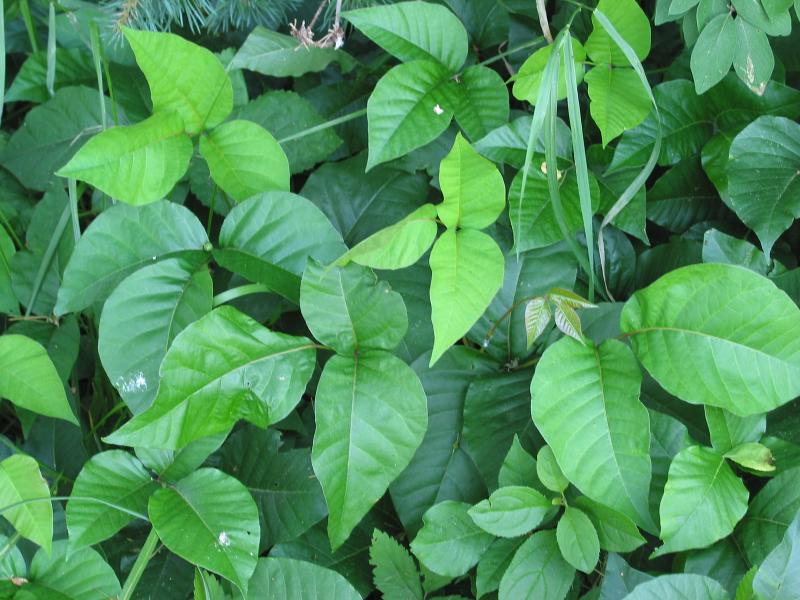
Poison ivy is a perennial plant. It commonly grows in wooded areas, exposed rocky areas, open fields, and disturbed locations. Contact with the plant can cause urushiol-induced allergic contact dermatitis in most people.
Written 26 November 2026 from the sources listed below. Each statement was checked against the passage it cites; statements that could not be supported were removed.
Appearance
Its leaves generally change from green to red, orange, or yellow during autumn. Its sap darkens after exposure to air.[1][2]
Its flowers are inconspicuous and yellowish or greenish-white. Its fruit is a berry-like drupe that becomes grayish-white when mature.[3][4]
Its climbing stems attach to supporting surfaces through numerous aerial rootlets.[5]
Habitat
Poison ivy commonly grows in wooded areas, particularly along forest edges receiving filtered sunlight. It can also grow as an understory plant in forests but has only moderate shade tolerance.[6][7]
It also grows in exposed rocky areas, open fields, and disturbed locations. Its habitats include fields, pastures, woodlands, farms, and residential landscapes.[8][9]
It commonly occupies roadsides, thickets, clearings, fence rows, and meadows. It can grow in areas experiencing seasonal flooding or brackish water.[10][11]
It tolerates soil pH values ranging from 6.0 to 7.9.[12]
Diet
Birds and other animals consume poison ivy fruits, particularly during winter. More than 60 bird species consume its fruits.[13][14]
Caterpillars of moths feed on its leaves.[15]
Reproduction and life cycle
Poison ivy flowers from May through July. Its flowers grow in clusters measuring up to 8 centimetres above the leaves.[16][17]
Small bees and flies pollinate its flowers during spring. Its fruits mature between August and November.[18][19]
The species propagates through underground rhizomes and seeds. It spreads through both vegetative and sexual reproduction.[20][21]
Its seeds are primarily dispersed by animals and can remain viable after passing through digestive tracts.[22]
Behaviour
Poison ivy's growth increases substantially under elevated atmospheric carbon dioxide concentrations.[23]
Conservation
Poison ivy is classified as a noxious weed in Minnesota, Michigan, and Ontario.[24]
Similar species
Western poison ivy (Toxicodendron rydbergii) is a distinct species that resembles eastern poison ivy.[25]
Classification of the Poison Ivy
| Kingdom | Plantae |
|---|---|
| Subkingdom | Pteridobiotina |
| Phylum | Tracheophyta |
| Class | Magnoliopsida |
| Order | Sapindales |
| Family | Anacardiaceae (Sumac Family) |
| Tribe | Rhoeae |
| Genus | Toxicodendron (Poison Ivy) |
| Species | Toxicodendron radicans (L.) Kuntze |
Where the Poison Ivy is found
Checklists and occurrence records place Toxicodendron radicans in 15 countries across Asia, Europe and North America. GBIF holds 117,155 georeferenced records of it.
Countries where it is native or its origin is not stated
Countries where it has been introduced
Regions and cities with the most records
- Texas, United States 17,321
- New York, United States 10,880
- Virginia, United States 5,982
- Pennsylvania, United States 5,848
- New Jersey, United States 5,678
- Massachusetts, United States 5,571
- Maryland, United States 5,174
- Florida, United States 5,112
- North Carolina, United States 4,856
- Illinois, United States 4,587
- Tennessee, United States 4,518
- Ohio, United States 4,345
- McLean, United States 3,540
- Arlington, United States 3,419
- Adams Morgan, United States 3,392
- Manhattan, United States 3,370
- Bethesda, United States 3,355
- Mount Pleasant, United States 3,350
- The Bronx, United States 3,326
- Foggy Bottom, United States 3,321
- Golden Triangle, United States 3,287
- Columbia Heights, United States 3,272
- Shaw, United States 3,255
- Downtown DC, United States 3,253
- Idylwood, United States 3,246
- Central 14th Street / Spring Road, United States 3,242
- Pleasant Plains, United States 3,232
- Mount Vernon Triangle, United States 3,226
- Washington, United States 3,226
- NoMa, United States 3,216
- Northwest One, United States 3,216
- Park View, United States 3,201
- West Falls Church, United States 3,194
- Petworth, United States 3,184
- Baileys Crossroads, United States 3,182
- H Street NE, United States 3,175
9 more countries have a few records outside this range
These countries hold a few records of Toxicodendron radicans but lie outside the range the checklists give for it. Such records are often zoo or garden specimens, museum material or vagrants, so the species is not counted as occurring there.
A number beside a place is its count of GBIF occurrence records. A place without a number comes from a checklist alone. Records show where a species has been observed or collected, which can include escapes and vagrants.
Common names
English
- Poison Ivy
- Sister Ivy
- Central Poison-ivy
- Climbing Poison Ivy
- Eastern Poison Ivy
- Poison-ivy
Names in 24 other languages
- Chinese
- 毒漆藤
- Czech
- škumpa zákeřná, škumpovník zákeřný
- Danish
- Almindelig giftsumak
- Dutch
- Gifsumak
- Estonian
- roniv mürgipuu
- Finnish
- liaanimyrkkysumakki, myrkkymuratti
- French
- Lierre toxique, Sumac à la gale, Sumac à la puce, Toxicodendron radicant, herbe à la puce, herbe à puce, herbe à puce de l'Est, herbe à puce grimpante
- German
- Efeu-Giftsumach, Kletternder Giftsumach, kletternder Gift-Sumach
- Italian
- edera velenosa
- Norwegian Bokmål
- gifteføy, giftsumak
- Polish
- Sumak pnący
- Russian
- Токсикодендрон укореняющийся
- Slovak
- sumachovec popínavý
- Slovenian
- strupeni bršljan
- Spanish
- hiedra mala, hiedra venenosa
- Swedish
- klättersumak
- Turkish
- Zehirli Sarmaşık
- Ukrainian
- Отруйник укорінливий
- akz
- Ittokánko
- chr
- ᎤᎸᏗ
- hus
- Betz-tzaj
- mic
- kjimsiku
- mus
- vfvlla
- nav
- Kʼíshíshjį́į́zh
Synonyms
6 other scientific names have been used for this species and are now treated as synonyms of Toxicodendron radicans.
- Ptelea pentandra DC.
- Rhus radicans subsp. radicans
- Rhus radicans var. radicans
- Rhus toxicodendron var. radicans (L.) Torr.
- Rhus toxicodendron var. trilobata M. J. Young, Familiar Lessons Bot.
- Toxicodendron radicans var. radicans
Subspecies and varieties
- Toxicodendron radicans subsp. barkleyi subspecies
- Toxicodendron radicans subsp. divaricatum subspecies
- Toxicodendron radicans subsp. eximium subspecies
- Toxicodendron radicans subsp. negundo (Midwestern Poison Ivy) subspecies
- Toxicodendron radicans subsp. pubens subspecies
- Toxicodendron radicans subsp. radicans (Poison-ivy) subspecies
- Toxicodendron radicans subsp. verrucosum (Texas Poison Ivy) subspecies
Related species
-
 Poison SumacToxicodendron vernix
-
 Chinese LacquertreeToxicodendron vernicifluum
-
 Atlantic Poison OakToxicodendron pubescens
-
 Pacific Poison-oakToxicodendron diversilobum
-
 Western Poison IvyToxicodendron rydbergii
-
 Japanese Wax TreeToxicodendron succedaneum
-
 Asian Poison IvyToxicodendron orientale
-
 Western Poison IvyToxicodendron striatum
Compare
Questions and answers
What is the scientific name of the Poison Ivy?
The scientific name of the Poison Ivy is Toxicodendron radicans. Written with its author, the full name is Toxicodendron radicans (L.) Kuntze.
Which family does the Poison Ivy belong to?
Toxicodendron radicans belongs to the family Anacardiaceae, in the order Sapindales and the class Magnoliopsida.
Where is the Poison Ivy found?
Checklists and occurrence records place Toxicodendron radicans in 15 countries, including United States, Canada, Mexico, Bermuda, Bahamas and Guatemala.
What is the conservation status of the Poison Ivy?
The IUCN Red List category recorded for Toxicodendron radicans is Least Concern (LC).
What other names does the Poison Ivy have?
Toxicodendron radicans is also known in English as Sister Ivy, Central Poison-ivy, Climbing Poison Ivy, Eastern Poison Ivy and Poison-ivy.
Sources
Passages the profile rests on
- Its leaves generally change from green to red, orange, or yellow during autumn. Source passage: “The leaf color ranges from light green (usually when young) to dark green (in maturity), turning red, orange or yellow in fall” — English Wikipedia
- Its sap darkens after exposure to air. Source passage: “The milky sap of poison ivy darkens after exposure to the air.” — English Wikipedia
- Its flowers are inconspicuous and yellowish or greenish-white. Source passage: “The yellowish- or greenish-white flowers are typically inconspicuous” — English Wikipedia
- Its fruit is a berry-like drupe that becomes grayish-white when mature. Source passage: “The berry-like fruit, a drupe, mature by August to November with a grayish-white colour.” — English Wikipedia
- Its climbing stems attach to supporting surfaces through numerous aerial rootlets. Source passage: “Vines growing on the trunk of a tree become firmly attached through numerous aerial rootlets.” — English Wikipedia
- The species commonly grows in wooded areas, particularly along forest edges receiving filtered sunlight. Source passage: “It is normally found in wooded areas, especially along edge areas where the tree line breaks and allows sunshine to filter through.” — English Wikipedia
- It can grow as an understory plant in forests but has only moderate shade tolerance. Source passage: “It may grow as a forest understory plant, although it is only somewhat shade-tolerant.” — English Wikipedia
- It also grows in exposed rocky areas, open fields, and disturbed locations. Source passage: “It also grows in exposed rocky areas, open fields, and disturbed areas.” — English Wikipedia
- It occurs in fields, pastures, woodlands, farms, and residential landscapes. Source passage: “can be found in fields, pastures, woodlands, farms, and home landscapes.” — hgic.clemson.edu
- It can grow in areas experiencing seasonal flooding or brackish water. Source passage: “It can grow in areas subject to seasonal flooding or brackish water.” — English Wikipedia
- It commonly occupies roadsides, thickets, clearings, fence rows, and meadows. Source passage: “Therefore, likely locations include wooded areas, thickets, roadsides, clearings, fence rows, and meadows.” — nps.gov
- It tolerates soil pH values ranging from 6.0 to 7.9. Source passage: “soil pH from 6.0 (acidic) to 7.9 (moderately alkaline).” — English Wikipedia
- Birds and other animals consume its fruits, particularly during winter. Source passage: “The fruits are a favorite winter food of some birds and other animals, including wild turkeys.” — English Wikipedia
- More than 60 bird species consume its fruits. Source passage: “More than 60 species of birds eat the fruits from poison ivy.” — nps.gov
- Caterpillars of moths feed on its leaves. Source passage: “Insects feed on the plant, and caterpillars from moths feed on the leaves.” — nps.gov
- Its flowering period extends from May through July. Source passage: “flowering occurs from May to July.” — English Wikipedia
- Its flowers grow in clusters measuring up to 8 centimetres above the leaves. Source passage: “are located in clusters up to 8 cm (3 in) above the leaves.” — English Wikipedia
- Its fruits mature between August and November. Source passage: “The berry-like fruit, a drupe, mature by August to November” — English Wikipedia
- Small bees and flies pollinate its flowers during spring. Source passage: “Small bees and flies pollinate the flowers in the spring.” — nps.gov
- The species spreads through both vegetative and sexual reproduction. Source passage: “T. radicans spreads either vegetatively or sexually.” — English Wikipedia
- The species propagates through underground rhizomes and seeds. Source passage: “Poison ivy grows fairly quickly and propagates itself by underground rhizomes and seeds.” — hgic.clemson.edu
- Its seeds are primarily dispersed by animals and can remain viable after passing through digestive tracts. Source passage: “Seeds are spread mainly by animals and remain viable after passing through the digestive tract.” — English Wikipedia
- Its growth increases substantially under elevated atmospheric carbon dioxide concentrations. Source passage: “Higher carbon dioxide levels increase the rate of plant growth” — English Wikipedia
- The species is classified as a noxious weed in Minnesota, Michigan, and Ontario. Source passage: “It is listed as a noxious weed in the US states of Minnesota and Michigan and in the Canadian province of Ontario.” — English Wikipedia
- Western poison ivy (Toxicodendron rydbergii) is a distinct species that resembles eastern poison ivy. Source passage: “It is different from western poison ivy, Toxicodendron rydbergii, and resembles a number of species.” — English Wikipedia
- Contact with the plant can cause urushiol-induced allergic contact dermatitis in most people. Source passage: “As a poison ivy, it causes urushiol-induced contact dermatitis in most people who touch it” — English Wikipedia
- Urushiol occurs in all parts of the plant. Source passage: “The entire plant is poisonous because all parts contain the irritating oil urushiol.” — hgic.clemson.edu
- Its urushiol oil can remain active on objects for months. Source passage: “The oil can remain active for months on objects.” — hgic.clemson.edu
Data
- Catalogue of Life, 2026-10-16 XR cc by
- Global Biodiversity Information Facility CC BY 4.0
- Wikidata CC0
- GeoNames CC BY 4.0
- Wikimedia Commons per image; credit shown with each image
- Within the Catalogue of Life, this name comes from Synonymic Checklists of the Vascular Plants of the World cc by
References
- (L.) Kuntze. where the name was published
This species in other databases
- Catalogue of Life 57LHS
- Wikidata Q7218532
- iNaturalist 58732
- World Flora Online wfo-0001049365
- GRIN 101866
Page built on 27 November 2026. See how the catalog is made and all sources and licences.
Cite this page
ScientificNames.org. (2026). Toxicodendron radicans (Poison Ivy). Retrieved November 27, 2026, from https://scientificnames.org/species/toxicodendron-radicans
“Toxicodendron radicans (Poison Ivy).” ScientificNames.org, 2026, scientificnames.org/species/toxicodendron-radicans. Accessed 27 Nov. 2026.
ScientificNames.org. “Toxicodendron radicans (Poison Ivy).” Accessed November 27, 2026. https://scientificnames.org/species/toxicodendron-radicans.
@misc{scientificnames_toxicodendron_radicans_poison_ivy,
  author = {{ScientificNames.org}},
  title = {Toxicodendron radicans (Poison Ivy)},
  year = {2026},
  url = {https://scientificnames.org/species/toxicodendron-radicans},
  note = {Accessed 2026-11-27}
}