Species · Flowering plants
Western Poison Ivy Toxicodendron rydbergii
The scientific name of the Western Poison Ivy is Toxicodendron rydbergii. It is a species of flowering plant in the family Anacardiaceae (sumac family), order Sapindales.
- Scientific name
- Toxicodendron rydbergii (Small ex Rydb.) Greene
- Common name
- Western Poison Ivy
- Genus
- Toxicodendron
- Family
- Anacardiaceae (Sumac Family)
- Order
- Sapindales
- Class
- Magnoliopsida
- Recorded in
- 3 countries
- Name status
- accepted in the Catalogue of Life

Overview
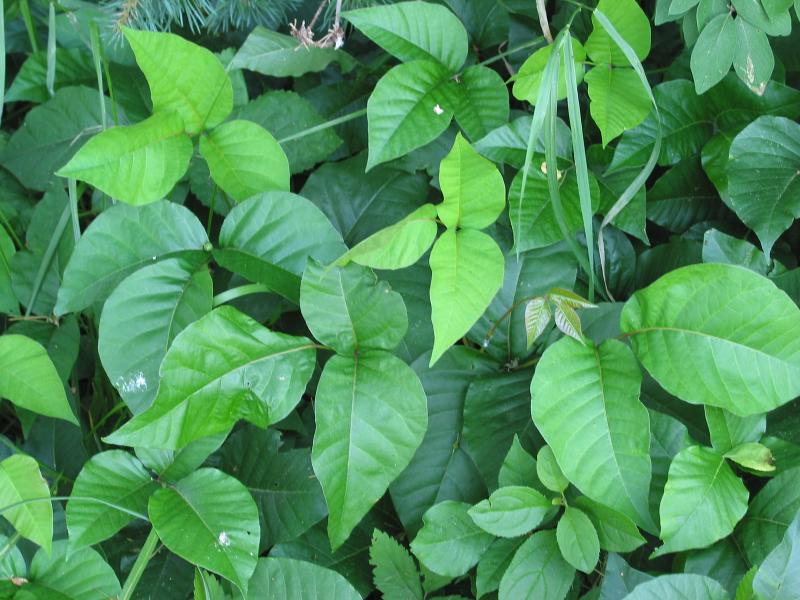
Western poison ivy is a shrub rather than typically a trailing or climbing vine. It grows in forests and other wooded areas, generally near streams and rivers. Its alternate leaves consist of three leaflets, and all parts of the plant contain urushiol.
Written 26 November 2026 from the sources listed below. Each statement was checked against the passage it cites; statements that could not be supported were removed.
Appearance
Western poison ivy commonly reaches 1 metre in height and rarely grows as tall as 3 metres. Its alternate leaves consist of three leaflets, usually approximately 15 centimetres long, that vary in size and shape.[1][2][3]
The two opposite lateral leaflets are typically asymmetrical, while the terminal leaflet is bilaterally symmetrical. Young leaves are shiny red, mature leaves are glossy green, and the undersides are lighter green and covered with velvety hairs.[4][5][6]
The leaves turn yellow or orange during autumn. Its flowers are greenish-white and approximately one-quarter inch across, with usually either five or ten stamens.[7][8][9]
The flowers grow in clusters on slender stems in the axils of alternate leaves. The fruits are small, round drupes that develop from greenish, pumpkin-like immature fruits into cream-colored to whitish mature fruits approximately one-quarter inch across.[10][11][12][13][14]
Habitat
Western poison ivy grows in forests and other wooded areas, generally near streams and rivers. It is commonly found in moist locations, including roadsides, railroads, and fencerows.[15][16]
The species occurs in riparian communities within Arches National Park.[17]
Diet
Various game animals, rodents, livestock, and birds consume the foliage and fruits without ill effect.[18]
Reproduction and life cycle
Western poison ivy has separate male and female plants. Its flowers have a dioecious reproductive arrangement.[19][20]
The species reproduces through seeds and creeping root systems. In Arches National Park, it blooms during May and June.[21][22]
Uses
Western poison ivy was historically used by Native Americans and early pioneers for dyes and medicines.[23]
Similar species
Western poison ivy differs from eastern poison ivy in typically growing as a shrub rather than a trailing or climbing vine.[24]
Classification of the Western Poison Ivy
| Kingdom | Plantae |
|---|---|
| Subkingdom | Pteridobiotina |
| Phylum | Tracheophyta |
| Class | Magnoliopsida |
| Order | Sapindales |
| Family | Anacardiaceae (Sumac Family) |
| Tribe | Rhoeae |
| Genus | Toxicodendron (Poison Ivy) |
| Species | Toxicodendron rydbergii (Small ex Rydb.) Greene |
Where the Western Poison Ivy is found
Checklists and occurrence records place Toxicodendron rydbergii in 3 countries across North America. GBIF holds 23,539 georeferenced records of it.
Countries
Regions and cities with the most records
- Ontario, Canada 6,318
- British Columbia, Canada 2,157
- Minnesota, United States 1,856
- Colorado, United States 1,526
- Manitoba, Canada 1,363
- Quebec, Canada 1,077
- Wisconsin, United States 1,035
- Michigan, United States 755
- Utah, United States 640
- Aylmer, Canada 582
- Ottawa, Canada 576
- Ottawa South, Canada 574
- Idaho, United States 565
- Nepean, Canada 561
- Gloucester, Canada 538
- Gatineau, Canada 537
- Vanier, Canada 536
- Boulder, United States 503
- Winnipeg, Canada 503
- Kanata, Canada 493
- New Mexico, United States 493
- Bridlewood, Canada 485
- Willowdale, Canada 477
- Thornhill, Canada 463
- Vermont, United States 461
- Washington, United States 461
- Louisville, United States 460
- Broomfield, United States 422
- Lafayette, United States 422
- Arizona, United States 419
- Stittsville, Canada 386
- Markham, Canada 381
- Nova Scotia, Canada 346
- Midland, Canada 337
- Vaughan, Canada 335
- Penticton, Canada 318
3 more countries have a few records outside this range
These countries hold a few records of Toxicodendron rydbergii but lie outside the range the checklists give for it. Such records are often zoo or garden specimens, museum material or vagrants, so the species is not counted as occurring there.
Range as the checklists state it
Canada (Alberta, British Columbia, Manitoba, New Brunswick, Nova Scotia, Ontario, Prince Edward Isl., Quebec, Saskatchewan, Yukon); USA (Arizona, Colorado, Connecticut, Iowa, Idaho, Illinois, Indiana, Kansas, Massachusetts, Maryland, Maine, Michigan, Minnesota, Montana, North Carolina, North Dakota, Nebraska, New Hampshire, New Mexico, Nevada, New York, Ohio, Oklahoma, Oregon, Pennsylvania, Rhode Island, South Dakota, Texas, Utah, Virginia, Vermont, Washington State, Wisconsin, West Virginia, Wyoming); Mexico (Chihuahua, Sonora)
A number beside a place is its count of GBIF occurrence records. A place without a number comes from a checklist alone. Records show where a species has been observed or collected, which can include escapes and vagrants.
Common names
English
- Western Poison Ivy
- Rydberg's Poison-ivy
- Creeping Poison Ivy
- Northern Poison Ivy
- Poison Ivy
- Western Poison-ivy
Names in 5 other languages
- Finnish
- kanadanmyrkkysumakki
- French
- herbe à puce de Rydberg
- Portuguese
- Hera-venenosa-ocidental
- Ukrainian
- Отруйник Рідберга
- nav
- K’ishishjiin
Synonyms
16 other scientific names have been used for this species and are now treated as synonyms of Toxicodendron rydbergii.
- Rhus radicans subsp. rydbergii (Small ex Rydb.) McNeill
- Rhus radicans var. rydbergii (Small ex Rydb.) Rehder
- Rhus radicans var. vulgaris (Michx.) DC.
- Rhus rydbergii Small
- Rhus rydbergii Small ex Rydb.
- Rhus toxicodendron var. rydbergii (Small ex Rydb.) Garrett
- Rhus toxicodendron var. vulgaris Michx.
- Toxicodendron desertorum Lunell
- Toxicodendron fothergilloides Lunell
- Toxicodendron punctatum Greene
- Toxicodendron radicans subsp. rydbergii (Small ex Rydb.) Á.Löve & D.Löve
- Toxicodendron radicans var. rydbergii (Small ex Rydb.) Erskine
- Toxicodendron rufescens Greene
- Toxicodendron longipes Greene ambiguous synonym
- Toxicodendron macrocarpum Greene ambiguous synonym
- Toxicodendron pumilum Greene ambiguous synonym
Related species
-
 Poison IvyToxicodendron radicans
-
 Poison SumacToxicodendron vernix
-
 Chinese LacquertreeToxicodendron vernicifluum
-
 Atlantic Poison OakToxicodendron pubescens
-
 Pacific Poison-oakToxicodendron diversilobum
-
 Japanese Wax TreeToxicodendron succedaneum
-
 Asian Poison IvyToxicodendron orientale
-
 Western Poison IvyToxicodendron striatum
Compare
Questions and answers
What is the scientific name of the Western Poison Ivy?
The scientific name of the Western Poison Ivy is Toxicodendron rydbergii. Written with its author, the full name is Toxicodendron rydbergii (Small ex Rydb.) Greene.
Which family does the Western Poison Ivy belong to?
Toxicodendron rydbergii belongs to the family Anacardiaceae, in the order Sapindales and the class Magnoliopsida.
Where is the Western Poison Ivy found?
Checklists and occurrence records place Toxicodendron rydbergii in 3 countries: Canada, United States and Mexico.
What other names does the Western Poison Ivy have?
Toxicodendron rydbergii is also known in English as Rydberg's Poison-ivy, Creeping Poison Ivy, Northern Poison Ivy, Poison Ivy and Western Poison-ivy.
Sources
Passages the profile rests on
- The shrub commonly reaches 1 metre in height and rarely grows as tall as 3 metres. Source passage: “can grow to 1 m (3 ft) tall, rarely up to 3 m (10 ft).” — English Wikipedia
- Its leaves are alternate and consist of three leaflets. Source passage: “The leaves are trifoliate and alternate.” — English Wikipedia
- The leaflets vary in size and shape and are usually approximately 15 centimetres long. Source passage: “The leaflets are variable in size and shape, and are usually 15 cm (6 in) long” — English Wikipedia
- The two opposite lateral leaflets are typically asymmetrical, whereas the terminal leaflet is bilaterally symmetrical. Source passage: “the two leaflets opposite each other are typically asymmetrical, in contrast to the terminal leaflet which always shows bilateral symmetry.” — English Wikipedia
- Young leaves are shiny red, while mature leaves are glossy green. Source passage: “Young leaves are shiny red, while older leaves are glossy green.” — hortsense.cahnrs.wsu.edu
- The undersides of its leaves are lighter green and covered with velvety hairs. Source passage: “Leaf undersides are lighter green with a coat of velvety hairs.” — hortsense.cahnrs.wsu.edu
- The leaves turn yellow or orange during autumn. Source passage: “turning yellow or orange in autumn.” — English Wikipedia
- Its flowers usually have either five or ten stamens. Source passage: “stamens usually 5 or 10” — nps.gov
- Its blossoms are greenish-white and approximately one-quarter inch across. Source passage: “The greenish-white blossoms are about 1/4 inch across.” — hortsense.cahnrs.wsu.edu
- Its fruits are small, round, and yellowish. Source passage: “The fruits are small, round, and yellowish.” — English Wikipedia
- The species has cream-colored to yellowish fruits classified as drupes. Source passage: “Fruits: cream to yellow drupes” — nps.gov
- Its flowers grow in clusters on slender stems in the axils of alternate leaves. Source passage: “Flowers occur in clusters on slender stems in the axils of the alternate leaves.” — hortsense.cahnrs.wsu.edu
- Its immature fruits are greenish and resemble tiny pumpkins. Source passage: “The ridged, berrylike fruits are greenish and resemble tiny pumpkins when immature.” — hortsense.cahnrs.wsu.edu
- Its mature fruits are cream-colored to whitish and approximately one-quarter inch across. Source passage: “At maturity, they are cream-colored to whitish, reaching about 1/4 inch across.” — hortsense.cahnrs.wsu.edu
- The species grows in forests and other wooded areas, generally near streams and rivers. Source passage: “It can be found growing in forests, and other wooded areas, usually near streams and rivers.” — English Wikipedia
- The species is commonly found in moist locations, including roadsides, railroads, and fencerows. Source passage: “Poison ivy and poison oak are commonly found in moist places, and along roadsides, railroads, and fencerows.” — hortsense.cahnrs.wsu.edu
- The species occurs in riparian communities within Arches National Park. Source passage: “Habitat in Arches National Park: riparian communities” — nps.gov
- Various game animals, rodents, livestock, and birds consume the species' foliage and fruits without ill effect. Source passage: “many game species, rodents, livestock, and birds consume the foliage or white, berry-like fruits without ill effect.” — fs.usda.gov
- The species has separate male and female plants. Source passage: “flowers are dioecious (individual flowers are either male or female, but only one sex is to be found on any one plant)” — nps.gov
- The flowers of the species have a dioecious reproductive arrangement. Source passage: “flowers are dioecious” — nps.gov
- The species reproduces through seeds and creeping root systems. Source passage: “Plants reproduce by seeds and creeping root systems.” — hortsense.cahnrs.wsu.edu
- The species blooms in Arches National Park during May and June. Source passage: “Blooms in Arches National Park: May, June” — nps.gov
- The species was historically used by Native Americans and early pioneers for dyes and medicines. Source passage: “Native Americans and early pioneers used poison ivy for dyes and medicines.” — fs.usda.gov
- The species differs from eastern poison ivy in typically growing as a shrub rather than a trailing or climbing vine. Source passage: “Unlike Toxicodendron radicans (eastern poison ivy), which often appears as a trailing or climbing vine, T. rydbergii is a shrub” — English Wikipedia
Data
- Catalogue of Life, 2026-10-16 XR cc by
- Global Biodiversity Information Facility CC BY 4.0
- Wikidata CC0
- GeoNames CC BY 4.0
- Wikimedia Commons per image; credit shown with each image
- Within the Catalogue of Life, this name comes from Synonymic Checklists of the Vascular Plants of the World cc by
References
- Greene. (1905). Leafl. Bot. Observ. Crit. 1: 117 (1905). where the name was published
This species in other databases
- Catalogue of Life 57LJ4
- Wikidata Q7830405
- iNaturalist 58729
- World Flora Online wfo-0001049958
- GRIN 409811
Page built on 27 November 2026. See how the catalog is made and all sources and licences.
Cite this page
ScientificNames.org. (2026). Toxicodendron rydbergii (Western Poison Ivy). Retrieved November 27, 2026, from https://scientificnames.org/species/toxicodendron-rydbergii
“Toxicodendron rydbergii (Western Poison Ivy).” ScientificNames.org, 2026, scientificnames.org/species/toxicodendron-rydbergii. Accessed 27 Nov. 2026.
ScientificNames.org. “Toxicodendron rydbergii (Western Poison Ivy).” Accessed November 27, 2026. https://scientificnames.org/species/toxicodendron-rydbergii.
@misc{scientificnames_toxicodendron_rydbergii_western_poison_ivy,
  author = {{ScientificNames.org}},
  title = {Toxicodendron rydbergii (Western Poison Ivy)},
  year = {2026},
  url = {https://scientificnames.org/species/toxicodendron-rydbergii},
  note = {Accessed 2026-11-27}
}