Species · Flowering plants
Poison Sumac Toxicodendron vernix
The scientific name of the Poison Sumac is Toxicodendron vernix. It is a species of flowering plant in the family Anacardiaceae (sumac family), order Sapindales.
- Scientific name
- Toxicodendron vernix (L.) Kuntze
- Common name
- Poison Sumac
- Genus
- Toxicodendron
- Family
- Anacardiaceae (Sumac Family)
- Order
- Sapindales
- Class
- Magnoliopsida
- Red List category
- LC Least Concern
- Recorded in
- 2 countries
- Name status
- accepted in the Catalogue of Life

Overview
Toxicodendron vernix occurs in the eastern United States and extreme southeastern Canada. All parts of poison sumac contain urushiol resin that irritates human skin and mucous membranes.
Written 26 November 2026 from the sources listed below. Each statement was checked against the passage it cites; statements that could not be supported were removed.
Appearance
Poison sumac can reach approximately 9 metres in height. Its bark is initially light gray and darkens with age.[1][2]
Its alternate leaves are dark green and contain seven to thirteen leaflets arranged in pairs with a single terminal leaflet. Individual leaflets measure approximately 5–10 centimetres long and are oval to oblong, with pointed tips, wedge-shaped bases, and wavy edges.[3][4][5][6]
The undersides of its leaflets are hairless or slightly covered with down-like hairs. The stems running along the leaflets are red.[7][8]
Its leaves emerge bright orange in early spring, mature to dark green, and turn orange to red in autumn. They can develop a reddish tint, particularly near the top of the plant.[9][10]
Its flowers are greenish-yellow and grow in loose branching clusters in the leaf axils.[11][12]
Its fruits are flattened, nearly spherical, and whitish-gray, measuring approximately 0.5 centimetres across.[13][14]
Habitat
Poison sumac grows exclusively in wet and clay soils. Its typical habitats include swamps and peat bogs.[15][16]
Diet
Birds eat the fruits of poison sumac. Birds and other animals consume its fruits and leaves when other food is scarce, particularly during winter.[17][18]
Similar species
Poison sumac has shorter leaves and fewer leaflets than other sumacs, which have red fruits.[19]
Reproduction and life cycle
Poison sumac flowers during June and July.[20]
Its fruits develop after flowering, begin green, and ripen to yellowish-white in late summer.[21]
Classification of the Poison Sumac
| Kingdom | Plantae |
|---|---|
| Subkingdom | Pteridobiotina |
| Phylum | Tracheophyta |
| Class | Magnoliopsida |
| Order | Sapindales |
| Family | Anacardiaceae (Sumac Family) |
| Tribe | Rhoeae |
| Genus | Toxicodendron (Poison Ivy) |
| Species | Toxicodendron vernix (L.) Kuntze |
Where the Poison Sumac is found
Checklists and occurrence records place Toxicodendron vernix in 2 countries across North America. GBIF holds 6,905 georeferenced records of it.
Countries
Regions and cities with the most records
- Michigan, United States 870
- Wisconsin, United States 560
- Ohio, United States 477
- Massachusetts, United States 475
- Pennsylvania, United States 325
- Ontario, Canada 318
- New York, United States 287
- New Jersey, United States 197
- Indiana, United States 186
- Tallmadge, United States 184
- Stow, United States 176
- Cuyahoga Falls, United States 172
- Kent, United States 170
- North Carolina, United States 163
- Streetsboro, United States 163
- Florida, United States 135
- Minnesota, United States 135
- Mississippi, United States 135
- Connecticut, United States 133
- New Hampshire, United States 129
- Akron, United States 127
- Hudson, United States 122
- Maryland, United States 117
- Virginia, United States 113
- Illinois, United States 110
- Central 14th Street / Spring Road, United States 105
- Downtown DC, United States 105
- H Street NE, United States 105
- Mount Vernon Triangle, United States 105
- NoMa, United States 105
- Northwest One, United States 105
- Petworth, United States 105
- Chillum, United States 104
- Mount Pleasant, United States 104
- Park View, United States 104
- Pleasant Plains, United States 104
1 more country has a few records outside this range
These countries hold a few records of Toxicodendron vernix but lie outside the range the checklists give for it. Such records are often zoo or garden specimens, museum material or vagrants, so the species is not counted as occurring there.
Range as the checklists state it
European Russia [I]; Canada (Nova Scotia, Ontario, Quebec); USA (Alabama, Connecticut, District of Columbia, Delaware, Florida, Georgia, Illinois, Indiana, Kentucky, Louisiana, Massachusetts, Maryland, Maine, Michigan, Minnesota, Mississippi, North Carolina, New Hampshire, New Jersey, New York, Ohio, Pennsylvania, Rhode Island, South Carolina, Tennessee, Texas, Virginia, Vermont, Wisconsin, West Virginia)
A number beside a place is its count of GBIF occurrence records. A place without a number comes from a checklist alone. Records show where a species has been observed or collected, which can include escapes and vagrants.
Common names
English
- Poison Sumac
- Poison Shumake
- Poison-ash
- Swamp Sumac
- Thunderwood
- White Shoe-make
Names in 6 other languages
- Chinese
- 东美毒漆, 毒漆
- Finnish
- suomyrkkysumakki
- French
- sumac à vernis, toxicodendron à vernis
- Russian
- Токсикодендрон лаковый
- Slovak
- sumachovec úžitkový
- see
- Gotgó’dä:’s
Synonyms
3 other scientific names have been used for this species and are now treated as synonyms of Toxicodendron vernix.
- Rhus aequalis Pers.
- Rhus venenata DC.
- Rhus vernix L.
Related species
-
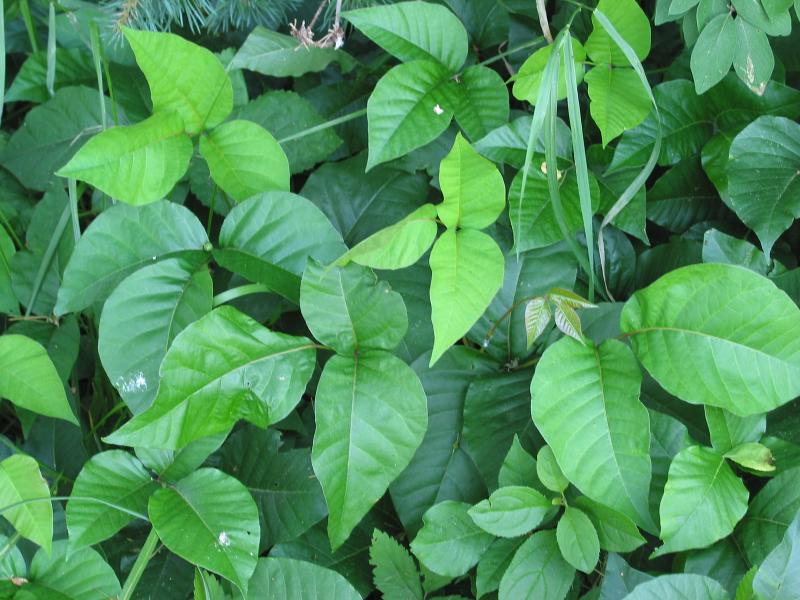 Poison IvyToxicodendron radicans
-
 Chinese LacquertreeToxicodendron vernicifluum
-
 Atlantic Poison OakToxicodendron pubescens
-
 Pacific Poison-oakToxicodendron diversilobum
-
 Western Poison IvyToxicodendron rydbergii
-
 Japanese Wax TreeToxicodendron succedaneum
-
 Asian Poison IvyToxicodendron orientale
-
 Western Poison IvyToxicodendron striatum
Compare
Questions and answers
What is the scientific name of the Poison Sumac?
The scientific name of the Poison Sumac is Toxicodendron vernix. Written with its author, the full name is Toxicodendron vernix (L.) Kuntze.
Which family does the Poison Sumac belong to?
Toxicodendron vernix belongs to the family Anacardiaceae, in the order Sapindales and the class Magnoliopsida.
Where is the Poison Sumac found?
Checklists and occurrence records place Toxicodendron vernix in 2 countries: United States and Canada.
What is the conservation status of the Poison Sumac?
The IUCN Red List category recorded for Toxicodendron vernix is Least Concern (LC).
What other names does the Poison Sumac have?
Toxicodendron vernix is also known in English as Poison Shumake, Poison-ash, Swamp Sumac, Thunderwood and White Shoe-make.
Where is poison sumac native to?
Poison sumac occurs in the eastern United States and extreme southeastern Canada.[22]
Sources
Passages the profile rests on
- The species can reach approximately 9 metres in height. Source passage: “Poison sumac is a shrub or small tree, growing up to nearly 9 metres (30 feet) in height.” — English Wikipedia
- Its bark is initially light gray and darkens with age. Source passage: “The bew bark is lightish gray, becoming darker as it ages.” — English Wikipedia
- Each pinnate leaf contains between seven and thirteen leaflets. Source passage: “Each pinnate leaf has 7–13 leaflets” — English Wikipedia
- Individual leaflets measure approximately 5–10 centimetres long. Source passage: “each of which is 5–10 centimetres (2–4 inches) long.” — English Wikipedia
- Its leaflets are oval to oblong, taper to pointed tips, have wedge-shaped bases, and feature wavy edges. Source passage: “These are oval-to-oblong; acuminate (tapering to a sharp point); cuneate (wedge-shaped) at the base; undulate (wavy-edged)” — English Wikipedia
- Its alternate leaves are dark green and contain seven to thirteen leaflets arranged in pairs with a single terminal leaflet. Source passage: “Its dark green, alternate leaves consist of seven to thirteen 2- to 4-inch-long leaflets arranged in pairs along a stem with a single leaflet at the end.” — extension.psu.edu
- The undersides of its leaflets are hairless or slightly covered with down-like hairs. Source passage: “with an underside that is glabrous (hairless) or slightly pubescent (down-like hair) beneath.” — English Wikipedia
- The stems running along its leaflets are red. Source passage: “The stems along the leaflets are red” — English Wikipedia
- Its leaves can develop a reddish tint, particularly near the top of the plant. Source passage: “the leaves can have a reddish tint to them, particularly at the top of the plant.” — English Wikipedia
- Its leaves emerge bright orange in early spring, mature to dark green, and turn orange to red in autumn. Source passage: “The leaves are bright orange as they emerge in early spring, mature to dark green, and turn orange to red in the fall.” — extension.psu.edu
- Its flowers are greenish and grow in loose clusters in the leaf axils. Source passage: “the flowers are greenish, growing in loose axillary panicles (clusters)” — English Wikipedia
- Its flowers are greenish-yellow and grow in loose branching clusters. Source passage: “Loose branching clusters of greenish-yellow flowers appear in early to mid-summer” — extension.psu.edu
- Its fruits are flattened, nearly spherical, and whitish-gray. Source passage: “The fruits are subglobose (not quite spherical), whitish-gray, flattened” — English Wikipedia
- Its fruits measure approximately 0.5 centimetres across. Source passage: “about 0.5 cm (1⁄4 in) across” — English Wikipedia
- The species grows exclusively in wet and clay soils. Source passage: “Poison sumac grows exclusively in wet and clay soils” — English Wikipedia
- Its typical habitats include swamps and peat bogs. Source passage: “usually in swamps and peat bogs” — English Wikipedia
- Birds eat the fruits of the species. Source passage: “these are eaten by birds.” — English Wikipedia
- Birds and other animals consume its fruits and leaves when other food is scarce, particularly during winter. Source passage: “They are, however, not toxic to birds or other animals, and eaten by them when other food is scarce, especially in winter.” — English Wikipedia
- The species has shorter leaves and fewer leaflets than other sumacs, which have red fruits. Source passage: “Poison sumac has shorter leaves and fewer leaflets than other sumacs, which have red fruit.” — English Wikipedia
- The species flowers during June and July. Source passage: “Blooming in June and July” — English Wikipedia
- Its fruits develop after flowering, begin green, and ripen to yellowish-white in late summer. Source passage: “are followed by round berry-like fruit that begin green and ripen to a yellowish-white in late summer.” — extension.psu.edu
- The species occurs in the eastern United States and extreme southeastern Canada. Source passage: “in the eastern United States and extreme southeast Canada.” — English Wikipedia
Data
- Catalogue of Life, 2026-10-16 XR cc by
- Global Biodiversity Information Facility CC BY 4.0
- Wikidata CC0
- GeoNames CC BY 4.0
- Wikimedia Commons per image; credit shown with each image
- iNaturalist per image; credit shown with each image
- Within the Catalogue of Life, this name comes from Synonymic Checklists of the Vascular Plants of the World cc by
References
- Kuntze. (1891). Revis. Gen. Pl. 1: 153 (1891). where the name was published
This species in other databases
- Catalogue of Life 57LK4
- Wikidata Q7002291
- iNaturalist 54767
- World Flora Online wfo-0001049963
- GRIN 101871
Page built on 26 November 2026. See how the catalog is made and all sources and licences.
Cite this page
ScientificNames.org. (2026). Toxicodendron vernix (Poison Sumac). Retrieved November 26, 2026, from https://scientificnames.org/species/toxicodendron-vernix
“Toxicodendron vernix (Poison Sumac).” ScientificNames.org, 2026, scientificnames.org/species/toxicodendron-vernix. Accessed 26 Nov. 2026.
ScientificNames.org. “Toxicodendron vernix (Poison Sumac).” Accessed November 26, 2026. https://scientificnames.org/species/toxicodendron-vernix.
@misc{scientificnames_toxicodendron_vernix_poison_sumac,
  author = {{ScientificNames.org}},
  title = {Toxicodendron vernix (Poison Sumac)},
  year = {2026},
  url = {https://scientificnames.org/species/toxicodendron-vernix},
  note = {Accessed 2026-11-26}
}