Species · Birds
Ceara Woodcreeper Xiphorhynchus atlanticus
The scientific name of the Ceara Woodcreeper is Xiphorhynchus atlanticus. It is a species of bird in the family Furnariidae (ovenbird), order Passeriformes. The name dates from 1916.
- Scientific name
- Xiphorhynchus atlanticus (Cory, 1916)
- Common name
- Ceara Woodcreeper
- Genus
- Xiphorhynchus
- Family
- Furnariidae (Ovenbird)
- Order
- Passeriformes
- Class
- Aves
- Red List category
- VU Vulnerable
- Recorded in
- 1 country
- Name status
- accepted in the Catalogue of Life

Overview
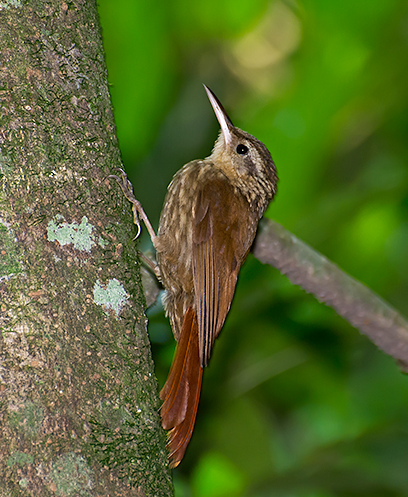
The Ceara Woodcreeper (Xiphorhynchus atlanticus) is a monotypic bird in the family Furnariidae, order Passeriformes, and class Aves. It occurs exclusively in northeastern Brazil, from Ceará south to Alagoas north of the Rio São Francisco. It has a dusky face, a spotted blackish-brown crown, and rufous-chestnut flight feathers, rump, and tail.
Written 27 November 2026 from the sources listed below. Each statement was checked against the passage it cites; statements that could not be supported were removed.
Appearance
The Ceara Woodcreeper is a small, slender bird with a proportionally large head and a long, slightly curved bill. It measures between 15 and 18.5 cm in length.[1][2]
Males and females have the same plumage. Adults have a mostly dusky face, a thin creamy to yellowish-buff eyebrow stripe, and often a pale eye ring.[3][4]
The crown and nape are blackish brown, with small yellowish-buff to cinnamon spots on the crown. These spots become streaks across the nape and sides of the neck and continue faintly onto the upper back.[5][6]
The back and wing coverts range from olive-brown to reddish brown. The flight feathers, rump, and tail are rufous-chestnut, with darker outer webs and flight-feather tips.[7][8]
The throat is creamy yellow with a faint darker pattern. The breast and belly are ochraceous brown with a subdued scaly pattern formed by blurry, dark-edged buff spots.[9][10]
The undertail and underwing coverts are cinnamon-colored. The iris is dark brown.[11][12]
The maxilla is blackish brown to dark horn-colored, often with a darker base. The mandible is pinkish to white and sometimes has a darker tip.[13][14]
The legs and feet are olive-gray to bluish gray.[15]
Habitat
The Ceara Woodcreeper inhabits primary and secondary humid forests. It also occurs in remnant patches of brejos de altitude within the Caatinga.[16][17]
It occurs at elevations reaching 600 m.[18]
Diet
The diet and foraging behaviour of the Ceara Woodcreeper have not been described in detail. They are assumed to resemble those of the lesser woodcreeper.[19][20]
Behaviour
The Ceara Woodcreeper is believed to remain throughout its geographic range year-round.[21]
Its calls are thought to include a very high, sharp 'fieet fieet' sound, doubled 'peep, peesp' sounds, and single 'speel' or 'wik' sounds.[22][23]
Conservation
The Ceara Woodcreeper was initially assessed as Least Concern before being reclassified as Vulnerable in 2021. Its estimated population comprises between 5,000 and 11,000 mature individuals.[24][25]
The population is believed to be declining, and the species has a limited geographic range. It is described as fairly common to common, although overall abundance data are very limited.[26][27][28]
Forest loss and degradation caused by urbanisation, agricultural conversion, and selective logging are identified as the principal threats. Its ability to adapt to fragmented or degraded habitats is not well understood.[29][30]
Similar species
The Ceara Woodcreeper was considered a subspecies of the lesser woodcreeper until the 2010s.[31]
Classification of the Ceara Woodcreeper
| Kingdom | Animalia |
|---|---|
| Phylum | Chordata |
| Subphylum | Vertebrata |
| Infraphylum | Gnathostomata |
| Parvphylum | Osteichthyes |
| Megaclass | Tetrapoda |
| Class | Aves (Bird) |
| Order | Passeriformes (Passerine) |
| Family | Furnariidae (Ovenbird) |
| Genus | Xiphorhynchus (Woodcreepers) |
| Species | Xiphorhynchus atlanticus (Cory, 1916) |
Where the Ceara Woodcreeper is found
Checklists and occurrence records place Xiphorhynchus atlanticus in 1 country across South America. GBIF holds 1,605 georeferenced records of it.
Countries
Regions and cities with the most records
- Ceará, Brazil 756
- Baturité, Brazil 626
- Pernambuco, Brazil 462
- Aracoiaba, Brazil 443
- Alagoas, Brazil 276
- Catende, Brazil 256
- Cupira, Brazil 251
- Panelas, Brazil 250
- Murici, Brazil 242
- Messias, Brazil 235
- União dos Palmares, Brazil 223
- Joaquim Gomes, Brazil 214
- Abreu e Lima, Brazil 112
- São Lourenço da Mata, Brazil 111
- Camaragibe, Brazil 110
- Paulista, Brazil 107
- Paraíba, Brazil 85
- Recife, Brazil 83
- Olinda, Brazil 82
- Igarassu, Brazil 79
- Jaboatão dos Guararapes, Brazil 59
- Santa Rita, Brazil 57
- Redenção, Brazil 53
- Massapê, Brazil 52
- Meruoca, Brazil 52
- Tamandaré, Brazil 52
- Ibiapina, Brazil 51
- Barreiros, Brazil 50
- Bayeux, Brazil 50
- João Pessoa, Brazil 50
- Cabedelo, Brazil 46
- Sirinhaém, Brazil 42
- Moreno, Brazil 41
- Rio Formoso, Brazil 40
- Tianguá, Brazil 40
- Ubajara, Brazil 36
Range as the checklists state it
South America
A number beside a place is its count of GBIF occurrence records. A place without a number comes from a checklist alone. Records show where a species has been observed or collected, which can include escapes and vagrants.
Common names
English
- Ceara Woodcreeper
- Atlantic Woodcreeper
- Northern Lesser Woodcreeper
Names in 19 other languages
- Chinese
- 大西洋䴕雀
- Croatian
- pjegavoprsa puzavica
- Danish
- Ceará Lille Trækryber
- Dutch
- Atlantische Muisspecht
- Esperanto
- atlantika trunkogrimpulo
- Finnish
- Caatingakipuaja
- French
- Grimpar atlantique
- German
- Ockerkehl-Baumsteiger, Ockerkehlbaumsteiger
- Japanese
- セアラオニキバシリ
- Lithuanian
- Atlantinis kalavijasnapis kopikas
- Norwegian
- paraibatreløper
- Polish
- mieczonos atlantycki
- Portuguese
- arapaçu-rajado-do-nordeste, trepa-troncos-atlântico
- Russian
- Тонкоклювый древолаз, Тонкоклювый мечеклювый древолаз
- Slovak
- klzáčik atlantický
- Spanish
- Trepatroncos atlántico
- Swedish
- cearáträdklättrare
- Turkish
- Seara Tırmaşığı
- Ukrainian
- кокоа сеарський
Synonyms
3 other scientific names have been used for this species and are now treated as synonyms of Xiphorhynchus atlanticus.
- Lepidocolaptes fuscus atlanticus Cory, CB, 1916
- Picolaptes fuscus atlanticus Cory, 1916
- Xiphorhynchus fuscus atlanticus (Cory, 1916)
Related species
-
 Ivory-billed WoodcreeperXiphorhynchus flavigaster
-
 Cocoa WoodcreeperXiphorhynchus susurrans
-
 Buff-throated WoodcreeperXiphorhynchus guttatus
-
 Spotted WoodcreeperXiphorhynchus erythropygius
-
 Black-striped WoodcreeperXiphorhynchus lachrymosus
-
 Lesser WoodcreeperXiphorhynchus fuscus
-
 Striped WoodcreeperXiphorhynchus obsoletus
-
 Elegant WoodcreeperXiphorhynchus elegans
Compare
Questions and answers
What is the scientific name of the Ceara Woodcreeper?
The scientific name of the Ceara Woodcreeper is Xiphorhynchus atlanticus. Written with its author, the full name is Xiphorhynchus atlanticus (Cory, 1916).
Which family does the Ceara Woodcreeper belong to?
Xiphorhynchus atlanticus belongs to the family Furnariidae, in the order Passeriformes and the class Aves.
Where is the Ceara Woodcreeper found?
Checklists and occurrence records place Xiphorhynchus atlanticus in 1 country: Brazil.
What is the conservation status of the Ceara Woodcreeper?
The IUCN Red List category recorded for Xiphorhynchus atlanticus is Vulnerable (VU).
What other names does the Ceara Woodcreeper have?
Xiphorhynchus atlanticus is also known in English as Atlantic Woodcreeper and Northern Lesser Woodcreeper.
Where does the Ceara Woodcreeper occur?
It occurs exclusively in northeastern Brazil, ranging from Ceará south to Alagoas north of the Rio São Francisco. A documented observation comes from the Frei Caneca Reserve in Pernambuco, Brazil.[32][33]
What habitats does the Ceara Woodcreeper inhabit?
It inhabits primary and secondary humid forests and remnant patches of brejos de altitude within the Caatinga. It occurs at elevations reaching 600 m.[16][17][18]
Is the Ceara Woodcreeper migratory?
It is believed to remain throughout its geographic range year-round.[21]
What is the conservation status of the Ceara Woodcreeper?
It was reclassified as Vulnerable in 2021 after initially being assessed as Least Concern. Its estimated population comprises between 5,000 and 11,000 mature individuals and is believed to be declining.[24][25][26]
What are the principal threats to the Ceara Woodcreeper?
The principal threats are forest loss and degradation caused by urbanisation, agricultural conversion, and selective logging.[29]
Sources
Passages the profile rests on
- The Ceara woodcreeper is a small, slender bird with a proportionally large head and a long, slightly curved bill. Source passage: “The Ceara woodcreeper is a small, slim member of its genus, with a disproportionatly large head and a longish, slim, slightly decurved bill.” — English Wikipedia
- The Ceara woodcreeper measures between 15 and 18.5 cm in length. Source passage: “The species is 15 to 18.5 cm (5.9 to 7.3 in) long.” — English Wikipedia
- Male and female Ceara woodcreepers have the same plumage. Source passage: “The sexes have the same plumage.” — English Wikipedia
- Adult Ceara woodcreepers have a mostly dusky face, a thin creamy to yellowish-buff eyebrow stripe, and often a pale eye ring. Source passage: “Adults have a mostly dusky face with a thin creamy to yellowish buff supercilium and often a pale eye ring.” — English Wikipedia
- The crown and nape are blackish brown, with small yellowish-buff to cinnamon spots on the crown. Source passage: “Their crown and nape are blackish brown with small yellowish buff to cinnamon spots on the crown.” — English Wikipedia
- The crown spots become streaks across the nape and sides of the neck and continue faintly onto the upper back. Source passage: “The spots become streaks on the nape and sides of the neck and weakly continue onto the upper back.” — English Wikipedia
- The back and wing coverts range from olive-brown to reddish brown. Source passage: “Their back and wing coverts are olive-brown to reddish brown.” — English Wikipedia
- The flight feathers, rump, and tail are rufous-chestnut, with darker outer webs and flight-feather tips. Source passage: “Their flight feathers, rump, and tail are rufous-chestnut with darker outer webs and tips on the flight feathers.” — English Wikipedia
- The throat is creamy yellow with a faint darker pattern. Source passage: “Their throat is creamy yellow with a faint darker pattern.” — English Wikipedia
- The breast and belly are ochraceous brown with a subdued scaly pattern formed by blurry, dark-edged buff spots. Source passage: “Their breast and belly are ochracous brown with a subdued scaly appearance from blurry dark-edged buff spots.” — English Wikipedia
- The undertail and underwing coverts are cinnamon-colored. Source passage: “Their undertail and underwing coverts are cinnamon.” — English Wikipedia
- The iris is dark brown. Source passage: “Their iris is dark brown” — English Wikipedia
- The maxilla is blackish brown to dark horn-colored, often with a darker base. Source passage: “their maxilla blackish brown to dark horn (often with a darker base)” — English Wikipedia
- The mandible is pinkish to white and sometimes has a darker tip. Source passage: “their mandible pinkish to white (sometimes with a darker tip)” — English Wikipedia
- The legs and feet are olive-gray to bluish gray. Source passage: “their legs and feet olive-gray to bluish gray.” — English Wikipedia
- The species inhabits both primary and secondary humid forests. Source passage: “It inhabits humid forest, both primary and secondary” — English Wikipedia
- The species also occurs in remnant patches of brejos de altitude within the Caatinga. Source passage: “and also relict patches of brejos de altitude in the Caatinga.” — English Wikipedia
- The Ceara woodcreeper occurs at elevations reaching 600 m. Source passage: “In elevation it reaches 600 m (2,000 ft).” — English Wikipedia
- The diet and foraging behaviour of the Ceara woodcreeper have not been described in detail. Source passage: “The Ceara woodcreeper's diet and foraging behavior have not been detailed” — English Wikipedia
- Its diet and foraging behaviour are assumed to resemble those of the lesser woodcreeper. Source passage: “but they are assumed to be similar to those of its former "parent", the lesser woodcreeper” — English Wikipedia
- The Ceara woodcreeper is believed to remain throughout its geographic range year-round. Source passage: “The Ceara woodcreeper is believed to be a year-round resident throughout its range.” — English Wikipedia
- The species' calls are thought to include a very high, sharp 'fieet fieet' sound. Source passage: “a "very high, sharp 'fieet fieet' "” — English Wikipedia
- The species' calls are also thought to include doubled 'peep, peesp' and single 'speel' or 'wik' sounds. Source passage: “"doubled 'peep, peesp' and single 'speel' or 'wik'” — English Wikipedia
- The species was initially assessed as Least Concern before being reclassified as Vulnerable in 2021. Source passage: “The IUCN originally assessed the Ceara woodcreeper as being of Least Concern but in 2021 reclassified it as Vulnerable.” — English Wikipedia
- The estimated population comprises between 5,000 and 11,000 mature individuals. Source passage: “its estimated population of 5000 to 11,000 mature individuals” — English Wikipedia
- The population of the Ceara woodcreeper is believed to be declining. Source passage: “is believed to be decreasing.” — English Wikipedia
- The species has a limited geographic range. Source passage: “It has a limited range” — English Wikipedia
- The species is described as fairly common to common, although overall abundance data are very limited. Source passage: “Fairly common to common, but very few data on overall abundance” — English Wikipedia
- Forest loss and degradation caused by urbanisation, agricultural conversion, and selective logging are identified as the principal threats. Source passage: “The principal threats are forest loss and degradation due to urbanisation, conversion to agriculture and selective logging.” — English Wikipedia
- The ability of the Ceara woodcreeper to adapt to fragmented or degraded habitats is not well understood. Source passage: “its ability to adapt to fragmented or otherwise degraded areas is imperfectly known.” — English Wikipedia
- The Ceara woodcreeper was considered a subspecies of the lesser woodcreeper until the 2010s. Source passage: “Until the 2010s it was considered a subspecies of the lesser woodcreeper (X. fuscus).” — English Wikipedia
- The Ceara woodcreeper occurs exclusively in northeastern Brazil, ranging from Ceará south to Alagoas north of the Rio São Francisco. Source passage: “The Ceara woodcreeper is found only in northeastern Brazil, from Ceara south into Alagoas north of the Rio São Francisco.” — English Wikipedia
- A documented observation of the species comes from the Frei Caneca Reserve in Pernambuco, Brazil. Source passage: “Jaqueira (Frei Caneca Reserve) (-8.6778, -35.834), Lagoa dos Gatos, Pernambuco, Brazil.” — ebird.org
- The Ceara woodcreeper was originally assigned to the genus Lepidocolaptes. Source passage: “The Ceara woodcreeper was originally placed in genus Lepidocolaptes” — English Wikipedia
- The species has remained in its current genus assignment since the late 1990s. Source passage: “but has been in its current assignment since the late 1990s.” — English Wikipedia
Data
- Catalogue of Life, 2026-10-16 XR cc by
- Global Biodiversity Information Facility CC BY 4.0
- Wikidata CC0
- GeoNames CC BY 4.0
- Wikimedia Commons per image; credit shown with each image
- Within the Catalogue of Life, this name comes from The Integrated Taxonomic Information System cc0
This species in other databases
Page built on 27 November 2026. See how the catalog is made and all sources and licences.
Cite this page
ScientificNames.org. (2026). Xiphorhynchus atlanticus (Ceara Woodcreeper). Retrieved November 27, 2026, from https://scientificnames.org/species/xiphorhynchus-atlanticus
“Xiphorhynchus atlanticus (Ceara Woodcreeper).” ScientificNames.org, 2026, scientificnames.org/species/xiphorhynchus-atlanticus. Accessed 27 Nov. 2026.
ScientificNames.org. “Xiphorhynchus atlanticus (Ceara Woodcreeper).” Accessed November 27, 2026. https://scientificnames.org/species/xiphorhynchus-atlanticus.
@misc{scientificnames_xiphorhynchus_atlanticus_ceara_woodcreeper,
  author = {{ScientificNames.org}},
  title = {Xiphorhynchus atlanticus (Ceara Woodcreeper)},
  year = {2026},
  url = {https://scientificnames.org/species/xiphorhynchus-atlanticus},
  note = {Accessed 2026-11-27}
}