Species · Birds
Ocellated Woodcreeper Xiphorhynchus ocellatus
The scientific name of the Ocellated Woodcreeper is Xiphorhynchus ocellatus. It is a species of bird in the family Furnariidae (ovenbird), order Passeriformes. The name dates from 1824.
- Scientific name
- Xiphorhynchus ocellatus (Spix, 1824)
- Common name
- Ocellated Woodcreeper
- Genus
- Xiphorhynchus
- Family
- Furnariidae (Ovenbird)
- Order
- Passeriformes
- Class
- Aves
- Red List category
- LC Least Concern
- Recorded in
- 6 countries
- Name status
- accepted in the Catalogue of Life

Overview
Xiphorhynchus ocellatus primarily inhabits evergreen forest in western Amazonia, south of the Amazon River, and occurs in Bolivia, Brazil, Colombia, Ecuador, Peru, and Venezuela. It is a slim, medium-sized woodcreeper with a long, nearly straight bill and buff markings on its upper breast.
Written 27 November 2026 from the sources listed below. Each statement was checked against the passage it cites; statements that could not be supported were removed.
Appearance
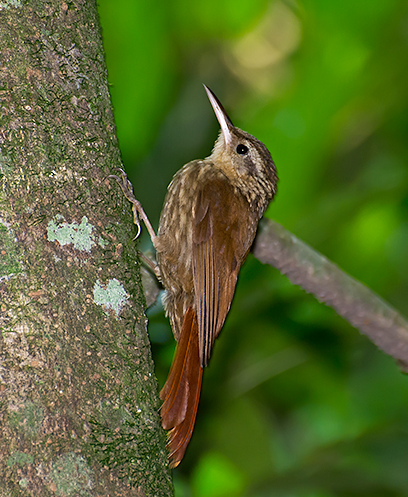
The Ocellated Woodcreeper is a slim, medium-sized woodcreeper with a long, nearly straight bill. It measures 20–24.5 cm in length and weighs 24–42 g.[1][2][3]
Adult nominate Ocellated Woodcreepers have a dark brown crown and nape with fine buff streaks on the crown. The nominate subspecies has a plain reddish-brown to olive-brown back, cinnamon-rufous rump and wings, and a darker cinnamon-rufous tail.[4][5]
The nominate subspecies has a deep buff throat with darker feather edges and olive-brown underparts that become more rufescent on the undertail coverts. Its upper breast has large buff teardrop markings, while its lower breast has weak buff streaks.[6][7][8]
The nominate subspecies has a dark brown iris, a blackish bill with a pale gray mandible, and gray legs and feet. Juveniles have heavier underpart markings than adults.[9][10]
The species lacks any truly distinctive visual features.[11]
Habitat
The Ocellated Woodcreeper primarily inhabits evergreen forest. It prefers mature forest interiors but also occurs along forest edges and in secondary forest.[12][13]
Most subspecies favor terra firme forest and also occur in seasonally flooded forests and wooded swamps. The three subspecies associated with Tschudi's Woodcreeper occur in terra firme forest but are more common in montane forest and cloudforest.[14][15]
The species generally occurs below 500 m elevation but reaches 1,800 m in the Andes.[16]
Diet
The Ocellated Woodcreeper's diet is believed to consist primarily of arthropods.[17]
Behaviour
The Ocellated Woodcreeper climbs tree trunks and branches, mainly between the forest understory and sub-canopy. It obtains most of its prey from bark by picking and probing and sometimes probes vegetation such as epiphytes while feeding.[18][19][20]
Individual birds and pairs frequently join mixed-species foraging flocks. The species occasionally follows army ant swarms while foraging.[21][22]
The Ocellated Woodcreeper is resident throughout its geographic range year-round. It sings mainly at dawn and dusk and usually produces only a few songs during those periods.[23][24]
The species' song varies geographically.[25]
Reproduction and life cycle
The breeding biology of the Ocellated Woodcreeper is essentially unknown.[26]
Conservation
The Ocellated Woodcreeper is assessed as Least Concern under the taxonomy followed by the IUCN. It is considered fairly common to common across most of its range.[27][28]
The population sizes of the assessed woodcreeper taxa are unknown and are believed to be decreasing. No immediate threats have been identified for the assessed woodcreeper taxa.[29][30]
The Ocellated Woodcreeper is believed to be highly sensitive to forest loss and fragmentation.[28]
Classification of the Ocellated Woodcreeper
| Kingdom | Animalia |
|---|---|
| Phylum | Chordata |
| Subphylum | Vertebrata |
| Infraphylum | Gnathostomata |
| Parvphylum | Osteichthyes |
| Megaclass | Tetrapoda |
| Class | Aves (Bird) |
| Order | Passeriformes (Passerine) |
| Family | Furnariidae (Ovenbird) |
| Genus | Xiphorhynchus (Woodcreepers) |
| Species | Xiphorhynchus ocellatus (Spix, 1824) |
Where the Ocellated Woodcreeper is found
Checklists and occurrence records place Xiphorhynchus ocellatus in 6 countries across South America. GBIF holds 5,558 georeferenced records of it.
Countries
Regions and cities with the most records
- Amazonas, Brazil 521
- Loreto, Peru 497
- San Martín Department, Peru 451
- Orellana Province, Ecuador 400
- La Paz Department, Bolivia 356
- Madre de Dios, Peru 351
- Putumayo Department, Colombia 336
- Santa Cruz Department, Bolivia 304
- Vaupés, Colombia 157
- Sucumbíos, Ecuador 154
- Moyobamba, Peru 140
- Napo, Ecuador 130
- Mitú, Colombia 127
- Zamora Chinchipe, Ecuador 127
- Cochabamba, Bolivia 124
- Cuzco Department, Peru 120
- Novo Airão, Brazil 118
- Amazonas Department, Colombia 112
- Guainía Department, Colombia 79
- La Banda, Peru 68
- Manacapuru, Brazil 61
- Pastaza Province, Ecuador 61
- Beni Department, Bolivia 54
- Pará, Brazil 52
- Caquetá, Colombia 50
- Pasco, Peru 48
- Cauca Department, Colombia 46
- Caranavi, Bolivia 45
- Ucayali, Peru 42
- Guaviare Department, Colombia 41
- Atalaia do Norte, Brazil 37
- Junin, Peru 32
- Puerto Maldonado, Peru 31
- Morona-Santiago Province, Ecuador 29
- San José del Guaviare, Colombia 29
- Huánuco Department, Peru 28
Range as the checklists state it
South America
A number beside a place is its count of GBIF occurrence records. A place without a number comes from a checklist alone. Records show where a species has been observed or collected, which can include escapes and vagrants.
Common names
English
- Ocellated Woodcreeper
Names in 24 other languages
- Catalan
- grimpatroncs ocel·lat
- Chinese
- 眼斑䴕雀, 眼斑爬木雀
- Croatian
- žućkastogrla puzavica
- Czech
- klouzálek plavoskvrnný
- Danish
- Forbjergstrækryber
- Dutch
- Amazonemuisspecht
- Esperanto
- ocela trunkogrimpulo
- Finnish
- viiruhuppukipuaja
- French
- Grimpar ocellé
- German
- Augenbaumsteiger, Augenflecken-Baumsteiger
- Italian
- Rampicatore ocellato
- Japanese
- ワモンオニキバシリ
- Lithuanian
- akiniuotasis kalavijasnapis kopikas
- Norwegian
- dråpetreløper
- Polish
- mieczonos skromny
- Portuguese
- arapaçu-ocelado, trepa-troncos-ocelado-amazónico
- Russian
- Глазчатый древолаз, Глазчатый мечеклювый древолаз
- Serbian
- Krupnopegava puzavica
- Slovak
- klzáčik krôpkavý
- Spanish
- Trepatroncos Ocelado, Trepatroncos ocelado meridional
- Swedish
- droppträdklättrare
- Turkish
- Benekli Tırmaşık
- Ukrainian
- кокоа колумбійський
- Welsh
- cropiwr llygedynnog
Synonyms
One other scientific name has been used for this species and is now treated as a synonym of Xiphorhynchus ocellatus.
- Dendrocolaptes ocellatus Spix, 1824
Subspecies and varieties
- Xiphorhynchus ocellatus beauperthuysii (Line-crowned Woodcreeper) subspecies
- Xiphorhynchus ocellatus brevirostris subspecies
- Xiphorhynchus ocellatus chunchotambo (Tschudi's Woodcreeper) subspecies
- Xiphorhynchus ocellatus lineatocapilla subspecies
- Xiphorhynchus ocellatus napensis subspecies
- Xiphorhynchus ocellatus ocellatus subspecies
- Xiphorhynchus ocellatus perplexus subspecies
Related species
-
 Ivory-billed WoodcreeperXiphorhynchus flavigaster
-
 Cocoa WoodcreeperXiphorhynchus susurrans
-
 Buff-throated WoodcreeperXiphorhynchus guttatus
-
 Spotted WoodcreeperXiphorhynchus erythropygius
-
 Black-striped WoodcreeperXiphorhynchus lachrymosus
-
 Lesser WoodcreeperXiphorhynchus fuscus
-
 Striped WoodcreeperXiphorhynchus obsoletus
-
 Elegant WoodcreeperXiphorhynchus elegans
Compare
Questions and answers
What is the scientific name of the Ocellated Woodcreeper?
The scientific name of the Ocellated Woodcreeper is Xiphorhynchus ocellatus. Written with its author, the full name is Xiphorhynchus ocellatus (Spix, 1824).
Which family does the Ocellated Woodcreeper belong to?
Xiphorhynchus ocellatus belongs to the family Furnariidae, in the order Passeriformes and the class Aves.
Where is the Ocellated Woodcreeper found?
Checklists and occurrence records place Xiphorhynchus ocellatus in 6 countries: Peru, Brazil, Ecuador, Bolivia, Colombia and Venezuela.
What is the conservation status of the Ocellated Woodcreeper?
The IUCN Red List category recorded for Xiphorhynchus ocellatus is Least Concern (LC).
Where does the Ocellated Woodcreeper occur?
It has been recorded in Bolivia, Brazil, Colombia, Ecuador, Peru, and Venezuela. It is primarily found in western Amazonia, south of the Amazon River.[31][32]
What are the geographic ranges of its subspecies?
The nominate subspecies occurs in Amazonian Brazil south of the Amazon between the Rio Purus and Rio Tapajós. The perplexus subspecies occurs in northeastern Peru, western Brazil, and extreme northeastern Bolivia. The beauperthuysii subspecies occurs in southern Colombia, southern Venezuela, northeastern Peru, and northwestern Brazil east to the Rio Negro. The lineatocapilla subspecies apparently occurs along the Rio Orinoco in southern Venezuela.[33][34][35][36]
Where do the other subspecies occur?
The napensis subspecies occurs from southern Colombia through Ecuador into northeastern Peru, reaching the Rio Marañón. The chunchotambo subspecies occurs on the lower Andean slopes of northeastern and eastern Peru south of the Marañón. The brevirostris subspecies occurs in southeastern Peru, northern and central Bolivia, and the Brazilian state of Acre.[37][38][39]
Is the taxonomy of the Ocellated Woodcreeper settled?
No. The taxonomy remains unsettled. The International Ornithological Committee lumped Tschudi's Woodcreeper into the Ocellated Woodcreeper in July 2023, while BirdLife International's Handbook of the Birds of the World recognizes only the perplexus and ocellatus subspecies as Ocellated Woodcreepers.[40][41][42]
Which taxa were previously lumped with the Ocellated Woodcreeper?
The BirdLife International factsheet identifies X. beauperthuysii and X. chunchotambo as taxa previously lumped with X. ocellatus.[43]
Sources
Passages the profile rests on
- The Ocellated Woodcreeper measures 20–24.5 cm in length. Source passage: “The ocellated woodcreeper is 20 to 24.5 cm (7.9 to 9.6 in) long” — English Wikipedia
- The Ocellated Woodcreeper weighs 24–42 g. Source passage: “weighs 24 to 42 g (0.85 to 1.5 oz).” — English Wikipedia
- The species is a slim, medium-sized woodcreeper with a long, nearly straight bill. Source passage: “It is a slim, medium-sized woodcreeper with a long and nearly straight bill.” — English Wikipedia
- Adult nominate Ocellated Woodcreepers have a dark brown crown and nape with fine buff streaks on the crown. Source passage: “Adults of the nominate subspecies X. o. ocellatus have a dark brown crown and nape with fine buff streaks on the crown.” — English Wikipedia
- The nominate subspecies has a plain reddish-brown to olive-brown back, cinnamon-rufous rump and wings, and a darker cinnamon-rufous tail. Source passage: “Their back is plain reddish brown to olive-brown, their rump and wings cinnamon-rufous, and their tail a darker cinnamon-rufous.” — English Wikipedia
- The nominate subspecies has a deep buff throat with darker feather edges. Source passage: “Their throat is deep buff with darker edges to the feathers.” — English Wikipedia
- The nominate subspecies has olive-brown underparts that become more rufescent on the undertail coverts. Source passage: “Their underparts are olive-brown that becomes more rufescent on the undertail coverts.” — English Wikipedia
- The nominate subspecies has large buff teardrop markings on its upper breast and weak buff streaks on its lower breast. Source passage: “Their upper breast has large buff "teardrops" with weak darker borders, their lower breast has weak buff streaks” — English Wikipedia
- The nominate subspecies has a dark brown iris, a blackish bill with a pale gray mandible, and gray legs and feet. Source passage: “Their iris is dark brown, their bill blackish with a pale gray mandible, and their legs and feet gray.” — English Wikipedia
- Juveniles have heavier underpart markings than adults. Source passage: “Juveniles are similar to adults but with heavier markings on their underparts.” — English Wikipedia
- The Ocellated Woodcreeper lacks any truly distinctive visual features. Source passage: “Lacks any truly distinctive visual features.” — ebird.org
- The Ocellated Woodcreeper primarily inhabits evergreen forest. Source passage: “The ocellated woodcreeper primarily inhabits evergreen forest.” — English Wikipedia
- The species prefers mature forest interiors but also occurs along forest edges and in secondary forest. Source passage: “All prefer the interior of mature forest but also occur at its edges and in secondary forest.” — English Wikipedia
- Most subspecies favor terra firme forest and also occur in seasonally flooded forests and wooded swamps. Source passage: “Most of the subspecies favor terra firme forest and are also found in várzea, other seasonally flooded forest types, and wooded swamps.” — English Wikipedia
- The three subspecies associated with Tschudi's Woodcreeper occur in terra firme forest but are more common in montane forest and cloudforest. Source passage: “The three "Tschudi's" subspecies are found in terra firme but are more common in montane forest and cloudforest.” — English Wikipedia
- The species generally occurs below 500 m elevation but reaches 1,800 m in the Andes. Source passage: “The species mostly occurs at elevations below 500 m (1,600 ft) but reaches 1,800 m (5,900 ft) in the Andes.” — English Wikipedia
- The Ocellated Woodcreeper's diet is believed to consist primarily of arthropods. Source passage: “but is believed to be primarily arthropods.” — English Wikipedia
- The Ocellated Woodcreeper climbs tree trunks and branches, mainly between the forest understory and sub-canopy. Source passage: “The species hitches up trunks and along branches, mostly from the forest's understory to its sub-canopy.” — English Wikipedia
- The species obtains most of its prey from bark by picking and probing. Source passage: “It takes most of its prey from bark, by picking and probing.” — English Wikipedia
- The species sometimes probes vegetation such as epiphytes while feeding. Source passage: “It also sometimes probes vegetation like epiphytes.” — English Wikipedia
- Individual birds and pairs frequently join mixed-species foraging flocks. Source passage: “Single birds and pairs frequently join mixed-species foraging flocks” — English Wikipedia
- The species occasionally follows army ant swarms while foraging. Source passage: “and occasionally follow army ant swarms.” — English Wikipedia
- The Ocellated Woodcreeper is resident throughout its geographic range year-round. Source passage: “The ocellated woodcreeper is a year-round resident throughout its range.” — English Wikipedia
- The species sings mainly at dawn and dusk and usually produces only a few songs during those periods. Source passage: “The ocellated woodcreeper sings mostly at dawn and dusk, and usually gives only a few songs then.” — English Wikipedia
- The species' song varies geographically. Source passage: “Its song varies geographically.” — English Wikipedia
- The breeding biology of the Ocellated Woodcreeper is essentially unknown. Source passage: “Essentially nothing is known about the ocellated woodcreeper's breeding biology.” — English Wikipedia
- The Ocellated Woodcreeper is assessed as Least Concern under the taxonomy followed by the IUCN. Source passage: “All three are assessed as being of Least Concern.” — English Wikipedia
- The species is considered fairly common to common across most of its range but is believed to be highly sensitive to forest loss and fragmentation. Source passage: “The species appears to be fairly common to common in most of its range but is "believed to be highly sensitive to loss and fragmentation of forest"” — English Wikipedia
- The population sizes of the assessed woodcreeper taxa are unknown and are believed to be decreasing. Source passage: “their population sizes are not known and all are believed to be decreasing.” — English Wikipedia
- No immediate threats have been identified for the assessed woodcreeper taxa. Source passage: “No immediate threats to any of them have been identified.” — English Wikipedia
- The species is primarily found in western Amazonia, south of the Amazon River. Source passage: “A medium-sized woodcreeper, found primarily in western Amazonia, south of the Amazon river.” — ebird.org
- The species has been recorded in Bolivia, Brazil, Colombia, Ecuador, Peru, and Venezuela. Source passage: “It is found in Bolivia, Brazil, Colombia, Ecuador, Peru, and Venezuela.” — English Wikipedia
- The nominate subspecies occurs in Amazonian Brazil south of the Amazon between the Rio Purus and Rio Tapajós. Source passage: “X. o. ocellatus, Amazonian Brazil south of the Amazon between the Rio Purus and Rio Tapajós” — English Wikipedia
- The perplexus subspecies occurs in northeastern Peru, western Brazil, and extreme northeastern Bolivia. Source passage: “X. o. perplexus, western Amazonia south of the Amazon in northeastern Peru, western Brazil, and extreme northeastern Bolivia” — English Wikipedia
- The beauperthuysii subspecies occurs in southern Colombia, southern Venezuela, northeastern Peru, and northwestern Brazil east to the Rio Negro. Source passage: “X. o. beauperthuysii, northwestern Amazonia north of the Amazon in southern Colombia, southern Venezuela, northeastern Peru, and northwestern Brazil east to the Rio Negro” — English Wikipedia
- The lineatocapilla subspecies apparently occurs along the Rio Orinoco in southern Venezuela. Source passage: “X. o. lineatocapilla, range not well defined but apparently along the Rio Orinoco in southern Venezuela” — English Wikipedia
- The napensis subspecies occurs from southern Colombia through Ecuador into northeastern Peru, reaching the Rio Marañón. Source passage: “X. o. napensis, lower slopes of the Andes and adjacent western Amazonia from southern Colombia through Ecuador into northeastern Peru to the Rio Marañón” — English Wikipedia
- The chunchotambo subspecies occurs on the lower Andean slopes of northeastern and eastern Peru south of the Marañón. Source passage: “X. o. chunchotambo, lower Andean slopes of northeastern and eastern Peru south of the Marañón” — English Wikipedia
- The brevirostris subspecies occurs in southeastern Peru, northern and central Bolivia, and the Brazilian state of Acre. Source passage: “X. o. brevirostris, foothills of the Andes and adjacent Amazonia of southeastern Peru, northern and central Bolivia, and Brazil's Acre state” — English Wikipedia
- The taxonomy of the Ocellated Woodcreeper remains unsettled. Source passage: “The ocellated woodcreeper's taxonomy is unsettled.” — English Wikipedia
- The International Ornithological Committee lumped Tschudi's Woodcreeper into the Ocellated Woodcreeper in July 2023. Source passage: “In July 2023 the IOC lumped Tschudi's into the ocellated woodcreeper” — English Wikipedia
- BirdLife International's Handbook of the Birds of the World recognizes only the perplexus and ocellatus subspecies as Ocellated Woodcreepers. Source passage: “considers only X. o. perplexus and X. o. ocellatus as the ocellated woodcreeper.” — English Wikipedia
- The BirdLife International factsheet identifies X. beauperthuysii and X. chunchotambo as taxa previously lumped with X. ocellatus. Source passage: “Xiphorhynchus ocellatus, X. beauperthuysii and X. chunchotambo (del Hoyo and Collar 2016) were previously lumped as X. ocellatus” — datazone.birdlife.org
Data
- Catalogue of Life, 2026-10-16 XR cc by
- Global Biodiversity Information Facility CC BY 4.0
- Wikidata CC0
- GeoNames CC BY 4.0
- Wikimedia Commons per image; credit shown with each image
- Within the Catalogue of Life, this name comes from The Integrated Taxonomic Information System cc0
References
- Gill, Frank, & and Minturn Wright. (2006). Birds of the World: Recommended English Names.
This species in other databases
Page built on 27 November 2026. See how the catalog is made and all sources and licences.
Cite this page
ScientificNames.org. (2026). Xiphorhynchus ocellatus (Ocellated Woodcreeper). Retrieved November 27, 2026, from https://scientificnames.org/species/xiphorhynchus-ocellatus
“Xiphorhynchus ocellatus (Ocellated Woodcreeper).” ScientificNames.org, 2026, scientificnames.org/species/xiphorhynchus-ocellatus. Accessed 27 Nov. 2026.
ScientificNames.org. “Xiphorhynchus ocellatus (Ocellated Woodcreeper).” Accessed November 27, 2026. https://scientificnames.org/species/xiphorhynchus-ocellatus.
@misc{scientificnames_xiphorhynchus_ocellatus_ocellated_woodcreeper,
  author = {{ScientificNames.org}},
  title = {Xiphorhynchus ocellatus (Ocellated Woodcreeper)},
  year = {2026},
  url = {https://scientificnames.org/species/xiphorhynchus-ocellatus},
  note = {Accessed 2026-11-27}
}