Species · Birds
Chestnut-rumped Woodcreeper Xiphorhynchus pardalotus
The scientific name of the Chestnut-rumped Woodcreeper is Xiphorhynchus pardalotus. It is a species of bird in the family Furnariidae (ovenbird), order Passeriformes. The name dates from 1818.
- Scientific name
- Xiphorhynchus pardalotus (Vieillot, 1818)
- Common name
- Chestnut-rumped Woodcreeper
- Genus
- Xiphorhynchus
- Family
- Furnariidae (Ovenbird)
- Order
- Passeriformes
- Class
- Aves
- Red List category
- LC Least Concern
- Recorded in
- 5 countries
- Name status
- accepted in the Catalogue of Life

Overview
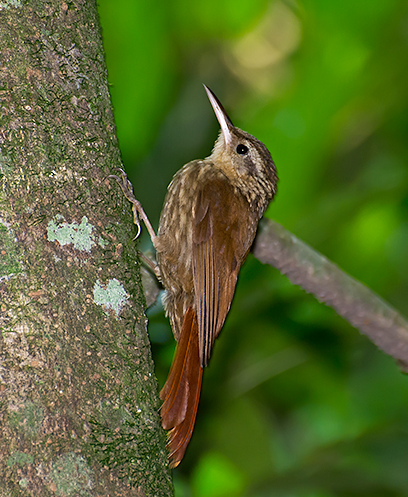
Xiphorhynchus pardalotus occurs in Brazil, French Guiana, Guyana, Suriname, and Venezuela, primarily inhabiting lowland evergreen forests. It has a long, slender, slightly downcurved bill and rufous-chestnut wings, rump, and tail.
Written 27 November 2026 from the sources listed below. Each statement was checked against the passage it cites; statements that could not be supported were removed.
Appearance
Its wings, rump, and tail are rufous-chestnut, with darker tips on the primary feathers. The sexes have identical plumage.[1][2]
Juveniles have shorter bills and less pronounced dark streak borders than adults. The subspecies X. p. caurensis has more reddish upperparts and weaker streaking than the nominate subspecies.[3][4]
The species is described as a medium-sized rufous-brown bird associated with lowland forests. It measures between 20 and 23.5 cm in length.[5][6]
Males weigh between 32 and 49 g, while females weigh between 27 and 46 g.[7][8]
Habitat
The species primarily inhabits lowland evergreen forests and favors the interior of mature terra firme forests. It also regularly occurs at forest edges and in mature secondary forests.[9][10][11]
It also occurs in lower-elevation montane forests in the tepui region. It occurs less frequently in floodplain forests and wooded savannas.[12][13]
Its usual elevational range extends up to approximately 500 m, although it reaches 1,800 m on the tepuis.[14]
Diet
The species feeds primarily on arthropods.[15]
Behaviour
Individuals or pairs frequently participate as core species in mixed-species foraging flocks. The species favors flocks led by Thamnomanes antshrikes.[16][17]
While foraging, it moves from the understory to the canopy by hitching along trunks and branches. It captures prey by gleaning and probing bark crevices, dead-leaf clusters, epiphytes, and dead wood.[18][19]
The species sometimes follows army ant swarms to capture prey disturbed by the ants. When following army ants, it generally remains within approximately 5 m of the ground.[20][21]
The species remains in its geographic range throughout the year. It sings mainly at dawn and dusk.[22][23]
Reproduction and life cycle
The species breeds mainly during the dry season from September through January. It nests in natural cavities in trees or stumps and adds bark chips to the nesting site.[24][25]
All documented clutches contain a single egg. Both parents feed the nestlings.[26][27]
Conservation
The species was assessed as Least Concern by the IUCN, most recently in 2018. Its population is believed to be stable, although its population size is unknown.[28][29][30]
No immediate threats to the species have been identified. It is considered fairly common to common in lowland habitats but highly sensitive to forest loss and fragmentation.[31][32][33]
Classification of the Chestnut-rumped Woodcreeper
| Kingdom | Animalia |
|---|---|
| Phylum | Chordata |
| Subphylum | Vertebrata |
| Infraphylum | Gnathostomata |
| Parvphylum | Osteichthyes |
| Megaclass | Tetrapoda |
| Class | Aves (Bird) |
| Order | Passeriformes (Passerine) |
| Family | Furnariidae (Ovenbird) |
| Genus | Xiphorhynchus (Woodcreepers) |
| Species | Xiphorhynchus pardalotus (Vieillot, 1818) |
Where the Chestnut-rumped Woodcreeper is found
Checklists and occurrence records place Xiphorhynchus pardalotus in 5 countries across South America. GBIF holds 6,154 georeferenced records of it.
Countries
Regions and cities with the most records
- Amazonas, Brazil 2,319
- Manaus, Brazil 509
- Bolívar, Venezuela 382
- Potaro-Siparuni, Guyana 375
- Presidente Figueiredo, Brazil 370
- Sipaliwini District, Suriname 363
- Brokopondo District, Suriname 305
- Upper Takutu-Upper Essequibo, Guyana 163
- Amapá, Brazil 161
- Roraima, Brazil 122
- Kourou, French Guiana 115
- Pará, Brazil 90
- Cuyuni-Mazaruni, Guyana 89
- Pedra Branca do Amapari, Brazil 54
- Oiapoque, Brazil 42
- Saint-Laurent-du-Maroni, French Guiana 37
- Matoury, French Guiana 35
- Upper Demerara-Berbice, Guyana 34
- Para District, Suriname 28
- Amazonas, Venezuela 25
- Porto Grande, Brazil 25
- Barima-Waini, Guyana 20
- Essequibo Islands-West Demerara, Guyana 17
- Pacaraima, Brazil 15
- Santa Elena de Uairén, Venezuela 15
- Cayenne, French Guiana 14
- Rémire-Montjoly, French Guiana 13
- Caracaraí, Brazil 11
- Careiro da Várzea, Brazil 11
- Laranjal do Jari, Brazil 11
- Commewijne District, Suriname 7
- Paramaribo, Suriname 7
- Lelydorp, Suriname 6
- Novo Airão, Brazil 6
- Santana, Brazil 5
- Itacoatiara, Brazil 4
Range as the checklists state it
South America
A number beside a place is its count of GBIF occurrence records. A place without a number comes from a checklist alone. Records show where a species has been observed or collected, which can include escapes and vagrants.
Common names
English
- Chestnut-rumped Woodcreeper
Names in 24 other languages
- Catalan
- grimpatroncs xiulador
- Chinese
- 栗腰䴕雀, 栗腰爬木雀
- Croatian
- cimetastogrla puzavica
- Czech
- klouzálek guyanský
- Danish
- Rødgumpet Trækryber
- Dutch
- Roodkeelmuisspecht
- Esperanto
- kaŝtanpuga trunkogrimpulo
- Finnish
- kastanjaperäkipuaja
- French
- Grimpar flambé
- German
- Beigekehl-Baumsteiger, Beigekehlbaumsteiger, Kastanienbürzel-Baumsteiger, Rostbürzel-Baumsteiger, Rostkehlbaumsteiger
- Italian
- Rampicatore groppacastana
- Japanese
- キボシオニキバシリ
- Lithuanian
- Kaštoninis kalavijasparnis kopikas, kaštoninis kalavijasnapis kopikas
- Norwegian
- guyanatreløper
- Polish
- mieczonos lamparci
- Portuguese
- arapaçu-assobiador, trepa-troncos-assobiador
- Russian
- Рыжегорлый древолаз, Рыжегорлый мечеклювый древолаз
- Serbian
- Puzavica kestenjastog nadrepka
- Slovak
- klzáčik fakliar
- Spanish
- Trepatroncos silbador
- Swedish
- guyanaträdklättrare
- Turkish
- Kestane Sokumlu Tırmaşık
- Ukrainian
- кокоа леопардовий
- Welsh
- cropiwr tinwinau
Synonyms
One other scientific name has been used for this species and is now treated as a synonym of Xiphorhynchus pardalotus.
- Dendrocopus pardalotus Vieillot, 1818
Subspecies and varieties
- Xiphorhynchus pardalotus caurensis subspecies
- Xiphorhynchus pardalotus pardalotus subspecies
Related species
-
 Ivory-billed WoodcreeperXiphorhynchus flavigaster
-
 Cocoa WoodcreeperXiphorhynchus susurrans
-
 Buff-throated WoodcreeperXiphorhynchus guttatus
-
 Spotted WoodcreeperXiphorhynchus erythropygius
-
 Black-striped WoodcreeperXiphorhynchus lachrymosus
-
 Lesser WoodcreeperXiphorhynchus fuscus
-
 Striped WoodcreeperXiphorhynchus obsoletus
-
 Elegant WoodcreeperXiphorhynchus elegans
Compare
Questions and answers
What is the scientific name of the Chestnut-rumped Woodcreeper?
The scientific name of the Chestnut-rumped Woodcreeper is Xiphorhynchus pardalotus. Written with its author, the full name is Xiphorhynchus pardalotus (Vieillot, 1818).
Which family does the Chestnut-rumped Woodcreeper belong to?
Xiphorhynchus pardalotus belongs to the family Furnariidae, in the order Passeriformes and the class Aves.
Where is the Chestnut-rumped Woodcreeper found?
Checklists and occurrence records place Xiphorhynchus pardalotus in 5 countries: Brazil, French Guiana, Guyana, Suriname and Venezuela.
What is the conservation status of the Chestnut-rumped Woodcreeper?
The IUCN Red List category recorded for Xiphorhynchus pardalotus is Least Concern (LC).
Where does the Chestnut-rumped Woodcreeper occur?
It occurs in Brazil, French Guiana, Guyana, Suriname, and Venezuela. The nominate subspecies occurs in the Guianas and northern Brazil north of the Amazon River, between the Rio Negro and the Atlantic Ocean in Amapá state. X. p. caurensis occurs in the tepui region where Venezuela, Guyana, and Brazil meet.[34][35][36]
How many subspecies are recognized?
Two subspecies are recognized: X. p. pardalotus and X. p. caurensis.[37]
What does the Chestnut-rumped Woodcreeper eat?
It feeds primarily on arthropods, which it captures by gleaning and probing bark crevices, dead-leaf clusters, epiphytes, and dead wood.[15][19]
When does the Chestnut-rumped Woodcreeper breed?
It breeds mainly during the dry season from September through January.[24]
Sources
Passages the profile rests on
- Its wings, rump, and tail are rufous-chestnut, with darker tips on the primary feathers. Source passage: “Their wings, rump, and tail are rufous-chestnut with darker tips on the primaries.” — English Wikipedia
- The sexes have identical plumage. Source passage: “The sexes have the same plumage.” — English Wikipedia
- Juveniles have shorter bills and less pronounced dark streak borders than adults. Source passage: “Juveniles have a shorter bill than adults and the dark borders of their streaking are weaker.” — English Wikipedia
- The subspecies X. p. caurensis has more reddish upperparts and weaker streaking than the nominate subspecies. Source passage: “Subspecies X. p. caurensis has more rufescent upperparts than the nominate, with weaker streaking throughout.” — English Wikipedia
- The species is described as a medium-sized rufous-brown bird associated with lowland forests. Source passage: “Medium-sized rufous-brown bird of lowland forests.” — ebird.org
- The species measures between 20 and 23.5 cm in length. Source passage: “The species is 20 to 23.5 cm (7.9 to 9.3 in) long;” — English Wikipedia
- Males weigh between 32 and 49 g. Source passage: “males weigh 32 to 49 g (1.1 to 1.7 oz)” — English Wikipedia
- Females weigh between 27 and 46 g. Source passage: “females 27 to 46 g (0.95 to 1.6 oz).” — English Wikipedia
- The species primarily inhabits lowland evergreen forests. Source passage: “The chestnut-rumped woodcreeper primarily inhabits lowland evergreen forest” — English Wikipedia
- The species favors the interior of mature terra firme forests. Source passage: “It favors the interior of mature terra firme forest” — English Wikipedia
- It regularly inhabits forest edges and mature secondary forests. Source passage: “and also regularly occurs at its edges and in mature secondary forest.” — English Wikipedia
- It also occurs in lower-elevation montane forests in the tepui region. Source passage: “and also occurs in lower elevations of montane forest in the tepui region.” — English Wikipedia
- The species occurs less frequently in floodplain forests and wooded savannas. Source passage: “It less often occurs in floodplain forest and wooded savanna.” — English Wikipedia
- Its usual elevational range extends up to approximately 500 m, although it reaches 1,800 m on the tepuis. Source passage: “In elevation it mostly ranges up to 500 m (1,600 ft) but reaches 1,800 m (5,900 ft) on the tepuis.” — English Wikipedia
- The species feeds primarily on arthropods. Source passage: “The chestnut-rumped woodcreeper feeds mostly on arthropods.” — English Wikipedia
- Individuals or pairs frequently participate as core species in mixed-species foraging flocks. Source passage: “Single birds or pairs are often a core species in mixed-species foraging flocks;” — English Wikipedia
- The species favors mixed-species flocks led by Thamnomanes antshrikes. Source passage: “it favors those led by Thamnomanes antshrikes.” — English Wikipedia
- While foraging, it moves from the understory to the canopy by hitching along trunks and branches. Source passage: “In a flock or by itself it feeds from the understory to the canopy, hitching up and along trunks and branches.” — English Wikipedia
- It captures prey by gleaning and probing bark crevices, dead-leaf clusters, epiphytes, and dead wood. Source passage: “It captures prey by gleaning and by probing bark crevices, clusters of dead leaves, epiphytes, and dead wood.” — English Wikipedia
- The species sometimes follows army ant swarms to capture prey disturbed by the ants. Source passage: “It sometimes follows army ant swarms, capturing prey disturbed by them” — English Wikipedia
- When following army ants, it generally remains within approximately 5 m of the ground. Source passage: “it tends to remain within about 5 m (16 ft) of the ground when following ants.” — English Wikipedia
- The species remains in its geographic range throughout the year. Source passage: “The chestnut-rumped woodcreeper is a year-round resident throughout its range.” — English Wikipedia
- The species sings mainly at dawn and dusk. Source passage: “The chestnut-rumped woodcreeper sings mostly at dawn and dusk.” — English Wikipedia
- The species breeds mainly during the dry season from September through January. Source passage: “The chesnut-rumped woodcreeper breeds mostly in the dry season of September to January.” — English Wikipedia
- It nests in natural cavities in trees or stumps and adds bark chips to the nesting site. Source passage: “It nests in a natural cavity in a tree or stump that it adds bark chips to.” — English Wikipedia
- All documented clutches contain a single egg. Source passage: “All known clutches were of one egg.” — English Wikipedia
- Both parents feed the nestlings. Source passage: “Both parents provision nestlings.” — English Wikipedia
- The species was assessed as Least Concern by the IUCN. Source passage: “The IUCN has assessed the chestnut-rumped woodcreeper as being of Least Concern.” — English Wikipedia
- Its population is believed to be stable despite its population size being unknown. Source passage: “though its population size is not known it is believed to be stable.” — English Wikipedia
- The species was most recently assessed for the IUCN Red List in 2018. Source passage: “has most recently been assessed for The IUCN Red List of Threatened Species in 2018.” — iucnredlist.org
- No immediate threats to the species have been identified. Source passage: “No immediate threats have been identified.” — English Wikipedia
- The species is considered fairly common to common in lowland habitats. Source passage: “It is considered fairly common to common in the lowlands.” — English Wikipedia
- The species is considered highly sensitive to forest loss and fragmentation. Source passage: “generally considered highly sensitive to loss and fragmentation of forest.” — English Wikipedia
- The species occurs in Brazil, French Guiana, Guyana, Suriname, and Venezuela. Source passage: “It is found in Brazil, French Guiana, Guyana, Suriname, and Venezuela.” — English Wikipedia
- The nominate subspecies occurs in the Guianas and northern Brazil north of the Amazon River, between the Rio Negro and the Atlantic Ocean in Amapá state. Source passage: “The nominate subspecies of the chestnut-rumped woodcreeper is found in the Guianas and northern Brazil north of the Amazon River between the Rio Negro and the Atlantic Ocean in Amapá state.” — English Wikipedia
- The subspecies X. p. caurensis occurs in the tepui region where Venezuela, Guyana, and Brazil meet. Source passage: “Subspecies X. p. caurensis is found further west, in the tepui region where Venezuela, Guyana, and Brazil meet.” — English Wikipedia
- The species has two recognized subspecies, X. p. pardalotus and X. p. caurensis. Source passage: “The chestnut-rumped woodcreeper has two subspecies, the nominate X. p. pardalotus (Vieillot, 1818) and X. p. caurensis (Todd, 1948).” — English Wikipedia
Data
- Catalogue of Life, 2026-10-16 XR cc by
- Global Biodiversity Information Facility CC BY 4.0
- Wikidata CC0
- GeoNames CC BY 4.0
- Wikimedia Commons per image; credit shown with each image
- Within the Catalogue of Life, this name comes from The Integrated Taxonomic Information System cc0
References
- Gill, Frank, & and Minturn Wright. (2006). Birds of the World: Recommended English Names.
This species in other databases
Page built on 27 November 2026. See how the catalog is made and all sources and licences.
Cite this page
ScientificNames.org. (2026). Xiphorhynchus pardalotus (Chestnut-rumped Woodcreeper). Retrieved November 27, 2026, from https://scientificnames.org/species/xiphorhynchus-pardalotus
“Xiphorhynchus pardalotus (Chestnut-rumped Woodcreeper).” ScientificNames.org, 2026, scientificnames.org/species/xiphorhynchus-pardalotus. Accessed 27 Nov. 2026.
ScientificNames.org. “Xiphorhynchus pardalotus (Chestnut-rumped Woodcreeper).” Accessed November 27, 2026. https://scientificnames.org/species/xiphorhynchus-pardalotus.
@misc{scientificnames_xiphorhynchus_pardalotus_chestnut_rumped_woodcreeper,
  author = {{ScientificNames.org}},
  title = {Xiphorhynchus pardalotus (Chestnut-rumped Woodcreeper)},
  year = {2026},
  url = {https://scientificnames.org/species/xiphorhynchus-pardalotus},
  note = {Accessed 2026-11-27}
}