Species · Birds
Spix's Woodcreeper Xiphorhynchus spixii
The scientific name of the Spix's Woodcreeper is Xiphorhynchus spixii. It is a species of bird in the family Furnariidae (ovenbird), order Passeriformes. The name dates from 1830.
- Scientific name
- Xiphorhynchus spixii (R. P. Lesson, 1830)
- Common name
- Spix's Woodcreeper
- Genus
- Xiphorhynchus
- Family
- Furnariidae (Ovenbird)
- Order
- Passeriformes
- Class
- Aves
- Red List category
- LC Least Concern
- Recorded in
- 5 countries
- Name status
- accepted in the Catalogue of Life

Overview
Xiphorhynchus spixii is endemic to Brazil and occurs in the lower Amazon Basin of northeastern Brazil. It is a medium-sized woodcreeper with a relatively long, slender, slightly curved bill.
Written 27 November 2026 from the sources listed below. Each statement was checked against the passage it cites; statements that could not be supported were removed.
Appearance
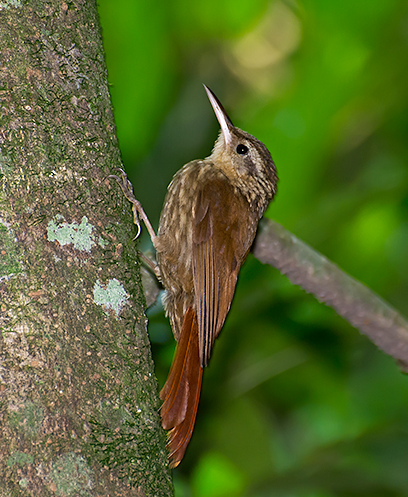
Spix's Woodcreeper measures 18.5–21 cm in length and weighs 27–36 g. Males and females have the same plumage.[1][2][3]
Adults have dusky brown faces with narrow buff streaks, pale supercilia, and a pale eyering. The crown and nape are blackish brown with small buff teardrop-shaped spots.[4][5]
The back and wing coverts are olive-brown, with buff teardrop spots edged in blackish on the back. The flight feathers, rump, and tail range from dark cinnamon to rufous-chestnut.[6][7]
The throat is pale buff with a dusky lower edge. The breast, sides, and belly are dull olive-brown with elongated buff streaks edged in dusky coloration.[8][9]
The iris is dark brown, and the bill is dark brown with a paler tip. The legs and feet are bluish to gray.[10][11]
Juveniles resemble adults but have less clearly defined streaks on their underparts.[12]
Habitat
Spix's Woodcreeper occurs in the lower Amazon Basin of northeastern Brazil. Its range extends south of the Amazon from the Rio Tapajós east to the northern Rio Maranhão and western Rio Tocantins.[13][14]
It primarily inhabits humid evergreen terra firme forest and also occurs in várzea forest. It favors the interior of primary forest.[15][16]
It sometimes occurs in secondary forest and less frequently along forest edges. Its recorded elevational range extends from sea level to 500 m.[17][18]
Diet
The diet of Spix's Woodcreeper consists mostly of arthropods.[19]
Behaviour
Spix's Woodcreeper is considered a year-round resident throughout its geographic range. Individual birds and occasionally pairs regularly join mixed-species foraging flocks.[20][21]
It less frequently forages alone or follows army ant swarms. It climbs along trunks and branches while searching for prey.[22][23]
It captures prey mainly by pecking into bark crevices, dead-leaf clusters, epiphytes, and dead wood. When following army ants, it sometimes captures prey by making sallies from a perch.[24][25]
The song is a very high, rapid trill that descends at the beginning and remains level at the end, with a higher final note. It has also been transcribed as a rapid sequence ending in a higher-pitched whine.[26][27]
The calls include sharp chip notes followed by a whine. The song is also described as a fast trill ending with a whine.[28][29]
Reproduction and life cycle
The breeding season appears to extend from at least November through March. Known nests have been found in tree cavities and are lined with wood chips.[30][31][32]
The clutch size is two eggs.[33]
Similar species
Spix's Woodcreeper and the elegant woodcreeper have sometimes been classified as the same species. Two subspecies currently associated with the elegant woodcreeper were formerly classified by some authors as subspecies of Spix's Woodcreeper.[34][35]
Spix's Woodcreeper is monotypic.[36]
Conservation
Spix's Woodcreeper was assessed as Least Concern by the IUCN, with the most recent assessment conducted in 2018.[37][38]
Its population size is unknown and is believed to be decreasing. No immediate threats have been identified.[39][40]
Spix's Woodcreeper is considered uncommon to fairly common.[41]
Classification of the Spix's Woodcreeper
| Kingdom | Animalia |
|---|---|
| Phylum | Chordata |
| Subphylum | Vertebrata |
| Infraphylum | Gnathostomata |
| Parvphylum | Osteichthyes |
| Megaclass | Tetrapoda |
| Class | Aves (Bird) |
| Order | Passeriformes (Passerine) |
| Family | Furnariidae (Ovenbird) |
| Genus | Xiphorhynchus (Woodcreepers) |
| Species | Xiphorhynchus spixii (R. P. Lesson, 1830) |
Where the Spix's Woodcreeper is found
Checklists and occurrence records place Xiphorhynchus spixii in 5 countries across South America. GBIF holds 2,553 georeferenced records of it.
Countries
Regions and cities with the most records
- Pará, Brazil 1,031
- Mato Grosso, Brazil 569
- Marituba, Brazil 148
- Benevides, Brazil 136
- Santa Bárbara do Pará, Brazil 120
- Parauapebas, Brazil 117
- Santa Isabel do Pará, Brazil 117
- Santo Antônio do Tauá, Brazil 106
- Ananindeua, Brazil 97
- Tocantins, Brazil 42
- Maranhão, Brazil 39
- Pando, Bolivia 18
- Araguaína, Brazil 15
- Cobija, Bolivia 15
- Loreto, Peru 15
- Meta Department, Colombia 15
- Belém, Brazil 13
- Guaviare Department, Colombia 13
- San José del Guaviare, Colombia 13
- São Félix do Xingu, Brazil 13
- Pacajá, Brazil 9
- Amazonas, Brazil 8
- Pasco, Peru 8
- Madre de Dios, Peru 7
- Nueva Loja, Ecuador 7
- Sucumbíos, Ecuador 7
- Bujaru, Brazil 6
- Castanhal, Brazil 6
- Aurora do Pará, Brazil 5
- Barcarena, Brazil 5
- La Paz Department, Bolivia 5
- Melgaço, Brazil 5
- Mãe do Rio, Brazil 5
- Portel, Brazil 5
- San Martín Department, Peru 5
- Altamira, Brazil 4
Range as the checklists state it
South America
A number beside a place is its count of GBIF occurrence records. A place without a number comes from a checklist alone. Records show where a species has been observed or collected, which can include escapes and vagrants.
Common names
English
- Spix's Woodcreeper
Names in 24 other languages
- Catalan
- grimpatroncs de Spix
- Chinese
- 斯彼氏爬木雀, 斯氏䴕雀
- Croatian
- paraska puzavica
- Czech
- klouzálek Spixův
- Danish
- Marajótrækryber
- Dutch
- Spix' Muisspecht
- Esperanto
- spiksa trunkogrimpulo
- Finnish
- helmirintakipuaja
- French
- Grimpar de Spix
- German
- Spix-Baumsteiger, Spixbaumsteiger
- Italian
- Rampicatore di Spix
- Japanese
- チャイロオニキバシリ
- Lithuanian
- Spikso kalavijasnapis kopikas
- Norwegian
- plettreløper
- Polish
- mieczonos smugowany
- Portuguese
- Arapaçu-de-Spix, Arapaçu-de-Spixi, arapaçu-do-pará, trepa-troncos-de-spix
- Russian
- Амазонский мечеклювый древолаз, Спиксов древолаз
- Serbian
- Spiksova puzavica
- Slovak
- klzáčik perlavochrbtý
- Spanish
- Trepatroncos de Spix
- Swedish
- marajóträdklättrare
- Turkish
- Spix Tırmaşığı
- Ukrainian
- кокоа амазонійський
- Welsh
- cropiwr Spix
Synonyms
2 other scientific names have been used for this species and are now treated as synonyms of Xiphorhynchus spixii.
- Picolaptes spixii R. P. Lesson, 1830
- Xiphorhynchus spixii spixii Lesson, RP, 1830
Related species
-
 Ivory-billed WoodcreeperXiphorhynchus flavigaster
-
 Cocoa WoodcreeperXiphorhynchus susurrans
-
 Buff-throated WoodcreeperXiphorhynchus guttatus
-
 Spotted WoodcreeperXiphorhynchus erythropygius
-
 Black-striped WoodcreeperXiphorhynchus lachrymosus
-
 Lesser WoodcreeperXiphorhynchus fuscus
-
 Striped WoodcreeperXiphorhynchus obsoletus
-
 Elegant WoodcreeperXiphorhynchus elegans
Compare
Questions and answers
What is the scientific name of the Spix's Woodcreeper?
The scientific name of the Spix's Woodcreeper is Xiphorhynchus spixii. Written with its author, the full name is Xiphorhynchus spixii (R. P. Lesson, 1830).
Which family does the Spix's Woodcreeper belong to?
Xiphorhynchus spixii belongs to the family Furnariidae, in the order Passeriformes and the class Aves.
Where is the Spix's Woodcreeper found?
Checklists and occurrence records place Xiphorhynchus spixii in 5 countries: Brazil, Peru, Colombia, Bolivia and Ecuador.
What is the conservation status of the Spix's Woodcreeper?
The IUCN Red List category recorded for Xiphorhynchus spixii is Least Concern (LC).
Sources
Passages the profile rests on
- Spix's Woodcreeper measures 18.5–21 cm in length. Source passage: “The species is 18.5 to 21 cm (7.3 to 8.3 in) long” — English Wikipedia
- Spix's Woodcreeper weighs 27–36 g. Source passage: “weighs 27 to 36 g (0.95 to 1.27 oz).” — English Wikipedia
- Male and female Spix's Woodcreepers have the same plumage. Source passage: “The sexes have the same plumage.” — English Wikipedia
- Adult Spix's Woodcreepers have dusky brown faces marked with narrow buff streaks and pale supercilia and eyering. Source passage: “Adults have a dusky brown face with narrow buff streaks and a pale supercilium and eyering.” — English Wikipedia
- The crown and nape of adult Spix's Woodcreepers are blackish brown with small buff teardrop-shaped spots. Source passage: “Their crown and nape are blackish brown with small buff teardrop spots” — English Wikipedia
- The back and wing coverts of Spix's Woodcreepers are olive-brown, with buff teardrop spots edged in blackish on the back. Source passage: “Their back and wing coverts are olive-brown, with buff teardrop spots with blackish edges on the back.” — English Wikipedia
- The flight feathers, rump, and tail range from dark cinnamon to rufous-chestnut. Source passage: “Their flight feathers, rump, and tail are dark cinnamon to rufous-chestnut” — English Wikipedia
- The throat of Spix's Woodcreeper is pale buff with a dusky lower edge. Source passage: “Their throat is pale buff with a dusky lower edge.” — English Wikipedia
- The breast, sides, and belly are dull olive-brown with elongated buff streaks edged in dusky coloration. Source passage: “Their breast, sides, and belly are dull olive-brown, with longish dusky-edged buff streaks.” — English Wikipedia
- The iris of Spix's Woodcreeper is dark brown, and its bill is dark brown with a paler tip. Source passage: “Their iris is dark brown, their bill dark brown with a paler tip” — English Wikipedia
- Spix's Woodcreeper has bluish to gray legs and feet. Source passage: “their legs and feet bluish to gray.” — English Wikipedia
- Juvenile Spix's Woodcreepers resemble adults but have less clearly defined streaks on their underparts. Source passage: “Juveniles are similar to adults but their underparts' streaks are not well defined.” — English Wikipedia
- Spix's Woodcreeper occurs in the lower Amazon Basin of northeastern Brazil. Source passage: “Spix's woodcreeper is found in the lower Amazon Basin of northeastern Brazil.” — English Wikipedia
- Its range extends south of the Amazon from the Rio Tapajós east to the northern Rio Maranhão and western Rio Tocantins. Source passage: “It occurs south of the Amazon from the Rio Tapajós east to the northern Rio Maranhão and western Rio Tocantins.” — English Wikipedia
- Spix's Woodcreeper primarily inhabits humid evergreen terra firme forest but also occurs in várzea forest. Source passage: “It mostly inhabits humid evergreen forest, primarily terra firme but also várzea.” — English Wikipedia
- Spix's Woodcreeper favors the interior of primary forest. Source passage: “It favors the interior of primary forest” — English Wikipedia
- Spix's Woodcreeper sometimes occurs in secondary forest and less frequently along forest edges. Source passage: “but sometimes occurs in secondary forest and even less frequently at forest edges.” — English Wikipedia
- Spix's Woodcreeper occurs from sea level to elevations of 500 m. Source passage: “In elevation it ranges from sea level to 500 m (1,600 ft).” — English Wikipedia
- The diet of Spix's Woodcreeper consists mostly of arthropods. Source passage: “The diet of Spix's woodcreeper's is mostly arthropods.” — English Wikipedia
- Spix's Woodcreeper is considered a year-round resident throughout its geographic range. Source passage: “Spix's woodcreeper is assumed to be a year-round resident throughout its range.” — English Wikipedia
- Individual Spix's Woodcreepers and occasionally pairs regularly join mixed-species foraging flocks. Source passage: “Single birds and sometimes pairs regularly join mixed-species foraging flocks” — English Wikipedia
- Spix's Woodcreeper less frequently forages alone or follows army ant swarms. Source passage: “they less often forage alone or by following army ant swarms.” — English Wikipedia
- Spix's Woodcreeper climbs along trunks and branches while searching for prey. Source passage: “It hitches up and along trunks and branches” — English Wikipedia
- Spix's Woodcreeper captures prey mainly by pecking into bark crevices, dead-leaf clusters, epiphytes, and dead wood. Source passage: “captures prey mostly by pecking into bark crevices, clusters of dead leaves, epiphytes, and dead wood.” — English Wikipedia
- When following army ants, Spix's Woodcreeper sometimes captures prey by making sallies from a perch. Source passage: “When following ants it sometimes catches prey by sallies from a perch.” — English Wikipedia
- The song of Spix's Woodcreeper is a very high, rapid trill that descends at the beginning and remains level at the end, with a higher final note. Source passage: “very high, very fast trill, descending at beginning, level at end, last note higher” — English Wikipedia
- The song of Spix's Woodcreeper has been transcribed as a rapid sequence ending in a higher-pitched whine. Source passage: “twe-tee-ti-ti-ti-…-ti-ti-it, wheu” — English Wikipedia
- The calls of Spix's Woodcreeper include sharp chip notes followed by a whine. Source passage: “sharp 'chip' notes followed by a whine” — English Wikipedia
- The song of Spix's Woodcreeper is described as a fast trill ending with a whine. Source passage: “The song is a fast trill that ends with a whine “-wheu.”” — ebird.org
- The breeding season of Spix's Woodcreeper appears to extend from at least November through March. Source passage: “Its breeding season appears to include at least November to March.” — English Wikipedia
- Known nests of Spix's Woodcreeper have been found in tree cavities. Source passage: “The few known nests were in tree cavities” — English Wikipedia
- The nests of Spix's Woodcreeper are lined with wood chips. Source passage: “and were lined with wood chips.” — English Wikipedia
- The clutch size of Spix's Woodcreeper is two eggs. Source passage: “The clutches were of two eggs.” — English Wikipedia
- Spix's Woodcreeper and the elegant woodcreeper have sometimes been classified as the same species. Source passage: “Spix's woodcreeper and the elegant woodcreeper (X. elegans) have been treated as conspecific by some authors.” — English Wikipedia
- Two subspecies currently associated with the elegant woodcreeper were formerly classified by some authors as subspecies of Spix's Woodcreeper. Source passage: “some authors treated what are now two subspecies of the elegant woodcreeper, X. e. insignis and X. e. juruanus, as subspecies of Spix's.” — English Wikipedia
- Spix's Woodcreeper is monotypic. Source passage: “Spix's woodcreeper is monotypic.” — English Wikipedia
- Spix's Woodcreeper was assessed as Least Concern by the IUCN. Source passage: “The IUCN has assessed Spix's woodcreeper as being of Least Concern.” — English Wikipedia
- The IUCN assessment of Spix's Woodcreeper was most recently conducted in 2018. Source passage: “Spix's Woodcreeper Xiphorhynchus spixii has most recently been assessed for The IUCN Red List of Threatened Species in 2018.” — iucnredlist.org
- The population size of Spix's Woodcreeper is unknown and is believed to be decreasing. Source passage: “its population size is not known and is believed to be decreasing.” — English Wikipedia
- No immediate threats to Spix's Woodcreeper have been identified. Source passage: “No immediate threats have been identified.” — English Wikipedia
- Spix's Woodcreeper is considered uncommon to fairly common. Source passage: “It is considered uncommon to fairly common” — English Wikipedia
Data
- Catalogue of Life, 2026-10-16 XR cc by
- Global Biodiversity Information Facility CC BY 4.0
- Wikidata CC0
- GeoNames CC BY 4.0
- Wikimedia Commons per image; credit shown with each image
- Within the Catalogue of Life, this name comes from The Integrated Taxonomic Information System cc0
References
- Gill, Frank, & and Minturn Wright. (2006). Birds of the World: Recommended English Names.
This species in other databases
Page built on 29 November 2026. See how the catalog is made and all sources and licences.
Cite this page
ScientificNames.org. (2026). Xiphorhynchus spixii (Spix's Woodcreeper). Retrieved November 29, 2026, from https://scientificnames.org/species/xiphorhynchus-spixii
“Xiphorhynchus spixii (Spix's Woodcreeper).” ScientificNames.org, 2026, scientificnames.org/species/xiphorhynchus-spixii. Accessed 29 Nov. 2026.
ScientificNames.org. “Xiphorhynchus spixii (Spix's Woodcreeper).” Accessed November 29, 2026. https://scientificnames.org/species/xiphorhynchus-spixii.
@misc{scientificnames_xiphorhynchus_spixii_spixs_woodcreeper,
  author = {{ScientificNames.org}},
  title = {Xiphorhynchus spixii (Spix's Woodcreeper)},
  year = {2026},
  url = {https://scientificnames.org/species/xiphorhynchus-spixii},
  note = {Accessed 2026-11-29}
}