Species · Fishes
Shortnose Sturgeon Acipenser brevirostrum
The scientific name of the Shortnose Sturgeon is Acipenser brevirostrum. It is a species of fish in the family Acipenseridae (sturgeon), order Acipenseriformes. The name dates from 1818.
- Scientific name
- Acipenser brevirostrum Lesueur, 1818
- Common name
- Shortnose Sturgeon
- Genus
- Acipenser
- Family
- Acipenseridae (Sturgeon)
- Order
- Acipenseriformes
- Class
- Chondrostei
- Red List category
- VU Vulnerable
- Environment
- brackish, freshwater, marine
- Recorded in
- 2 countries
- Name status
- accepted in the Catalogue of Life

Overview
The Shortnose Sturgeon is a fish in the family Acipenseridae, order Acipenseriformes, class Chondrostei, and genus Acipenser. It inhabits rivers, coastal waters, and streams along the Atlantic coast. It has a cylindrical body, five rows of bony scutes, a protrusible tube-like mouth, and sensory barbels.
Written 26 November 2026 from the sources listed below. Each statement was checked against the passage it cites; statements that could not be supported were removed.
Appearance
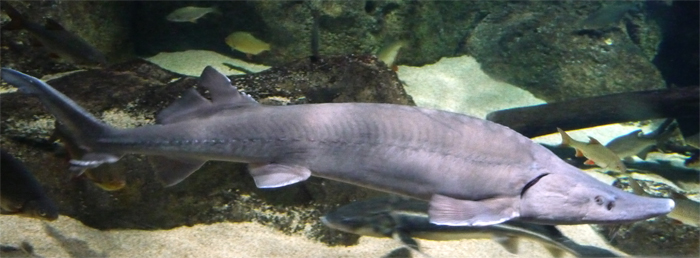
The Shortnose Sturgeon has a cylindrical body and a relatively small head and snout compared with the Atlantic sturgeon. Its dorsal surface is generally dark brown to olive-black, and five rows of bony scutes extend from its skull to its caudal peduncle.[1][2][3]
Its fins are positioned toward the rear of its body, with low-set pectoral fins. It has a protrusible tube-like mouth and sensory barbels.[4][5]
Adult Shortnose Sturgeons have bony plates along their esophagus that help crush hard food items. Their swim bladder connects to the intestinal tract by a duct, and their dark intestines contain a spiral valve associated with nutrient absorption.[6][7][8]
Habitat
Shortnose Sturgeons inhabit rivers, coastal waters, and streams along the Atlantic coast. They spend most of their time in estuaries and rivers after spawning.[9][10]
They rarely enter the Atlantic Ocean and remain near shore when they enter marine waters. They spawn in moving freshwater over rubble or gravel substrates.[11][12]
The Saco River in Maine has been documented as habitat used by Shortnose Sturgeons. It may provide foraging habitat during coastal migrations in the Gulf of Maine.[13][14]
Diet
Shortnose Sturgeons consume small bivalves, gastropods, polychaetes, and small benthic fishes. Amphipods are their most commonly reported prey.[15][16]
Pre-spawning females in the Saint John River rarely have food in their stomachs. Ripening males in the same river generally have full stomachs.[17][18]
Behaviour
Shortnose Sturgeons migrate upstream to spawn and spend much of their lives feeding in rivers, deltas, and estuaries. Adults move through different parts of river systems, remaining at particular sites for resting and feeding.[19][20]
Young Shortnose Sturgeons remain in freshwater until they are at least one year old. As they age, they gradually move toward more saline water.[21][22]
Reproduction and life cycle
Shortnose Sturgeons lay their eggs in freshwater before returning to saltwater. Spawning occurs at water temperatures of approximately 6.5–15 °C, and the eggs are left unattended afterward.[23][24][25]
Eggs hatch after approximately 13 days when incubated at 8–12 °C. Newly hatched Shortnose Sturgeons measure approximately 7–11 mm in length.[26][27]
Female Shortnose Sturgeons generally reproduce every three to five years and produce approximately 40,000–200,000 eggs per spawning event. Males may reproduce annually or every other year.[28][29][30]
Male Shortnose Sturgeons reach sexual maturity at approximately 2–3 years in warm habitats or 10–14 years in colder climates. Females reach sexual maturity between six and seventeen years of age.[31][32]
Conservation
The Shortnose Sturgeon was listed as endangered under the United States Endangered Species Act on March 11, 1967. The IUCN listed it as vulnerable in 2004, and it is listed as endangered in the United States.[33][34][35]
Dams that obstruct movement between freshwater and saltwater habitats can disrupt Shortnose Sturgeon spawning cycles. Conservation programs include removing outdated dams from their habitats.[36][37]
Uses
Shortnose Sturgeons have historically been harvested for their meat and eggs.[38]
Similar species
The Shortnose Sturgeon is often mistaken for a juvenile Atlantic sturgeon because of its small size. It can be distinguished from the Atlantic sturgeon by its shorter and rounder head.[39][40]
Classification of the Shortnose Sturgeon
| Kingdom | Animalia |
|---|---|
| Phylum | Chordata |
| Subphylum | Vertebrata |
| Infraphylum | Gnathostomata |
| Parvphylum | Osteichthyes |
| Gigaclass | Actinopterygii |
| Superclass | Actinopteri |
| Class | Chondrostei |
| Order | Acipenseriformes |
| Family | Acipenseridae (Sturgeon) |
| Genus | Acipenser (Sturgeons) |
| Species | Acipenser brevirostrum Lesueur, 1818 |
Where the Shortnose Sturgeon is found
Checklists and occurrence records place Acipenser brevirostrum in 2 countries. GBIF holds 428 georeferenced records of it.
Countries
Regions and cities with the most records
- New Brunswick, Canada 87
- Massachusetts, United States 59
- Quispamsis, Canada 47
- Amherst, United States 36
- Amherst Center, United States 36
- Greenfield, United States 33
- Northampton, United States 32
- South Hadley, United States 23
- Easthampton, United States 22
- Holyoke, United States 22
- North Chicopee, United States 16
- Agawam, United States 15
- Chicopee, United States 15
- Springfield, United States 15
- West Springfield, United States 15
- East Longmeadow, United States 14
- Longmeadow, United States 14
- Ludlow, United States 13
- Westfield, United States 13
- Saint John, Canada 12
- Saint John West, Canada 11
- Connecticut, United States 9
- New York, United States 8
- Bloomfield, United States 6
- Maine, United States 6
- South Windsor, United States 6
- Windsor, United States 6
- Florida, United States 5
- New Jersey, United States 5
- Avon, United States 4
- East Hartford, United States 4
- Enfield, United States 4
- Farmington, United States 4
- Fredericton, Canada 4
- Glastonbury, United States 4
- Hartford, United States 4
A number beside a place is its count of GBIF occurrence records. A place without a number comes from a checklist alone. Records show where a species has been observed or collected, which can include escapes and vagrants.
Common names
English
- Shortnose Sturgeon
Names in 9 other languages
- Czech
- Jeseter krátkorypý
- Finnish
- Lyhytkuonosampi
- French
- Esturgeon à nez court, esturgeon à museau court
- German
- Kurznasen-Stör
- Italian
- Storione nasocorto
- Polish
- Jesiotr krótkonosy
- Spanish
- Esturión Hociquicorto
- Swedish
- Kortnosad stör
- Turkish
- Kisa burunlu mersin baligi
Synonyms
4 other scientific names have been used for this species and are now treated as synonyms of Acipenser brevirostrum.
- Acipenser (Huso) brevirostrum (Lesueur, 1818)
- Acipenser (Sterletus) brevirostrum Lesueur, 1818
- Huso brevirostrum (Lesueur, 1818)
- Acipenser brevirostris Lesueur, 1818 ambiguous synonym
Related species
-
 Lake SturgeonAcipenser fulvescens
-
 White SturgeonAcipenser transmontanus
-
 Dabry's SturgeonAcipenser dabryanus
-
 Atlantic SturgeonAcipenser oxyrinchus
-
 Russian SturgeonAcipenser gueldenstaedtii
-
 Chinese SturgeonAcipenser sinensis
-
 SterletAcipenser ruthenus
-
 Siberian SturgeonAcipenser baerii
Compare
Questions and answers
What is the scientific name of the Shortnose Sturgeon?
The scientific name of the Shortnose Sturgeon is Acipenser brevirostrum. Written with its author, the full name is Acipenser brevirostrum Lesueur, 1818.
Which family does the Shortnose Sturgeon belong to?
Acipenser brevirostrum belongs to the family Acipenseridae, in the order Acipenseriformes and the class Chondrostei.
Where is the Shortnose Sturgeon found?
Checklists and occurrence records place Acipenser brevirostrum in 2 countries: United States and Canada.
What is the conservation status of the Shortnose Sturgeon?
The IUCN Red List category recorded for Acipenser brevirostrum is Vulnerable (VU).
How big can shortnose sturgeon get?
Adult Shortnose Sturgeons grow to approximately 3–4 feet in length and rarely exceed four feet in total length. They are the smallest of the three sturgeon species occurring along the eastern seaboard of North America.[41][42][43]
What do shortnose sturgeon eat?
They consume small bivalves, gastropods, polychaetes, and small benthic fishes. Amphipods are their most commonly reported prey.[15][16]
Sources
Passages the profile rests on
- The shortnose sturgeon has a cylindrical body and a relatively small head and snout compared with the Atlantic sturgeon. Source passage: “It has a cylindrical body and compared to the Atlantic sturgeon, its head and snout are relatively small.” — English Wikipedia
- The dorsal surface of the shortnose sturgeon is generally dark brown to olive-black. Source passage: “These sturgeons tend to be generally dark brown to olive/black on the dorsal surface.” — English Wikipedia
- The shortnose sturgeon has five rows of bony scutes extending from its skull to its caudal peduncle. Source passage: “Sturgeons have bony plates called scutes that extend from the skull to the caudal peduncle and are divided into five rows on the body” — English Wikipedia
- The shortnose sturgeon's fins are positioned toward the rear of its body, with low-set pectoral fins. Source passage: “The fins on the shortnose sturgeon are located far back on the body. The pectoral fins are positioned low” — English Wikipedia
- The shortnose sturgeon has a protrusible tube-like mouth and sensory barbels. Source passage: “Prominent features of the shortnose sturgeon are the scutes, protractile tube-like mouth, and chemosensory barbels.” — English Wikipedia
- Adult shortnose sturgeons have bony plates along their esophagus that help crush hard food items. Source passage: “Adult sturgeons have bony plates along their esophagus that help them crush hard items instead of having teeth.” — English Wikipedia
- The shortnose sturgeon has a swim bladder connected to its intestinal tract by a duct. Source passage: “It is a physostome fish, so its swim bladder is connected to the intestinal tract by a special duct.” — English Wikipedia
- The shortnose sturgeon's intestines are dark and contain a spiral valve associated with nutrient absorption. Source passage: “The intestines for shortnose sturgeon are dark and have a spiral valve (important for nutrient absorption)” — English Wikipedia
- Shortnose sturgeons inhabit rivers, coastal waters, and streams along the Atlantic coast. Source passage: “Shortnose sturgeon live in rivers and coastal waters and streams that run from Canada to Florida.” — English Wikipedia
- Shortnose sturgeons spend most of their time in estuaries and rivers after spawning. Source passage: “Because shortnose sturgeon are amphidromous fish, after spawning most of their time is spent in estuaries and rivers.” — English Wikipedia
- Shortnose sturgeons rarely enter the Atlantic Ocean and remain near shore when they do enter marine waters. Source passage: “Shortnose sturgeon rarely spend time in the Atlantic Ocean. However, if the sturgeon do enter marine waters to feed or migrate they stay close to the shore.” — English Wikipedia
- Shortnose sturgeons spawn in moving freshwater over rubble or gravel substrates. Source passage: “Shortnose sturgeon spawn in moving freshwater water, over rubble or gravel bottoms.” — English Wikipedia
- The Saco River in Maine has been documented as habitat used by shortnose sturgeons. Source passage: “Two shortnose sturgeon were captured in the Saco River between August of 2010 and June of 2011.” — dune.une.edu
- The Saco River may provide foraging habitat for shortnose sturgeons during coastal migrations in the Gulf of Maine. Source passage: “Smaller rivers, such as the Saco, may play an important role as foraging habitat on these longer migrations.” — dune.une.edu
- Shortnose sturgeons consume small bivalves, gastropods, polychaetes, and small benthic fishes. Source passage: “Shortnose sturgeon tend to consume small bivalves, gastropods, polychaetes, and small benthic fishes based on studies of their gut contents.” — English Wikipedia
- Amphipods are the most commonly reported prey of shortnose sturgeons. Source passage: “The most common prey are amphipods” — English Wikipedia
- Pre-spawning female shortnose sturgeons in the Saint John River rarely have food in their stomachs. Source passage: “a study from the Saint John River found that pre-spawning females rarely had food in their stomachs” — English Wikipedia
- Ripening male shortnose sturgeons in the Saint John River generally have full stomachs. Source passage: “while ripening males generally had full stomachs.” — English Wikipedia
- Shortnose sturgeons migrate upstream to spawn and spend much of their lives feeding in rivers, deltas, and estuaries. Source passage: “which migrates upstream to spawn but spends most of its life feeding in rivers, deltas and estuaries.” — English Wikipedia
- Adult shortnose sturgeons move through different parts of river systems, remaining at particular sites for resting and feeding. Source passage: “Shortnose sturgeon are more likely to move through all areas of a river system. Times they remain at sites for an extended period of time include resting and feeding periods.” — English Wikipedia
- Young shortnose sturgeons gradually move toward more saline water as they age. Source passage: “As they age, the young fish slowly move to more saline water.” — English Wikipedia
- Young shortnose sturgeons remain in freshwater until they are at least one year old. Source passage: “Living in fresh or brackish water until they are at least a year old.” — English Wikipedia
- Shortnose sturgeons lay their eggs in freshwater before returning to saltwater. Source passage: “adults that lay their eggs in freshwater and then return to saltwater.” — English Wikipedia
- Shortnose sturgeon eggs are left unattended after spawning. Source passage: “The eggs are left to fend for themselves after spawning.” — English Wikipedia
- Shortnose sturgeon spawning occurs at water temperatures of approximately 6.5–15 °C. Source passage: “water temperatures in the range from 6.5–15 °C (43.7–59.0 °F)” — English Wikipedia
- Shortnose sturgeon eggs hatch after approximately 13 days when incubated at 8–12 °C. Source passage: “The eggs hatch after 13 days when incubated at water temperatures of 8 to 12 °C (46 to 54 °F)” — English Wikipedia
- Newly hatched shortnose sturgeons measure approximately 7–11 mm in length. Source passage: “into 7- to 11-mm-long hatchlings” — English Wikipedia
- Female shortnose sturgeons generally reproduce every three to five years. Source passage: “Females usually breed every third to the fifth year” — English Wikipedia
- Female shortnose sturgeons produce approximately 40,000–200,000 eggs per spawning event. Source passage: “lying between 40,000 and 200,000 eggs when they breed” — English Wikipedia
- Male shortnose sturgeons may reproduce annually or every other year. Source passage: “A male may breed every year or every other year” — English Wikipedia
- Male shortnose sturgeons reach sexual maturity at approximately 2–3 years in warm habitats or 10–14 years in colder climates. Source passage: “Males mature after 2–3 years in their warmest habitats or 10–14 years in colder climates” — English Wikipedia
- Female shortnose sturgeons reach sexual maturity between six and seventeen years of age. Source passage: “females mature between 6 and 17 years of age” — English Wikipedia
- The shortnose sturgeon was listed as endangered under the United States Endangered Species Act on March 11, 1967. Source passage: “was listed as endangered under the Endangered Species Act on March 11, 1967.” — English Wikipedia
- The IUCN listed the shortnose sturgeon as vulnerable in 2004. Source passage: “The IUCN has listed the shortnose sturgeon as a vulnerable species in 2004” — English Wikipedia
- The shortnose sturgeon is listed as endangered in the United States. Source passage: “The shortnose sturgeon is listed as an endangered species in the U.S.” — dnr.sc.gov
- Dams that obstruct movement between freshwater and saltwater habitats can disrupt shortnose sturgeon spawning cycles. Source passage: “some dams impede sturgeon travel back and forth between salt and fresh water, resulting in the disruption of natural spawning cycles” — English Wikipedia
- Shortnose sturgeon conservation programs include removing outdated dams from their habitats. Source passage: “Conservation efforts for the shortnose sturgeon include removing outdated dams from their habitats.” — English Wikipedia
- Shortnose sturgeons have historically been harvested for their meat and eggs. Source passage: “Native American fishermen harvested shortnose and Atlantic sturgeon for their meat and eggs.” — English Wikipedia
- The shortnose sturgeon is often mistaken for a juvenile Atlantic sturgeon because of its small size. Source passage: “The shortnose sturgeon is often mistaken as a juvenile Atlantic sturgeon (A. oxyrinchus) because of its small size.” — English Wikipedia
- The shortnose sturgeon can be distinguished from the Atlantic sturgeon by its shorter and rounder head. Source passage: “The shortnose is distinguishable from the Atlantic sturgeon due to its shorter and rounder head.” — English Wikipedia
- The shortnose sturgeon is the smallest of the three sturgeon species occurring along the eastern seaboard of North America. Source passage: “The shortnose sturgeon is the smallest of three sturgeon species that are present in the eastern seaboard of North America.” — English Wikipedia
- Adult shortnose sturgeons grow to approximately 3–4 feet in length. Source passage: “Adults continue to grow to between 3 and 4 ft in length.” — English Wikipedia
- Shortnose sturgeons rarely exceed four feet in total length. Source passage: “rarely exceeding 4 feet total length” — dnr.sc.gov
Data
- Catalogue of Life, 2026-10-16 XR cc by
- Global Biodiversity Information Facility CC BY 4.0
- Wikidata CC0
- GeoNames CC BY 4.0
- Wikimedia Commons per image; credit shown with each image
- Within the Catalogue of Life, this name comes from World Register of Marine Species cc by
References
- Lesueur, C. A. (1818). Description of several species of chondropterygious fishes of North America, with their varieties. Transactions of the American Philosophical Society (New Series), 1 (33): 383–394, Pl. 12. where the name was published
This species in other databases
Page built on 27 November 2026. See how the catalog is made and all sources and licences.
Cite this page
ScientificNames.org. (2026). Acipenser brevirostrum (Shortnose Sturgeon). Retrieved November 27, 2026, from https://scientificnames.org/species/acipenser-brevirostrum
“Acipenser brevirostrum (Shortnose Sturgeon).” ScientificNames.org, 2026, scientificnames.org/species/acipenser-brevirostrum. Accessed 27 Nov. 2026.
ScientificNames.org. “Acipenser brevirostrum (Shortnose Sturgeon).” Accessed November 27, 2026. https://scientificnames.org/species/acipenser-brevirostrum.
@misc{scientificnames_acipenser_brevirostrum_shortnose_sturgeon,
  author = {{ScientificNames.org}},
  title = {Acipenser brevirostrum (Shortnose Sturgeon)},
  year = {2026},
  url = {https://scientificnames.org/species/acipenser-brevirostrum},
  note = {Accessed 2026-11-27}
}