Species · Fishes
Green Sturgeon Acipenser medirostris
The scientific name of the Green Sturgeon is Acipenser medirostris. It is a species of fish in the family Acipenseridae (sturgeon), order Acipenseriformes. The name dates from 1854.
- Scientific name
- Acipenser medirostris Ayres, 1854
- Common name
- Green Sturgeon
- Genus
- Acipenser
- Family
- Acipenseridae (Sturgeon)
- Order
- Acipenseriformes
- Class
- Chondrostei
- Red List category
- EN Endangered
- Environment
- brackish, freshwater, marine
- Recorded in
- 2 countries
- Name status
- accepted in the Catalogue of Life

Overview
Acipenser medirostris inhabits freshwater and saltwater environments and spends most of its life in the coastal ocean. It has olive-green coloration and external bony plates called scutes along its back and sides.
Written 26 November 2026 from the sources listed below. Each statement was checked against the passage it cites; statements that could not be supported were removed.
Appearance
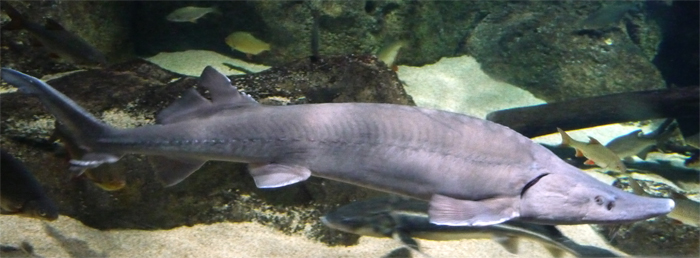
Green Sturgeon have olive-green coloration and external bony plates called scutes along their backs and sides.[1][2]
They lack teeth and use a protrusible jaw with flexible lips to suck up food from the bottom. Their mouth is adapted for siphoning food.[3][4]
Habitat
Green Sturgeon inhabit both freshwater and saltwater environments. They spend most of their lives in the coastal ocean, primarily at depths of 20–60 meters.[5][6][7]
They spend longer periods in marine areas with complex seafloors, particularly those containing a greater proportion of boulders. In Willapa Bay, Washington, they use fine-grained sediment areas as feeding habitat.[8][9]
Green Sturgeon feeding pits in Willapa Bay were concentrated between +0.25 m and +1.5 m mean lower low water tidal elevation.[10]
Diet
They use a protrusible jaw and flexible lips to suck up food from the bottom.[3]
Behaviour
Green Sturgeon migrate between freshwater spawning rivers and marine feeding and growth habitats. They generally spend their first two years in freshwater rivers before migrating to marine habitats.[11][12]
They may travel more than 40 km per day and cover distances of up to 1,000 km during ocean migrations. They may migrate northward in winter and southward in summer.[13][14]
Subadult and adult Green Sturgeon commonly visit bays and estuaries during summer and early autumn. Individuals from different natal rivers congregate at particular marine sites, presumably to exploit better foraging opportunities.[15][16]
Green Sturgeon spend more time in the ocean than most other sturgeon species.[17]
Reproduction and life cycle
Green Sturgeon reach sexual maturity at approximately 15 years of age. They return to their natal rivers to spawn in spring.[18][19]
They generally spawn every two to four years after their initial spawning maturity and may spawn several times during their lifetimes.[20][21]
Green Sturgeon spawning in the upper Sacramento River use cool areas with deep, turbulent water and clean, hard substrate.[22]
Adult southern population Green Sturgeon enter San Francisco Bay for spawning migrations between mid-February and early May.[23]
Conservation
The southern distinct population segment of North American Green Sturgeon has been listed as threatened under the United States Endangered Species Act since April 7, 2006. Critical habitat for this population segment was designated on October 9, 2009.[24][25]
Green Sturgeon populations are threatened by the loss and inaccessibility of spawning habitat. Dams and other impassable barriers can obstruct their migration.[26][27]
Green Sturgeon populations have experienced declines associated with anthropogenic harvesting and destruction of spawning and rearing habitat.[28]
Green Sturgeon are prohibited from being fished for, caught, or kept under the regulations described by NOAA Fisheries. They are vulnerable to incidental capture in commercial and recreational white sturgeon fisheries, tribal salmon gillnet fisheries, and coastal groundfish trawl fisheries.[29][30]
Classification of the Green Sturgeon
| Kingdom | Animalia |
|---|---|
| Phylum | Chordata |
| Subphylum | Vertebrata |
| Infraphylum | Gnathostomata |
| Parvphylum | Osteichthyes |
| Gigaclass | Actinopterygii |
| Superclass | Actinopteri |
| Class | Chondrostei |
| Order | Acipenseriformes |
| Family | Acipenseridae (Sturgeon) |
| Genus | Acipenser (Sturgeons) |
| Species | Acipenser medirostris Ayres, 1854 |
Where the Green Sturgeon is found
Checklists and occurrence records place Acipenser medirostris in 2 countries. GBIF holds 54,102 georeferenced records of it.
Countries
Regions and cities with the most records
- California, United States 39,967
- Oakley, United States 8,544
- Antioch, United States 8,220
- Bay Point, United States 7,771
- Concord, United States 7,365
- Martinez, United States 7,361
- Pleasant Hill, United States 7,350
- Pittsburg, United States 6,935
- Walnut Creek, United States 3,080
- McKinleyville, United States 3,055
- Arcata, United States 3,053
- Bayside, United States 3,053
- Eureka, United States 3,051
- Benicia, United States 1,685
- San Rafael, United States 1,617
- San Francisco, United States 1,592
- Daly City, United States 1,591
- Bayview-Hunters Point, United States 1,451
- Albany, United States 1,449
- Oakland, United States 1,449
- Alameda, United States 1,448
- Berkeley, United States 1,448
- El Cerrito, United States 1,448
- Richmond, United States 1,447
- San Pablo, United States 1,443
- Chico, United States 1,325
- Vallejo, United States 1,141
- American Canyon, United States 1,139
- Hercules, United States 1,132
- Orinda, United States 1,132
- Lafayette, United States 1,131
- Pinole, United States 1,131
- South San Francisco, United States 931
- Rio Linda, United States 865
- West Sacramento, United States 780
- Brentwood, United States 736
2 more countries have a few records outside this range
These countries hold a few records of Acipenser medirostris but lie outside the range the checklists give for it. Such records are often zoo or garden specimens, museum material or vagrants, so the species is not counted as occurring there.
A number beside a place is its count of GBIF occurrence records. A place without a number comes from a checklist alone. Records show where a species has been observed or collected, which can include escapes and vagrants.
Common names
English
- Green Sturgeon
- Sakhalin Sturgeon
Names in 12 other languages
- Czech
- jeseter sachalinský
- Dutch
- groene steur
- Finnish
- Vihersampi
- French
- esturgeon vert
- German
- grüner Stör
- Italian
- Storione verde
- Japanese
- Chôzame, チョウザメ
- Polish
- Jesiotr sachaliński
- Portuguese
- Esturjão-verde
- Russian
- Sterlyad, Сахалинский осётр, Тихоокеанский (сахалинский, зеленый) осетр
- Spanish
- esturión verde
- Turkish
- Yesil mersin baligi
Synonyms
3 other scientific names have been used for this species and are now treated as synonyms of Acipenser medirostris.
- Acipenser (Sinosturio) medirostris Ayres, 1854
- Acipenser acutirostris Ayres, 1854
- Sinosturio medirostris (Ayres, 1854)
Related species
-
 Lake SturgeonAcipenser fulvescens
-
 White SturgeonAcipenser transmontanus
-
 Dabry's SturgeonAcipenser dabryanus
-
 Atlantic SturgeonAcipenser oxyrinchus
-
 Russian SturgeonAcipenser gueldenstaedtii
-
 Chinese SturgeonAcipenser sinensis
-
 SterletAcipenser ruthenus
-
 Siberian SturgeonAcipenser baerii
Compare
Questions and answers
What is the scientific name of the Green Sturgeon?
The scientific name of the Green Sturgeon is Acipenser medirostris. Written with its author, the full name is Acipenser medirostris Ayres, 1854.
Which family does the Green Sturgeon belong to?
Acipenser medirostris belongs to the family Acipenseridae, in the order Acipenseriformes and the class Chondrostei.
Where is the Green Sturgeon found?
Checklists and occurrence records place Acipenser medirostris in 2 countries: United States and Canada.
What is the conservation status of the Green Sturgeon?
The IUCN Red List category recorded for Acipenser medirostris is Endangered (EN).
What other names does the Green Sturgeon have?
Acipenser medirostris is also known in English as Sakhalin Sturgeon.
Sources
Passages the profile rests on
- Green sturgeon have olive-green coloration. Source passage: “They differ from white sturgeon in their olive green coloration” — fisheries.noaa.gov
- Green sturgeon possess external bony plates called scutes along their backs and sides. Source passage: “they have a series of external bony plates called scutes along their backs and sides.” — fisheries.noaa.gov
- Green sturgeon lack teeth and use a protrusible jaw with flexible lips to suck up food from the bottom. Source passage: “Sturgeon do not have teeth. Instead, they use their long, flexible "lips" (i.e., protrusible jaw) to suck up food from the bottom.” — fisheries.noaa.gov
- Green sturgeon have a mouth adapted for siphoning food. Source passage: “Green Sturgeon are olive green in color and have a vacuum cleaner-like mouth that is used to siphon food.” — fws.gov
- Green sturgeon marine habitats are primarily located at depths of 20–60 meters. Source passage: “Green sturgeon in marine habitats are primarily found at depths of 20–60 meters” — pmc.ncbi.nlm.nih.gov
- Green sturgeon inhabit both freshwater and saltwater environments. Source passage: “Green sturgeon are an anadromous fish, which means they can live in both fresh and saltwater.” — fisheries.noaa.gov
- Green sturgeon spend most of their lives in the coastal ocean. Source passage: “Although green sturgeon use various environments throughout their life cycle, they spend most of their lives in the coastal ocean” — pmc.ncbi.nlm.nih.gov
- Green sturgeon spend longer periods in marine areas with complex seafloors, particularly those containing a greater proportion of boulders. Source passage: “green sturgeon, on average, spent a longer duration in areas with high seafloor complexity, especially where a greater proportion of the substrate consists of boulders.” — pmc.ncbi.nlm.nih.gov
- Green sturgeon use fine-grained sediment areas in Willapa Bay, Washington, as feeding habitat. Source passage: “Our findings show that green sturgeon are feeding in areas with fine-grained sediment (>2.0 phi).” — digitalcommons.cwu.edu
- Green sturgeon feeding pits in Willapa Bay were concentrated between +0.25 m and +1.5 m mean lower low water tidal elevation. Source passage: “The majority of feeding pits were found between +0.25 m and +1.5 m MLLW, in terms of tidal elevation.” — digitalcommons.cwu.edu
- Green sturgeon migrate between freshwater spawning rivers and marine feeding and growth habitats. Source passage: “includes spawning and juvenile rearing in rivers followed by migrating to saltwater to feed, grow, and mature before returning to freshwater to spawn.” — fisheries.noaa.gov
- Green sturgeon generally spend their first two years in freshwater rivers before migrating to marine habitats. Source passage: “Green sturgeon generally spend their first two years in freshwater rivers before they migrate to marine habitats” — pmc.ncbi.nlm.nih.gov
- Green sturgeon may travel more than 40 km per day and cover distances of up to 1,000 km during ocean migrations. Source passage: “They remain in relatively shallow depths (40–100 m) and may travel long distances (>40 km/day, up to 1000 km)” — pmc.ncbi.nlm.nih.gov
- Green sturgeon may migrate northward in winter and southward in summer. Source passage: “that include northward migrations in the winter followed by southward migrations in the summer” — pmc.ncbi.nlm.nih.gov
- Subadult and adult green sturgeon commonly visit bays and estuaries during summer and early autumn. Source passage: “Subadults and adults also commonly visit bays and estuaries during summer and early autumn” — pmc.ncbi.nlm.nih.gov
- Green sturgeon from different natal rivers congregate at particular marine sites, presumably to exploit better foraging opportunities. Source passage: “Green sturgeon from different natal rivers also congregate in great numbers at specific sites, presumably to exploit superior foraging opportunities” — pmc.ncbi.nlm.nih.gov
- Green sturgeon spend more time in the ocean than most other sturgeon species. Source passage: “They are anadromous but spend more time in the ocean than most sturgeon species.” — fisheries.noaa.gov
- Green sturgeon reach sexual maturity at approximately 15 years of age. Source passage: “Green sturgeon reach maturity around age 15” — fisheries.noaa.gov
- Green sturgeon return to their natal rivers to spawn in spring. Source passage: “At about age 15, they return to their natal rivers to spawn in the spring” — pmc.ncbi.nlm.nih.gov
- Green sturgeon generally spawn every two to four years after their initial spawning maturity. Source passage: “They will continue to spawn every 2–4 years afterwards” — pmc.ncbi.nlm.nih.gov
- Green sturgeon may spawn several times during their lifetimes. Source passage: “Unlike salmon, they may spawn several times during their long lives” — fisheries.noaa.gov
- Green sturgeon spawning in the upper Sacramento River use cool areas with deep, turbulent water and clean, hard substrate. Source passage: “Spawning occurs in cool sections of the upper Sacramento River where there are deep, turbulent flows and clean, hard substrate.” — fisheries.noaa.gov
- Adult southern population green sturgeon enter San Francisco Bay for spawning migrations between mid-February and early May. Source passage: “During spawning runs, adult sDPS fish enter San Francisco Bay between mid-February and early May” — fisheries.noaa.gov
- The southern distinct population segment of North American green sturgeon has been listed as threatened under the United States Endangered Species Act since April 7, 2006. Source passage: “On April 7, 2006, we listed the southern distinct population segment, or sDPS, of North American green sturgeon as threatened under the ESA.” — fisheries.noaa.gov
- Critical habitat for the southern distinct population segment was designated on October 9, 2009. Source passage: “Critical habitat was designated on October 9, 2009.” — fisheries.noaa.gov
- Green sturgeon populations are threatened by the loss and inaccessibility of spawning habitat. Source passage: “the most significant threats to green sturgeon likely relate to the ongoing loss and inaccessibility of available spawning habitat.” — fisheries.noaa.gov
- Dams and other impassable barriers can obstruct green sturgeon migration. Source passage: “Dams and other impassible barriers, altered flows, and entrainment in water diversions can impede or inhibit their migration.” — fisheries.noaa.gov
- Green sturgeon populations have experienced declines associated with anthropogenic harvesting and destruction of spawning and rearing habitat. Source passage: “They are thought to have experienced a precipitous decline in abundance during the past century, which is likely a result of anthropogenic harvest and destruction of spawning and rearing habitat.” — fisheries.noaa.gov
- Green sturgeon are prohibited from being fished for, caught, or kept under the regulations described by NOAA Fisheries. Source passage: “It is illegal to fish for, catch, or keep green sturgeon.” — fisheries.noaa.gov
- Green sturgeon are vulnerable to incidental capture in commercial and recreational white sturgeon fisheries, tribal salmon gillnet fisheries, and coastal groundfish trawl fisheries. Source passage: “that is captured as bycatch in white sturgeon commercial and sport fisheries, tribal salmon gillnet fisheries, and coastal groundfish trawl fisheries” — pmc.ncbi.nlm.nih.gov
Data
- Catalogue of Life, 2026-10-16 XR cc by
- Global Biodiversity Information Facility CC BY 4.0
- Wikidata CC0
- GeoNames CC BY 4.0
- Wikimedia Commons per image; credit shown with each image
- Within the Catalogue of Life, this name comes from World Register of Marine Species cc by
References
- Ayres, W. O. (1854). [Description of new fishes from California.]. The Pacific [Newspaper], (Minutes of Academy meetings were printed in “The Pacific” (a newspaper) shortly after each meeting. New species date to publication in The Pacific. Dates of publication are given in each species account). The Pacific [newspaper] v. 3 and 4 (thru no. 6). where the name was published
This species in other databases
Page built on 27 November 2026. See how the catalog is made and all sources and licences.
Cite this page
ScientificNames.org. (2026). Acipenser medirostris (Green Sturgeon). Retrieved November 27, 2026, from https://scientificnames.org/species/acipenser-medirostris
“Acipenser medirostris (Green Sturgeon).” ScientificNames.org, 2026, scientificnames.org/species/acipenser-medirostris. Accessed 27 Nov. 2026.
ScientificNames.org. “Acipenser medirostris (Green Sturgeon).” Accessed November 27, 2026. https://scientificnames.org/species/acipenser-medirostris.
@misc{scientificnames_acipenser_medirostris_green_sturgeon,
  author = {{ScientificNames.org}},
  title = {Acipenser medirostris (Green Sturgeon)},
  year = {2026},
  url = {https://scientificnames.org/species/acipenser-medirostris},
  note = {Accessed 2026-11-27}
}