Species · Fishes
Sakhalin Sturgeon Acipenser mikadoi
The scientific name of the Sakhalin Sturgeon is Acipenser mikadoi. It is a species of fish in the family Acipenseridae (sturgeon), order Acipenseriformes. The name dates from 1892.
- Scientific name
- Acipenser mikadoi Hilgendorf, 1892
- Common name
- Sakhalin Sturgeon
- Genus
- Acipenser
- Family
- Acipenseridae (Sturgeon)
- Order
- Acipenseriformes
- Class
- Chondrostei
- Red List category
- CR Critically Endangered
- Environment
- brackish, freshwater, marine
- Recorded in
- 2 countries
- Name status
- accepted in the Catalogue of Life

Overview
The species inhabits marine, freshwater and brackish waters at demersal depths. The Sakhalin Sturgeon has a two-part lower lip and migrates from the sea into rivers to spawn.
Written 26 November 2026 from the sources listed below. Each statement was checked against the passage it cites; statements that could not be supported were removed.
Appearance
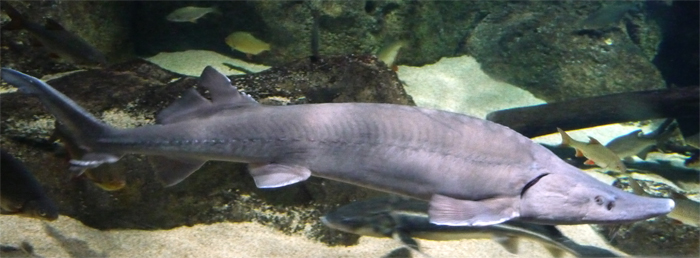
The Sakhalin Sturgeon has olive-green to dark-green coloration and yellowish-white sides with an olive-green stripe. Its lower lip is divided into two parts.[1][2][3]
The maximum recorded length is approximately 150 cm.[4]
Habitat
The Sakhalin Sturgeon inhabits marine and freshwater environments, including brackish waters. It occupies demersal depths.[5][6][7]
The species occurs in Japan and Russia, and is reported from the Amur River basin in China and Russia. It is also recorded from the Tumnin and Datta rivers, northern Japan and Korea, the Northwest Pacific and the Bering Sea.[8][9][10][11][12]
Behaviour
The Sakhalin Sturgeon feeds in freshwater during April and May before returning to the ocean in summer.[13]
Reproduction and life cycle
The Sakhalin Sturgeon migrates from the sea into rivers to spawn. It currently maintains persistent spawning activity in the Tumnin River.[14][15]
Conservation
The Sakhalin Sturgeon is listed as endangered. Its population is reported to be significantly decreasing, and the species is reported to be on the brink of extinction.[16][17][18]
Dam construction is identified as a threat to the species.[19]
FishBase reports a very high vulnerability score of 80 out of 100 and a minimum population doubling time exceeding 14 years.[20][21]
Similar species
The green sturgeon (A. medirostris) is a distinct species from the Sakhalin Sturgeon.[22]
Classification of the Sakhalin Sturgeon
| Kingdom | Animalia |
|---|---|
| Phylum | Chordata |
| Subphylum | Vertebrata |
| Infraphylum | Gnathostomata |
| Parvphylum | Osteichthyes |
| Gigaclass | Actinopterygii |
| Superclass | Actinopteri |
| Class | Chondrostei |
| Order | Acipenseriformes |
| Family | Acipenseridae (Sturgeon) |
| Genus | Acipenser (Sturgeons) |
| Species | Acipenser mikadoi Hilgendorf, 1892 |
Where the Sakhalin Sturgeon is found
Checklists and occurrence records place Acipenser mikadoi in 2 countries. GBIF holds 7 georeferenced records of it.
Countries
A number beside a place is its count of GBIF occurrence records. A place without a number comes from a checklist alone. Records show where a species has been observed or collected, which can include escapes and vagrants.
Common names
English
- Sakhalin Sturgeon
Names in 7 other languages
- Czech
- Jeseter severní
- Finnish
- Mikadosampi
- German
- Sachalin-Stör
- Italian
- Storione di Sakhalin
- Japanese
- Chôzame
- Russian
- Сахалинский осётр
- Turkish
- Sakhalin mersin baligi
Synonyms
2 other scientific names have been used for this species and are now treated as synonyms of Acipenser mikadoi.
- Acipenser (Sinosturio) mikadoi Hilgendorf, 1892
- Sinosturio mikadoi (Hilgendorf, 1892)
Related species
-
 Lake SturgeonAcipenser fulvescens
-
 White SturgeonAcipenser transmontanus
-
 Dabry's SturgeonAcipenser dabryanus
-
 Atlantic SturgeonAcipenser oxyrinchus
-
 Russian SturgeonAcipenser gueldenstaedtii
-
 Chinese SturgeonAcipenser sinensis
-
 SterletAcipenser ruthenus
-
 Siberian SturgeonAcipenser baerii
Compare
Questions and answers
What is the scientific name of the Sakhalin Sturgeon?
The scientific name of the Sakhalin Sturgeon is Acipenser mikadoi. Written with its author, the full name is Acipenser mikadoi Hilgendorf, 1892.
Which family does the Sakhalin Sturgeon belong to?
Acipenser mikadoi belongs to the family Acipenseridae, in the order Acipenseriformes and the class Chondrostei.
Where is the Sakhalin Sturgeon found?
Checklists and occurrence records place Acipenser mikadoi in 2 countries: Japan and Russia.
What is the conservation status of the Sakhalin Sturgeon?
The IUCN Red List category recorded for Acipenser mikadoi is Critically Endangered (CR).
Sources
Passages the profile rests on
- The Sakhalin sturgeon has olive-green to dark-green coloration. Source passage: “The Sakhalin sturgeon is recorded to be the colors of olive-green and dark green.” — English Wikipedia
- The species has yellowish-white sides with an olive-green stripe. Source passage: “Its sides have a yellowish white color and it includes an olive green stripe.” — English Wikipedia
- The species has a lower lip divided into two parts. Source passage: “The bottom lip of this species is split into two.” — English Wikipedia
- The maximum recorded length of the Sakhalin sturgeon is approximately 150 cm. Source passage: “The Sakhalin sturgeon has reached the maximum recorded length of about 150 centimeters” — English Wikipedia
- The Sakhalin sturgeon inhabits marine and freshwater environments. Source passage: “The Sakhalin sturgeon is known to be found in either a marine or freshwater environment” — English Wikipedia
- The species occurs in brackish waters. Source passage: “This species is found in brackish waters.” — English Wikipedia
- The species occupies demersal depths. Source passage: “within demersal depth range.” — English Wikipedia
- The Sakhalin sturgeon occurs in Japan and Russia. Source passage: “It is found in Japan and Russia.” — English Wikipedia
- The species is reported from the Amur River basin in China and Russia. Source passage: “which lives in the Amur River basin in China and Russia” — English Wikipedia
- The species occurs in the Northwest Pacific and the Bering Sea. Source passage: “The Sakhalin sturgeon is commonly found in the Northwest Pacific, Bering Sea” — English Wikipedia
- The species is recorded from the Tumnin and Datta rivers. Source passage: “Tumnin or Datta river” — English Wikipedia
- The species is reported from northern Japan and Korea. Source passage: “northern Japan, and Korea.” — English Wikipedia
- The Sakhalin sturgeon feeds in freshwater during April and May before returning to the ocean in summer. Source passage: “During the months of April to May, the Sakhalin sturgeon feeds in the freshwater and then returns to the ocean during the summer.” — English Wikipedia
- The Sakhalin sturgeon migrates from the sea into rivers to spawn. Source passage: “migrates up the river from the sea in order to spawn.” — English Wikipedia
- The species currently maintains persistent spawning activity in the Tumnin River. Source passage: “This species currently spawns persistently in the Tumnin River.” — English Wikipedia
- The Sakhalin sturgeon is listed as endangered. Source passage: “The Sakhalin sturgeon is listed as endangered through.” — fisheries.noaa.gov
- The species population is reported to be significantly decreasing. Source passage: “Currently, the species' population is significantly decreasing” — English Wikipedia
- The Sakhalin sturgeon is reported to be on the brink of extinction. Source passage: “is on the brink of extinction.” — English Wikipedia
- Dam construction is identified as a threat to the species. Source passage: “construction of dams.” — English Wikipedia
- FishBase reports a very high vulnerability score of 80 out of 100 for the species. Source passage: “Very high vulnerability (80 of 100).” — fishbase.se
- FishBase reports a minimum population doubling time exceeding 14 years. Source passage: “Very Low, minimum population doubling time more than 14 years” — fishbase.se
- The green sturgeon (A. medirostris) is identified as a distinct species compared with the Sakhalin sturgeon. Source passage: “the green sturgeon (A. medirostris), which lives along the Pacific coast of North America, are two different species of sturgeon.” — English Wikipedia
Data
- Catalogue of Life, 2026-10-16 XR cc by
- Global Biodiversity Information Facility CC BY 4.0
- Wikidata CC0
- GeoNames CC BY 4.0
- Wikimedia Commons per image; credit shown with each image
- Within the Catalogue of Life, this name comes from World Register of Marine Species cc by
References
- Hilgendorf, F. M. (1892). Neue Stör-Art von Nord-Japan, Acipenser mikadoi. Sitzungsberichte Der Gesellschaft Naturforschender Freunde Zu Berlin 1892, : 98–100. https://doi.org/10.5962/bhl.part.25601 Link where the name was published
This species in other databases
Page built on 28 November 2026. See how the catalog is made and all sources and licences.
Cite this page
ScientificNames.org. (2026). Acipenser mikadoi (Sakhalin Sturgeon). Retrieved November 28, 2026, from https://scientificnames.org/species/acipenser-mikadoi
“Acipenser mikadoi (Sakhalin Sturgeon).” ScientificNames.org, 2026, scientificnames.org/species/acipenser-mikadoi. Accessed 28 Nov. 2026.
ScientificNames.org. “Acipenser mikadoi (Sakhalin Sturgeon).” Accessed November 28, 2026. https://scientificnames.org/species/acipenser-mikadoi.
@misc{scientificnames_acipenser_mikadoi_sakhalin_sturgeon,
  author = {{ScientificNames.org}},
  title = {Acipenser mikadoi (Sakhalin Sturgeon)},
  year = {2026},
  url = {https://scientificnames.org/species/acipenser-mikadoi},
  note = {Accessed 2026-11-28}
}