Species · Fishes
Adriatic Sturgeon Acipenser naccarii
The scientific name of the Adriatic Sturgeon is Acipenser naccarii. It is a species of fish in the family Acipenseridae (sturgeon), order Acipenseriformes. The name dates from 1836.
- Scientific name
- Acipenser naccarii Bonaparte, 1836
- Common name
- Adriatic Sturgeon
- Genus
- Acipenser
- Family
- Acipenseridae (Sturgeon)
- Order
- Acipenseriformes
- Class
- Chondrostei
- Red List category
- CR Critically Endangered
- Environment
- brackish, freshwater, marine
- Recorded in
- 5 countries
- Name status
- accepted in the Catalogue of Life

Overview
Acipenser naccarii inhabits the Adriatic Sea and rivers flowing into it, occurring in freshwater, marine, estuarine and brackish-water environments.
Written 26 November 2026 from the sources listed below. Each statement was checked against the passage it cites; statements that could not be supported were removed.
Appearance
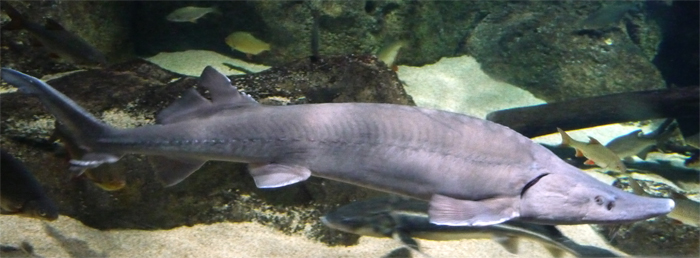
The Adriatic Sturgeon has an elongated body, a heterocercal tail, a partially cartilaginous skeleton and naked skin covered by longitudinal rows of bony scutes. Its snout is generally conical, relatively short and approximately one-third of the head length.[1][2]
Its head is broad and rounded at the apex, with a protrusible mouth and a thin lower lip featuring a central cleft. Four barbels with circular cross-sections are positioned closer to the snout tip than to the mouth.[3][4]
Its five longitudinal scute rows comprise 10–14 dorsal scutes, 30–42 lateral scutes on each side and 8–11 ventral scutes on each side. The dorsal fin has 36–48 soft rays and no spines, while the anal fin has 24–31 soft rays.[5][6]
Habitat
Its typical freshwater habitat consists of large, deep rivers with strong currents flowing into the Adriatic Sea. In marine environments, it inhabits lagoons and areas near estuaries, particularly over muddy and sandy substrates at depths of 10–40 metres.[7][8]
The species occurs in freshwater, marine, estuarine and brackish-water environments. Juveniles can adapt to salinities of 20–30‰, but the species has difficulty tolerating high salinity for extended periods.[9][10][11]
Its native range includes the Adriatic Sea and rivers flowing into it in Albania, Greece, Italy, Montenegro, Croatia, Bosnia and Herzegovina, and Slovenia. Its historical marine distribution extended from Venice and Trieste to Greece and Corfu.[12][13]
Its historical Italian river distribution included the Adige, Brenta, Bacchiglione, Piave, Livenza and Tagliamento rivers. It also occurred in the Po River and its tributaries as far upstream as Turin.[14][15]
Its historical distribution included the Ticino and Adda rivers, where it was reported to be numerous. Its historical range also included Lake Skadar and rivers in Slovenia, Croatia, Bosnia-Herzegovina and Montenegro.[16][17]
Diet
In rivers, the Adriatic Sturgeon primarily consumes gammarids, dipteran larvae and oligochaetes. Its freshwater diet sometimes includes small fish and potentially invasive Corbicula freshwater clams.[18][19]
In marine environments, its diet includes gammarids, shrimps, crabs, demersal fish, molluscs and vegetal matter. It feeds opportunistically by ingesting substrate together with prey and organic matter, including small decaying carrion.[20][21]
Digestive-tract analyses have revealed substantial inorganic material mixed with food, including sand, silt, mud and plastic.[22]
Reproduction and life cycle
Wild males reach sexual maturity at approximately 7–11 years of age and a length of about 80 cm. Females reach sexual maturity at approximately 12–14 years of age and a length of at least one metre, and ovulate every two to four years.[23][24][25]
Mature individuals migrate towards the upper parts of rivers during spring. Spawning occurs from April to June in deep, oxygenated waters over gravelly substrates.[26][27]
Spawning sites are reported at depths of 2–10 metres and current velocities of at least 0.8 metres per second. The eggs adhere to the substrate and hatch after approximately one week.[28][29]
Conservation
The Adriatic Sturgeon is classified as Critically Endangered on the IUCN Red List. It has experienced severe population declines associated with habitat loss, river regulation, pollution and overfishing.[30][31]
Damming is a major threat because it fragments habitats and obstructs feeding and spawning migrations. Pollution from industrial effluent, agricultural runoff and domestic wastewater is an additional threat.[32][33]
Illegal fishing and poaching remain important threats in the Po River basin. Predation by great cormorants on juvenile Adriatic sturgeons is an identified conservation problem, and the species also faces competition from the invasive wels catfish.[34][35][36]
Captive-bred juveniles have been officially released into the wild as part of reintroduction programmes since 2004. Recent conservation programmes primarily depend on releasing juveniles produced from adult breeders maintained in aquaculture facilities.[37][38]
Uses
The Adriatic Sturgeon has traditional regional importance associated with caviar production.[39]
Similar species
The Adriatic Sturgeon has been reported to resemble the critically endangered European sea sturgeon (Acipenser sturio). Compared with that species, it has a shorter, stockier snout, a darker brown back, fewer and smaller lateral scutes, and a larger mouth.[40][41]
Its barbels are positioned closer to the snout tip than those of the European sea sturgeon.[42]
Classification of the Adriatic Sturgeon
| Kingdom | Animalia |
|---|---|
| Phylum | Chordata |
| Subphylum | Vertebrata |
| Infraphylum | Gnathostomata |
| Parvphylum | Osteichthyes |
| Gigaclass | Actinopterygii |
| Superclass | Actinopteri |
| Class | Chondrostei |
| Order | Acipenseriformes |
| Family | Acipenseridae (Sturgeon) |
| Genus | Acipenser (Sturgeons) |
| Species | Acipenser naccarii Bonaparte, 1836 |
Where the Adriatic Sturgeon is found
Checklists and occurrence records place Acipenser naccarii in 5 countries. GBIF holds 197 georeferenced records of it.
Countries
Regions and cities with the most records
- Walcourt, Belgium 45
- Friuli Venezia Giulia, Italy 20
- Koper, Slovenia 20
- Trieste, Italy 20
- Veneto, Italy 17
- Lombardy, Italy 16
- Emilia-Romagna, Italy 11
- Ferrara, Italy 10
- Ticino, Switzerland 8
- Mira Taglio, Italy 6
- Camaiore, Italy 5
- Capannori, Italy 5
- Lucca, Italy 5
- Massarosa, Italy 5
- Mirano, Italy 5
- Pietrasanta, Italy 5
- Tuscany, Italy 5
- Lido, Italy 4
- Magenta, Italy 4
- Marghera, Italy 4
- Mestre, Italy 4
- Mogliano Veneto, Italy 4
- Pavia, Italy 4
- Portogruaro, Italy 4
- San Donà di Piave, Italy 4
- Spinea-Orgnano, Italy 4
- Venice, Italy 4
- Abano Terme, Italy 3
- Abbiategrasso, Italy 3
- Albignasego, Italy 3
- Chioggia, Italy 3
- Monselice, Italy 3
- Padua, Italy 3
- Pallanza-Intra-Suna, Italy 3
- Pays de la Loire, France 3
- Romano Banco, Italy 3
A number beside a place is its count of GBIF occurrence records. A place without a number comes from a checklist alone. Records show where a species has been observed or collected, which can include escapes and vagrants.
Common names
English
- Adriatic Sturgeon
Names in 19 other languages
- Albanian
- blini i Adriatikut, blini i Drinit, blini i bardhë
- Croatian
- Jadranska jesetra
- Czech
- Jeseter jaderský
- Danish
- Adriatisk stør
- Dutch
- Adriatische steur
- Finnish
- Välimerensampi
- French
- esturgeon de l'Adriatique
- German
- Adriatischer Stör
- Greek
- Οξύρρυγχος Αδριατικής, Οξύρυγχος Αδριατικής
- Hungarian
- Adriai tok
- Italian
- Storione adriatico, storione cobice
- Lithuanian
- Adrijos eršketas
- Polish
- jesiotr Adriatycki
- Portuguese
- Esturjão-adriático
- Russian
- адриатический осётр
- Slovenian
- jadranski jeseter
- Spanish
- Esturión del Adriático
- Turkish
- Adriyatik mersin baligi, Adriyatik mersin balığı
- Ukrainian
- Адріатичний осетер, Осетер адріатичний
Synonyms
15 other scientific names have been used for this species and are now treated as synonyms of Acipenser naccarii.
- Accipenser lutescens Rafinesque, 1820
- Acipenser (Huso) naccarii Bonaparte, 1836
- Acipenser (Sterletus) naccarii Bonaparte, 1836
- Acipenser heckelii Fitzinger, 1836
- Acipenser heckelii Brandt & Ratzeburg, 1833
- Acipenser ladanus Ninni, 1872
- Acipenser ladanus Nardo, 1847
- Acipenser naccari Bonaparte, 1836
- Acipenser nardoi Heckel, 1851
- Acipenser nasus Heckel, 1847
- Acipenser platycephalus Heckel, 1836
- Acipenser platycephalus Bonaparte, 1846
- Acipenser sturionaster Brusina, 1902
- Acipenser sturionellus Nardo, 1860
- Huso naccarii (Bonaparte, 1836)
Related species
-
 Lake SturgeonAcipenser fulvescens
-
 White SturgeonAcipenser transmontanus
-
 Dabry's SturgeonAcipenser dabryanus
-
 Atlantic SturgeonAcipenser oxyrinchus
-
 Russian SturgeonAcipenser gueldenstaedtii
-
 Chinese SturgeonAcipenser sinensis
-
 SterletAcipenser ruthenus
-
 Siberian SturgeonAcipenser baerii
Compare
Questions and answers
What is the scientific name of the Adriatic Sturgeon?
The scientific name of the Adriatic Sturgeon is Acipenser naccarii. Written with its author, the full name is Acipenser naccarii Bonaparte, 1836.
Which family does the Adriatic Sturgeon belong to?
Acipenser naccarii belongs to the family Acipenseridae, in the order Acipenseriformes and the class Chondrostei.
Where is the Adriatic Sturgeon found?
Checklists and occurrence records place Acipenser naccarii in 5 countries: Belgium, Italy, France, Switzerland and Montenegro.
What is the conservation status of the Adriatic Sturgeon?
The IUCN Red List category recorded for Acipenser naccarii is Critically Endangered (CR).
Why is catching sturgeon illegal?
Illegal fishing and poaching remain important threats to the Adriatic Sturgeon in the Po River basin. The species has experienced severe population declines associated with habitat loss, river regulation, pollution and overfishing.[31][34]
Sources
Passages the profile rests on
- The Adriatic sturgeon has an elongated body, a heterocercal tail, a partially cartilaginous skeleton, naked skin and longitudinal rows of bony scutes. Source passage: “Like other sturgeons it has an elongated body, heterocercal tail, partially cartilaginous skeleton, naked skin and longitudinal series of bony scutes on the body.” — English Wikipedia
- Its snout is generally conical, relatively short and approximately one-third of the head length. Source passage: “The rostrum is tendentially conical and rather short (1/3 of the head)” — English Wikipedia
- Its head is broad and rounded at the apex, with a protrusible mouth and a thin lower lip featuring a central cleft. Source passage: “the head is broad and rounded at the apex, with a protractile mouth which lower lip is thin with a central cleft” — English Wikipedia
- It has four barbels with circular cross-sections positioned closer to the snout tip than to the mouth. Source passage: “four barbels (circular section) which are closer to the tip of the snout than they are to the mouth.” — English Wikipedia
- Its five longitudinal scute rows comprise 10–14 dorsal scutes, 30–42 lateral scutes on each side and 8–11 ventral scutes on each side. Source passage: “dorsal (1 series, 10–14 scutes), lateral (2 series, one per side, 30–42 scutes each) and ventral series (2 series, one per side, 8–11 scutes each).” — English Wikipedia
- Its dorsal fin has 36–48 soft rays and no spines, while its anal fin has 24–31 soft rays. Source passage: “The dorsal fin has no spines and 36 to 48 soft rays, and the anal fin has 24 to 31 soft rays.” — English Wikipedia
- Its typical freshwater habitat consists of large, deep rivers with strong currents flowing into the Adriatic Sea. Source passage: “The typical habitat of H. naccarii are large, deep rivers with strong current, which flows in the Adriatic sea” — English Wikipedia
- In marine environments, it inhabits lagoons and areas near estuaries, particularly over muddy and sandy substrates at depths of 10–40 metres. Source passage: “In the sea it lives in lagoons and close to the estuaries, mainly on muddy and sandy substrates, at a depth of 10–40 m (30–130 ft).” — English Wikipedia
- The species occurs in freshwater, marine, estuarine and brackish-water environments. Source passage: “The Adriatic sturgeon can be found in freshwater and marine environments, including estuaries and brackish water.” — English Wikipedia
- Juveniles can adapt to salinities of 20–30‰. Source passage: “Juveniles of Adriatic sturgeon can adapt at a salinity of 20–30‰” — English Wikipedia
- The species has difficulty tolerating high salinity for extended periods and spends relatively short periods in marine environments for feeding. Source passage: “it has been shown that this sturgeon tolerates with difficulty high salinity for extended periods, spending short periods in marine environments for foraging activities.” — English Wikipedia
- Its native range includes the Adriatic Sea and rivers flowing into it in Albania, Greece, Italy, Montenegro, Croatia, Bosnia and Herzegovina, and Slovenia. Source passage: “It is native to the Adriatic Sea and large rivers which flow in it of Albania, Greece, Italy, Montenegro, Croatia, Bosnia and Herzegovina and Slovenia.” — English Wikipedia
- Historically, its marine distribution extended from Venice and Trieste to Greece and Corfu. Source passage: “In 1932 its range in the sea was reported to be from Venice and Trieste to Greece and Corfu.” — English Wikipedia
- Its historical Italian river distribution included the Adige, Brenta, Bacchiglione, Piave, Livenza and Tagliamento rivers. Source passage: “It used to be present in the rivers Adige, Brenta, Bacchiglione, Piave, Livenza and Tagliamento.” — English Wikipedia
- Historically, the species occurred in the Po River and its tributaries as far upstream as Turin. Source passage: “In the Po and its tributaries, it used to be present as far upstream as Turin” — English Wikipedia
- Its historical distribution included the Ticino and Adda rivers, where it was reported to be numerous. Source passage: “and it was reported numerous in the Ticino and Adda rivers.” — English Wikipedia
- Its historical range included Lake Skadar and rivers in Slovenia, Croatia, Bosnia-Herzegovina and Montenegro. Source passage: “in the rivers of Slovenia, Croatia, Bosnia-Herzegovina and Montenegro, including Lake Skadar.” — English Wikipedia
- In rivers, the species primarily consumes gammarids, dipteran larvae and oligochaetes. Source passage: “In the rivers they mainly eat gammarids, diptera larvae and oligochaetes” — English Wikipedia
- Its freshwater diet sometimes includes small fish and potentially invasive Corbicula freshwater clams. Source passage: “sometimes small fish, which they suck up with their toothless, funnel-like mouths; considering the present invasion in the Po and other rivers of the allochthonous Corbicula sp., probably these freshwater clams are now an important prey.” — English Wikipedia
- In marine environments, its diet includes gammarids, shrimps, crabs, demersal fish, molluscs and vegetal matter. Source passage: “In the sea they eat gammarids, shrimps, crabs, demersal fish, molluscs (cephalopods, gastropods, bivalves) and vegetal matter.” — English Wikipedia
- The species feeds opportunistically by ingesting substrate together with prey and organic matter, including small decaying carrion. Source passage: “Adriatic sturgeons tend toward an opportunistic feeding, swallowing substrate together with prey and organic matter, including small decaying carrions.” — English Wikipedia
- Digestive-tract analyses have revealed substantial inorganic material, including sand, silt, mud and plastic, mixed with food. Source passage: “In both cases, the analysis of the digestive tract revealed a high presence of inorganic matter (sand, silt, mud, etc., even plastic) mixed with food.” — English Wikipedia
- Wild males reach sexual maturity at approximately 7–11 years of age and a length of about 80 cm. Source passage: “wild males are sexually mature at 7–11 years old (about 80 cm (2.6 ft), long)” — English Wikipedia
- Females reach sexual maturity at approximately 12–14 years of age and a length of at least one metre. Source passage: “females at 12–14 years old (at least 1 m (3.3 ft), long).” — English Wikipedia
- Females ovulate every two to four years. Source passage: “Females ovulate every 2–4 years.” — English Wikipedia
- Mature individuals migrate towards the upper parts of rivers during spring. Source passage: “During spring months mature fish migrate to the upper part of the rivers” — English Wikipedia
- Spawning occurs from April to June in deep, oxygenated waters over gravelly substrates. Source passage: “then they lay eggs from April to June in deep and oxygenated waters, on gravelly substrates” — English Wikipedia
- Spawning sites are reported at depths of 2–10 metres and current velocities of at least 0.8 metres per second. Source passage: “at a depth of 2–10 m (10–30 ft), with a current velocity of 0.8 m/s (2.6 ft/s) at least.” — English Wikipedia
- The eggs adhere to the substrate and hatch after approximately one week. Source passage: “The eggs adhere at the substrate and hatch after about a week” — English Wikipedia
- The Adriatic sturgeon is classified as Critically Endangered on the IUCN Red List. Source passage: “is currently classified as Critically Endangered according to the International Union for Conservation of Nature (IUCN) Red List.” — pmc.ncbi.nlm.nih.gov
- The species has experienced severe population declines associated with habitat loss, river regulation, pollution and overfishing. Source passage: “A. naccarii has suffered severe population declines due to habitat loss, river regulation, pollution and overfishing.” — pmc.ncbi.nlm.nih.gov
- Damming is a major threat because it fragments habitats and obstructs feeding and spawning migrations. Source passage: “The main threat that Adriatic sturgeons face is damming, which involves the fragmentation of the habitat and prevents trophic and spawning migrations.” — English Wikipedia
- Pollution from industrial effluent, agricultural runoff and domestic wastewater is an additional threat. Source passage: “Another important problem is pollution of rivers by industrial effluent, agricultural runoff and civil wastewaters.” — English Wikipedia
- Illegal fishing and poaching remain important threats to the species in the Po River basin. Source passage: “illegal fishing by poachers is presently one of the main threat in the Po basin” — English Wikipedia
- Predation by great cormorants on juvenile Adriatic sturgeons is an identified conservation problem. Source passage: “Predation by Great cormorants on juveniles is another important problem” — English Wikipedia
- The species faces competition from the invasive wels catfish. Source passage: “Adriatic sturgeons also face competition from the wels catfish, which has expanded its range into Western Europe” — English Wikipedia
- Captive-bred juveniles have been officially released into the wild as part of reintroduction programmes since 2004. Source passage: “young microchipped fish released into the wild officially since 2004” — English Wikipedia
- Recent conservation programmes primarily depend on releasing juveniles produced from adult breeders maintained in aquaculture facilities. Source passage: “the species survival mostly depends on restocking programmes conducted by releasing juveniles generated from adult breeders reared in aquaculture establishments.” — pmc.ncbi.nlm.nih.gov
- The Adriatic sturgeon has traditional regional importance associated with caviar production. Source passage: “beside its traditional importance in some regions linked to caviar production.” — pmc.ncbi.nlm.nih.gov
- The Adriatic sturgeon has been reported to resemble the critically endangered European sea sturgeon (Acipenser sturio). Source passage: “Adriatic sturgeon was reported as very similar to the critically endangered European sea sturgeon (Acipenser sturio)” — English Wikipedia
- Compared with the European sea sturgeon, the Adriatic sturgeon has a shorter, stockier snout, a darker brown back, fewer and smaller lateral scutes, and a larger mouth. Source passage: “shorter and stocky snout; darker back, brown; less and lesser scutes in the lateral series; larger mouth;” — English Wikipedia
- The Adriatic sturgeon's barbels are positioned closer to the snout tip than those of the European sea sturgeon. Source passage: “barbels closer to the tip of the snout (in A. sturio they are closer to the mouth);” — English Wikipedia
Data
- Catalogue of Life, 2026-10-16 XR cc by
- Global Biodiversity Information Facility CC BY 4.0
- Wikidata CC0
- GeoNames CC BY 4.0
- Wikimedia Commons per image; credit shown with each image
- Within the Catalogue of Life, this name comes from World Register of Marine Species cc by
References
- Bonaparte, C. L. (1836). Iconografia della fauna italica per le quattro classi degli animali vertebrati. Tomo III. Pesci. Roma., Fasc. 15–18, puntata 80–93, 10 pls. where the name was published
This species in other databases
Page built on 28 November 2026. See how the catalog is made and all sources and licences.
Cite this page
ScientificNames.org. (2026). Acipenser naccarii (Adriatic Sturgeon). Retrieved November 28, 2026, from https://scientificnames.org/species/acipenser-naccarii
“Acipenser naccarii (Adriatic Sturgeon).” ScientificNames.org, 2026, scientificnames.org/species/acipenser-naccarii. Accessed 28 Nov. 2026.
ScientificNames.org. “Acipenser naccarii (Adriatic Sturgeon).” Accessed November 28, 2026. https://scientificnames.org/species/acipenser-naccarii.
@misc{scientificnames_acipenser_naccarii_adriatic_sturgeon,
  author = {{ScientificNames.org}},
  title = {Acipenser naccarii (Adriatic Sturgeon)},
  year = {2026},
  url = {https://scientificnames.org/species/acipenser-naccarii},
  note = {Accessed 2026-11-28}
}