Species · Fishes
Starry Sturgeon Acipenser stellatus
The scientific name of the Starry Sturgeon is Acipenser stellatus. It is a species of fish in the family Acipenseridae (sturgeon), order Acipenseriformes. The name dates from 1771.
- Scientific name
- Acipenser stellatus Pallas, 1771
- Common name
- Starry Sturgeon
- Genus
- Acipenser
- Family
- Acipenseridae (Sturgeon)
- Order
- Acipenseriformes
- Class
- Chondrostei
- Red List category
- CR Critically Endangered
- Environment
- brackish, freshwater, marine
- Recorded in
- 14 countries
- Name status
- accepted in the Catalogue of Life

Overview
Acipenser stellatus occurs naturally in the coastal and basin waters of the Black, Azov, and Caspian seas. It is distinguished by its slim body, long and thin straight snout, and pale lateral-line scales.
Written 26 November 2026 from the sources listed below. Each statement was checked against the passage it cites; statements that could not be supported were removed.
Appearance
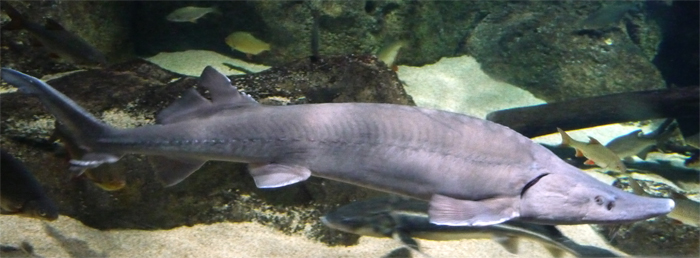
The Starry Sturgeon has a slim body and a long, thin, straight snout. The snout accounts for approximately 25% of the fish's total length.[1][2]
It has five small barbels positioned closer to its mouth than to its snout tip. Its lateral line contains between 30 and 40 scales, which are pale.[3][4][5]
The dorsal side is dark greyish-green or brown, while the underside is pale. Protective scutes run along its upper side.[6][7]
The Starry Sturgeon reaches approximately 220 cm in length and can weigh up to 80 kg.[8][9]
Habitat
The Starry Sturgeon inhabits coastal, marine, and estuarine environments.[10]
During spawning migrations, it prefers rivers with strong currents and stone-covered bottoms. When suitable spawning habitat is unavailable in rivers, it has been recorded in flooded riverbanks with sandy bottoms.[11][12]
The species occurs naturally in the coastal and basin waters of the Black, Azov, and Caspian seas. It has been extirpated from the Aegean Sea and is currently absent there.[13][14][15]
Diet
The Starry Sturgeon feeds on fish, worms, crustaceans, and mollusks.[16]
Behaviour
The Starry Sturgeon rests on the seabed during daylight hours and feeds mainly at night.[17]
It migrates upstream into shallow waters to spawn. Individuals do not seek or consume food during spawning migrations and resume feeding after spawning.[18][19]
Reproduction and life cycle
Male Starry Sturgeons reach sexual maturity after approximately 6–12 years, while females mature after approximately 8–14 years.[20][21]
Males reproduce at intervals of approximately two to three years. Females reproduce at intervals of approximately three to four years.[22][23]
Spawning occurs at depths of up to 5 metres over stony riverbed substrates. The preferred water-flow velocity at spawning sites exceeds 1 metre per second.[24][25]
Juvenile growth is promoted by water temperatures of approximately 25–26°C.[26]
Conservation
The Starry Sturgeon was classified as critically endangered on the IUCN Red List in 2019. It is believed to have lost 95% of its population over three generations.[27][28]
The species is threatened by habitat loss, overfishing, introduced pathogens, and competition from non-native sturgeons. Illegal fishing is identified as a major threat to its survival.[29][30]
Hatcheries in Ukraine, Kazakhstan, and Azerbaijan have been constructed to breed Starry Sturgeons artificially. Juveniles are released into the Caspian Sea to counter population declines.[31][32]
The species has a low minimum population doubling time estimated at 4.5–14 years. FishBase reports a very high vulnerability score of 85 out of 100.[33][34]
The maximum reported age of the Starry Sturgeon is 27 years.[35]
Uses
The Starry Sturgeon is commercially harvested as a food fish in European cuisines. It is an important source of sevruga caviar.[36][37]
Its meat is used in dishes such as kebabs and can be pan-fried, smoked, or broiled.[38]
Classification of the Starry Sturgeon
| Kingdom | Animalia |
|---|---|
| Phylum | Chordata |
| Subphylum | Vertebrata |
| Infraphylum | Gnathostomata |
| Parvphylum | Osteichthyes |
| Gigaclass | Actinopterygii |
| Superclass | Actinopteri |
| Class | Chondrostei |
| Order | Acipenseriformes |
| Family | Acipenseridae (Sturgeon) |
| Genus | Acipenser (Sturgeons) |
| Species | Acipenser stellatus Pallas, 1771 |
Where the Starry Sturgeon is found
Checklists and occurrence records place Acipenser stellatus in 14 countries. GBIF holds 392 georeferenced records of it.
Countries
- Austria 3
- Belgium 4
- Czechia 11
- Denmark 3
- Finland 3
- Germany 3
- Iran 20
- Kazakhstan 9
- Romania 40
- Russia 54
- Serbia 6
- The Netherlands 3
- Turkey 37
- Ukraine 196
Regions and cities with the most records
- Odesa, Ukraine 54
- Kayseri, Turkey 16
- České Budějovice, Czechia 11
- Astrakhan Oblast, Russia 9
- Chornomors’k, Ukraine 9
- Tulcea County, Romania 9
- Cheremushky, Ukraine 8
- Kherson, Ukraine 8
- Odesa, Ukraine 8
- Kherson, Ukraine 7
- Oleshky, Ukraine 7
- Bilhorod-Dnistrovskyi, Ukraine 6
- Pivdenne, Ukraine 6
- Krasnodar Krai, Russia 5
- Atyrau, Kazakhstan 4
- Balykshi, Kazakhstan 4
- Astrakhan, Russia 3
- Gilan Province, Iran 3
A number beside a place is its count of GBIF occurrence records. A place without a number comes from a checklist alone. Records show where a species has been observed or collected, which can include escapes and vagrants.
Common names
English
- Starry Sturgeon
- Sevruga
- Star Sturgeon
- Stellate Sturgeon
Names in 20 other languages
- Albanian
- blini me yje, blini turigjatë
- Azerbaijani
- Ag-Balyg, Uzun-burun
- Bulgarian
- pastruga, pastrugа, Пъструга
- Dutch
- spitssnuitsteur, stersteur
- Finnish
- tähtisampi
- French
- esturgeon étoilé, sevruga
- German
- Scherg, Sternhausen
- Greek
- Aστροξυρύχι, Αστροξυρίχι, Αστροξυρύχι
- Italian
- storione stellato
- Kazakh
- Shokkyr
- Lithuanian
- žvaigždėtasis eršketas
- Polish
- siewruga
- Romanian
- pastruga
- Russian
- Sevryuga, Shevriga, Осетр севрюга, севрюга
- Slovenian
- sevruga
- Spanish
- esturión estrellado
- Swedish
- stjärnstör
- Turkish
- mersin baligi, mersin balığı
- Ukrainian
- Осетер севрюга, Севрюга, Севрюга звичайна
- tuk
- Tirana
Synonyms
11 other scientific names have been used for this species and are now treated as synonyms of Acipenser stellatus.
- Acipenser (Huso) stellatus Pallas, 1771
- Acipenser (Sterletus) stellatus Pallas, 1771
- Acipenser helops Pallas, 1814
- Acipenser ratzeburgii Brandt, 1833
- Acipenser rostratus Brandt & Ratzeburg, 1833
- Acipenser seuruga Bonnaterre, 1788
- Acipenser stellatus danubialis Brusina, 1902
- Acipenser stellatus donensis Lovetsky, 1834
- Acipenser stellatus illyricus Brusina, 1902
- Huso stellatus (Pallas, 1771)
- Sterletus stellatus (Pallas, 1771)
Subspecies and varieties
- Acipenser stellatus ponticus subspecies
- Acipenser stellatus stellatus subspecies
Related species
-
 Lake SturgeonAcipenser fulvescens
-
 White SturgeonAcipenser transmontanus
-
 Dabry's SturgeonAcipenser dabryanus
-
 Atlantic SturgeonAcipenser oxyrinchus
-
 Russian SturgeonAcipenser gueldenstaedtii
-
 Chinese SturgeonAcipenser sinensis
-
 SterletAcipenser ruthenus
-
 Siberian SturgeonAcipenser baerii
Compare
Questions and answers
What is the scientific name of the Starry Sturgeon?
The scientific name of the Starry Sturgeon is Acipenser stellatus. Written with its author, the full name is Acipenser stellatus Pallas, 1771.
Which family does the Starry Sturgeon belong to?
Acipenser stellatus belongs to the family Acipenseridae, in the order Acipenseriformes and the class Chondrostei.
Where is the Starry Sturgeon found?
Checklists and occurrence records place Acipenser stellatus in 14 countries, including Ukraine, Russia, Romania, Turkey, Iran and Czechia.
What is the conservation status of the Starry Sturgeon?
The IUCN Red List category recorded for Acipenser stellatus is Critically Endangered (CR).
What other names does the Starry Sturgeon have?
Acipenser stellatus is also known in English as Sevruga, Star Sturgeon and Stellate Sturgeon.
Why is sturgeon illegal to fish?
Illegal fishing is identified as a major threat to the Starry Sturgeon's survival. The species is threatened by overfishing and was classified as critically endangered on the IUCN Red List in 2019.[27][29][30]
What do sturgeon fish eat?
The Starry Sturgeon feeds on fish, worms, crustaceans, and mollusks.[16]
Sources
Passages the profile rests on
- The starry sturgeon has a slim body and a long, thin, straight snout. Source passage: “It is a slim-bodied fish, easily distinguished from other sturgeons by its long, thin, and straight snout” — English Wikipedia
- The snout accounts for approximately 25% of the fish's total length. Source passage: “that makes up roughly 25% of its total length.” — English Wikipedia
- The fish has five small barbels positioned closer to its mouth than to its snout tip. Source passage: “A row of five small barbels lies closer to the mouth than to the tip of the snout.” — English Wikipedia
- The lateral line contains between 30 and 40 scales. Source passage: “The scales on the lateral line number between 30 and 40” — English Wikipedia
- The scales along the lateral line are pale. Source passage: “The scales on the lateral line are pale.” — English Wikipedia
- The dorsal side is dark greyish-green or brown, while the underside is pale. Source passage: “Its general colouring is dark greyish-green or brown with a pale underside.” — English Wikipedia
- The fish has protective scutes along its upper side. Source passage: “It has many scutes along its top side to act as protection.” — English Wikipedia
- The starry sturgeon reaches approximately 220 cm in length. Source passage: “The starry sturgeon reaches about 220 cm (7.2 ft) in length” — English Wikipedia
- The species can weigh up to 80 kg. Source passage: “weighs up to 80 kg (180 lb).” — English Wikipedia
- The species inhabits coastal, marine, and estuarine environments. Source passage: “The starry sturgeon can be found in coastal, sea, and estuarine environments.” — English Wikipedia
- During spawning migrations, the species prefers rivers with strong currents and stone-covered bottoms. Source passage: “During the spring spawn season, the species is known to migrate to rivers with heavy currents and have a preference for stone-filled river bottoms.” — English Wikipedia
- When suitable spawning habitat is unavailable in rivers, the species has been recorded in flooded riverbanks with sandy bottoms. Source passage: “If a river is not an optimal spawn habitat, sturgeon have been recorded to reside in flooded river banks with sandy ground.” — English Wikipedia
- The species occurs naturally in the coastal and basin waters of the Black, Azov, and Caspian seas. Source passage: “It is native to coastal and basin waters of the Black, Azov, Caspian, and Aegean seas” — English Wikipedia
- The species has been extirpated from the Aegean Sea. Source passage: “but it has been extirpated from the last” — English Wikipedia
- The starry sturgeon is currently absent from the Aegean Sea. Source passage: “but is now absent from the Aegean Sea.” — English Wikipedia
- The starry sturgeon feeds on fish, worms, crustaceans, and mollusks. Source passage: “that feeds on fish, worms, crustaceans, and mollusks.” — English Wikipedia
- The species rests on the seabed during daylight hours and feeds mainly at night. Source passage: “It lies on the bottom of the seabed during the day and feeds mostly at night.” — English Wikipedia
- The starry sturgeon migrates upstream into shallow waters to spawn. Source passage: “This fish is anadromous and moves upriver into shallow waters to spawn during spring and winter.” — English Wikipedia
- Individuals do not seek or consume food during spawning migrations and resume feeding after spawning. Source passage: “During migration, starry sturgeons do not seek or consume food until after the spawning period is complete” — English Wikipedia
- Male starry sturgeons reach sexual maturity after approximately 6–12 years. Source passage: “after 6-12 years of sexual maturity development” — English Wikipedia
- Females reach sexual maturity after approximately 8–14 years. Source passage: “after 8-14 years of sexual maturity.” — English Wikipedia
- Males reproduce at intervals of approximately two to three years. Source passage: “Male sturgeons reproduce every 2-3 years” — English Wikipedia
- Females reproduce at intervals of approximately three to four years. Source passage: “while females follow suit every 3-4 years” — English Wikipedia
- Spawning occurs at depths of up to 5 metres over stony riverbed substrates. Source passage: “Spawning sturgeon appears at depths down to 5 m (16.4 ft) on the stone ground of riverbeds” — English Wikipedia
- The preferred water-flow velocity at spawning sites exceeds 1 metre per second. Source passage: “with a preferred water flow velocity greater than 1 m/s (2.2 mph).” — English Wikipedia
- Juvenile growth is promoted by water temperatures of approximately 25–26°C. Source passage: “Optimal temperatures for growing juveniles is from 25-26°C (77-78.8°F)” — English Wikipedia
- The starry sturgeon was classified as critically endangered on the IUCN Red List in 2019. Source passage: “On the IUCN Red List of Threatened Species, the starry sturgeon was classified as "critically endangered" in 2019.” — English Wikipedia
- The species is believed to have lost 95% of its population over three generations. Source passage: “The species is believed to have undergone a loss of 95% of its population in three generations.” — English Wikipedia
- The species is threatened by habitat loss, overfishing, introduced pathogens, and competition from non-native sturgeons. Source passage: “The starry sturgeon species is threatened by habitat loss, overfishing, introduction of unfamiliar pathogens, and increased competition from non-native sturgeon species.” — English Wikipedia
- Illegal fishing is identified as a major threat to the species' survival. Source passage: “Illegal fishing is a major threat to the survival of this species.” — English Wikipedia
- Hatcheries in Ukraine, Kazakhstan, and Azerbaijan have been constructed to breed starry sturgeons artificially. Source passage: “Hatcheries along Caspian territories and independent countries such as Ukraine, Kazakhstan, and Azerbaijan, have been constructed to artificially breed starry sturgeons and other sturgeon species to increase populations.” — English Wikipedia
- Juvenile starry sturgeons are released into the Caspian Sea to counter population declines. Source passage: “The countries involved have increased the release of juveniles into the Caspian Sea to combat the population decline.” — English Wikipedia
- The species has a low minimum population doubling time estimated at 4.5–14 years. Source passage: “Low, minimum population doubling time 4.5 - 14 years” — fishbase.se
- FishBase reports a very high vulnerability score of 85 out of 100 for the species. Source passage: “Very high vulnerability (85 of 100).” — fishbase.se
- The maximum reported age of the starry sturgeon is 27 years. Source passage: “The maximum reported age for this species is 27 years.” — English Wikipedia
- The starry sturgeon is commercially harvested as a food fish in European cuisines. Source passage: “The starry sturgeon is an important commercial fish species that serves as food in many cuisines across Europe.” — English Wikipedia
- The species is an important source of sevruga caviar. Source passage: “It is an essential source of caviar, see Sevruga caviar” — English Wikipedia
- Its meat is used in dishes such as kebabs and can be pan-fried, smoked, or broiled. Source passage: “It can be a common ingredient in kababs, and can be cooked in various methods such as pan frying, smoking, and broiling” — English Wikipedia
Data
- Catalogue of Life, 2026-10-16 XR cc by
- Global Biodiversity Information Facility CC BY 4.0
- Wikidata CC0
- GeoNames CC BY 4.0
- Wikimedia Commons per image; credit shown with each image
- Within the Catalogue of Life, this name comes from World Register of Marine Species cc by
References
- Pallas, P. S. (1771). Reise durch verschiedene Provinzen des Russischen Reichs. Theil 1. Physicalische Reise durch verschiedene Provinzen des Russischen Reichs im 1768- und 1769 sten Jahren. St. Petersburg: Kayserliche Akademie Der Wissenschaften, 12. where the name was published
This species in other databases
Page built on 28 November 2026. See how the catalog is made and all sources and licences.
Cite this page
ScientificNames.org. (2026). Acipenser stellatus (Starry Sturgeon). Retrieved November 28, 2026, from https://scientificnames.org/species/acipenser-stellatus
“Acipenser stellatus (Starry Sturgeon).” ScientificNames.org, 2026, scientificnames.org/species/acipenser-stellatus. Accessed 28 Nov. 2026.
ScientificNames.org. “Acipenser stellatus (Starry Sturgeon).” Accessed November 28, 2026. https://scientificnames.org/species/acipenser-stellatus.
@misc{scientificnames_acipenser_stellatus_starry_sturgeon,
  author = {{ScientificNames.org}},
  title = {Acipenser stellatus (Starry Sturgeon)},
  year = {2026},
  url = {https://scientificnames.org/species/acipenser-stellatus},
  note = {Accessed 2026-11-28}
}