Species · Flowering plants
Crucifixion Thorns Canotia holacantha
The scientific name of the Crucifixion Thorns is Canotia holacantha. It is a species of flowering plant in the family Celastraceae (staff-tree family), order Celastrales.
- Scientific name
- Canotia holacantha Torr.
- Common name
- Crucifixion Thorns
- Genus
- Canotia
- Family
- Celastraceae (Staff-tree Family)
- Order
- Celastrales
- Class
- Magnoliopsida
- Red List category
- LC Least Concern
- Recorded in
- 3 countries
- Name status
- accepted in the Catalogue of Life
Overview
Crucifixion thorns is a flowering shrub or small tree belonging to the Celastraceae family. It grows in desert scrub environments, particularly on slopes and in washes, across Arizona and southeastern California, with isolated locations in Baja California and Sonora, Mexico. It has gray-green thorny branches, small leaves that are shed quickly, and reddish-brown seed capsules that persist in hanging clusters of five.
Written 26 November 2026 from the sources listed below. Each statement was checked against the passage it cites; statements that could not be supported were removed.
Appearance
Crucifixion thorns typically has gray-green branches ending in sharp thorns. It performs photosynthesis through its twigs rather than its short-lived leaves, which are small scales that are shed quickly and are rarely visible.[1][2][3]
Its reddish-brown seed capsules persist in hanging clusters of five. The plant typically reaches a height of 10–15 feet (3.0–4.6 meters).[4][5]
An individual in the eastern Mojave Desert near Wikieup, Arizona, exceeds 30 feet (9.1 meters) in height.[6]
Habitat
Crucifixion thorns grows in desert scrub environments, particularly on slopes and in washes.[7]
The species occurs across central Arizona in the higher Sonoran Desert and extends into the Mojave Desert of California and northwest Arizona. It also occurs in the lower reaches of the Grand Canyon.[8][9]
Similar species
Crucifixion thorns closely resembles the unrelated foothill palo verde (Parkinsonia microphylla).[10]
Uses
Crucifixion thorns is cultivated using seeds.[11]
Classification of the Crucifixion Thorns
| Kingdom | Plantae |
|---|---|
| Subkingdom | Pteridobiotina |
| Phylum | Tracheophyta |
| Class | Magnoliopsida |
| Order | Celastrales |
| Family | Celastraceae (Staff-tree Family) |
| Subfamily | Celastroideae |
| Tribe | Euonymae |
| Genus | Canotia |
| Species | Canotia holacantha Torr. |
Where the Crucifixion Thorns is found
Checklists and occurrence records place Canotia holacantha in 3 countries across North America. GBIF holds 2,542 georeferenced records of it.
Countries
Regions and cities with the most records
- Arizona, United States 2,191
- Kingman, United States 276
- Fountain Hills, United States 103
- Payson, United States 23
- Sonora, Mexico 17
- Magdalena de Kino, Mexico 12
- Apache Junction, United States 11
- Scottsdale, United States 11
- Mesa, United States 4
- Lake Havasu City, United States 3
- Phoenix, United States 3
- Prescott, United States 3
- Prescott Valley, United States 3
- Tempe, United States 3
- Tempe Junction, United States 3
Range as the checklists state it
USA (Arizona); Mexico (Baja California Norte, Sonora)
A number beside a place is its count of GBIF occurrence records. A place without a number comes from a checklist alone. Records show where a species has been observed or collected, which can include escapes and vagrants.
Common names
English
- Crucifixion Thorns
Names in 1 other language
- Spanish
- Corona de cristo, Junco
Related species
- Canotia wendtii
-
 BurningbushEuonymus alatus
-
 European Spindle-treeEuonymus europaeus
-
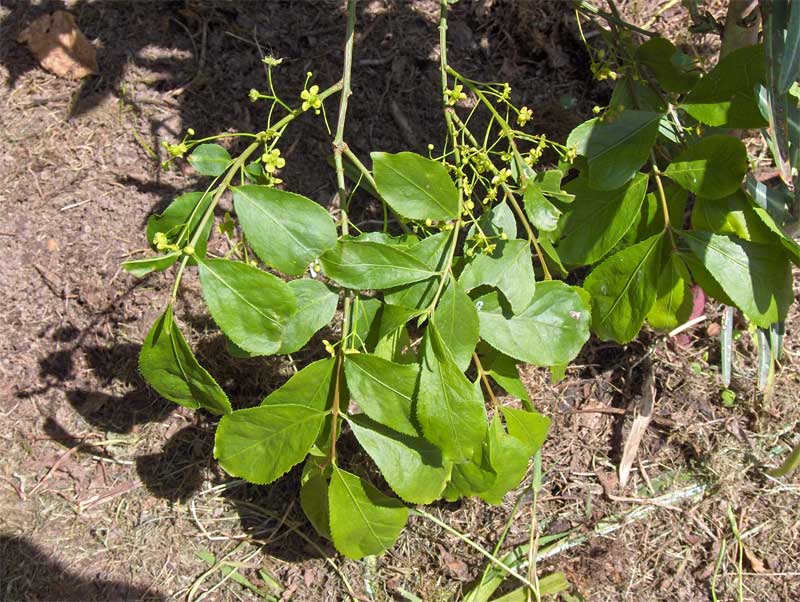 Japanese SpindleEuonymus japonicus
-
 Fortune's EuonymusEuonymus fortunei
-
 Asian BittersweetCelastrus orbiculatus
-
 American Strawberry BushEuonymus americanus
-
 Climbing BittersweetCelastrus scandens
Compare
Questions and answers
What is the scientific name of the Crucifixion Thorns?
The scientific name of the Crucifixion Thorns is Canotia holacantha. Written with its author, the full name is Canotia holacantha Torr..
Which family does the Crucifixion Thorns belong to?
Canotia holacantha belongs to the family Celastraceae, in the order Celastrales and the class Magnoliopsida.
Where is the Crucifixion Thorns found?
Checklists and occurrence records place Canotia holacantha in 3 countries: United States, Mexico and Panama.
What is the conservation status of the Crucifixion Thorns?
The IUCN Red List category recorded for Canotia holacantha is Least Concern (LC).
Sources
Passages the profile rests on
- The plant typically has gray-green branches ending in sharp thorns. Source passage: “It is usually a scrubby species, with gray-green branches tipped with sharp thorns.” — English Wikipedia
- The plant performs photosynthesis through its twigs rather than its short-lived leaves. Source passage: “This species handles photosynthesis with its twigs, rather than the short-lived leaves” — English Wikipedia
- Its leaves are small scales that are shed quickly and are rarely visible. Source passage: “Its leaves are insignificant scales which are quickly shed and rarely seen” — English Wikipedia
- Its reddish-brown seed capsules persist in hanging clusters of five. Source passage: “persistent clusters of reddish-brown seed capsules which hang in groups of five.” — English Wikipedia
- The plant typically reaches a height of 10–15 feet (3.0–4.6 meters). Source passage: “Canotia holacantha reaches a height of 10–15 feet (3.0–4.6 m).” — English Wikipedia
- An individual in the eastern Mojave Desert near Wikieup, Arizona, exceeds 30 feet (9.1 meters) in height. Source passage: “one specimen located in the eastern Mojave Desert near Wikieup, Arizona is known to exceed 30 feet (9.1 m) in height.” — English Wikipedia
- The species grows in desert scrub environments, particularly on slopes and in washes. Source passage: “Canotia grows in desert scrub environments, primarily on slopes or in washes.” — English Wikipedia
- The species occurs across central Arizona in the higher Sonoran Desert and extends into the Mojave Desert of California and northwest Arizona. Source passage: “It is found in the higher Sonoran Desert across central Arizona, reaching to the Mojave Desert of California and northwest Arizona” — English Wikipedia
- The species also occurs in the lower reaches of the Grand Canyon. Source passage: “and into the lower reaches of the Grand Canyon.” — English Wikipedia
- Canotia holacantha closely resembles the unrelated foothill palo verde (Parkinsonia microphylla). Source passage: “like the unrelated Foothill palo verde (Parkinsonia microphylla) which it closely resembles.” — English Wikipedia
- Canotia holacantha is cultivated using seeds. Source passage: “Canotia is grown in cultivation by seeds.” — English Wikipedia
Data
- Catalogue of Life, 2026-10-16 XR cc by
- Global Biodiversity Information Facility CC BY 4.0
- Wikidata CC0
- GeoNames CC BY 4.0
- Within the Catalogue of Life, this name comes from Synonymic Checklists of the Vascular Plants of the World cc by
References
- Torr. Pacif. Railr. Rep. 4(5, no. 4), Bot. [Whipple] 68 (1856). where the name was published
This species in other databases
Page built on 28 November 2026. See how the catalog is made and all sources and licences.
Cite this page
ScientificNames.org. (2026). Canotia holacantha (Crucifixion Thorns). Retrieved November 28, 2026, from https://scientificnames.org/species/canotia-holacantha
“Canotia holacantha (Crucifixion Thorns).” ScientificNames.org, 2026, scientificnames.org/species/canotia-holacantha. Accessed 28 Nov. 2026.
ScientificNames.org. “Canotia holacantha (Crucifixion Thorns).” Accessed November 28, 2026. https://scientificnames.org/species/canotia-holacantha.
@misc{scientificnames_canotia_holacantha_crucifixion_thorns,
  author = {{ScientificNames.org}},
  title = {Canotia holacantha (Crucifixion Thorns)},
  year = {2026},
  url = {https://scientificnames.org/species/canotia-holacantha},
  note = {Accessed 2026-11-28}
}