Species · Flowering plants
Chinese Sumac Rhus chinensis
The scientific name of the Chinese Sumac is Rhus chinensis. It is a species of flowering plant in the family Anacardiaceae (sumac family), order Sapindales.
- Scientific name
- Rhus chinensis Mill.
- Common name
- Chinese Sumac
- Genus
- Rhus
- Family
- Anacardiaceae (Sumac Family)
- Order
- Sapindales
- Class
- Magnoliopsida
- Red List category
- LC Least Concern
- Recorded in
- 18 countries
- Name status
- accepted in the Catalogue of Life

Overview
Chinese sumac is a deciduous shrub or small tree. The species is common in East and South Asia. Its leaves turn red in autumn before falling.
Written 26 November 2026 from the sources listed below. Each statement was checked against the passage it cites; statements that could not be supported were removed.
Appearance
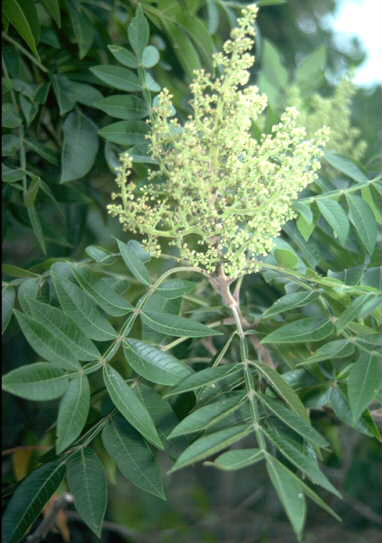
Chinese sumac is a deciduous shrub or small tree that can grow to 6 m tall. Its leaves consist of several leaflets and turn red in autumn before falling.[1][2][3][4]
The species has creamy-white flowers and mature fruits that are orange or red drupes. Each fruit contains one seed.[5][6][7]
Habitat
Chinese sumac is common in East and South Asia and occurs in temperate, subtropical and tropical regions. It grows in areas with marginal agricultural capacity.[8][9][10]
Behaviour
Infestation by Chinese sumac aphids may induce gall production. Galla chinensis is the gall produced by the Chinese aphid Schlechtendalia chinensis on the leaves of the species.[11][12]
Reproduction and life cycle
Each fruit contains one seed.[7]
Uses
Chinese sumac is cultivated as an ornamental plant in temperate climates. Galls produced on the species are a source of gallotannins.[13][14]
Chinese galls from the species are traditionally used in Chinese medicine to treat coughs, diarrhea, night sweats and dysentery. They are also used for intestinal and uterine bleeding.[15][16][17][18][19]
The leaves and roots are traditionally used as depuratives and to stimulate blood circulation. A decoction of the species is traditionally used to treat hemoptysis, laryngitis, snakebite, stomachache and traumatic fractures.[20][21][22][23][24][25][26]
The ripe fruits are traditionally used in Asia to treat dysentery and diarrhea. The fruit is also traditionally used as a food preservative.[27][28][29]
The seeds are traditionally used to treat malaria and rheumatism.[30][31]
Compounds isolated from the stem have demonstrated HIV-1 inhibitory activity in vitro. Other compounds from the species have demonstrated inhibitory effects on enamel demineralization in vitro and enhancement of fluoride-assisted dental enamel remineralization.[32][33][34]
Classification of the Chinese Sumac
| Kingdom | Plantae |
|---|---|
| Subkingdom | Pteridobiotina |
| Phylum | Tracheophyta |
| Class | Magnoliopsida |
| Order | Sapindales |
| Family | Anacardiaceae (Sumac Family) |
| Tribe | Rhoeae |
| Genus | Rhus (Sumac) |
| Species | Rhus chinensis Mill. |
Where the Chinese Sumac is found
Checklists and occurrence records place Rhus chinensis in 18 countries across Asia. GBIF holds 10,806 georeferenced records of it.
Countries
- Bangladesh
- Bhutan 9
- Cambodia 2
- China 4,891
- Hong Kong 91
- India 85
- Indonesia 17
- Japan 1,920
- Laos 11
- Macao 52
- Myanmar 37
- Nepal 27
- North Korea 24
- Pakistan 4
- South Korea 947
- Taiwan 2,571
- Thailand 59
- Vietnam 59
Regions and cities with the most records
- Taiwan, Taiwan 1,520
- Yunnan, China 568
- Banqiao, Taiwan 493
- Taipei, Taiwan 460
- Sichuan, China 434
- New Taipei City, Taiwan 431
- Neihu, Taiwan 420
- Anhui, China 399
- Xizhi, Taiwan 386
- Shulin, Taiwan 342
- Hubei, China 319
- Chongqing, China 297
- Jiangxi, China 269
- Azamino, Japan 247
- Taipei, Taiwan 247
- Machida, Japan 240
- Inagi, Japan 237
- Noborito, Japan 231
- Fuchū, Japan 230
- Minamirinkan, Japan 228
- Minawa, Japan 228
- Zama, Japan 224
- Danshui, Taiwan 222
- Komae, Japan 220
- Chōfu, Japan 219
- Yamato, Japan 219
- Tokyo, Japan 218
- Kokubunji, Japan 215
- Guangdong, China 214
- Aihara, Japan 211
- Kanagawa, Japan 210
- Sanxia, Taiwan 210
- Guizhou, China 207
- Musashino, Japan 204
- Tama, Japan 204
- Koganei, Japan 203
2 more countries have a few records outside this range
These countries hold a few records of Rhus chinensis but lie outside the range the checklists give for it. Such records are often zoo or garden specimens, museum material or vagrants, so the species is not counted as occurring there.
Range as the checklists state it
China (Hainan, Guangdong, Guangxi, Hunan, Hubei, Jiangxi, Fujian, Zhejiang, Anhui, Jiangsu, Shandong, Hebei, Henan, Shanxi, Shaanxi, Ningxia, Gansu, Qinghai, Sichuan, Guizhou, Yunnan); Tibet; North Korea; South Korea; Japan (Hokkaido, Honshu, Shikoku, Kyushu); Ryukyu Isl.; Taiwan; Pakistan (Swat, Hazara, Murree); Bhutan; India (Arunachal Pradesh, Assam, Himachal Pradesh, Jammu & Kashmir, Manipur, Meghalaya, Nagaland, Rajasthan Sikkim, Uttar Pradesh, Uttarakhand, West Bengal); Bangladesh; Myanmar (Chin, Kachin, Mandalay, Mon, Sagaing, Shan); Thailand; Laos; Cambodia; peninsular Malaysia; Borneo
A number beside a place is its count of GBIF occurrence records. A place without a number comes from a checklist alone. Records show where a species has been observed or collected, which can include escapes and vagrants.
Common names
English
- Chinese Sumac
- Chinese Gall
- Nutgall
- Nutgalltree
Names in 12 other languages
- Chinese
- 五倍子, 五倍子苗, 地耳草(田基黄), 滨盐肤木(盐肤木), 盐肤叶, 盐肤子, 盐肤木, 盐肤木根
- Czech
- škumpa čínská
- Estonian
- hiina sumahh
- French
- Sumac de Chine
- German
- Gallen-Sumach
- Japanese
- ヌルデ
- Korean
- 붉나무
- Polish
- sumak chiński
- Russian
- Сумах китайский
- Slovak
- sumach hálkový
- Turkish
- Sumak
- asm
- নগা টেঙা
Synonyms
15 other scientific names have been used for this species and are now treated as synonyms of Rhus chinensis.
- Rhus chinensis f. purpurea (Sprenger) Rehder
- Rhus chinensis var. glabra S.B.Liang
- Rhus japonica Buch.-Ham. ex D.Don
- Rhus javanica f. toyohashiensis (Hayashi) Satomi
- Rhus javanica var. chinensis (Mill.) T.Yamaz.
- Rhus javanica var. toyohashiensis Hayashi
- Rhus osbeckii DC. ex Steud.
- Rhus semialata Murray
- Rhus semialata Brandis
- Rhus semialata f. exalata Franch.
- Rhus semialata var. osbeckii DC.
- Rhus semialata var. purpurea Sprenger
- Rhus simonii Carrière
- Schinus indicus Burm.fil.
- Toxicodendron semialatum (Murray) Kuntze
Subspecies and varieties
- Rhus chinensis var. chinensis variety
- Rhus chinensis var. roxburghii variety
Related species
-
 Staghorn SumacRhus typhina
-
 SumacRhus coriaria
-
 Smooth SumacRhus glabra
-
 Fragrant SumacRhus aromatica
-
 Shining SumacRhus copallina
-
 LemonadeberryRhus integrifolia
-
 Skunkbush SumacRhus trilobata
-
 Sugar BushRhus ovata
Compare
Questions and answers
What is the scientific name of the Chinese Sumac?
The scientific name of the Chinese Sumac is Rhus chinensis. Written with its author, the full name is Rhus chinensis Mill..
Which family does the Chinese Sumac belong to?
Rhus chinensis belongs to the family Anacardiaceae, in the order Sapindales and the class Magnoliopsida.
Where is the Chinese Sumac found?
Checklists and occurrence records place Rhus chinensis in 18 countries, including China, Taiwan, Japan, South Korea, Hong Kong and India.
What is the conservation status of the Chinese Sumac?
The IUCN Red List category recorded for Rhus chinensis is Least Concern (LC).
What other names does the Chinese Sumac have?
Rhus chinensis is also known in English as Chinese Gall, Nutgall and Nutgalltree.
What are the medicinal uses of Rhus chinensis?
Chinese galls are traditionally used in Chinese medicine to treat coughs, diarrhea, night sweats, dysentery, and intestinal and uterine bleeding. The leaves and roots are used as depuratives and to stimulate blood circulation. A decoction is traditionally used for hemoptysis, laryngitis, snakebite, stomachache and traumatic fractures; ripe fruits are used for dysentery and diarrhea, and seeds for malaria and rheumatism.[15][16][17][18][19][20][21][22][23][24][25][26][27][28][30][31]
What is rhus chinensis?
Rhus chinensis Mill., known as Chinese sumac, is a flowering plant in the family Anacardiaceae, order Sapindales and class Magnoliopsida. It is a deciduous shrub or small tree.[1]
Sources
Passages the profile rests on
- Rhus chinensis is a deciduous shrub or small tree. Source passage: “is a deciduous shrub or small tree in the genus Rhus.” — English Wikipedia
- The species can grow to 6 m tall. Source passage: “Growing to 6 m (20 ft) tall” — English Wikipedia
- Its leaves consist of several leaflets. Source passage: “leaves comprising several leaflets.” — English Wikipedia
- Its leaves turn red in autumn before falling. Source passage: “These turn red in autumn before falling.” — English Wikipedia
- Its flowers are creamy-white. Source passage: “and creamy‐white flowers.” — pmc.ncbi.nlm.nih.gov
- Its mature fruits are orange or red drupes. Source passage: “The fruits (drupes) are orange or red in color at maturity” — pmc.ncbi.nlm.nih.gov
- Each fruit contains one seed. Source passage: “and contain one seed” — pmc.ncbi.nlm.nih.gov
- The species is common in East and South Asia. Source passage: “The plant is common in East and South Asia” — English Wikipedia
- The species grows in areas with marginal agricultural capacity. Source passage: “The species grows in areas with marginal agricultural capacity” — pmc.ncbi.nlm.nih.gov
- The species occurs in temperate, subtropical and tropical regions. Source passage: “is widely distributed in temperate, subtropical, and tropical regions” — pmc.ncbi.nlm.nih.gov
- Infestation by Chinese sumac aphids may induce gall production. Source passage: “Infestation of the tree by Chinese sumac aphids (Melaphis chinensis Bell) may lead to production of a gall” — English Wikipedia
- Galla chinensis is the gall produced by the Chinese aphid Schlechtendalia chinensis on the leaves of this species. Source passage: “Galla chinensis or Galla rhois is the term used to describe the gall caused by the Chinese aphid, Schlechtendalia chinensis (Bell), on the leaves of Rhus chinensis” — pmc.ncbi.nlm.nih.gov
- The species is cultivated as an ornamental plant in temperate climates. Source passage: “is cultivated as an ornamental in temperate climates.” — English Wikipedia
- Galls produced on this species are a source of gallotannins. Source passage: “Galls produced on the species that are called Chinese gall (Galla chinensis), are a source of gallotannins” — English Wikipedia
- Chinese galls from the species are used in traditional Chinese medicine to treat coughs. Source passage: “Chinese galls are used in traditional Chinese medicine for coughs,” — English Wikipedia
- Chinese galls from the species are used in traditional Chinese medicine to treat diarrhea. Source passage: “Chinese galls are used in traditional Chinese medicine for coughs, diarrhea,” — English Wikipedia
- Chinese galls from the species are used in traditional Chinese medicine to treat night sweats. Source passage: “diarrhea, night sweats,” — English Wikipedia
- Chinese galls from the species are used in traditional Chinese medicine to treat dysentery. Source passage: “night sweats, dysentery,” — English Wikipedia
- Chinese galls from the species are used in traditional Chinese medicine for intestinal and uterine bleeding. Source passage: “and intestinal and uterine bleeding.” — English Wikipedia
- The leaves and roots are traditionally used as depuratives. Source passage: “The leaves and the root are used as depuratives” — pmc.ncbi.nlm.nih.gov
- The leaves and roots are traditionally used to stimulate blood circulation. Source passage: “stimulating blood circulation.” — pmc.ncbi.nlm.nih.gov
- A decoction of the species is traditionally used to treat hemoptysis. Source passage: “Its decoction is used in the treatment of hemoptysis” — pmc.ncbi.nlm.nih.gov
- A decoction of the species is traditionally used to treat laryngitis. Source passage: “inflammations, laryngitis,” — pmc.ncbi.nlm.nih.gov
- A decoction of the species is traditionally used to treat snakebite. Source passage: “laryngitis, snakebite,” — pmc.ncbi.nlm.nih.gov
- A decoction of the species is traditionally used to treat stomachache. Source passage: “snakebite, stomachache” — pmc.ncbi.nlm.nih.gov
- A decoction of the species is traditionally used to treat traumatic fractures. Source passage: “and traumatic fractures” — pmc.ncbi.nlm.nih.gov
- The ripe fruits are traditionally used in Asia to treat dysentery. Source passage: “The ripe fruits of this plant have long been used in Asia to treat dysentery” — pmc.ncbi.nlm.nih.gov
- The ripe fruits are traditionally used in Asia to treat diarrhea. Source passage: “to treat dysentery and diarrhea” — pmc.ncbi.nlm.nih.gov
- The fruit is traditionally used as a food preservative. Source passage: “and also as a food preservative” — pmc.ncbi.nlm.nih.gov
- The seeds are traditionally used to treat malaria. Source passage: “The seed is used in the treatment of cough, dysentery, fever, jaundice, malaria and rheumatism” — pmc.ncbi.nlm.nih.gov
- The seeds are traditionally used to treat rheumatism. Source passage: “malaria and rheumatism” — pmc.ncbi.nlm.nih.gov
- Compounds isolated from the stem have demonstrated HIV-1 inhibitory activity in vitro. Source passage: “compounds isolated from the stem of Rhus chinensis significantly suppressed HIV‐1 activity in vitro.” — pmc.ncbi.nlm.nih.gov
- Compounds from the species have demonstrated inhibitory effects on enamel demineralization in vitro. Source passage: “Compounds from this plant were also found to inhibit enamel demineralization in vitro” — pmc.ncbi.nlm.nih.gov
- Compounds from the species have demonstrated enhancement of fluoride-assisted dental enamel remineralization. Source passage: “and enhance remineralization of dental enamel with fluoride.” — pmc.ncbi.nlm.nih.gov
Data
- Catalogue of Life, 2026-10-16 XR cc by
- Global Biodiversity Information Facility CC BY 4.0
- Wikidata CC0
- GeoNames CC BY 4.0
- Wikimedia Commons per image; credit shown with each image
- iNaturalist per image; credit shown with each image
- Within the Catalogue of Life, this name comes from Synonymic Checklists of the Vascular Plants of the World cc by
References
- Mill. (1768). Gard. Dict., ed. 8: 7 (1768). where the name was published
This species in other databases
- Catalogue of Life 4SMYY
- Wikidata Q163116
- iNaturalist 472886
- World Flora Online wfo-0000402760
- GRIN 31679
Page built on 29 November 2026. See how the catalog is made and all sources and licences.
Cite this page
ScientificNames.org. (2026). Rhus chinensis (Chinese Sumac). Retrieved November 29, 2026, from https://scientificnames.org/species/rhus-chinensis
“Rhus chinensis (Chinese Sumac).” ScientificNames.org, 2026, scientificnames.org/species/rhus-chinensis. Accessed 29 Nov. 2026.
ScientificNames.org. “Rhus chinensis (Chinese Sumac).” Accessed November 29, 2026. https://scientificnames.org/species/rhus-chinensis.
@misc{scientificnames_rhus_chinensis_chinese_sumac,
  author = {{ScientificNames.org}},
  title = {Rhus chinensis (Chinese Sumac)},
  year = {2026},
  url = {https://scientificnames.org/species/rhus-chinensis},
  note = {Accessed 2026-11-29}
}