Species · Flowering plants
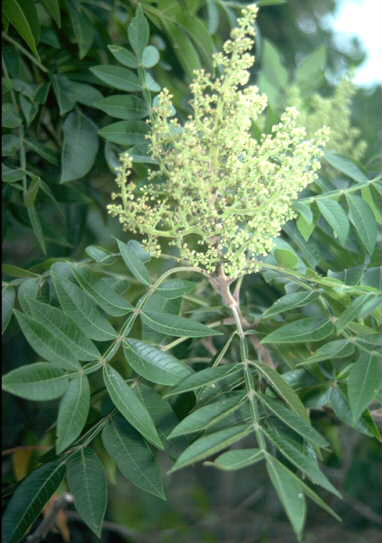
Sumac Rhus coriaria
The scientific name of the Sumac is Rhus coriaria. It is a species of flowering plant in the family Anacardiaceae (sumac family), order Sapindales.
- Scientific name
- Rhus coriaria L.
- Common name
- Sumac
- Genus
- Rhus
- Family
- Anacardiaceae (Sumac Family)
- Order
- Sapindales
- Class
- Magnoliopsida
- Red List category
- LC Least Concern
- Recorded in
- 35 countries
- Name status
- accepted in the Catalogue of Life

Overview
Sumac (Rhus coriaria L.) is a deciduous shrub that can also grow into a small tree. It is native to southern Europe and western Asia, including the Eastern Mediterranean, Crimea, the Caucasus and northern Iran. Its dried fruits are used as a spice, and its leaves and bark are traditionally used in leather tanning.
Written 26 November 2026 from the sources listed below. Each statement was checked against the passage it cites; statements that could not be supported were removed.
Appearance
Sumac is a deciduous shrub that can also develop into a small tree. Shrub forms can reach 3 metres in height, while tree forms can grow up to 5 metres.[1][2]
Habitat
Sumac grows in deep, well-drained soils, including poor, rocky, alkaline and slightly acidic soils.[3]
Behaviour
Sumac is drought-tolerant and sensitive to frost. It grows at a medium rate when developing as a shrub.[4][5][6]
Diet
The immature fruits and seeds of Sumac are eaten.[7]
Uses
The dried and crushed fruits are used as a spice in the Middle East, particularly in the spice mixture za'atar. The fruits have a sour taste and have historically been used as a souring ingredient in vinaigrettes.[8][9][10]
The leaves and bark are traditionally used in leather tanning. Different parts of the plant can also be used to produce red, yellow, black and brown dyes.[11][12]
Oil extracted from the seeds can be used in candle production.[13]
Sumac has traditionally been used for lipid-lowering effects and has also been investigated clinically for these effects.[14]
Classification of the Sumac
| Kingdom | Plantae |
|---|---|
| Subkingdom | Pteridobiotina |
| Phylum | Tracheophyta |
| Class | Magnoliopsida |
| Order | Sapindales |
| Family | Anacardiaceae (Sumac Family) |
| Tribe | Rhoeae |
| Genus | Rhus (Sumac) |
| Species | Rhus coriaria L. |
Where the Sumac is found
Checklists and occurrence records place Rhus coriaria in 35 countries across Africa, Asia and Europe. GBIF holds 12,382 georeferenced records of it.
Countries where it is native or its origin is not stated
- Afghanistan 5
- Albania 5
- Algeria 13
- Armenia 6
- Azerbaijan 74
- Bulgaria 10
- Croatia 45
- Cyprus 101
- France 6,771
- Georgia 43
- Greece 157
- Iran 36
- Iraq 63
- Israel 457
- Italy 572
- Jordan 7
- Lebanon 101
- Malta
- Montenegro 22
- North Macedonia 5
- Palestinian Territory 38
- Romania 5
- Russia 568
- Sweden 27
- Syria 33
- Tajikistan 8
- The Netherlands 7
- Turkey 296
- Turkmenistan 5
- Ukraine 391
- United Kingdom 6
- Uzbekistan 10
Countries where it has been introduced
Regions and cities with the most records
- Provence-Alpes-Côte d'Azur, France 4,707
- Aubagne, France 3,266
- Allauch, France 3,011
- Marseille 11, France 2,902
- Marseille 12, France 2,901
- Marseille 10, France 2,736
- Marseille 09, France 2,691
- La Ciotat, France 2,612
- Marseille 13, France 2,523
- Marseille 04, France 2,510
- Marseille 05, France 2,489
- Marseille 01, France 2,444
- Marseille, France 2,429
- Marseille 06, France 2,411
- Marseille 08, France 2,407
- Marseille 03, France 2,398
- Marseille 02, France 2,369
- Marseille 07, France 2,331
- Marseille 14, France 2,252
- Marseille 16, France 1,888
- Marseille 15, France 1,750
- Occitanie, France 1,248
- Gardanne, France 1,178
- Sanary-sur-Mer, France 1,005
- Les Pennes-Mirabeau, France 963
- Toulon, France 921
- La Valette-du-Var, France 901
- Saint-Maximin-la-Sainte-Baume, France 817
- La Seyne-sur-Mer, France 797
- Six-Fours-les-Plages, France 754
- La Garde, France 705
- La Crau, France 669
- Montpellier, France 639
- Lattes, France 635
- Castelnau-le-Lez, France 623
- Brignoles, France 603
1 more country has a few records outside this range
These countries hold a few records of Rhus coriaria but lie outside the range the checklists give for it. Such records are often zoo or garden specimens, museum material or vagrants, so the species is not counted as occurring there.
Range as the checklists state it
Germany [I]; Portugal [I]; Spain [I]; France; Italy; Sicily; Pantelleria; Malta; Croatia; Montenegro; North Macedonia; Albania; Bulgaria; European Turkey; Greece (widespread in mainland, Samothraki); Crete (very rare, Ida only); European Russia; Crimea; Algeria; Azores (Sao Miguel Isl., Terceira, Graciosa, Sao Jorge, Pico, Flores Isl., Corvo Isl.); Madeira [I] (Madeira Isl. [I]); Canary Isl. (Gran Canaria, Tenerife, La Gomera, Hierro, La Palma); Turkmenistan; Uzbekistan; Tajikistan; Northern Caucasus; Georgia [Caucasus]; Armenia; Azerbaijan; East Aegaean Isl. (Lesvos, Samos, Rhodos); Turkey (Inner Anatolia, N-Anatolia, NE-Anatolia, NW-Anatolia: Bithynia, S-Anatolia, SE-Anatolia, SSW-Anatolia, W-Anatolia, WN-Anatolia); Iraq (NE-Iraq, NW-Iraq); Iran (EC-Iran, NE-Iran: Mts., N-Iran, Iranian Aserbaijan, S-Iran); Afghanistan (Herat, Kabul); Cyprus (C-Mountains, N-Cyprus); Lebanon (Antilebanon, C-Lebanon, coastal W-Lebanon); Syria (C-Syrian Desert, Jbel Druze); Israel (coastal W-Israel, N-Israel); Sinai peninsula (S-Sinai); Jordania (S-Jordania, W-Jordania)
A number beside a place is its count of GBIF occurrence records. A place without a number comes from a checklist alone. Records show where a species has been observed or collected, which can include escapes and vagrants.
Common names
English
- Sumac
- Elm-Leaved Sumac
- Sicilian Sumac
- Tanner's Sumach
- Tanner's Sumac
Names in 22 other languages
- Arabic
- سماق, سماق الدباغين, سماق الصباغين
- Armenian
- Աղտոր դաբաղային
- Basque
- zumake
- Chinese
- 南欧盐麸木, 西西里漆树, 西西里鹽膚木
- Czech
- škumpa koželužská
- Estonian
- parkesumahh
- Finnish
- parkkisumakki, välimerensumakki
- French
- sumac des corroyeurs, vinaigrier
- German
- Gerber-Sumach
- Greek
- Πλατύφυλλο Ρούδι, Ρους ο βυρσοδεψικός, Ρούδι βυρσοδέψη
- Hebrew
- אוג הבורסקאים, סומק
- Italian
- Sommacco siciliano, Sommaco
- Macedonian
- Руј
- Norwegian Bokmål
- middelhavssumak
- Polish
- sumak garbarski
- Portuguese
- Sumagre
- Russian
- Сумак дубильный, Сумах дубильный
- Slovak
- sumach garbiarsky
- Spanish
- Zumaque, Zumaquero
- Swedish
- bärsumak
- Turkish
- Derice Sumağı, Derici Sumağı, Sicilya Sumağı, Sumak
- Ukrainian
- Сумах дубильний
Synonyms
9 other scientific names have been used for this species and are now treated as synonyms of Rhus coriaria.
- Rhus amoena Salisb.
- Rhus coriaria f. longifolia (Sennen) Sennen
- Rhus coriaria var. longifolia Sennen
- Rhus coriaria var. zebaria Shahbaz
- Rhus heterophylla C.C.Gmel.
- Rhus ornifolia Pall. ex Gueldenst.
- Rhus sumac O.Targ.Tozz.
- Rhus variifolia DC.
- Toxicodendron coriaria (L.) Kuntze
Related species
-
 Staghorn SumacRhus typhina
-
 Smooth SumacRhus glabra
-
 Fragrant SumacRhus aromatica
-
 Shining SumacRhus copallina
-
 LemonadeberryRhus integrifolia
-
 Chinese SumacRhus chinensis
-
 Skunkbush SumacRhus trilobata
-
 Sugar BushRhus ovata
Compare
Questions and answers
What is the scientific name of the Sumac?
The scientific name of the Sumac is Rhus coriaria. Written with its author, the full name is Rhus coriaria L..
Which family does the Sumac belong to?
Rhus coriaria belongs to the family Anacardiaceae, in the order Sapindales and the class Magnoliopsida.
Where is the Sumac found?
Checklists and occurrence records place Rhus coriaria in 35 countries, including France, Italy, Russia, Israel, Ukraine and Turkey.
What is the conservation status of the Sumac?
The IUCN Red List category recorded for Rhus coriaria is Least Concern (LC).
What other names does the Sumac have?
Rhus coriaria is also known in English as Elm-Leaved Sumac, Sicilian Sumac, Tanner's Sumach and Tanner's Sumac.
Where does sumac grow naturally?
Sumac is native to southern Europe and western Asia. Its native range includes the Eastern Mediterranean, Crimea, the Caucasus and northern Iran.[15][16]
Sources
Passages the profile rests on
- Rhus coriaria is a deciduous shrub that can also grow into a small tree. Source passage: “is a deciduous shrub to small tree in the cashew family Anacardiaceae.” — English Wikipedia
- The shrub can reach 3 metres in height, while tree forms can grow up to 5 metres. Source passage: “growing to 3 metres (10 ft) at a medium rate or to a small tree up to 5 m (16 ft) high.” — English Wikipedia
- The species grows in deep, well-drained soils, including poor, rocky, alkaline and slightly acidic soils. Source passage: “any type of soil that is deep and well-drained, including poor, rocky, alkaline or slightly acidic soils.” — English Wikipedia
- The species is drought-tolerant. Source passage: “a hardy, drought-tolerant, deciduous shrub” — English Wikipedia
- The species is sensitive to frost. Source passage: “It is frost-sensitive” — English Wikipedia
- The species grows at a medium rate when developing as a shrub. Source passage: “growing to 3 metres (10 ft) at a medium rate” — English Wikipedia
- The immature fruits and seeds of the species are eaten. Source passage: “Immature fruits and seeds are also eaten.” — English Wikipedia
- The dried fruits are used as a spice, particularly in the Middle Eastern spice mixture za'atar. Source passage: “The dried fruits are used as a spice, particularly in combination with other spices in the mixture called za'atar.” — English Wikipedia
- The dried and crushed fruits are used as a popular spice in the Middle East. Source passage: “dried and crushed, it is a popular spice in the Middle East” — English Wikipedia
- The fruits have a sour taste and have historically been used as a souring ingredient in vinaigrettes. Source passage: “Mature fruits were also known well before lemons to the Europeans since the times of the ancient Romans, who appreciated its sourness and used it in vinaigrettes like lemons in modern times.” — English Wikipedia
- The leaves and bark are traditionally used in leather tanning. Source passage: “The leaves and the bark were traditionally used in leather tanning” — English Wikipedia
- Different parts of the plant can be used to produce red, yellow, black and brown dyes. Source passage: “Dyes of various colours, red, yellow, black, and brown, can be made from different parts of the plant.” — English Wikipedia
- Oil extracted from the seeds can be used in candle production. Source passage: “Oil extracted from the seeds can be used to make candles.” — English Wikipedia
- The species has traditionally been used for lipid-lowering effects and has also been investigated clinically for these effects. Source passage: “It is traditionally used and also clinically investigated for lipid lowing effects.” — English Wikipedia
- Rhus coriaria is native to southern Europe and western Asia. Source passage: “It is native to southern Europe and western Asia.” — English Wikipedia
- Its native range includes the Eastern Mediterranean, Crimea, the Caucasus and northern Iran. Source passage: “including the Eastern Mediterranean, Crimea, Caucasus and northern Iran” — English Wikipedia
Data
- Catalogue of Life, 2026-10-16 XR cc by
- Global Biodiversity Information Facility CC BY 4.0
- Wikidata CC0
- GeoNames CC BY 4.0
- Wikimedia Commons per image; credit shown with each image
- Within the Catalogue of Life, this name comes from Synonymic Checklists of the Vascular Plants of the World cc by
References
- L. (1753). Sp. Pl. [Linnaeus] 1: 265 (1753). where the name was published
This species in other databases
- Catalogue of Life 4SMZF
- Wikidata Q159546
- iNaturalist 122987
- World Flora Online wfo-0000402784
- GRIN 31683
Page built on 29 November 2026. See how the catalog is made and all sources and licences.
Cite this page
ScientificNames.org. (2026). Rhus coriaria (Sumac). Retrieved November 29, 2026, from https://scientificnames.org/species/rhus-coriaria
“Rhus coriaria (Sumac).” ScientificNames.org, 2026, scientificnames.org/species/rhus-coriaria. Accessed 29 Nov. 2026.
ScientificNames.org. “Rhus coriaria (Sumac).” Accessed November 29, 2026. https://scientificnames.org/species/rhus-coriaria.
@misc{scientificnames_rhus_coriaria_sumac,
  author = {{ScientificNames.org}},
  title = {Rhus coriaria (Sumac)},
  year = {2026},
  url = {https://scientificnames.org/species/rhus-coriaria},
  note = {Accessed 2026-11-29}
}