Species · Flowering plants
Lemonadeberry Rhus integrifolia
The scientific name of the Lemonadeberry is Rhus integrifolia. It is a species of flowering plant in the family Anacardiaceae (sumac family), order Sapindales.
- Scientific name
- Rhus integrifolia (Nutt.) Benth. & Hook.fil. ex Brewer & S.Watson
- Common name
- Lemonadeberry
- Genus
- Rhus
- Family
- Anacardiaceae (Sumac Family)
- Order
- Sapindales
- Class
- Magnoliopsida
- Red List category
- LC Least Concern
- Recorded in
- 2 countries
- Name status
- accepted in the Catalogue of Life

Overview
Rhus integrifolia is native to the Transverse and Peninsular Ranges and the South Coast regions of Southern California, extending into north-central coastal Baja California and offshore islands including Cedros Island.
Written 26 November 2026 from the sources listed below. Each statement was checked against the passage it cites; statements that could not be supported were removed.
Appearance
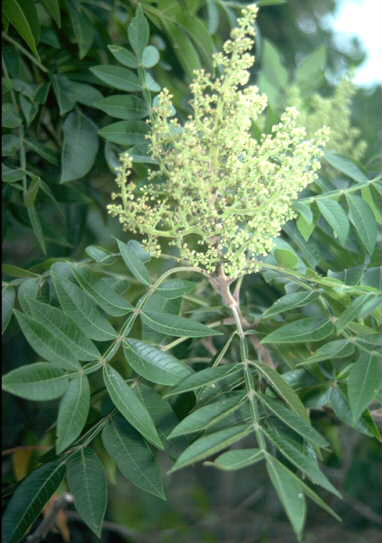
Its leaves are simple, alternate, evergreen, and leathery. They measure five to seven centimeters long and two to four centimeters wide, with toothed margins, a waxy smooth upper surface, and a paler lower surface.[1][2][3]
Its mature fruits are sticky, reddish, hairy, and elliptical, measuring approximately seven to ten millimeters in diameter. They grow in tight clusters at the ends of twigs.[4][5][6]
Young plants have smooth reddish bark, while mature plants develop cracked or scaly grayish bark.[7]
Habitat
Its native range includes the Transverse and Peninsular Ranges and the South Coast regions of Southern California, extending from Santa Barbara County and the Channel Islands to San Diego County. It also occurs in north-central coastal Baja California and offshore islands including Cedros Island, with an additional colony observed as far north as Santa Cruz County.[8][9][10][11]
The species can grow in nutrient-deficient soils and tolerates mildly acidic to mildly alkaline soil conditions. It also tolerates heat and windy conditions.[12][13][14]
Diet
Birds consume the fruits of lemonadeberry.[15]
Behaviour
Birds are major dispersers of lemonadeberry fruits.[16]
Reproduction and life cycle
Lemonadeberry can propagate through seeds or rhizomes. Its flowers may be bisexual or pistillate.[17][18]
Its ovary is superior and usually contains a single ovule. Flowering occurs between February and May.[19][20]
Conservation
Lemonadeberry is not frost tolerant.[21]
Similar species
Lemonadeberry frequently hybridizes with Rhus ovata, a frost-tolerant species. Hybridization occurs where their ranges overlap in the foothills of California and Mexico.[22][23]
Uses
Lemonadeberry fruits can be used to prepare lemonade-flavored beverages. Its leaves contain substantial amounts of tannins, and fallen autumn leaves can be used as a brown dye or mordant.[24][25][26]
Oil extracted from its seeds can be used to manufacture candles. The wood of mature plants is dense and hard and is used as fireplace kindling.[27][28]
The species is cultivated as a landscape shrub and can be used for hedging and espalier. It provides nectar and fruit for birds and nectar for butterflies.[29][30]
Lemonadeberry has a slow-to-moderate growth rate. It is relatively resistant to deer when cultivated in gardens.[31][32]
Classification of the Lemonadeberry
| Kingdom | Plantae |
|---|---|
| Subkingdom | Pteridobiotina |
| Phylum | Tracheophyta |
| Class | Magnoliopsida |
| Order | Sapindales |
| Family | Anacardiaceae (Sumac Family) |
| Tribe | Rhoeae |
| Genus | Rhus (Sumac) |
| Species | Rhus integrifolia (Nutt.) Benth. & Hook.fil. ex Brewer & S.Watson |
Where the Lemonadeberry is found
Checklists and occurrence records place Rhus integrifolia in 2 countries across North America. GBIF holds 23,326 georeferenced records of it.
Countries
Regions and cities with the most records
- California, United States 20,170
- San Diego, United States 4,828
- Encinitas, United States 4,725
- National City, United States 4,273
- Coronado, United States 4,237
- Chula Vista, United States 3,446
- La Mesa, United States 3,187
- Lemon Grove, United States 3,154
- La Presa, United States 3,057
- Spring Valley, United States 2,883
- Imperial Beach, United States 2,532
- San Marcos, United States 2,448
- Casa de Oro-Mount Helix, United States 2,344
- Poway, United States 2,308
- El Cajon, United States 2,273
- Rancho San Diego, United States 2,064
- Laguna Hills, United States 2,035
- Laguna Woods, United States 2,020
- Lake Forest, United States 2,014
- Carlsbad, United States 2,011
- Santee, United States 2,004
- Aliso Viejo, United States 1,946
- Baja California, Mexico 1,892
- Irvine, United States 1,876
- Bostonia, United States 1,841
- Escondido, United States 1,814
- Mission Viejo, United States 1,814
- Laguna Beach, United States 1,700
- Vista, United States 1,689
- Laguna Niguel, United States 1,688
- Tustin, United States 1,652
- Winter Gardens, United States 1,540
- Ladera Ranch, United States 1,529
- San Juan Capistrano, United States 1,433
- Gardena, United States 1,414
- Lawndale, United States 1,403
Range as the checklists state it
USA (California); Mexico (Baja California Norte, Baja California Sur, Sonora); Isla Guadalupe
A number beside a place is its count of GBIF occurrence records. A place without a number comes from a checklist alone. Records show where a species has been observed or collected, which can include escapes and vagrants.
Common names
English
- Lemonadeberry
- Sourberry
Names in 9 other languages
- Chinese
- 檸檬鹽膚木
- French
- Sumac limonadier
- German
- Limonaden-Sumach
- Polish
- sumak całolistny
- Russian
- Сумах цельнолистный
- Spanish
- Saladito, Zumaque de limonada
- Ukrainian
- Сумах цілолистий
- chl
- Pánaqwet
- xgf
- sorah
Synonyms
8 other scientific names have been used for this species and are now treated as synonyms of Rhus integrifolia.
- Neostyphonia integrifolia (Nutt.) Shafer
- Rhus hindsiana Engl.
- Rhus integrifolia var. serrata (Nutt.) Engl.
- Schmaltzia integrifolia (Nutt. ex Torr. & A.Gray) F.A.Barkley
- Styphonia integrifolia Nutt.
- Styphonia serrata Nutt.
- Toxicodendron hindsianum (Engl.) Kuntze
- Toxicodendron integrifolium (Nutt.) Kuntze
Subspecies and varieties
Related species
-
 Staghorn SumacRhus typhina
-
 SumacRhus coriaria
-
 Smooth SumacRhus glabra
-
 Fragrant SumacRhus aromatica
-
 Shining SumacRhus copallina
-
 Chinese SumacRhus chinensis
-
 Skunkbush SumacRhus trilobata
-
 Sugar BushRhus ovata
Compare
Questions and answers
What is the scientific name of the Lemonadeberry?
The scientific name of the Lemonadeberry is Rhus integrifolia. Written with its author, the full name is Rhus integrifolia (Nutt.) Benth. & Hook.fil. ex Brewer & S.Watson.
Which family does the Lemonadeberry belong to?
Rhus integrifolia belongs to the family Anacardiaceae, in the order Sapindales and the class Magnoliopsida.
Where is the Lemonadeberry found?
Checklists and occurrence records place Rhus integrifolia in 2 countries: United States and Mexico.
What is the conservation status of the Lemonadeberry?
The IUCN Red List category recorded for Rhus integrifolia is Least Concern (LC).
What other names does the Lemonadeberry have?
Rhus integrifolia is also known in English as Sourberry.
What is a sourberry?
Sourberry is an English name recorded for Rhus integrifolia, also known as lemonadeberry.[33]
Is rhus integrifolia edible?
Its fruits can be used to prepare lemonade-flavored beverages.[24]
How fast does lemonade berry grow?
Lemonadeberry has a slow-to-moderate growth rate.[31]
Sources
Passages the profile rests on
- Its leaves are simple, alternate, evergreen, and leathery. Source passage: “leaves are simple (unusual in a genus where most species are trifoliate), alternating, evergreen and leathery” — English Wikipedia
- Its leaves measure five to seven centimeters long and two to four centimeters wide. Source passage: “ranging from two to four centimeters wide on reddish twigs; length of leaves is five to seven centimeters.” — English Wikipedia
- Its leaves have toothed margins, a waxy smooth upper surface, and a paler lower surface. Source passage: “Leaves are toothed with a waxy smooth appearance above and a paler tone below.” — English Wikipedia
- Its mature fruits are sticky, reddish, hairy, and elliptical. Source passage: “The mature fruit of Rhus integrifolia is sticky, reddish, covered with hairs” — English Wikipedia
- Its mature fruits measure approximately seven to ten millimeters in diameter. Source passage: “about seven to ten millimeters in diameter.” — English Wikipedia
- Its fruits grow in tight clusters at the ends of twigs. Source passage: “The elliptical fruit presents tight clusters at the very ends of twigs.” — English Wikipedia
- Young plants have smooth reddish bark, while mature plants develop cracked or scaly grayish bark. Source passage: “Young plants manifest smooth reddish bark, while more mature individuals have cracked, even scaly, grayish bark” — English Wikipedia
- The species is native to the Transverse and Peninsular Ranges and the South Coast regions of Southern California. Source passage: “It is native to the Transverse and Peninsular Ranges and the South Coast regions of Southern California.” — English Wikipedia
- Its native range extends from Santa Barbara County and the Channel Islands to San Diego County. Source passage: “This extends from Santa Barbara County and the Channel Islands to San Diego County” — English Wikipedia
- Its range extends into north-central coastal Baja California and offshore islands including Cedros Island. Source passage: “extending into north-central Pacific coastal Baja California and its offshore islands such as Cedros Island.” — English Wikipedia
- An additional colony has been observed as far north as Santa Cruz County. Source passage: “one colony has even been observed as far north as Santa Cruz County.” — English Wikipedia
- It can grow in nutrient-deficient soils. Source passage: “it can even thrive in nutrient deficient soil.” — English Wikipedia
- It tolerates mildly acidic to mildly alkaline soil conditions. Source passage: “This plant tolerates mildly acid to mildly alkaline soils” — English Wikipedia
- The species tolerates heat and windy conditions. Source passage: “This plant thrives on well-drained soils and endures heat and windy conditions well.” — English Wikipedia
- Birds consume the fruits of Rhus integrifolia. Source passage: “Bird species enjoy the fruits” — English Wikipedia
- Birds are major dispersers of the species' fruits. Source passage: “Bird species enjoy the fruits and act as a major disperser.” — English Wikipedia
- The species can propagate through seeds or rhizomes. Source passage: “Propagation is by seed or by rhizome.” — English Wikipedia
- Its flowers may be bisexual or pistillate. Source passage: “may be either bisexual or pistillate.” — English Wikipedia
- Its ovary is superior and usually contains a single ovule. Source passage: “The ovary is superior and usually has a single ovule” — English Wikipedia
- Flowering occurs between February and May. Source passage: “The flowers which appear from February to May” — English Wikipedia
- Rhus integrifolia is not frost tolerant. Source passage: “Lemonade berry is not frost tolerant” — English Wikipedia
- Rhus integrifolia frequently hybridizes with Rhus ovata. Source passage: “Rhus integrifolia often hybridizes with Rhus ovata.” — English Wikipedia
- The species hybridizes with the frost-tolerant Rhus ovata where their ranges overlap in the foothills of California and Mexico. Source passage: “will hybridize with the frost tolerant Rhus ovata (sugarbush) in the foothills of California and Mexico where their ranges overlap.” — English Wikipedia
- Its fruits can be used to prepare lemonade-flavored beverages. Source passage: “The berries (drupes) of this species can be used to make lemonade flavored drinks” — English Wikipedia
- Its leaves contain substantial amounts of tannins. Source passage: “Lemonade berry leaves are rich in tannins.” — English Wikipedia
- Fallen autumn leaves can be used as a brown dye or mordant. Source passage: “the fallen leaves may be used as a brown dye or mordant.” — English Wikipedia
- Oil extracted from its seeds can be used to manufacture candles. Source passage: “Thereafter the oil can be employed to manufacture candles” — English Wikipedia
- The wood of mature plants is used as fireplace kindling because it is dense and hard. Source passage: “The wood of mature plants is dense and hard, making it prized for wood-burning fireplace kindling.” — English Wikipedia
- The species is cultivated as a landscape shrub and can be used for hedging and espalier. Source passage: “can also be used as a landscape shrub and is suitable for hedging and espalier.” — English Wikipedia
- The plant provides nectar and fruit for birds and nectar for butterflies. Source passage: “supplies nectar and fruit for birds and nectar for butterflies.” — English Wikipedia
- The species has a slow-to-moderate growth rate. Source passage: “The growth habit is slow to moderate” — English Wikipedia
- The species is relatively resistant to deer when cultivated in gardens. Source passage: “as a garden plant, this species is quite resistant to deer” — English Wikipedia
- Rhus integrifolia is an evergreen shrub or small tree with a sprawling growth habit. Source passage: “It is 1–8 metres (3.3–26.2 ft) in height, with a sprawling form” — English Wikipedia
Data
- Catalogue of Life, 2026-10-16 XR cc by
- Global Biodiversity Information Facility CC BY 4.0
- Wikidata CC0
- GeoNames CC BY 4.0
- Wikimedia Commons per image; credit shown with each image
- Within the Catalogue of Life, this name comes from Synonymic Checklists of the Vascular Plants of the World cc by
References
- Benth. & Hook.fil. ex Brewer & S.Watson. (1876). Bot. California [W.H.Brewer] 1: 110 (1876). where the name was published
This species in other databases
- Catalogue of Life 4SN53
- Wikidata Q7321565
- iNaturalist 55009
- World Flora Online wfo-0001049906
- GRIN 406649
Page built on 27 November 2026. See how the catalog is made and all sources and licences.
Cite this page
ScientificNames.org. (2026). Rhus integrifolia (Lemonadeberry). Retrieved November 27, 2026, from https://scientificnames.org/species/rhus-integrifolia
“Rhus integrifolia (Lemonadeberry).” ScientificNames.org, 2026, scientificnames.org/species/rhus-integrifolia. Accessed 27 Nov. 2026.
ScientificNames.org. “Rhus integrifolia (Lemonadeberry).” Accessed November 27, 2026. https://scientificnames.org/species/rhus-integrifolia.
@misc{scientificnames_rhus_integrifolia_lemonadeberry,
  author = {{ScientificNames.org}},
  title = {Rhus integrifolia (Lemonadeberry)},
  year = {2026},
  url = {https://scientificnames.org/species/rhus-integrifolia},
  note = {Accessed 2026-11-27}
}