Species · Flowering plants
Staghorn Sumac Rhus typhina
The scientific name of the Staghorn Sumac is Rhus typhina. It is a species of flowering plant in the family Anacardiaceae (sumac family), order Sapindales.
- Scientific name
- Rhus typhina L.
- Common name
- Staghorn Sumac
- Genus
- Rhus
- Family
- Anacardiaceae (Sumac Family)
- Order
- Sapindales
- Class
- Magnoliopsida
- Red List category
- LC Least Concern
- Recorded in
- 34 countries
- Name status
- accepted in the Catalogue of Life

Overview
The species is native to eastern North America, with a principal distribution in southeastern Canada, the northeastern and midwestern United States, and the Appalachian Mountains. It is marked by densely hairy, rust-colored shoots and twigs, pinnately compound leaves, and clusters of reddish fruits.
Written 26 November 2026 from the sources listed below. Each statement was checked against the passage it cites; statements that could not be supported were removed.
Appearance
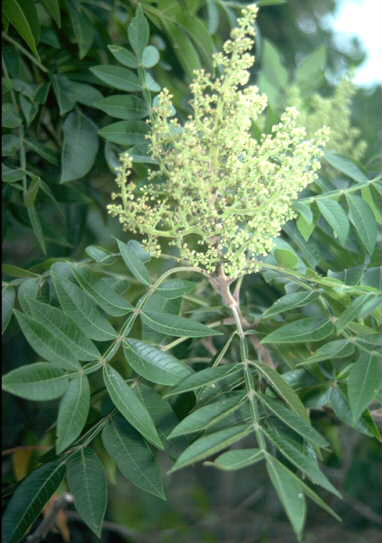
The plant can grow up to 5 metres tall and 6 metres wide. Its alternate, pinnately compound leaves usually have 9–31 toothed leaflets and measure 25–60 cm in length; they can sometimes be doubly compound.[1][2][3][4]
The leaves turn brilliant orange-red during autumn. Its small greenish-white to yellowish flowers grow in dense terminal clusters.[5][6]
Its fruits are small drupes that change from green to reddish as they develop. They have slender, straight red hairs that are nearly ⅛ inch long.[7][8]
Habitat
Staghorn sumac grows successfully in locations receiving full sun to partial shade. It grows in well-drained soil and tolerates drought.[9][10]
Diet
Birds consume the fruits during winter, and wildlife feeds on the seeds during winter. The foliage provides browse for various mammals.[11][12][13]
Honey bees, native bees, butterflies, and hummingbirds visit the flowers for nectar and pollen.[14]
Behaviour
Staghorn sumac spreads through underground suckers. It forms male or female clones, with younger shoots often growing around older central shoots.[15][16]
The species can tolerate salt spray and salt runoff. It can escape cultivation and become invasive in some regions.[17][18]
Reproduction and life cycle
The species has separate male and female plants. Flowering occurs from May through June.[19][20]
The fruits mature around October and remain on the plant throughout winter. The species propagates through seeds and rhizomes.[21][22]
Conservation
In Missouri, staghorn sumac is introduced rather than native and is not considered invasive there.[23]
Uses
Fruit extract can be used to prepare jelly. The shoots can be peeled and eaten raw.[24][25]
The plant's parts other than its roots can serve as natural dyes and mordants. Its tannins can improve the light fastness of other dye baths.[26][27]
Classification of the Staghorn Sumac
| Kingdom | Plantae |
|---|---|
| Subkingdom | Pteridobiotina |
| Phylum | Tracheophyta |
| Class | Magnoliopsida |
| Order | Sapindales |
| Family | Anacardiaceae (Sumac Family) |
| Tribe | Rhoeae |
| Genus | Rhus (Sumac) |
| Species | Rhus typhina L. |
Where the Staghorn Sumac is found
Checklists and occurrence records place Rhus typhina in 34 countries across Asia, Europe, North America and Oceania. GBIF holds 123,364 georeferenced records of it.
Countries where it is native or its origin is not stated
- Austria 1,483
- Belgium 4,211
- Canada 19,090
- Denmark 498
- Mexico 11
- Poland 1,184
- Sweden 1,617
- The Netherlands 2,497
- Ukraine 523
- United States 36,508
Countries where it has been introduced
- Belarus 437
- Bulgaria 91
- Croatia 257
- Czechia 1,519
- Estonia 31
- France 17,058
- Germany 8,065
- Guernsey 2
- Hungary 192
- Ireland 16
- Italy 2,241
- Jersey 4
- Kazakhstan 106
- Liechtenstein 1
- New Zealand 72
- Portugal 39
- Romania 1,133
- Slovakia 794
- Slovenia 642
- Spain 81
- Switzerland 14,313
- Tajikistan 1
- United Kingdom 8,645
- Uzbekistan 2
Regions and cities with the most records
- Ontario, Canada 12,340
- England, United Kingdom 8,005
- Zurich, Switzerland 5,735
- New York, United States 5,721
- Dübendorf, Switzerland 4,856
- Zürich, Switzerland 4,687
- Quebec, Canada 4,610
- Adliswil, Switzerland 4,607
- Massachusetts, United States 4,529
- Opfikon, Switzerland 4,519
- Kloten, Switzerland 4,346
- Uster, Switzerland 4,200
- Horgen, Switzerland 4,005
- Pennsylvania, United States 3,809
- Dietikon, Switzerland 3,805
- Wetzikon, Switzerland 3,356
- Bülach, Switzerland 3,331
- Michigan, United States 2,797
- Bavaria, Germany 2,631
- Wettingen, Switzerland 2,571
- Vermont, United States 2,549
- Stadt Winterthur (Kreis 1), Switzerland 2,543
- Auvergne-Rhône-Alpes, France 2,523
- Seen (Kreis 3), Switzerland 2,396
- Winterthur, Switzerland 2,373
- Baden, Switzerland 2,364
- Saint-Michel, Canada 2,240
- Villeray–Saint-Michel–Parc-Extension, Canada 2,229
- Rapperswil, Switzerland 2,191
- Mont-Royal, Canada 2,182
- Rosemont–La Petite-Patrie, Canada 2,172
- Le Plateau-Mont-Royal, Canada 2,161
- Val-des-Arbres, Canada 2,158
- Montréal-Nord, Canada 2,155
- Mercier–Hochelaga-Maisonneuve, Canada 2,141
- Montréal, Canada 2,127
21 more countries have a few records outside this range
These countries hold a few records of Rhus typhina but lie outside the range the checklists give for it. Such records are often zoo or garden specimens, museum material or vagrants, so the species is not counted as occurring there.
Range as the checklists state it
England [I] (England [I], Wales [I], Isle of Man [I], Scotland [I], Isles of Scilly [I]); Ireland [I] (Ireland [I], Northern Ireland [I]); Germany [I]; Switzerland [I]; Liechtenstein [I]; Czech Republic [I]; Slovakia [I]; Hungary [I]; Portugal [I]; Spain [I]; France [I]; Channel Isl. [I] (Alderney [I], Guernsey [I], Jersey [I], Sark [I]); Italy [I]; Slovenia [I]; Croatia [I]; Bosnia & Hercegovina [I]; Romania [I]; Bulgaria [I]; Estonia [I]; Belarus [I]; European Russia [I]; Russian Far East [I] (Primorye [I]); Kazakhstan [I]; Uzbekistan [I]; Tajikistan [I]; New Zealand [I]; Canada (New Brunswick, Nova Scotia, Ontario, Prince Edward Isl., Quebec); USA (Alabama, Connecticut, District of Columbia, Delaware, Georgia, Iowa, Illinois, Indiana, Kansas, Kentucky, Massachusetts, Maryland, Maine, Michigan, Minnesota, Missouri, Mississippi, North Carolina, New Hampshire, New Jersey, New York, Ohio, Pennsylvania, Rhode Island, South Carolina, South Dakota, Tennessee, Utah, Virginia, Vermont, Wisconsin, West Virginia)
A number beside a place is its count of GBIF occurrence records. A place without a number comes from a checklist alone. Records show where a species has been observed or collected, which can include escapes and vagrants.
Common names
English
- Staghorn Sumac
- Stag's-Horn Sumach
- Virginia Sumac
- Red Sumac
- Staghorn Sumach
- Velvet Sumac
- Vinegar Tree
Names in 28 other languages
- Bulgarian
- Влакнест шмак
- Chinese
- 火炬树, 火炬樹, 火炬漆, 鹿角漆樹, 鹿角鹽膚木
- Croatian
- Dlakavi ruj, Kiseli ruj
- Czech
- škumpa orobincová
- Danish
- Hjortetaktræ
- Dutch
- Azijnboom, Fluweelboom
- Estonian
- harilik sumahh, äädikapuu
- Finnish
- samettisumakki
- French
- sumac amarante, sumac amaranthe, sumac deVirginie, sumac vinaigrier, vinaigrier
- German
- Essigbaum, Kolben-Sumach
- Hungarian
- Ecetfa, ecetszömörce
- Italian
- sommacco maggiore
- Japanese
- ルスティフィナ, ルス・ティフィナ
- Latvian
- Parastais etiķkoks
- Lithuanian
- Rūgštusis žagrenis
- Norwegian Bokmål
- hjortesumak
- Polish
- Sumak octowiec, Sumak odurzający
- Romanian
- Oțetar roșu
- Russian
- Сумах оленерогий
- Serbian
- Кисели руј
- Slovak
- sumach pálkový
- Slovenian
- Octovec
- Spanish
- Zumaque de Virginia
- Swedish
- rönnsumak
- Turkish
- Kızaran Sumak, Sumak
- Welsh
- Siwmac
- moh
- Tará:kwi
- oji
- Baakwaanaatig
Synonyms
28 other scientific names have been used for this species and are now treated as synonyms of Rhus typhina.
- Datisca hirta L.
- Rhus americana Dippel
- Rhus filicifolia Demcker
- Rhus frutescens G.Nicholson
- Rhus gracilis Engl.
- Rhus hirta f. dissecta (Rehder) Reveal
- Rhus hirta f. typhina (L.) Reveal
- Rhus hirta var. dissecta (Rehder) Nash
- Rhus hirta var. laciniata C.K.Schneid.
- Rhus hirta var. typhina (L.) Farw.
- Rhus hypselodendrum Moench
- Rhus typhia Crantz
- Rhus typhina f. dissecta Rehder
- Rhus typhina f. laciniata (Alph.Wood) Rehder
- Rhus typhina f. typhina
- Rhus typhina var. arborescens Willd.
- Rhus typhina var. filicifolia Demcker
- Rhus typhina var. filicina Sprenger
- Rhus typhina var. frutescens Willd.
- Rhus typhina var. laciniata Alph.Wood
- Rhus typhina var. viridiflora Engl.
- Rhus virginiana Garsault
- Rhus viridiflora Duhamel
- Rhus viridiflora var. canadensis (Mill.) Poir.
- Schmaltzia hirta (L.) Small
- Toxicodendron typhinum (L.) Kuntze
- Rhus canadensis Mill. ambiguous synonym
- Rhus hirta (L.) Südw. ambiguous synonym
Related species
-
 SumacRhus coriaria
-
 Smooth SumacRhus glabra
-
 Fragrant SumacRhus aromatica
-
 Shining SumacRhus copallina
-
 LemonadeberryRhus integrifolia
-
 Chinese SumacRhus chinensis
-
 Skunkbush SumacRhus trilobata
-
 SugarbushRhus ovata
Compare
Questions and answers
What is the scientific name of the Staghorn Sumac?
The scientific name of the Staghorn Sumac is Rhus typhina. Written with its author, the full name is Rhus typhina L..
Which family does the Staghorn Sumac belong to?
Rhus typhina belongs to the family Anacardiaceae, in the order Sapindales and the class Magnoliopsida.
Where is the Staghorn Sumac found?
Checklists and occurrence records place Rhus typhina in 34 countries, including United States, Canada, Belgium, The Netherlands, Sweden and Austria.
What is the conservation status of the Staghorn Sumac?
The IUCN Red List category recorded for Rhus typhina is Least Concern (LC).
What other names does the Staghorn Sumac have?
Rhus typhina is also known in English as Stag's-Horn Sumach, Virginia Sumac, Red Sumac, Staghorn Sumach, Velvet Sumac and Vinegar Tree.
Are there two types of sumac?
Staghorn sumac has separate male and female plants.[19]
Is sumac indigenous to North America?
Staghorn sumac is native to eastern North America.[28]
Where does sumac grow naturally?
Its principal natural distribution includes southeastern Canada, the northeastern and midwestern United States, and the Appalachian Mountains.[28][29]
Which animals eat sumac?
Birds consume its fruits during winter, various mammals browse its foliage, and wildlife feeds on its seeds during winter. Honey bees, native bees, butterflies, and hummingbirds visit its flowers for nectar and pollen.[11][12][14][13]
What part of sumac do deer eat?
The foliage provides browse for various mammals.[12]
Sources
Passages the profile rests on
- The plant can grow up to 5 metres tall and 6 metres wide. Source passage: “growing up to 5 m (16 ft) tall by 6 m (20 ft) broad.” — English Wikipedia
- Its leaves are alternate and pinnately compound, with 9–31 toothed leaflets. Source passage: “The leaves are alternate, pinnately compound, and 25–60 cm (10–24 in) long, each with 9–31 serrate leaflets” — English Wikipedia
- Its leaves measure 25–60 cm in length. Source passage: “25–60 cm (10–24 in) long” — English Wikipedia
- Its leaves can sometimes be doubly compound. Source passage: “The feather-compound leaves are sometimes doubly compound.” — mdc.mo.gov
- Its leaves turn brilliant orange-red during autumn. Source passage: “The leaves turn brilliant orange-red in autumn.” — English Wikipedia
- Its flowers are small and greenish-white to yellowish, growing in dense terminal clusters. Source passage: “small, greenish-white through yellowish flowers occur in dense terminal panicles” — English Wikipedia
- Its fruits are small drupes that change from green to reddish as they develop. Source passage: “Small, green then reddish drupes occur in panicles” — English Wikipedia
- Its fruits have slender, straight red hairs that are nearly ⅛ inch long. Source passage: “the fruits are densely covered with slender, straight, red hairs that are nearly ⅛ inch long.” — mdc.mo.gov
- The species grows successfully in locations receiving full sun to partial shade. Source passage: “Sumacs are happiest growing in areas with full sun to partial shade.” — extension.psu.edu
- The species grows in well-drained soil and tolerates drought. Source passage: “growing in well-drained soil, and are drought-tolerant in urban, suburban, or rural environments.” — extension.psu.edu
- Birds consume the fruits during winter. Source passage: “The fruits are eaten by many birds in winter” — English Wikipedia
- The foliage provides browse for various mammals. Source passage: “sumac foliage provides browse for various mammals.” — English Wikipedia
- Wildlife feeds on the seeds during winter. Source passage: “Wildlife feeds on the seeds as winter progresses.” — extension.psu.edu
- Honey bees, native bees, butterflies, and hummingbirds visit its flowers for nectar and pollen. Source passage: “I've seen honey bees, native bees, butterflies, and even hummingbirds gathering nectar and pollen from the small blossoms.” — extension.psu.edu
- The species forms male or female clones, with younger shoots often growing around older central shoots. Source passage: “forms female or male clones, often with the older shoots in the center and younger shoots around central older ones.” — English Wikipedia
- The species spreads through underground suckers. Source passage: “They spread by underground suckers” — extension.psu.edu
- The species can escape cultivation and become invasive in some regions. Source passage: “The species easily escapes cultivation and is an invasive species in some parts of the world.” — English Wikipedia
- The species tolerates salt spray and salt runoff. Source passage: “Sumacs also tolerate salt spray and salt runoff” — extension.psu.edu
- The species has separate male and female plants. Source passage: “Rhus typhina is a dioecious” — English Wikipedia
- Flowering occurs from May through June. Source passage: “Blooming from May to June” — English Wikipedia
- Its fruits mature around October and remain on the plant throughout winter. Source passage: “maturing around October and remaining on the plant through winter.” — English Wikipedia
- The species propagates through seeds and rhizomes. Source passage: “Staghorn sumac spreads by seeds and rhizomes” — English Wikipedia
- The species is introduced rather than native in Missouri and is not considered invasive there. Source passage: “Staghorn sumac has been introduced from regions to our east and north, but although it may persist in locations, it is not considered invasive.” — mdc.mo.gov
- The fruit extract can be used to prepare jelly. Source passage: “The drink extract can also be used to make jelly.” — English Wikipedia
- The shoots can be peeled and eaten raw. Source passage: “The shoots can be peeled and eaten raw.” — English Wikipedia
- The plant's parts other than its roots can serve as natural dyes and mordants. Source passage: “All parts of the staghorn sumac, except the roots, can be used as both a natural dye and as a mordant.” — English Wikipedia
- The plant contains tannins that can improve the light fastness of other dye baths. Source passage: “The plant is rich in tannins and can be added to other dye baths to improve light fastness.” — English Wikipedia
- The species is native to eastern North America. Source passage: “It is native to eastern North America” — English Wikipedia
- Its principal distribution includes southeastern Canada, the northeastern and midwestern United States, and the Appalachian Mountains. Source passage: “It is primarily found in southeastern Canada, the northeastern and midwestern United States, and the Appalachian Mountains.” — English Wikipedia
Data
- Catalogue of Life, 2026-10-16 XR cc by
- Global Biodiversity Information Facility CC BY 4.0
- Wikidata CC0
- GeoNames CC BY 4.0
- Wikimedia Commons per image; credit shown with each image
- Within the Catalogue of Life, this name comes from Synonymic Checklists of the Vascular Plants of the World cc by
References
- L. (1756). Cent. Pl. II: 14 (1756). where the name was published
This species in other databases
- Catalogue of Life 4SND6
- Wikidata Q148986
- iNaturalist 167829
- World Flora Online wfo-0000403060
- GRIN 31720
Page built on 26 November 2026. See how the catalog is made and all sources and licences.
Cite this page
ScientificNames.org. (2026). Rhus typhina (Staghorn Sumac). Retrieved November 26, 2026, from https://scientificnames.org/species/rhus-typhina
“Rhus typhina (Staghorn Sumac).” ScientificNames.org, 2026, scientificnames.org/species/rhus-typhina. Accessed 26 Nov. 2026.
ScientificNames.org. “Rhus typhina (Staghorn Sumac).” Accessed November 26, 2026. https://scientificnames.org/species/rhus-typhina.
@misc{scientificnames_rhus_typhina_staghorn_sumac,
  author = {{ScientificNames.org}},
  title = {Rhus typhina (Staghorn Sumac)},
  year = {2026},
  url = {https://scientificnames.org/species/rhus-typhina},
  note = {Accessed 2026-11-26}
}