Species · Flowering plants
Skunkbush Sumac Rhus trilobata
The scientific name of the Skunkbush Sumac is Rhus trilobata. It is a species of flowering plant in the family Anacardiaceae (sumac family), order Sapindales.
- Scientific name
- Rhus trilobata Nutt.
- Common name
- Skunkbush Sumac
- Genus
- Rhus
- Family
- Anacardiaceae (Sumac Family)
- Order
- Sapindales
- Class
- Magnoliopsida
- Recorded in
- 3 countries
- Name status
- accepted in the Catalogue of Life

Overview
Rhus trilobata is native to western Canada and the western United States, extending from the Great Plains to California and south through Arizona into northern Mexico.
Written 26 November 2026 from the sources listed below. Each statement was checked against the passage it cites; statements that could not be supported were removed.
Appearance
New twigs are fuzzy but become smooth as they age. The leaves can reach 1.5 centimetres in length, are green when young and turn orange and brown in autumn.[1][2][3]
The flowers are yellowish-green and grow on small catkins. They are pollinated by animals.[4][5]
The berries are reddish-orange, hairy and slightly sticky. They have a lime-like aroma and a very sour taste, with tannic and gallic acids contributing to their acidity.[6][7][8]
Habitat
Skunkbush Sumac grows on dry rocky slopes and can also occur in moist valleys. It occurs in grasslands east of the Rocky Mountains, mountainous shrubland, and pine, juniper and fir forests.[9][10][11][12]
The species also grows in wetlands, oak woodlands and chaparral. It is a common component of Arizona chaparral communities.[13][14]
In the Great Basin National Park area, the species occurs at elevations above 4,000 feet. Across its distribution, it occurs from deserts to mountain peaks at elevations of approximately 2,100 metres.[15][16]
The species is native to western Canada and the western United States, extending from the Great Plains to California and south through Arizona into northern Mexico. The variety R. trilobata var. racemulosa occurs in Arizona and New Mexico, while R. trilobata var. trilobata occurs throughout the species' range.[17][18][19][20]
Reproduction and life cycle
Animals pollinate the flowers, and animals that eat the berries disperse the seeds. The shrub also reproduces vegetatively by producing sprouts several meters from the parent plant.[21][22][23]
Diet
The berries provide an important winter food source for many birds and some small mammals.[24]
Behaviour
Skunkbush Sumac readily produces new growth in areas affected by wildfire.[25]
Uses
The berries are edible despite their sour taste. They can be baked into bread or added to porridge and soup.[26][27]
Steeping the berries produces tea or a tart beverage resembling lemonade. The bark has traditionally been chewed or brewed into a drink for cold symptoms.[28][29]
The berries have traditionally been eaten for gastrointestinal complaints and toothache. The leaves and roots have traditionally been boiled and eaten for various complaints.[30][31]
The flexible branches have been used to make baskets and rugs. The Zuni, Navajo and Mono peoples have used the stems to make baskets after removing the bark.[32][33]
The species is planted for erosion control and landscaping. It is also used to reclaim barren land damaged by mining.[34][35]
Similar species
Toxicodendron diversilobum differs from Skunkbush Sumac by lacking its foul odour and having white berries.[36]
Conservation
The species has no federal legal status listed in the cited assessment.[37]
Classification of the Skunkbush Sumac
| Kingdom | Plantae |
|---|---|
| Subkingdom | Pteridobiotina |
| Phylum | Tracheophyta |
| Class | Magnoliopsida |
| Order | Sapindales |
| Family | Anacardiaceae (Sumac Family) |
| Tribe | Rhoeae |
| Genus | Rhus (Sumac) |
| Species | Rhus trilobata Nutt. |
Where the Skunkbush Sumac is found
Checklists and occurrence records place Rhus trilobata in 3 countries across North America. GBIF holds 12,695 georeferenced records of it.
Countries
Regions and cities with the most records
- Colorado, United States 2,412
- Utah, United States 1,044
- New Mexico, United States 1,040
- Texas, United States 910
- California, United States 847
- Arizona, United States 623
- Boulder, United States 470
- Louisville, United States 372
- Lafayette, United States 342
- Broomfield, United States 307
- Longmont, United States 280
- Baja California, Mexico 269
- Lakewood, United States 268
- Dakota Ridge, United States 266
- Colorado Springs, United States 263
- Nebraska, United States 259
- Wheat Ridge, United States 252
- Arvada, United States 247
- Columbine, United States 244
- Golden, United States 241
- Montana, United States 238
- Englewood, United States 222
- Ken Caryl, United States 221
- Fort Collins, United States 219
- Littleton, United States 212
- Nevada, United States 200
- Loveland, United States 195
- Denver, United States 192
- Westminster, United States 189
- Idaho, United States 174
- Security-Widefield, United States 172
- Greenwood Village, United States 163
- Highlands Ranch, United States 155
- Albuquerque, United States 147
- Wyoming, United States 142
- Sherrelwood, United States 133
3 more countries have a few records outside this range
These countries hold a few records of Rhus trilobata but lie outside the range the checklists give for it. Such records are often zoo or garden specimens, museum material or vagrants, so the species is not counted as occurring there.
Range as the checklists state it
Canada (Alberta, Saskatchewan); USA (Arkansas, Arizona, California, Colorado, Iowa, Idaho, Kansas, Maryland, Montana, North Dakota, Nebraska, New Mexico, Nevada, Oklahoma, Oregon, South Dakota, Texas, Utah, Washington State, Wyoming); Mexico (Aguascalientes, Baja California Norte, Baja California Sur, Chihuahua, Coahuila, Colima, Durango, Guanajuato, Hidalgo, Jalisco, Michoacán, Nayarit, Nuevo León, Oaxaca, Queretaro, San Luis Potosí, Sinaloa, Sonora, Tamaulipas, Veracruz, Zacatecas)
A number beside a place is its count of GBIF occurrence records. A place without a number comes from a checklist alone. Records show where a species has been observed or collected, which can include escapes and vagrants.
Common names
English
- Skunkbush Sumac
- Skunk Bush
- Three-Leaf Sumac
- Lemonadebush
- Skunkbrush
- Squawbush
Names in 9 other languages
- Chinese
- 三裂盐麸木, 臭鹽膚木
- Czech
- škumpa trojlaločná
- Finnish
- haisusumakki
- German
- Dreilappiger Sumach
- Russian
- Сумах трёхлопастный
- Slovak
- sumach trojlaločný
- Spanish
- zumaque
- nav
- Ch’ilłichiin
- twe
- Ojohey beh
Synonyms
29 other scientific names have been used for this species and are now treated as synonyms of Rhus trilobata.
- Rhus aromatica subsp. flabelliformis (Shinners) R.E.Brooks
- Rhus aromatica subsp. trilobata (Nutt.) W.A.Weber
- Rhus aromatica var. flabelliformis Shinners
- Rhus aromatica var. trilobata (Nutt.) A.Gray
- Rhus canadensis var. trilobata (Nutt.) A.Gray ex J.M.Coult.
- Rhus crenatifolia Schltdl.
- Rhus osterhoutii Rydb.
- Rhus trilobata var. glaberrima Engl.
- Schmaltzia bakeri Greene
- Schmaltzia botryoides Greene
- Schmaltzia cognata Greene
- Schmaltzia elegantula Greene
- Schmaltzia glabrata Greene
- Schmaltzia glauca Greene
- Schmaltzia glomerata Greene
- Schmaltzia hirtella Greene
- Schmaltzia leiocarpa Greene
- Schmaltzia oxyacanthoides Greene
- Schmaltzia pubescens Osterh.
- Schmaltzia quercifolia Greene
- Schmaltzia ribifolia Greene
- Schmaltzia sabulosa Greene
- Schmaltzia scaberula Greene
- Schmaltzia straminea Greene
- Schmaltzia subpinnata Greene
- Schmaltzia tridophylloides Greene
- Schmaltzia trilobata (Nutt.) Small
- Toxicodendron trilobatum (Nutt.) Kuntze
- Rhus oxyacanthoides (Greene) Rydb. ambiguous synonym
Subspecies and varieties
- Rhus trilobata var. anisophylla variety
- Rhus trilobata var. pilosissima (Downy Fragrant Sumac) variety
- Rhus trilobata var. quinata variety
- Rhus trilobata var. racemulosa variety
- Rhus trilobata var. simplicifolia variety
- Rhus trilobata var. trilobata (Skunkbush Sumac) variety
Related species
-
 Staghorn SumacRhus typhina
-
 SumacRhus coriaria
-
 Smooth SumacRhus glabra
-
 Fragrant SumacRhus aromatica
-
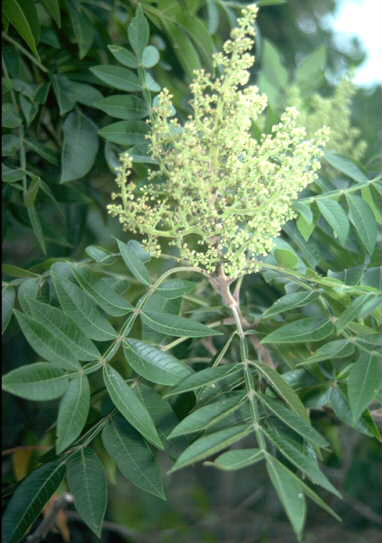 Shining SumacRhus copallina
-
 LemonadeberryRhus integrifolia
-
 Chinese SumacRhus chinensis
-
 Sugar BushRhus ovata
Compare
Questions and answers
What is the scientific name of the Skunkbush Sumac?
The scientific name of the Skunkbush Sumac is Rhus trilobata. Written with its author, the full name is Rhus trilobata Nutt..
Which family does the Skunkbush Sumac belong to?
Rhus trilobata belongs to the family Anacardiaceae, in the order Sapindales and the class Magnoliopsida.
Where is the Skunkbush Sumac found?
Checklists and occurrence records place Rhus trilobata in 3 countries: United States, Mexico and Canada.
What other names does the Skunkbush Sumac have?
Rhus trilobata is also known in English as Skunk Bush, Three-Leaf Sumac, Lemonadebush, Skunkbrush and Squawbush.
What is three-leaf sumac?
Three-Leaf Sumac is an English name recorded for Rhus trilobata Nutt., a flowering shrub in the Anacardiaceae family.[38]
Sources
Passages the profile rests on
- New twigs are fuzzy but become smooth as they age. Source passage: “The twigs are fuzzy when new, and turn sleek with age.” — English Wikipedia
- The leaves can reach 1.5 centimetres in length. Source passage: “The leaves are up to 1.5 centimetres (1⁄2 in) long” — English Wikipedia
- The leaves are green when young and turn orange and brown in autumn. Source passage: “The leaves are green when new and turn orange and brown in the fall.” — English Wikipedia
- The flowers are yellowish-green and grow on small catkins. Source passage: “The flowers, borne on small catkins ("short shoots"), are yellowish-green” — English Wikipedia
- The flowers are pollinated by animals. Source passage: “pollinated by animals.” — English Wikipedia
- The berries are reddish-orange, hairy and slightly sticky. Source passage: “hairy and slightly sticky reddish-orange berries” — English Wikipedia
- The berries have a lime-like aroma and a very sour taste. Source passage: “which have an aroma similar to limes and a very sour taste.” — English Wikipedia
- Tannic and gallic acids contribute to the acidity of the berries. Source passage: “The acidity comes from tannic and gallic acids.” — English Wikipedia
- The species grows on dry rocky slopes and can also occur in moist valleys. Source passage: “It usually grows on dry rocky slopes but can grow in moist valleys.” — nps.gov
- The species occurs in grasslands east of the Rocky Mountains. Source passage: “the grasslands east of the Rocky Mountains” — English Wikipedia
- The species occurs in mountainous shrubland. Source passage: “mountainous shrubland” — English Wikipedia
- The species occurs in pine, juniper and fir forests. Source passage: “pine, juniper, and fir forests” — English Wikipedia
- The species also grows in wetlands, oak woodlands and chaparral. Source passage: “wetlands, oak woodlands, and chaparral.” — English Wikipedia
- The species is a common component of Arizona chaparral communities. Source passage: “Skunkbush sumac is a common constituent of Arizona chaparral communities.” — fs.usda.gov
- The species occurs at elevations above 4,000 feet in the Great Basin National Park area. Source passage: “found above 4,000 feet.” — nps.gov
- The species occurs from deserts to mountain peaks at elevations of approximately 2,100 metres. Source passage: “from deserts to mountain peaks up to about 2,100 metres (7,000 ft) in elevation.” — English Wikipedia
- The species is native to western Canada and the western United States, extending from the Great Plains to California. Source passage: “The species is native to the western half of Canada and the Western United States, from the Great Plains to California” — English Wikipedia
- The species' range extends south through Arizona into northern Mexico. Source passage: “and south through Arizona extending into northern Mexico.” — English Wikipedia
- The variety R. trilobata var. racemulosa occurs in Arizona and New Mexico. Source passage: “R. t. var. racemulosa Arizona and New Mexico” — fs.usda.gov
- The variety R. trilobata var. trilobata occurs throughout the species' range. Source passage: “R. t. var. trilobata entire range” — fs.usda.gov
- Animals pollinate the flowers. Source passage: “pollinated by animals.” — English Wikipedia
- Animals that eat the berries disperse the seeds. Source passage: “The seeds are dispersed by animals that eat the berries.” — English Wikipedia
- The shrub reproduces vegetatively by producing sprouts several meters from the parent plant. Source passage: “sending up sprouts several meters away” — English Wikipedia
- The berries provide an important winter food source for many birds and some small mammals. Source passage: “The berries are an important food source in winter for many birds and some small mammals.” — English Wikipedia
- The shrub readily produces new growth in areas affected by wildfire. Source passage: “will readily sprout back up in burned areas.” — English Wikipedia
- The berries are edible despite their sour taste. Source passage: “The berries, although sour, are edible.” — English Wikipedia
- The berries can be baked into bread or added to porridge and soup. Source passage: “They can be baked into bread or mixed into porridge or soup.” — English Wikipedia
- Steeping the berries produces tea or a tart beverage resembling lemonade. Source passage: “Steeped, they can make a tea or tart beverage similar to lemonade.” — English Wikipedia
- The bark has traditionally been chewed or brewed into a drink for cold symptoms. Source passage: “The bark has been chewed or brewed into a drink for cold symptoms” — English Wikipedia
- The berries have traditionally been eaten for gastrointestinal complaints and toothache. Source passage: “the berries eaten for gastrointestinal complaints and toothache” — English Wikipedia
- The leaves and roots have traditionally been boiled and eaten for various complaints. Source passage: “the leaves and roots boiled and eaten for many complaints.” — English Wikipedia
- The flexible branches have been used to make baskets and rugs. Source passage: “The flexible branches were useful and sought after for twisting into basketry and rugs.” — English Wikipedia
- The Zuni, Navajo and Mono peoples have used the stems to make baskets after removing the bark. Source passage: “The Zuni people, Navajo, Mono tribe of California, and other tribes in the area use the stems with the bark removed to make baskets.” — English Wikipedia
- The species is planted for erosion control and landscaping. Source passage: “It is sometimes planted for erosion control and landscaping” — English Wikipedia
- The species is used to reclaim barren land damaged by mining. Source passage: “a plant used for reclaiming barren land stripped by mining.” — English Wikipedia
- Toxicodendron diversilobum differs from this species by lacking its foul odour and having white berries. Source passage: “Toxicodendron diversilobum lacks the foul odour and has white berries.” — English Wikipedia
- The species has no federal legal status listed in the cited assessment. Source passage: “FEDERAL LEGAL STATUS: None” — fs.usda.gov
- The accepted scientific name of the species is Rhus trilobata Nutt., and it belongs to the Anacardiaceae family. Source passage: “The currently accepted scientific name of skunkbush sumac is Rhus trilobata Nutt. (Anacardiaceae)” — fs.usda.gov
Data
- Catalogue of Life, 2026-10-16 XR cc by
- Global Biodiversity Information Facility CC BY 4.0
- Wikidata CC0
- GeoNames CC BY 4.0
- Wikimedia Commons per image; credit shown with each image
- Within the Catalogue of Life, this name comes from Synonymic Checklists of the Vascular Plants of the World cc by
References
- Nutt. (1838). Fl. N. Amer. [Torrey & A.Gray] 1: 219 (1838). where the name was published
This species in other databases
- Catalogue of Life 4SND2
- Wikidata Q7155056
- iNaturalist 867365
- World Flora Online wfo-0001049775
- GRIN 31717
Page built on 29 November 2026. See how the catalog is made and all sources and licences.
Cite this page
ScientificNames.org. (2026). Rhus trilobata (Skunkbush Sumac). Retrieved November 29, 2026, from https://scientificnames.org/species/rhus-trilobata
“Rhus trilobata (Skunkbush Sumac).” ScientificNames.org, 2026, scientificnames.org/species/rhus-trilobata. Accessed 29 Nov. 2026.
ScientificNames.org. “Rhus trilobata (Skunkbush Sumac).” Accessed November 29, 2026. https://scientificnames.org/species/rhus-trilobata.
@misc{scientificnames_rhus_trilobata_skunkbush_sumac,
  author = {{ScientificNames.org}},
  title = {Rhus trilobata (Skunkbush Sumac)},
  year = {2026},
  url = {https://scientificnames.org/species/rhus-trilobata},
  note = {Accessed 2026-11-29}
}