Species · Flowering plants
Sugar Bush Rhus ovata
The scientific name of the Sugar Bush is Rhus ovata. It is a species of flowering plant in the family Anacardiaceae (sumac family), order Sapindales.
- Scientific name
- Rhus ovata S.Watson
- Common name
- Sugar Bush
- Genus
- Rhus
- Family
- Anacardiaceae (Sumac Family)
- Order
- Sapindales
- Class
- Magnoliopsida
- Red List category
- LC Least Concern
- Recorded in
- 2 countries
- Name status
- accepted in the Catalogue of Life

Overview
Rhus ovata occurs in the inland mountains and foothills of Southern California, extends into Baja California and Baja California Sur, and has a geographically distant population on the Mogollon Rim in Arizona.
Written 26 November 2026 from the sources listed below. Each statement was checked against the passage it cites; statements that could not be supported were removed.
Appearance
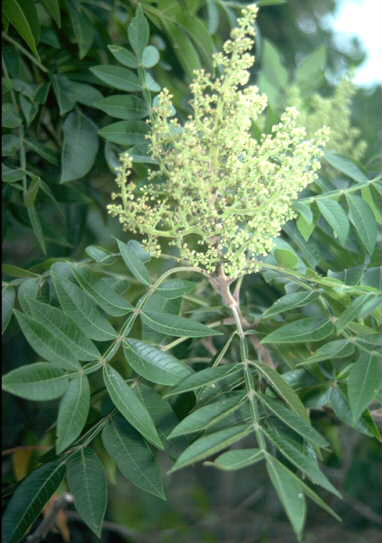
Its leaves are 3–8 cm long and approximately as wide as they are long. They are broadly ovate to broadly elliptic, leathery, hairless, and have entire margins with tips ranging from acute to acuminate.[1][2][3]
The flowers are less than 1 cm wide, with five white to pink petals and five reddish sepals. They grow in clusters on branched inflorescences at the ends of current-season branches.[4][5]
The fruit is a reddish, hairy, sticky, flattened drupe containing one seed. It measures 3–5 mm in length and 6–8 mm in diameter.[6][7]
Habitat
Sugar bush grows on canyon slopes and mountain foothills, primarily in chaparral and associated ecosystems. It occurs in well-drained soils derived from granitic and sedimentary materials and does not prefer alkaline soils.[8][9]
The species is drought-tolerant and occurs along the eastern foothills of the Peninsular Ranges bordering the Colorado Desert.[10]
Its distribution includes the inland mountains and foothills of Southern California and extends southward through San Diego County into northern Baja California. It occurs in the Sierra de Juarez and Sierra de San Pedro Martir of Baja California.[11][12][13]
Disjunct populations occur in the Sierra La Asamblea and Sierra San Borja mountains of Baja California. The southernmost recorded limit is the Tres Virgenes volcano in Baja California Sur.[14][15]
The species also occurs on the Mogollon Rim in Arizona, Santa Cruz Island, and Catalina Island.[16][17]
Reproduction and life cycle
Sugar bush has gynodioecious and self-incompatible flowers. Individual plants may produce only female flowers, only hermaphroditic bisexual flowers, or a combination of female and bisexual flowers.[18][19]
The fruits mature during summer and can be collected from July through August. Fallen fruits contribute to a seed bank in the soil, while some fruits remain attached to the plant into autumn.[20][21]
Germination of the seeds requires scarification because the fruits have a hard endocarp.[22]
Behaviour
The flowers bloom between March and May. Western honey bees, black-tailed bumblebees, and several smaller bee genera visit the flowers.[23][24]
Diet
The seeds may be consumed by larvae of eurytomid wasps. Rodents and birds consume or disperse the fruits and seeds.[25][26]
Dusky-footed woodrats strip and consume the bark, sometimes leaving entire branches bare.[27]
Uses
The Cahuilla used the leaves to prepare tea for treating colds and coughs. They consumed the fruits fresh, dried, or ground into mush.[28][29]
The plant is used for erosion control.[30]
Similar species
Sugar bush is closely related to Rhus integrifolia, commonly known as lemonade sumac. The two species hybridize where their geographic ranges overlap, typically in coastal mountains.[31][32]
The hybrids have morphological characteristics intermediate between those of the two parent species. Only 19% of crosses between the two species produced seeds in the reported research.[33][34]
Classification of the Sugar Bush
| Kingdom | Plantae |
|---|---|
| Subkingdom | Pteridobiotina |
| Phylum | Tracheophyta |
| Class | Magnoliopsida |
| Order | Sapindales |
| Family | Anacardiaceae (Sumac Family) |
| Tribe | Rhoeae |
| Genus | Rhus (Sumac) |
| Species | Rhus ovata S.Watson |
Where the Sugar Bush is found
Checklists and occurrence records place Rhus ovata in 2 countries across North America. GBIF holds 14,213 georeferenced records of it.
Countries
Regions and cities with the most records
- California, United States 10,812
- Glendale, United States 1,808
- Burbank, United States 1,770
- South Pasadena, United States 1,683
- Pasadena, United States 1,676
- La Crescenta-Montrose, United States 1,675
- La Cañada Flintridge, United States 1,668
- Altadena, United States 1,652
- Alhambra, United States 1,567
- San Gabriel, United States 1,535
- Monterey Park, United States 1,426
- Arcadia, United States 1,375
- Temple City, United States 1,363
- Los Angeles, United States 1,318
- Rosemead, United States 1,290
- Monrovia, United States 1,279
- Arizona, United States 1,228
- Baja California, Mexico 1,155
- El Monte, United States 1,151
- Duarte, United States 1,134
- South El Monte, United States 1,069
- East Los Angeles, United States 1,043
- Agoura, United States 1,004
- Agoura Hills, United States 901
- Santa Monica, United States 846
- Baldwin Park, United States 806
- Montebello, United States 789
- Thousand Oaks, United States 770
- Avocado Heights, United States 703
- Vincent, United States 680
- Azusa, United States 662
- West Puente Valley, United States 651
- Huntington Park, United States 638
- Rancho Mirage, United States 634
- West Covina, United States 629
- Palm Desert, United States 622
Range as the checklists state it
USA (Arizona, California); Mexico (Baja California Norte, Baja California Sur, Chihuahua, Sonora)
A number beside a place is its count of GBIF occurrence records. A place without a number comes from a checklist alone. Records show where a species has been observed or collected, which can include escapes and vagrants.
Common names
English
- Sugar Bush
- Sugarbush
Names in 4 other languages
- Chinese
- 糖鹽膚木
- German
- Zucker-Sumach
- Russian
- Сумах овальнолистный
- Spanish
- arbusto de azúcar
Synonyms
4 other scientific names have been used for this species and are now treated as synonyms of Rhus ovata.
- Neostyphonia ovata (S.Watson) Abrams
- Rhus ovata var. traskiae F.A.Barkley
- Schmaltzia ovata (S.Watson) F.A.Barkley
- Schmaltzia ovata var. traskiae (F.A.Barkley) F.A.Barkley
Related species
-
 Staghorn SumacRhus typhina
-
 SumacRhus coriaria
-
 Smooth SumacRhus glabra
-
 Fragrant SumacRhus aromatica
-
 Shining SumacRhus copallina
-
 LemonadeberryRhus integrifolia
-
 Chinese SumacRhus chinensis
-
 Skunkbush SumacRhus trilobata
Compare
Questions and answers
What is the scientific name of the Sugar Bush?
The scientific name of the Sugar Bush is Rhus ovata. Written with its author, the full name is Rhus ovata S.Watson.
Which family does the Sugar Bush belong to?
Rhus ovata belongs to the family Anacardiaceae, in the order Sapindales and the class Magnoliopsida.
Where is the Sugar Bush found?
Checklists and occurrence records place Rhus ovata in 2 countries: United States and Mexico.
What is the conservation status of the Sugar Bush?
The IUCN Red List category recorded for Rhus ovata is Least Concern (LC).
What other names does the Sugar Bush have?
Rhus ovata is also known in English as Sugarbush.
What kind of plant is a sugar bush?
Sugar bush is a flowering plant in the family Anacardiaceae, order Sapindales, and class Magnoliopsida. It is an evergreen woody shrub or small tree.[35]
Sources
Passages the profile rests on
- Its leaves are 3–8 cm long and approximately as wide as they are long. Source passage: “The leaves are 3 to 8 cm long, and roughly the same size in width” — English Wikipedia
- The leaves are broadly ovate to broadly elliptic and have a leathery, hairless texture. Source passage: “shaped broadly ovate to broadly elliptic, folded at the midrib, and have a leathery, glabrous texture.” — English Wikipedia
- The leaf margins are entire, and their tips range from acute to acuminate. Source passage: “The leaf tips range from acute to acuminate, and the leaf margins are entire.” — English Wikipedia
- The flowers are less than 1 cm wide and have five white to pink petals and five reddish sepals. Source passage: “The flowers are small, less than 1 cm wide, composed of 5 white to pink petals and 5 reddish sepals” — English Wikipedia
- The flowers grow in clusters on branched inflorescences at the ends of current-season branches. Source passage: “The flowers occur clustered on branched inflorescences at the end of current seasonal branches.” — English Wikipedia
- Its fruit is a reddish, hairy, sticky, flattened drupe containing one seed. Source passage: “The fruit is a reddish, hairy and sticky drupe, 3–5 mm long and 6–8 mm in diameter, with a flattened appearance, producing a single seed” — English Wikipedia
- The fruit measures 3–5 mm in length and 6–8 mm in diameter. Source passage: “3–5 mm long and 6–8 mm in diameter” — English Wikipedia
- The species grows on canyon slopes and mountain foothills, primarily in chaparral and associated ecosystems. Source passage: “The plant may be found along the slopes of canyons in the foothills of mountains, mostly in the chaparral and associated ecosystems.” — English Wikipedia
- It grows in well-drained soils derived from granitic and sedimentary materials and does not prefer alkaline soils. Source passage: “Their preferred soil types include well-drained mediums derived from both granitic and sedimentary materials, but not alkaline soils.” — English Wikipedia
- The species is drought-tolerant and occurs along the eastern foothills of the Peninsular Ranges bordering the Colorado Desert. Source passage: “They are drought-tolerant plants, and even occur along the edges of the Colorado Desert in the eastern foothills of the Peninsular Ranges.” — English Wikipedia
- Rhus ovata occurs in the inland mountains and foothills of Southern California. Source passage: “It may be found throughout the inland mountains and foothills of Southern California” — English Wikipedia
- Its range extends southward through San Diego County into northern Baja California. Source passage: “continuing southward through the Peninsular Ranges of San Diego County into northern Baja California” — English Wikipedia
- The species occurs in the Sierra de Juarez and Sierra de San Pedro Martir of Baja California. Source passage: “in the foothills and mountains of the Sierra de Juarez and the Sierra de San Pedro Martir.” — English Wikipedia
- Disjunct populations occur in the Sierra La Asamblea and Sierra San Borja mountains of Baja California. Source passage: “primarily in the mountains of the Sierra La Asamblea and the Sierra San Borja.” — English Wikipedia
- The southernmost recorded limit of the species is the Tres Virgenes volcano in Baja California Sur. Source passage: “The southern limit occurs in Baja California Sur, on the Tres Virgenes volcano.” — English Wikipedia
- The species also has a geographically distant population on the Mogollon Rim in Arizona. Source passage: “The species is also found distantly in Arizona, on the Mogollon Rim.” — English Wikipedia
- The species occurs on Santa Cruz Island and Catalina Island. Source passage: “However, it does occur on Santa Cruz and Catalina Island.” — English Wikipedia
- The species has gynodioecious and self-incompatible flowers. Source passage: “They are gynodioecious and self-incompatible.” — English Wikipedia
- Individual plants may produce only female flowers, only hermaphroditic bisexual flowers, or a combination of female and bisexual flowers. Source passage: “Some plants may only have female flowers, others may be hermaphroditic with bisexual flowers, and some with a combination of both male-sterile female flowers and bisexual flowers.” — English Wikipedia
- The fruits mature during summer and can be collected from July through August. Source passage: “fruits mature over the summer and may be collected from July to August.” — English Wikipedia
- Fallen fruits contribute to a seed bank in the soil, while some fruits remain attached to the plant into autumn. Source passage: “They generally will fall onto the ground, forming a seed bank in the soil, but many will also remain on the plant into fall.” — English Wikipedia
- Germination of the seeds requires scarification because the fruits have a hard endocarp. Source passage: “Because the fruits have a hard endocarp, seeds must be scarified to germinate” — English Wikipedia
- The flowers bloom between March and May. Source passage: “The flowers bloom from March to May” — English Wikipedia
- Western honey bees, black-tailed bumblebees, and several smaller bee genera visit the flowers. Source passage: “including the Western honey bee and the black-tailed bumblebee, along with smaller bee genera such as Andrena, Perdita, Nomada, Evylaeus.” — English Wikipedia
- The seeds may be consumed by larvae of eurytomid wasps. Source passage: “Seeds may be consumed by the larvae of eurytomid wasps.” — English Wikipedia
- Rodents and birds consume or disperse the fruits and seeds. Source passage: “Other interactors with the fruits include rodents and birds, who will also eat or disperse the seeds.” — English Wikipedia
- Dusky-footed woodrats strip and consume the bark, sometimes leaving entire branches bare. Source passage: “Some rodents, like the dusky-footed woodrat, will strip and consume the bark of the plant, leaving entire branches bare.” — English Wikipedia
- The Cahuilla used the leaves to prepare tea for treating colds and coughs. Source passage: “Rhus ovata was used by the Cahuilla to treat colds and coughs, by making a tea with the leaves.” — English Wikipedia
- The Cahuilla consumed the fruits fresh, dried, or ground into mush. Source passage: “It was also used as food, by eating the fresh fruits raw, dried, or ground into mush.” — English Wikipedia
- The plant is used for erosion control. Source passage: “The plant is good at controlling erosion.” — English Wikipedia
- Rhus ovata is closely related to Rhus integrifolia, commonly known as lemonade sumac. Source passage: “Both plants are their closest relatives” — English Wikipedia
- Rhus ovata hybridizes with Rhus integrifolia where their geographic ranges overlap, typically in coastal mountains. Source passage: “Both plants are their closest relatives, and hybridize where their range overlaps, this overlap typically being in coastal mountains.” — English Wikipedia
- The hybrids have morphological characteristics intermediate between those of the two parent species. Source passage: “Hybrids possess morphological traits intermediate between both species.” — English Wikipedia
- Only 19% of crosses between the two species produced seeds in the reported research. Source passage: “Research has shown that only 19% of interspecific crosses produced seeds” — English Wikipedia
- Rhus ovata is an evergreen woody shrub or small tree with dense foliage and a rounded growth form. Source passage: “This plant is a tall, wide woody shrub to small tree” — English Wikipedia
Data
- Catalogue of Life, 2026-10-16 XR cc by
- Global Biodiversity Information Facility CC BY 4.0
- Wikidata CC0
- GeoNames CC BY 4.0
- Wikimedia Commons per image; credit shown with each image
- Within the Catalogue of Life, this name comes from Synonymic Checklists of the Vascular Plants of the World cc by
References
- Watson, S. (1885). Proc. Amer. Acad. Arts 20: 358 (1885). where the name was published
This species in other databases
- Catalogue of Life 4SN87
- Wikidata Q7321569
- iNaturalist 64121
- World Flora Online wfo-0001049912
- GRIN 408332
Page built on 26 November 2026. See how the catalog is made and all sources and licences.
Cite this page
ScientificNames.org. (2026). Rhus ovata (Sugar Bush). Retrieved November 26, 2026, from https://scientificnames.org/species/rhus-ovata
“Rhus ovata (Sugar Bush).” ScientificNames.org, 2026, scientificnames.org/species/rhus-ovata. Accessed 26 Nov. 2026.
ScientificNames.org. “Rhus ovata (Sugar Bush).” Accessed November 26, 2026. https://scientificnames.org/species/rhus-ovata.
@misc{scientificnames_rhus_ovata_sugar_bush,
  author = {{ScientificNames.org}},
  title = {Rhus ovata (Sugar Bush)},
  year = {2026},
  url = {https://scientificnames.org/species/rhus-ovata},
  note = {Accessed 2026-11-26}
}