Species · Fishes
Pallid Sturgeon Scaphirhynchus albus
The scientific name of the Pallid Sturgeon is Scaphirhynchus albus. It is a species of fish in the family Acipenseridae (sturgeon), order Acipenseriformes. The name dates from 1905.
- Scientific name
- Scaphirhynchus albus (Forbes & Richardson, 1905)
- Common name
- Pallid Sturgeon
- Genus
- Scaphirhynchus
- Family
- Acipenseridae (Sturgeon)
- Order
- Acipenseriformes
- Class
- Chondrostei
- Red List category
- CR Critically Endangered
- Environment
- freshwater
- Recorded in
- 1 country
- Name status
- accepted in the Catalogue of Life

Overview
Scaphirhynchus albus is endemic to the Missouri and lower Mississippi River basins in the United States. It has grayish-white coloration, a cartilaginous skeleton, and five rows of protective cartilage plates along its body and head.
Written 26 November 2026 from the sources listed below. Each statement was checked against the passage it cites; statements that could not be supported were removed.
Appearance
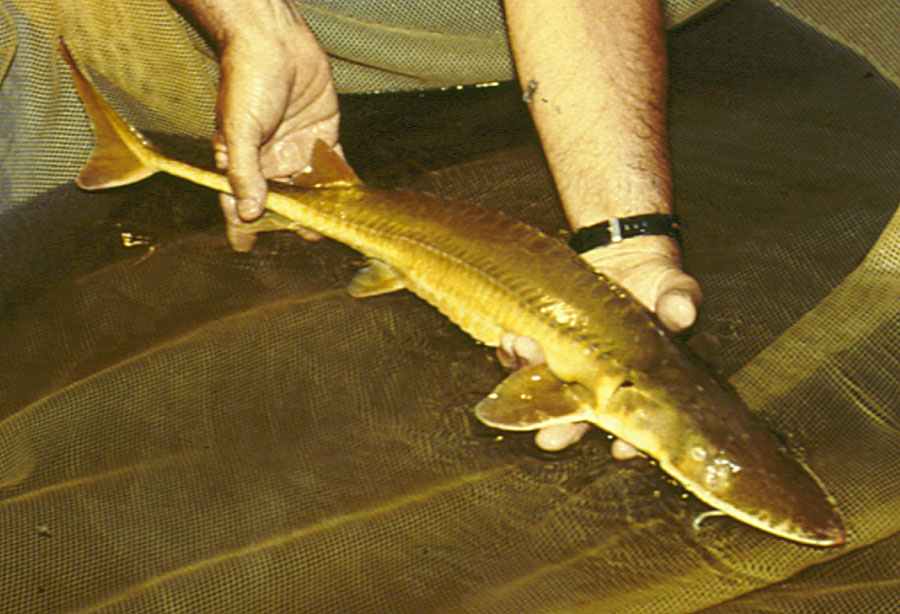
The Pallid Sturgeon has grayish-white coloration along its back and sides and becomes whiter as it ages. Its upper tail fin is longer than its lower tail fin.[1][2][3]
Its skeleton is cartilaginous rather than bony. Its body and head have five rows of thick protective cartilage plates.[4][5]
Its snout and head are longer than those of the shovelnose sturgeon. Four barbels extend downward from its snout near the front of its mouth, with the two inner barbels approximately half the length of the two outer barbels.[6][7][8]
Adult Pallid Sturgeon generally measure between 30 and 60 inches (76–152 cm) in length. Mature individuals can weigh as much as 85 pounds (39 kg).[9][10]
Habitat
The Pallid Sturgeon inhabits large rivers and prefers moderate to swift currents, generally ranging from 0.10 to 0.88 m/s. It generally occupies water depths between 0.91 and 7.62 m.[11][12][13]
It is commonly found in waterways with abundant sandy substrates, although it also inhabits predominantly rocky waterways. It prefers wider river channels, midchannel sandbars, and numerous islands.[14][15]
A radio-tracking study recorded the species at water depths ranging from 0.61 to 14.33 m. It is associated with bottom-oriented habitats in large rivers.[16][17]
Diet
Pallid Sturgeon are generally bottom-feeding fish that forage along sandy river reaches. They use opportunistic feeding strategies and consume small fish, mollusks, and other food sources collected from river bottoms.[18][19][20]
Juveniles consume different insects and fish species depending on the season. Small cyprinid fishes are an important dietary component.[21][22]
In hatchery-reared individuals studied in the upper Missouri River, small fish accounted for 82% of stomach-content wet weight. Stomach contents of lower Missouri River Pallid Sturgeon included fishes, aquatic insects, copepods, leeches, and mussels.[23][24]
Cyprinid fishes were the most abundant prey recorded in the lower Missouri River study. Macrhybopsis fishes were particularly preferred relative to ictalurids.[25][26]
Diptera larvae were the dominant prey identified in the guts of sampled larval Pallid Sturgeon. Larvae consumed a maximum of 11 distinct prey taxa in the upper Missouri River study.[27][28]
Behaviour
Pallid Sturgeon can travel as far as 13 miles (21 km) in a day. Tracked individuals reached swimming speeds of up to 5.7 miles per hour (9.2 km/h).[29][30]
Reproduction and life cycle
Male Pallid Sturgeon reach sexual maturity between five and seven years of age. Females generally reach reproductive maturity at approximately 15 years of age.[31][32]
Spawning generally occurs between May and July. The average interval between spawning events is approximately three years.[33][34]
Before dam construction, Pallid Sturgeon migrated hundreds of miles upstream to spawn. Females deposit their eggs on rocky or hard surfaces.[35][36]
Fertilized eggs hatch within five to eight days. After hatching, larvae drift downstream for several weeks, and their survival rate to adulthood is extremely low.[37][38][39]
Conservation
The Pallid Sturgeon was listed as endangered by the United States in 1990. Habitat loss is considered a major cause of its decline.[40][41]
Damming and channelization have reduced the gravel deposits and slow-moving side channels used as spawning habitat. Pallid Sturgeon are raised in approximately twelve hatcheries for release into the wild.[42][43]
Captured Pallid Sturgeon must be released back into the wild.[44]
Uses
Pallid Sturgeon were historically valued as trophy game fish. The species has been regarded as good-tasting, and its roe has been used to produce caviar.[45][46]
Similar species
The shovelnose sturgeon is a close relative of the Pallid Sturgeon. The Alabama sturgeon is another close relative.[47][48]
Classification of the Pallid Sturgeon
| Kingdom | Animalia |
|---|---|
| Phylum | Chordata |
| Subphylum | Vertebrata |
| Infraphylum | Gnathostomata |
| Parvphylum | Osteichthyes |
| Gigaclass | Actinopterygii |
| Superclass | Actinopteri |
| Class | Chondrostei |
| Order | Acipenseriformes |
| Family | Acipenseridae (Sturgeon) |
| Genus | Scaphirhynchus (Shovelnose Sturgeons) |
| Species | Scaphirhynchus albus (Forbes & Richardson, 1905) |
Where the Pallid Sturgeon is found
Checklists and occurrence records place Scaphirhynchus albus in 1 country. GBIF holds 1,495 georeferenced records of it.
Countries
Regions and cities with the most records
- Louisiana, United States 161
- Missouri, United States 45
- North Dakota, United States 37
- South Dakota, United States 17
- Nebraska, United States 15
- Illinois, United States 14
- Bellevue, United States 11
- Kentucky, United States 10
- Papillion, United States 9
- Kansas, United States 8
- La Vista, United States 8
- Council Bluffs, United States 7
- Omaha, United States 7
- Lawrence, United States 6
- Montana, United States 6
- Ferguson, United States 5
- Granite City, United States 4
- Iowa, United States 4
- Old Jamestown, United States 4
- Spanish Lake, United States 4
- Florissant, United States 3
A number beside a place is its count of GBIF occurrence records. A place without a number comes from a checklist alone. Records show where a species has been observed or collected, which can include escapes and vagrants.
Common names
English
- Pallid Sturgeon
- Hackleback
- White Sturgeon
Names in 7 other languages
- Arabic
- حفش شاحب
- Czech
- lopatonos velký
- Danish
- Bleg stør
- German
- Weißer Schaufelstör
- Italian
- storione pallido
- Polish
- łopatonos blady
- Russian
- Белый лопатонос
Synonyms
One other scientific name has been used for this species and is now treated as a synonym of Scaphirhynchus albus.
- Parascaphirhynchus albus Forbes & Richardson, 1905
Related species
-
 Shovelnose SturgeonScaphirhynchus platorynchus
-
 Alabama SturgeonScaphirhynchus suttkusi
-
 Lake SturgeonAcipenser fulvescens
-
 White SturgeonAcipenser transmontanus
-
 Dabry's SturgeonAcipenser dabryanus
-
 Atlantic SturgeonAcipenser oxyrinchus
-
 Russian SturgeonAcipenser gueldenstaedtii
-
 Syr Darya SturgeonPseudoscaphirhynchus fedtschenkoi
Compare
Questions and answers
What is the scientific name of the Pallid Sturgeon?
The scientific name of the Pallid Sturgeon is Scaphirhynchus albus. Written with its author, the full name is Scaphirhynchus albus (Forbes & Richardson, 1905).
Which family does the Pallid Sturgeon belong to?
Scaphirhynchus albus belongs to the family Acipenseridae, in the order Acipenseriformes and the class Chondrostei.
Where is the Pallid Sturgeon found?
Checklists and occurrence records place Scaphirhynchus albus in 1 country: United States.
What is the conservation status of the Pallid Sturgeon?
The IUCN Red List category recorded for Scaphirhynchus albus is Critically Endangered (CR).
What other names does the Pallid Sturgeon have?
Scaphirhynchus albus is also known in English as Hackleback and White Sturgeon.
How rare is a pallid sturgeon?
The Pallid Sturgeon was listed as endangered by the United States in 1990. Its larval survival rate to adulthood is extremely low, and approximately twelve hatcheries raise individuals for release into the wild.[39][40][43]
What are pallid sturgeons?
Pallid Sturgeon are fish in the family Acipenseridae. They have grayish-white coloration, cartilaginous skeletons, and five rows of protective cartilage plates along their bodies and heads.[1][4][5]
Why are pallid sturgeon important?
Pallid Sturgeon were historically valued as trophy game fish, and their roe has been used to produce caviar. They are also the subject of hatchery programs that raise individuals for release into the wild.[45][46][43]
What do pallid sturgeon eat?
Pallid Sturgeon are bottom-feeding fish that consume small fish, mollusks, aquatic insects, copepods, leeches, and mussels. Small cyprinid fishes are an important dietary component.[18][20][22][24]
What is the diet of a sturgeon?
The Pallid Sturgeon's diet includes small fish, mollusks, aquatic insects, copepods, leeches, and mussels. It generally forages along sandy river reaches and collects food from river bottoms.[18][20][24]
Sources
Passages the profile rests on
- The pallid sturgeon has grayish-white coloration along its back and sides. Source passage: “Pallid sturgeon are much paler in coloration with grayish white backs and sides” — English Wikipedia
- The species becomes whiter as it ages. Source passage: “Pallid sturgeon turn whiter as they age” — English Wikipedia
- Its upper tail fin is longer than its lower tail fin. Source passage: “their tails are heterocercal, with the top tail fin being longer than the bottom fin” — English Wikipedia
- Its skeleton is cartilaginous rather than bony. Source passage: “Instead, they have cartilaginous skeletons” — English Wikipedia
- Its body and head have five rows of thick protective cartilage plates. Source passage: “they have cartilaginous skeletons with five rows of thick cartilage plates that extend along their sides, undersides, and backs, as well as over most of the head.” — English Wikipedia
- Its snout and head are longer than those of the shovelnose sturgeon. Source passage: “The pallid sturgeon's snout and head are longer than those of the shovelnose sturgeon.” — English Wikipedia
- It has four barbels extending downward from its snout near the front of its mouth. Source passage: “Both species also have four barbels which descend from the snout near the front of the mouth.” — English Wikipedia
- Its two inner barbels are approximately half the length of its two outer barbels. Source passage: “On pallid sturgeon, the two inner barbels are about half as long as the outer ones” — English Wikipedia
- Adult pallid sturgeon generally measure between 30 and 60 inches (76–152 cm) in length. Source passage: “They are generally between 30 and 60 inches (76 and 152 cm) in length” — English Wikipedia
- Mature individuals can weigh as much as 85 pounds (39 kg). Source passage: “weigh as much as 85 pounds (39 kg).” — English Wikipedia
- The species inhabits large rivers and prefers moderate to swift currents. Source passage: “Pallid sturgeon prefer moderate to swift river currents” — English Wikipedia
- Its preferred river currents generally range from 0.10 to 0.88 m/s. Source passage: “the current averages between 0.33 and 2.9 feet per second (0.10 and 0.88 m/s).” — English Wikipedia
- The species generally occupies water depths between 0.91 and 7.62 m. Source passage: “water depths between 3 and 25 feet (0.91 and 7.62 m).” — English Wikipedia
- It is commonly found in waterways with abundant sandy substrates, although it also inhabits predominantly rocky waterways. Source passage: “The species is more commonly found where sandy substrates are plentiful, but also lives in predominately rocky waterways.” — English Wikipedia
- The species prefers wider river channels, midchannel sandbars, and numerous islands. Source passage: “Pallid sturgeon were found to prefer wider river channels, midchannel sandbars, and numerous islands” — English Wikipedia
- It has been recorded in water depths ranging from 0.61 to 14.33 m in a radio-tracking study. Source passage: “were most commonly recorded in water depths between 2 and 47 feet (0.61 and 14.33 m).” — English Wikipedia
- The species is associated with bottom-oriented habitats in large rivers. Source passage: “Pallid sturgeon are a bottom-oriented, large river obligate fish inhabiting the ...” — ecos.fws.gov
- Pallid sturgeon are generally bottom-feeding fish that forage along sandy river reaches. Source passage: “Pallid sturgeon are generally bottom feeders, skimming the sandy reaches of the various rivers and streams in their habitat.” — English Wikipedia
- The species uses opportunistic feeding strategies. Source passage: “they are thought to be opportunistic feeders.” — English Wikipedia
- Its diet includes small fish, mollusks, and other food sources collected from river bottoms. Source passage: “they use their extendable mouths to suck up small fish, mollusks, and other food sources from river bottoms.” — English Wikipedia
- Juvenile pallid sturgeon consume different insects and fish species depending on the season. Source passage: “Various insects were consumed during some seasons and various fish species during others.” — English Wikipedia
- Small cyprinid fishes are an important dietary component. Source passage: “the pallid sturgeon was found to consume far greater numbers of small fish such as cyprinids (minnows).” — English Wikipedia
- In hatchery-reared individuals studied in the upper Missouri River, small fish accounted for 82% of stomach-content wet weight. Source passage: “82% of the wet weight was small fish” — English Wikipedia
- Stomach contents of lower Missouri River pallid sturgeon included fishes, aquatic insects, copepods, leeches, and mussels. Source passage: “Stomach contents of pallid sturgeon included fish (Cyprinidae and Ictaluridae), aquatic insects, copepods, leeches, and mussels.” — hero.epa.gov
- Cyprinid fishes were the most abundant prey recorded in the lower Missouri River study. Source passage: “Cyprinids were the most abundant prey item” — hero.epa.gov
- Macrhybopsis fishes were particularly preferred relative to ictalurids in the lower Missouri River study. Source passage: “indicated preference for cyprinids (1.5 : 1), particularly Macrhybopsis species” — hero.epa.gov
- Diptera larvae were the dominant prey identified in the guts of sampled larval pallid sturgeon. Source passage: “Abundance of dominant prey in the gut (Diptera larvae) increased with fish length for both species” — usgs.gov
- Larval pallid sturgeon consumed a maximum of 11 distinct prey taxa in the upper Missouri River study. Source passage: “Larval pallid sturgeon consumed a maximum of 11 unique taxa” — usgs.gov
- Pallid sturgeon can travel as far as 13 miles (21 km) in a day. Source passage: “the pallid sturgeon moved as much as 13 miles (21 km) per day” — English Wikipedia
- Tracked individuals reached swimming speeds of up to 5.7 miles per hour (9.2 km/h). Source passage: “and up to 5.7 miles per hour (9.2 km/h).” — English Wikipedia
- Male pallid sturgeon reach sexual maturity between five and seven years of age. Source passage: “Males reach sexual maturity between the ages of 5 and 7 years” — English Wikipedia
- Females generally reach reproductive maturity at approximately 15 years of age. Source passage: “females are believed to become capable of reproduction when they are at least 15 years old.” — English Wikipedia
- Spawning generally occurs between May and July. Source passage: “Spawning usually takes place May to July.” — English Wikipedia
- The average interval between spawning events is approximately three years. Source passage: “the average interval between spawnings is three years” — English Wikipedia
- Before dam construction, pallid sturgeon migrated hundreds of miles upstream to spawn. Source passage: “pallid sturgeon migrated hundreds of miles upstream to spawn” — English Wikipedia
- Females deposit their eggs on rocky or hard surfaces. Source passage: “sought out rocky or hard surfaces to deposit hundreds of thousands of eggs.” — English Wikipedia
- Fertilized eggs hatch within five to eight days. Source passage: “After fertilization, pallid sturgeon eggs hatch in 5 to 8 days” — English Wikipedia
- After hatching, larvae drift downstream for several weeks. Source passage: “after which the larvae drift back downstream for several weeks.” — English Wikipedia
- The larval survival rate to adulthood is extremely low. Source passage: “The rate of survival to maturity for pallid sturgeon larvae is extremely low” — English Wikipedia
- The pallid sturgeon was listed as endangered by the United States in 1990. Source passage: “the species was listed as endangered on September 6, 1990.” — English Wikipedia
- Habitat loss is considered a major cause of the species' decline. Source passage: “a loss of its habitat is thought to be responsible for its decline.” — English Wikipedia
- Damming and channelization have reduced the gravel deposits and slow-moving side channels used as spawning habitat. Source passage: “reducing the gravel deposits and slow-moving side channels that are its favored spawning areas.” — English Wikipedia
- Pallid sturgeon are raised in approximately twelve hatcheries for release into the wild. Source passage: “Pallid sturgeon are actively being raised in a dozen hatcheries” — English Wikipedia
- Captured pallid sturgeon must be released back into the wild. Source passage: “All captured pallid sturgeon must now be released back to the wild.” — English Wikipedia
- Pallid sturgeon were historically valued as trophy game fish. Source passage: “Pallid sturgeon were previously considered a prized trophy game fish species” — English Wikipedia
- The species has been regarded as good-tasting and its roe has been used to produce caviar. Source passage: “The species was known for being very palatable and the roe from females was used as caviar.” — English Wikipedia
- The shovelnose sturgeon is a close relative of the pallid sturgeon. Source passage: “Its closest relatives are the shovelnose sturgeon (Scaphirhynchus platorynchus)” — English Wikipedia
- The Alabama sturgeon is another close relative of the pallid sturgeon. Source passage: “and the critically endangered Alabama sturgeon (Scaphirhynchus suttkusi)” — English Wikipedia
- The species is endemic to the Missouri and lower Mississippi River basins in the United States. Source passage: “endemic to the waters of the Missouri and lower Mississippi River basins of the United States.” — English Wikipedia
- The Atchafalaya River in Louisiana continues to support a population of pallid sturgeon. Source passage: “The Missouri and Mississippi rivers from Montana to Louisiana, as well as the Atchafalaya River in Louisiana, continue to harbor an aging population of pallid sturgeon.” — English Wikipedia
Data
- Catalogue of Life, 2026-10-16 XR cc by
- Global Biodiversity Information Facility CC BY 4.0
- Wikidata CC0
- GeoNames CC BY 4.0
- Wikimedia Commons per image; credit shown with each image
- Within the Catalogue of Life, this name comes from World Register of Marine Species cc by
This species in other databases
- Catalogue of Life 79TKJ
- Wikidata Q921461
- iNaturalist 112106
- WoRMS urn:lsid:marinespecies.org:taxname:1425016
- ITIS 161081
Page built on 28 November 2026. See how the catalog is made and all sources and licences.
Cite this page
ScientificNames.org. (2026). Scaphirhynchus albus (Pallid Sturgeon). Retrieved November 28, 2026, from https://scientificnames.org/species/scaphirhynchus-albus
“Scaphirhynchus albus (Pallid Sturgeon).” ScientificNames.org, 2026, scientificnames.org/species/scaphirhynchus-albus. Accessed 28 Nov. 2026.
ScientificNames.org. “Scaphirhynchus albus (Pallid Sturgeon).” Accessed November 28, 2026. https://scientificnames.org/species/scaphirhynchus-albus.
@misc{scientificnames_scaphirhynchus_albus_pallid_sturgeon,
  author = {{ScientificNames.org}},
  title = {Scaphirhynchus albus (Pallid Sturgeon)},
  year = {2026},
  url = {https://scientificnames.org/species/scaphirhynchus-albus},
  note = {Accessed 2026-11-28}
}