Species · Fishes
Alabama Sturgeon Scaphirhynchus suttkusi
The scientific name of the Alabama Sturgeon is Scaphirhynchus suttkusi. It is a species of fish in the family Acipenseridae (sturgeon), order Acipenseriformes. The name dates from 1991.
- Scientific name
- Scaphirhynchus suttkusi Williams & Clemmer, 1991
- Common name
- Alabama Sturgeon
- Genus
- Scaphirhynchus
- Family
- Acipenseridae (Sturgeon)
- Order
- Acipenseriformes
- Class
- Chondrostei
- Red List category
- CR Critically Endangered
- Environment
- brackish, freshwater
- Recorded in
- 1 country
- Name status
- accepted in the Catalogue of Life
Overview
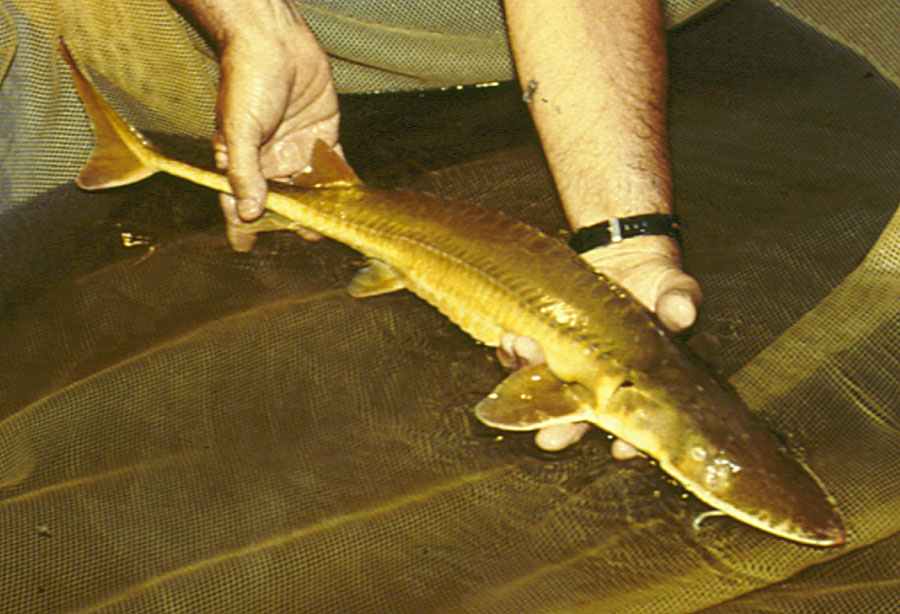
The Alabama Sturgeon is a distinct fish species formally identified by J.D. Williams and G.H. Clemmer in 1991. The species is native to the United States and is believed to survive only in approximately 210 kilometres of the lower Alabama River. It has distinctive yellowish-orange coloration, with brownish-orange back and fins, golden yellow sides, and a cream-colored belly.
Written 26 November 2026 from the sources listed below. Each statement was checked against the passage it cites; statements that could not be supported were removed.
Appearance
The Alabama Sturgeon has a yellowish-orange coloration. Its back and fins are brownish-orange, its sides are golden yellow, and its belly is cream-colored.[1][2]
Its eye orbit measures 16 millimetres in length and is wider than those of other sturgeons. Its gill arches have 5–9 gill rakers on the upper limb and 12–15 on the lower limb.[3][4]
Its anal and dorsal fins are positioned farther back and are proportionally shorter than those of the shovelnose sturgeon.[5]
The Alabama Sturgeon typically grows to approximately 76 centimetres in length. It is the smallest of all North American sturgeons.[6][7]
Diet
The Alabama Sturgeon is an opportunistic bottom feeder that feeds on aquatic insects and fish. Its insect prey includes flies, mayflies, caddisflies, beetles, and dragonflies.[8][9][10]
Fish constitute approximately one-third of its diet. Its fish prey includes minnows, shiners, logperch, darters, and bluegills.[11][12]
Its stomach contents frequently include considerable quantities of sand and gravel. Its barbels and gill rakers help it detect and capture insects and small fish on river and stream bottoms.[13][14]
Habitat
The Alabama Sturgeon is believed to survive only in approximately 210 kilometres of the lower Alabama River. Its historical range covered more than 1,600 kilometres of rivers, including the Alabama, Tombigbee, Mobile, Tensaw, Black Warrior, Cahaba, Coosa, and Tallapoosa rivers.[15][16][17]
The species occupies benthic feeding areas. Its insect prey occurs on rock surfaces, in swift and slow currents, and in the water column.[18][19]
Reproduction and life cycle
The reproductive habits of the Alabama Sturgeon remain poorly understood. Sexual maturity is estimated to occur between five and seven years of age, and the species is believed to spawn once every two to three years.[20][21][22]
Females with mature eggs have been recorded in late March, April, and early May. One artificial propagation experiment produced 4,000 mature eggs from a female Alabama Sturgeon.[23][24]
One female specimen was recorded with black eggs measuring 2.4–2.8 millimetres in diameter. Another female specimen had brown eggs measuring 1.8–2.1 millimetres in diameter.[25][26]
Similar species
The Alabama Sturgeon was formerly misidentified as the shovelnose sturgeon (Scaphirhynchus platorynchus). The two are closely related species.[27][28]
The pallid sturgeon (Scaphirhynchus albus) is identified as the sister group of the Alabama and shovelnose sturgeons within the Scaphirhynchus genus.[29]
Conservation
A captive breeding program for the Alabama Sturgeon began in 1993. The species was listed for protection in 2000 following a lawsuit against the U.S. Fish and Wildlife Service.[30][31]
Only six individuals have been captured since the captive breeding program began, and all were males. The last Alabama Sturgeon held in captivity died in 2002.[32][33]
The most recent specimen described was captured in April 2007, sampled for sperm, tagged, and released.[34]
A 2013 recovery plan proposed establishing a captive population to produce fingerlings for release into the wild. It also proposed improving Alabama River habitat through operational changes at Claiborne and Millers Ferry Lock and Dams.[35][36]
Environmental DNA from the Alabama Sturgeon was detected in water samples collected during studies conducted in 2014 and 2015. Sampling detected the species in the Alabama, Cahaba, Mobile, and Tombigbee rivers.[37][38]
Environmental DNA detections increased during the spawning season in April. Increased detections in the Tombigbee River during December suggest possible winter migration to that river.[39][40]
Classification of the Alabama Sturgeon
| Kingdom | Animalia |
|---|---|
| Phylum | Chordata |
| Subphylum | Vertebrata |
| Infraphylum | Gnathostomata |
| Parvphylum | Osteichthyes |
| Gigaclass | Actinopterygii |
| Superclass | Actinopteri |
| Class | Chondrostei |
| Order | Acipenseriformes |
| Family | Acipenseridae (Sturgeon) |
| Genus | Scaphirhynchus (Shovelnose Sturgeons) |
| Species | Scaphirhynchus suttkusi Williams & Clemmer, 1991 |
Where the Alabama Sturgeon is found
Checklists and occurrence records place Scaphirhynchus suttkusi in 1 country. GBIF holds 60 georeferenced records of it.
Countries
Regions and cities with the most records
A number beside a place is its count of GBIF occurrence records. A place without a number comes from a checklist alone. Records show where a species has been observed or collected, which can include escapes and vagrants.
Common names
English
- Alabama Sturgeon
Names in 6 other languages
- Arabic
- حفش ألاباما
- Czech
- lopatonos alabamský
- Danish
- Alabamastør
- German
- Alabama-Schaufelstör
- Italian
- storione dell'Alabama
- Portuguese
- Esturjão-do-alabama
Related species
-
 Pallid SturgeonScaphirhynchus albus
-
 Shovelnose SturgeonScaphirhynchus platorynchus
-
 Lake SturgeonAcipenser fulvescens
-
 White SturgeonAcipenser transmontanus
-
 Dabry's SturgeonAcipenser dabryanus
-
 Atlantic SturgeonAcipenser oxyrinchus
-
 Russian SturgeonAcipenser gueldenstaedtii
-
 Syr Darya SturgeonPseudoscaphirhynchus fedtschenkoi
Compare
Questions and answers
What is the scientific name of the Alabama Sturgeon?
The scientific name of the Alabama Sturgeon is Scaphirhynchus suttkusi. Written with its author, the full name is Scaphirhynchus suttkusi Williams & Clemmer, 1991.
Which family does the Alabama Sturgeon belong to?
Scaphirhynchus suttkusi belongs to the family Acipenseridae, in the order Acipenseriformes and the class Chondrostei.
Where is the Alabama Sturgeon found?
Checklists and occurrence records place Scaphirhynchus suttkusi in 1 country: United States.
What is the conservation status of the Alabama Sturgeon?
The IUCN Red List category recorded for Scaphirhynchus suttkusi is Critically Endangered (CR).
What is the diet of a sturgeon?
The Alabama Sturgeon is an opportunistic bottom feeder that eats aquatic insects and fish. Its insect prey includes flies, mayflies, caddisflies, beetles, and dragonflies. Fish constitute approximately one-third of its diet and include minnows, shiners, logperch, darters, and bluegills.[8][9][10][11][12]
Sources
Passages the profile rests on
- The species has a distinctive yellowish-orange coloration. Source passage: “The fish has a distinctive yellowish-orange color” — English Wikipedia
- Its back and fins are brownish-orange, its sides are golden yellow, and its belly is cream-colored. Source passage: “It has a distinct brownish-orange color on its back and fins, golden yellow sides, and a cream-colored belly.” — English Wikipedia
- Its eye orbit measures 16 millimetres in length and is wider than those of other sturgeons. Source passage: “Its orbit, the space where the eye is positioned, at 16 mm long is wider than those of other sturgeons.” — English Wikipedia
- Its gill arches have 5–9 gill rakers on the upper limb and 12–15 on the lower limb. Source passage: “They have 5–9 gill rakers on the upper limb of their gill arches and 12–15 on the lower limb.” — English Wikipedia
- Its anal and dorsal fins are positioned farther back and are proportionally shorter than those of the shovelnose sturgeon. Source passage: “Alabama sturgeons have more posterior anal and dorsal fins than the shovelnose sturgeon. Their fins are also proportionally shorter than those of the shovelnose.” — English Wikipedia
- The Alabama sturgeon typically grows to approximately 76 centimetres in length. Source passage: “grows to a size of about 30 in (76 cm) long” — English Wikipedia
- The Alabama sturgeon is the smallest of all North American sturgeons. Source passage: “The Alabama sturgeon ( Scaphirhynchus suttkusi) is the smallest of all the North American sturgeons” — federalregister.gov
- The Alabama sturgeon feeds on aquatic insects and fish. Source passage: “The diet of Alabama sturgeon consists of aquatic insects and fish.” — English Wikipedia
- The species is an opportunistic bottom feeder. Source passage: “These opportunistic bottom feeders eat a variety of insects” — English Wikipedia
- Its insect prey includes flies, mayflies, caddisflies, beetles, and dragonflies. Source passage: “including flies, mayflies, caddisflies, beetles, and dragonflies.” — English Wikipedia
- Fish constitute approximately one-third of its diet. Source passage: “Fish make up roughly 1/3 of their diet” — English Wikipedia
- Its fish prey includes minnows, shiners, logperch, darters, and bluegills. Source passage: “including those from the orders Cypriniformes (minnows, shiners, logperch) and Perciformes (darters, bluegills).” — English Wikipedia
- Its stomach contents frequently include considerable quantities of sand and gravel. Source passage: “Alabama sturgeon stomachs also tend to contain considerable amounts of sand and gravel” — English Wikipedia
- Its barbels and gill rakers help it detect and capture insects and small fish on river and stream bottoms. Source passage: “to help detect and trap insects and small fish in the bottoms of rivers and streams.” — English Wikipedia
- The species is believed to survive only in approximately 210 kilometres of the lower Alabama River. Source passage: “now only believed to exist in 130 miles (210 km) of the lower Alabama River.” — English Wikipedia
- Its historical range covered more than 1,600 kilometres of rivers. Source passage: “Its historical ranges were believed to be over 1,600 kilometres (990 mi) of river” — English Wikipedia
- Its historical range included the Alabama, Tombigbee, Mobile, Tensaw, Black Warrior, Cahaba, Coosa, and Tallapoosa rivers. Source passage: “included the Alabama, Tombigbee, Mobile, Tensaw, Black Warrior, Cahaba, Coosa, and Tallapoosa rivers.” — English Wikipedia
- The species occupies benthic feeding areas, as suggested by the sand and gravel found in its stomachs. Source passage: “which suggests feeding in benthic areas.” — English Wikipedia
- Its insect prey occurs on rock surfaces, in swift and slow currents, and in the water column. Source passage: “such as on the surfaces of rocks, in swift and slow currents, and in the water column.” — English Wikipedia
- The reproductive habits of the Alabama sturgeon remain poorly understood. Source passage: “little is known about the reproductive habits of Alabama sturgeon.” — English Wikipedia
- Sexual maturity is estimated to occur between five and seven years of age. Source passage: “Sexual maturation likely occurs between 5 and 7 years of age” — English Wikipedia
- The species is believed to spawn once every two to three years. Source passage: “they likely spawn once every 2–3 years.” — English Wikipedia
- Females with mature eggs have been recorded in late March, April, and early May. Source passage: “Female Alabama sturgeons with mature eggs have been found in late March, April, and early May.” — English Wikipedia
- One artificial propagation experiment produced 4,000 mature eggs from a female Alabama sturgeon. Source passage: “One artificial propagation experiment yielded the harvest of 4000 mature eggs from an Alabama sturgeon” — English Wikipedia
- A female specimen was recorded with black eggs measuring 2.4–2.8 millimetres in diameter. Source passage: “A female specimen was found with black eggs 2.4-2.8 mm in diameter” — English Wikipedia
- Another female specimen was recorded with brown eggs measuring 1.8–2.1 millimetres in diameter. Source passage: “another was found with brown eggs 1.8-2.1 mm in diameter.” — English Wikipedia
- The Alabama sturgeon was formerly misidentified as the shovelnose sturgeon (Scaphirhynchus platorynchus). Source passage: “Before its discovery, it was misidentified as a Scaphirhynchus platorynchus, a shovelnose sturgeon” — English Wikipedia
- The Alabama sturgeon and shovelnose sturgeon are closely related species. Source passage: “The Alabama sturgeon and the shovelnose sturgeon (S. platorynchus) are closely related” — English Wikipedia
- The pallid sturgeon (Scaphirhynchus albus) is identified as the sister group of the Alabama and shovelnose sturgeons within the Scaphirhynchus genus. Source passage: “have a sister group in the pallid sturgeon (S. albus) within the monophyletic Scaphirhynchus genus.” — English Wikipedia
- The Alabama sturgeon was listed for protection in 2000 following a lawsuit against the U.S. Fish and Wildlife Service. Source passage: “in 2000, won, requiring Fish and Wildlife to list the fish for protection.” — English Wikipedia
- A captive breeding program for the species began in 1993. Source passage: “In 1993, state and federal biologists began a program to help save the Alabama sturgeon through a captive breeding program.” — English Wikipedia
- Only six individuals have been captured since the captive breeding program began, and all were males. Source passage: “only six fish have been captured since then, all male.” — English Wikipedia
- The last Alabama sturgeon held in captivity died in 2002. Source passage: “The last fish held in captivity died in 2002.” — English Wikipedia
- The most recent specimen described in the document was captured in April 2007, sampled for sperm, tagged, and released. Source passage: “The most recent specimen was captured in April 2007. After determining the fish was a male, sperm were collected, a small tracking device implanted, and it was released once it had fully healed.” — English Wikipedia
- A 2013 recovery plan proposed establishing a captive population to produce fingerlings for release into the wild. Source passage: “It includes a plan to establish a captive stock that can produce fingerlings to be released back into the wild” — English Wikipedia
- The recovery plan also proposed improving Alabama River habitat through operational changes at Claiborne and Millers Ferry Lock and Dams. Source passage: “to improve the habitat in the Alabama River through operational changes at Claiborne and Millers Ferry Lock and Dams.” — English Wikipedia
- Environmental DNA from the Alabama sturgeon was detected in water samples collected in studies conducted during 2014 and 2015. Source passage: “Studies from 2014 and 2015 indicated that despite the very few sightings over the last decade, the species is still extant. This is due to numerous traces of recent Alabama sturgeon DNA (environmental DNA) found in water samples gathered from the river.” — English Wikipedia
- Environmental DNA sampling detected the species in the Alabama, Cahaba, Mobile, and Tombigbee rivers. Source passage: “More recent eDNA sampling found Alabama sturgeon DNA in the Alabama, Cahaba, Mobile, and Tombigbee Rivers.” — English Wikipedia
- Environmental DNA detections increased during the spawning season in April. Source passage: “During spawning season (April), researchers found a greater number of Alabama sturgeon eDNA detections.” — English Wikipedia
- Increased environmental DNA detections in the Tombigbee River during December suggest possible winter migration to that river. Source passage: “There were increased detections in the Tombigbee River during December, which suggests that Alabama sturgeons may be migrating there for the winter” — English Wikipedia
Data
- Catalogue of Life, 2026-10-16 XR cc by
- Global Biodiversity Information Facility CC BY 4.0
- Wikidata CC0
- GeoNames CC BY 4.0
- Wikimedia Commons per image; credit shown with each image
- iNaturalist per image; credit shown with each image
- Within the Catalogue of Life, this name comes from World Register of Marine Species cc by
References
- Williams, J. D., & Clemmer, G. H. (1991). Scaphirhynchus suttkusi, a new sturgeon (Pisces: Acipenseridae) from the Mobile basin of Alabama and Mississippi. Alabama Museum of Natural History Bulletin, 10: 17–31. where the name was published
This species in other databases
- Catalogue of Life 79TKM
- Wikidata Q2123132
- iNaturalist 112108
- WoRMS urn:lsid:marinespecies.org:taxname:282668
- ITIS 201895
Page built on 29 November 2026. See how the catalog is made and all sources and licences.
Cite this page
ScientificNames.org. (2026). Scaphirhynchus suttkusi (Alabama Sturgeon). Retrieved November 29, 2026, from https://scientificnames.org/species/scaphirhynchus-suttkusi
“Scaphirhynchus suttkusi (Alabama Sturgeon).” ScientificNames.org, 2026, scientificnames.org/species/scaphirhynchus-suttkusi. Accessed 29 Nov. 2026.
ScientificNames.org. “Scaphirhynchus suttkusi (Alabama Sturgeon).” Accessed November 29, 2026. https://scientificnames.org/species/scaphirhynchus-suttkusi.
@misc{scientificnames_scaphirhynchus_suttkusi_alabama_sturgeon,
  author = {{ScientificNames.org}},
  title = {Scaphirhynchus suttkusi (Alabama Sturgeon)},
  year = {2026},
  url = {https://scientificnames.org/species/scaphirhynchus-suttkusi},
  note = {Accessed 2026-11-29}
}