Species · Fishes
Shovelnose Sturgeon Scaphirhynchus platorynchus
The scientific name of the Shovelnose Sturgeon is Scaphirhynchus platorynchus. It is a species of fish in the family Acipenseridae (sturgeon), order Acipenseriformes. The name dates from 1820.
- Scientific name
- Scaphirhynchus platorynchus (Rafinesque, 1820)
- Common name
- Shovelnose Sturgeon
- Genus
- Scaphirhynchus
- Family
- Acipenseridae (Sturgeon)
- Order
- Acipenseriformes
- Class
- Chondrostei
- Red List category
- VU Vulnerable
- Environment
- freshwater
- Recorded in
- 1 country
- Name status
- accepted in the Catalogue of Life

Overview
Scaphirhynchus platorynchus inhabits large rivers, particularly the Missouri and Mississippi River systems.
Written 26 November 2026 from the sources listed below. Each statement was checked against the passage it cites; statements that could not be supported were removed.
Appearance
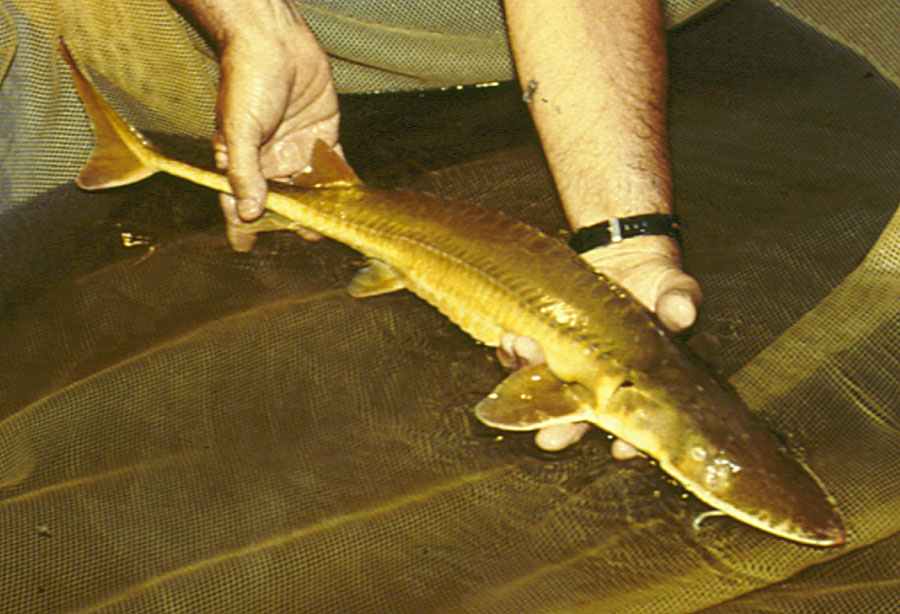
The Shovelnose Sturgeon has an elongated body with five rows of sharply keeled body plates. Its dorsal coloration ranges from olive to yellowish-brown, with lighter sides and a white underside.[1][2]
Its caudal peduncle is elongated, flattened, and completely armored, and its belly is covered with scale-like plates. Its heterocercal tail has long, thread-like filaments on the upper lobe, and four evenly spaced barbels extend beneath its jaw.[3][4][5][6]
Habitat
The Shovelnose Sturgeon inhabits open-channel and main-channel areas of large rivers. It commonly occupies river bottoms with swift currents and sandy or gravelly substrates, including pools downstream of sandbars and along main-channel borders.[7][8][9]
It inhabits flowing freshwater with temperatures of approximately 18–20 °C and spends most of its life near the bottom in deep, cool river channels. During low-water periods and warm summer months, it seeks cooler and deeper channel areas.[10][11][12]
Diet
Its diet consists primarily of aquatic insect larvae, particularly mayflies, true flies, and caddisflies. It also consumes crustaceans, worms, and small fish.[13][14]
In a lower Platte River study, aquatic insect larvae and nymphs accounted for more than 99% of its diet by number. Chironomidae accounted for 98.1% of its diet in 2001 in the lower Platte River, with Paracladopelma, Chernovskiia, Saetheria, and Robackia among the prominent genera.[15][16][17]
Its diet also includes mayflies from the families Isonychiidae and Caenidae and caddisflies belonging to the family Hydropsychidae. It obtains food by using a protrusible mouth to suck organisms from the river bottom.[18][19][20]
Behaviour
The Shovelnose Sturgeon does not maintain a restricted home range and can travel long distances. It can travel upstream as far as 540 kilometres when migration routes are unobstructed and can cover up to 20 kilometres in a single day.[21][22][23]
Reproduction and life cycle
Females generally begin breeding at approximately seven years of age, while males generally begin breeding at approximately five years. Spawning usually occurs between April and early July over rocky substrates in flowing water at temperatures of approximately 17–21 °C.[24][25][26][27]
A female deposits approximately 50,000 eggs during each spawning season. The eggs measure approximately 2–3 millimetres in diameter and generally hatch after five to eight days.[28][29][30]
Conservation
The Shovelnose Sturgeon was listed as threatened under the United States Endangered Species Act in 2010. Its range restriction is associated primarily with dam construction on native waterways.[31][32]
Locks and dams have contributed to population decline by blocking access to ancestral spawning grounds and eliminating required habitat.[33]
Uses
Its roe is marketed as hackleback caviar. Its flesh is considered a delicacy, particularly when smoked.[34][35]
Classification of the Shovelnose Sturgeon
| Kingdom | Animalia |
|---|---|
| Phylum | Chordata |
| Subphylum | Vertebrata |
| Infraphylum | Gnathostomata |
| Parvphylum | Osteichthyes |
| Gigaclass | Actinopterygii |
| Superclass | Actinopteri |
| Class | Chondrostei |
| Order | Acipenseriformes |
| Family | Acipenseridae (Sturgeon) |
| Genus | Scaphirhynchus (Shovelnose Sturgeons) |
| Species | Scaphirhynchus platorynchus (Rafinesque, 1820) |
Where the Shovelnose Sturgeon is found
Checklists and occurrence records place Scaphirhynchus platorynchus in 1 country. GBIF holds 914 georeferenced records of it.
Countries
Regions and cities with the most records
- Kansas, United States 155
- Kansas City, United States 101
- Kansas City, United States 101
- Prairie Village, United States 100
- Shawnee, United States 100
- Leawood, United States 99
- Overland Park, United States 99
- Lenexa, United States 98
- Minnesota, United States 77
- Missouri, United States 52
- Illinois, United States 51
- Louisiana, United States 49
- Lawrence, United States 42
- Wisconsin, United States 39
- Iowa, United States 30
- Kentucky, United States 30
- Nebraska, United States 24
- Shakopee, United States 23
- Chaska, United States 21
- Chanhassen, United States 20
- South Dakota, United States 19
- Prior Lake, United States 18
- Indiana, United States 17
- North Dakota, United States 16
- Mankato, United States 15
- Paducah, United States 15
- Eden Prairie, United States 13
- Arkansas, United States 12
- Oklahoma, United States 12
- Minnetonka, United States 11
- Wyoming, United States 11
- Hopkins, United States 10
- Spanish Lake, United States 10
- Ferguson, United States 9
- Ohio, United States 9
- Savage, United States 9
A number beside a place is its count of GBIF occurrence records. A place without a number comes from a checklist alone. Records show where a species has been observed or collected, which can include escapes and vagrants.
Common names
English
- Shovelnose Sturgeon
- Hackleback
- Sand Sturgeon
- Switchtail
Names in 8 other languages
- Arabic
- حفش الرمال, حفش مجرفي الأنف
- Czech
- lopatonos americký
- Danish
- Almindelig skovlhovedstør
- German
- Amerikanischer Schaufelstör, Gewöhnlicher Schaufelstör, Schaufelstör
- Italian
- storione dal naso a pala
- Polish
- Łopatonos amerykański
- Russian
- Обыкновенный лопатонос
- Spanish
- esturión pala
Synonyms
3 other scientific names have been used for this species and are now treated as synonyms of Scaphirhynchus platorynchus.
- Accipenser platorynchus Rafinesque, 1820
- Scaphirhincus platorhynchus (Rafinesque, 1820)
- Scaphirhynchus platyrhynchus (Rafinesque, 1820)
Related species
-
 Pallid SturgeonScaphirhynchus albus
-
 Alabama SturgeonScaphirhynchus suttkusi
-
 Lake SturgeonAcipenser fulvescens
-
 White SturgeonAcipenser transmontanus
-
 Dabry's SturgeonAcipenser dabryanus
-
 Atlantic SturgeonAcipenser oxyrinchus
-
 Russian SturgeonAcipenser gueldenstaedtii
-
 Syr Darya SturgeonPseudoscaphirhynchus fedtschenkoi
Compare
Questions and answers
What is the scientific name of the Shovelnose Sturgeon?
The scientific name of the Shovelnose Sturgeon is Scaphirhynchus platorynchus. Written with its author, the full name is Scaphirhynchus platorynchus (Rafinesque, 1820).
Which family does the Shovelnose Sturgeon belong to?
Scaphirhynchus platorynchus belongs to the family Acipenseridae, in the order Acipenseriformes and the class Chondrostei.
Where is the Shovelnose Sturgeon found?
Checklists and occurrence records place Scaphirhynchus platorynchus in 1 country: United States.
What is the conservation status of the Shovelnose Sturgeon?
The IUCN Red List category recorded for Scaphirhynchus platorynchus is Vulnerable (VU).
What other names does the Shovelnose Sturgeon have?
Scaphirhynchus platorynchus is also known in English as Hackleback, Sand Sturgeon and Switchtail.
Do shovelnose sturgeon have caviar?
Yes. Their roe is marketed as hackleback caviar.[34]
How big does a shovelnose sturgeon get?
The Shovelnose Sturgeon can reach approximately 100 centimetres in length. Commonly observed lengths are approximately 50–85 centimetres, and commonly observed weight is approximately 2.5 kilograms. The largest recorded individual weighed 6.2 kilograms.[36][37][38][39]
What is the diet of a sturgeon?
The Shovelnose Sturgeon's diet consists primarily of aquatic insect larvae, particularly mayflies, true flies, and caddisflies. It also consumes crustaceans, worms, and small fish.[13][14]
What habitat do sturgeon live in?
The Shovelnose Sturgeon inhabits open-channel and main-channel areas of large rivers. It commonly occupies river bottoms with swift currents and sandy or gravelly substrates, spending most of its life near the bottom in deep, cool river channels.[7][8][12]
Where do shovelnose sturgeon live?
The species historically occurred throughout much of the Mississippi and Missouri River basins, with a historical range extending from Montana south to Louisiana and from Pennsylvania west to New Mexico. It is no longer found in Pennsylvania, New Mexico, or large parts of Kansas, Kentucky, and Tennessee where it was formerly abundant. It is particularly abundant in the Missouri and Mississippi River systems.[40][41][42][43]
Sources
Passages the profile rests on
- The species has an elongated body with five rows of sharply keeled body plates. Source passage: “Shovelnose sturgeons have an elongated body with five rows of sharply keeled body plates: 14-19 dorsal plates, 38-47 lateral, 10-14 ventrolateral.” — animaldiversity.org
- Its dorsal coloration ranges from olive to yellowish-brown, with lighter sides and a white underside. Source passage: “They are olive to yellowish-brown in color on the top with lighter sides, and white on the bottom.” — animaldiversity.org
- Its caudal peduncle is elongated, flattened, and completely armored. Source passage: “The caudal peduncle is long, depressed, and fully armored.” — animaldiversity.org
- Its tail has a heterocercal shape, with long thread-like filaments on the upper lobe. Source passage: “The tail is heterocercal, with the upper lobe containing long, thread-like filaments.” — animaldiversity.org
- It has four evenly spaced barbels beneath its jaw. Source passage: “All four barbels are evenly spaced under the jaw” — animaldiversity.org
- Its belly is covered with scale-like plates. Source passage: “The belly of the shovelnose sturgeon is covered with scale-like plates” — English Wikipedia
- The species inhabits open-channel and main-channel areas of large rivers. Source passage: “Here the sturgeon inhabits the open channel or main channel areas of the large rivers.” — English Wikipedia
- It commonly occupies river bottoms with swift currents and sandy or gravelly substrates. Source passage: “It lives on the bottom, often in areas with swift current and sand or gravel bottom.” — English Wikipedia
- It commonly occurs in pools downstream of sandbars and along main-channel borders. Source passage: “usually found in pools downstream of sandbars or along the main channel border.” — animaldiversity.org
- It inhabits flowing freshwater with temperatures of approximately 18–20 °C. Source passage: “The flowing freshwater is between 18-20 deg C.” — animaldiversity.org
- During low-water periods and warm summer months, it seeks cooler and deeper channel areas. Source passage: “During low water or in the warm summer months, these sturgeons seek cooler, deep channel areas.” — animaldiversity.org
- It spends most of its life near the bottom in deep, cool river channels. Source passage: “They spend most of their lives, except during spawning, on the river bottom in deep, cool channels.” — animaldiversity.org
- Its diet consists primarily of aquatic insect larvae, particularly mayflies, true flies, and caddisflies. Source passage: “The diet is mainly aquatic insect larvae, consisting principally of mayflies, true flies (Diptera), and caddisflies.” — English Wikipedia
- It also consumes crustaceans, worms, and small fish. Source passage: “The sturgeon also feed on crustaceans, worms, and small fish” — English Wikipedia
- Aquatic insect larvae and nymphs account for more than 99% of its diet by number in the lower Platte River study. Source passage: “Shovelnose sturgeon fed primarily upon aquatic insect larvae and nymphs (>99% composition by number).” — usgs.gov
- Chironomidae accounted for 98.1% of its diet in 2001 in the lower Platte River. Source passage: “Diptera of the family Chironomidae were the dominant prey items in both years and composed 98.1% of the shovelnose sturgeon diet in 2001” — usgs.gov
- Four prominent Chironomidae genera in its diet are Paracladopelma, Chernovskiia, Saetheria, and Robackia. Source passage: “the four genera Paracladopelma, Chernovskiia, Saetheria and Robackia” — usgs.gov
- Its diet also includes mayflies from the families Isonychiidae and Caenidae. Source passage: “Ephemeroptera of the families Isonychiidae and Caenidae” — usgs.gov
- It also consumes caddisflies belonging to the family Hydropsychidae. Source passage: “Trichoptera of the family Hydropsychidae.” — usgs.gov
- It obtains food by using a protrusible mouth to suck organisms from the river bottom. Source passage: “using its highly protrusible mouth to suck up its food.” — English Wikipedia
- It can travel long distances because it does not maintain a restricted home range. Source passage: “the shovelnose sturgeon does not have a restricted home range and may travel long distances” — English Wikipedia
- It can travel upstream as far as 540 kilometres when migration routes are unobstructed. Source passage: “Shovelnose sturgeons migrate upstream, sometimes as far as 540 km if unimpeded” — animaldiversity.org
- It can travel up to 20 kilometres in a single day. Source passage: “The shovelnose sturgeon can travel up to 20 km in one day” — animaldiversity.org
- Females generally begin breeding at approximately seven years of age. Source passage: “Breeding begins when females are around seven years of age” — animaldiversity.org
- Males generally begin breeding at approximately five years of age. Source passage: “and the males are approximately five.” — animaldiversity.org
- Spawning usually occurs between April and early July. Source passage: “usually downstream from a dam in April to early July.” — animaldiversity.org
- Spawning takes place over rocky substrates in flowing water at temperatures of approximately 17–21 °C. Source passage: “spawn over rocky substrates in flowing water between 17-21 deg C” — animaldiversity.org
- A female deposits approximately 50,000 eggs during each spawning season. Source passage: “the female deposits approximately 50,000 eggs per spawning season.” — animaldiversity.org
- Its eggs measure approximately 2–3 millimetres in diameter. Source passage: “the dark gray eggs, measuring 2 to 3 mm in diameter, hatch.” — animaldiversity.org
- Eggs generally hatch after five to eight days. Source passage: “After 5 to 8 days the dark gray eggs” — animaldiversity.org
- The species was listed as threatened under the United States Endangered Species Act in 2010. Source passage: “In 2010, the shovelnose sturgeon was listed as threatened under the U.S. Endangered Species Act” — English Wikipedia
- Its range restriction is associated primarily with dam construction on native waterways. Source passage: “The main cause for the restriction of range is the construction of dams on many of their native waterways.” — animaldiversity.org
- Locks and dams have contributed to population decline by blocking access to ancestral spawning grounds and eliminating required habitat. Source passage: “The alteration of large rivers, and construction of locks and dams for navigational purposes has contributed significantly to the decline of the species by blocking access to ancestral spawning grounds, and by eliminating its required habitat.” — animaldiversity.org
- Its roe is marketed as hackleback caviar. Source passage: “The roe of the shovelnose sturgeon was marketed as "hackleback" caviar.” — English Wikipedia
- Its flesh is considered a delicacy, particularly when smoked. Source passage: “The flesh of the sturgeon is widely considered a delicacy, especially smoked sturgeon.” — English Wikipedia
- The species can reach approximately 100 centimetres in length. Source passage: “They can reach 1 metre (39 in) in length” — English Wikipedia
- Its commonly observed length is approximately 50–85 centimetres. Source passage: “50–85 centimetres (20–33 in) and 2.5 kilograms (5.5 lb) is more common.” — English Wikipedia
- Its commonly observed weight is approximately 2.5 kilograms. Source passage: “50–85 centimetres (20–33 in) and 2.5 kilograms (5.5 lb) is more common.” — English Wikipedia
- The largest recorded individual weighed 6.2 kilograms. Source passage: “The largest shovelnose sturgeon recorded weighed 13.72 lbs (6.2 kg).” — animaldiversity.org
- The species historically occurred throughout much of the Mississippi and Missouri River basins. Source passage: “historically found in most portions of the Mississippi and Missouri river basins.” — animaldiversity.org
- Its historical range extended from Montana south to Louisiana and from Pennsylvania west to New Mexico. Source passage: “This area ranges from Montana south to Louisiana, and from Pennsylvania west to New Mexico.” — animaldiversity.org
- It is no longer found in Pennsylvania, New Mexico, or large parts of Kansas, Kentucky, and Tennessee where it was formerly abundant. Source passage: “shovelnose sturgeons are no longer found in Pennsylvania, New Mexico, and large parts of Kansas, Kentucky, and Tennessee where they were once abundant.” — animaldiversity.org
- The species is particularly abundant in the Missouri and Mississippi River systems. Source passage: “Shovelnose sturgeon are the most abundant sturgeon found in the Missouri River and Mississippi River systems” — English Wikipedia
Data
- Catalogue of Life, 2026-10-16 XR cc by
- Global Biodiversity Information Facility CC BY 4.0
- Wikidata CC0
- GeoNames CC BY 4.0
- Wikimedia Commons per image; credit shown with each image
- Within the Catalogue of Life, this name comes from World Register of Marine Species cc by
This species in other databases
- Catalogue of Life 6XTKM
- Wikidata Q2701034
- iNaturalist 112107
- WoRMS urn:lsid:marinespecies.org:taxname:1022840
- ITIS 161082
Page built on 28 November 2026. See how the catalog is made and all sources and licences.
Cite this page
ScientificNames.org. (2026). Scaphirhynchus platorynchus (Shovelnose Sturgeon). Retrieved November 28, 2026, from https://scientificnames.org/species/scaphirhynchus-platorynchus
“Scaphirhynchus platorynchus (Shovelnose Sturgeon).” ScientificNames.org, 2026, scientificnames.org/species/scaphirhynchus-platorynchus. Accessed 28 Nov. 2026.
ScientificNames.org. “Scaphirhynchus platorynchus (Shovelnose Sturgeon).” Accessed November 28, 2026. https://scientificnames.org/species/scaphirhynchus-platorynchus.
@misc{scientificnames_scaphirhynchus_platorynchus_shovelnose_sturgeon,
  author = {{ScientificNames.org}},
  title = {Scaphirhynchus platorynchus (Shovelnose Sturgeon)},
  year = {2026},
  url = {https://scientificnames.org/species/scaphirhynchus-platorynchus},
  note = {Accessed 2026-11-28}
}