Species · Birds
Red-breasted Nuthatch Sitta canadensis
The scientific name of the Red-breasted Nuthatch is Sitta canadensis. It is a species of bird in the family Sittidae (nuthatch), order Passeriformes. The name dates from 1766.
- Scientific name
- Sitta canadensis Linnaeus, 1766
- Common name
- Red-breasted Nuthatch
- Genus
- Sitta
- Family
- Sittidae (Nuthatch)
- Order
- Passeriformes
- Class
- Aves
- Red List category
- LC Least Concern
- Environment
- terrestrial
- Recorded in
- 5 countries
- Name status
- accepted in the Catalogue of Life

Overview
Sitta canadensis primarily inhabits northern and subalpine conifer forests. It has blue-grey upperparts, cinnamon underparts, a white throat and face, and a black stripe through the eyes.
Written 26 November 2026 from the sources listed below. Each statement was checked against the passage it cites; statements that could not be supported were removed.
Appearance
Adults have blue-grey upperparts, cinnamon underparts, a white throat and face, a black stripe through the eyes, a straight grey bill, and a black crown. Adult males have brighter orange underparts than females, while females and juveniles have duller heads and paler underparts.[1][2]
The species has a compact body, short tail and neck, long tapered bill, and sturdy toes and claws. Its outer tail feathers have dark tips and white bands.[3][4]
The species measures approximately 11 cm in length, has a wingspan of 22 cm, and weighs about 9.9 grams. Its average body length is 11.5 cm and average mass is 10 grams.[5][6]
Habitat
The species primarily inhabits northern and subalpine conifer forests. For breeding, it prefers mature, partly open coniferous or mixed conifer-deciduous forest stands.[7][8]
Breeding habitat typically has a tall, dense canopy and a dense understory of saplings. Ponderosa pine and incense cedar are preferred tree species, while black oak and white fir are not visited regularly.[9][10]
Diet
The species eats mainly insects and seeds, particularly seeds from conifers. Its diet consists mostly of insects during summer and conifer seeds during winter.[11][12]
At bird feeders, it consumes sunflower seeds, peanut butter, and suet.[13]
Behaviour
The species climbs down tree trunks headfirst and can move along the undersides of branches. Unlike woodpeckers and creepers, it does not use its tail as support when climbing.[14][15]
It generally forages alone or in pairs. It wedges food into bark crevices and breaks it apart with its bill.[16][17]
Food shortages in northern regions trigger irregular southward irruptions involving unusually large numbers of birds.[18]
During breeding, pairs defend territories and may continue defending food territories during winter when resources are plentiful.[19]
Males perform courtship displays involving raised heads and tails, drooping wings, and side-to-side swaying. During courtship, males sing from treetops and potential nesting trees as frequently as 50 times per minute.[20][21]
Reproduction and life cycle
The species is monogamous. Breeding pairs form during winter or spring and remain together for at least a year or more.[22][23]
The nest lining includes grasses, mosses, shredded bark, roots, and plant fibers. Females usually lay six eggs, with a documented clutch range of five to eight eggs.[24][25]
The eggs are pinkish-white and speckled with reddish-brown markings. The female incubates the eggs for 12 to 13 days.[26][27]
Young birds become fully independent approximately two weeks after fledging. The species normally raises one brood per year.[28][29]
Conservation
The species is classified as Least Concern by the International Union for Conservation of Nature. In the Americas, it is protected under the Migratory Bird Treaty Act of 1918.[30][31]
Classification of the Red-breasted Nuthatch
| Kingdom | Animalia |
|---|---|
| Phylum | Chordata |
| Subphylum | Vertebrata |
| Infraphylum | Gnathostomata |
| Parvphylum | Osteichthyes |
| Megaclass | Tetrapoda |
| Class | Aves (Bird) |
| Order | Passeriformes (Passerine) |
| Family | Sittidae (Nuthatch) |
| Genus | Sitta (Nuthatch) |
| Species | Sitta canadensis Linnaeus, 1766 |
Where the Red-breasted Nuthatch is found
Checklists and occurrence records place Sitta canadensis in 5 countries across North America. GBIF holds 5,644,134 georeferenced records of it.
Countries
Regions and cities with the most records
- Ontario, Canada 556,152
- Washington, United States 487,744
- British Columbia, Canada 430,847
- Quebec, Canada 399,434
- Oregon, United States 346,855
- New York, United States 274,702
- California, United States 265,555
- Michigan, United States 230,230
- Wisconsin, United States 224,858
- Maine, United States 190,767
- Alberta, Canada 183,072
- Colorado, United States 174,723
- Massachusetts, United States 162,090
- Minnesota, United States 136,793
- Kirkland, United States 112,342
- Inglewood-Finn Hill, United States 111,233
- Shoreline, United States 106,910
- Montana, United States 106,597
- Seattle, United States 105,687
- Bothell, United States 105,491
- Kenmore, United States 105,399
- Vermont, United States 105,271
- Bellevue, United States 102,170
- Mountlake Terrace, United States 99,186
- Portland, United States 98,985
- Edmonds, United States 95,066
- Milwaukie, United States 94,675
- Lake Oswego, United States 94,535
- Oak Grove, United States 94,373
- Tigard, United States 94,123
- Langford, Canada 94,001
- Columbia City, United States 93,997
- Beaverton, United States 93,885
- Colwood, Canada 93,042
- Lynnwood, United States 91,968
- Illinois, United States 90,660
4 more countries have a few records outside this range
These countries hold a few records of Sitta canadensis but lie outside the range the checklists give for it. Such records are often zoo or garden specimens, museum material or vagrants, so the species is not counted as occurring there.
Range as the checklists state it
North America
A number beside a place is its count of GBIF occurrence records. A place without a number comes from a checklist alone. Records show where a species has been observed or collected, which can include escapes and vagrants.
Common names
English
- Red-breasted Nuthatch
Names in 39 other languages
- Arabic
- كاسر الجوز أحمر الصدر
- Breton
- Pokerig-Kanada
- Bulgarian
- Червеногръда зидарка
- Catalan
- pica-soques del Canadà
- Chinese
- 紅胸鳾, 红胸䴓
- Croatian
- kanadski brgljez
- Czech
- brhlík americký
- Danish
- Amerikansk Spætmejse
- Dutch
- Canadese Boomklever, Zwartkopboomklever
- Esperanto
- Kanada sito, rufbrusta sito
- Estonian
- valgekulm-puukoristaja
- Finnish
- valkokulmanakkeli
- French
- Sittelle à poitrine rousse
- German
- Kanada-Kleiber, Kanadakleiber, Rotbrustkleiber
- Greek
- Καναδέζικος Τσοπανάκος
- Hebrew
- סיטה קנדית
- Hungarian
- kanadai csuszka
- Icelandic
- Bandigða
- Italian
- Picchio muratore pettofulvo
- Japanese
- ムネアカゴジュウカラ, ムネアカゴジュウガラ
- Korean
- 붉은가슴동고비, 캐나다동고비
- Latvian
- Kanādas dzilnītis
- Lithuanian
- kanadinis bukutis
- Northern Sami
- Kanádačáihnegaccet
- Norwegian
- rustspettmeis
- Polish
- kowalik czarnogłowy
- Portuguese
- Trepadeira-azul do Canadá, Trepadeira-azul-do-canadá, trepadeira-de-peito-ruivo, trepadeira-ruiva
- Russian
- Канадский красногрудый поползень, Канадский поползень
- Scottish Gaelic
- Scoltan cleeau-yiarg
- Serbian
- Crvenogrudi američki brgljez
- Slovak
- brhlík čiernohlavý
- Slovenian
- kanadski brglez
- Spanish
- Bajapalos Pecho Canela, Sita canadiense, Trepador canadiense
- Swedish
- rödbröstad nötväcka
- Turkish
- Kanada Sıvacısı, Kırmızı göğüslü sıvacı kuşu
- Ukrainian
- Повзик червоногрудий, повзик канадський
- Welsh
- delor cnau brongoch
- kbd
- КъэбцӀацӀэцӀыкӀу
- nav
- Nákʼeʼnáʼijiní
Synonyms
2 other scientific names have been used for this species and are now treated as synonyms of Sitta canadensis.
- Sitta canadensis clariterga Burleigh, TD, 1960
- Sitta varia Wilson, A, 1808
Related species
-
 Eurasian NuthatchSitta europaea
-
 White-breasted NuthatchSitta carolinensis
-
 Pygmy NuthatchSitta pygmaea
-
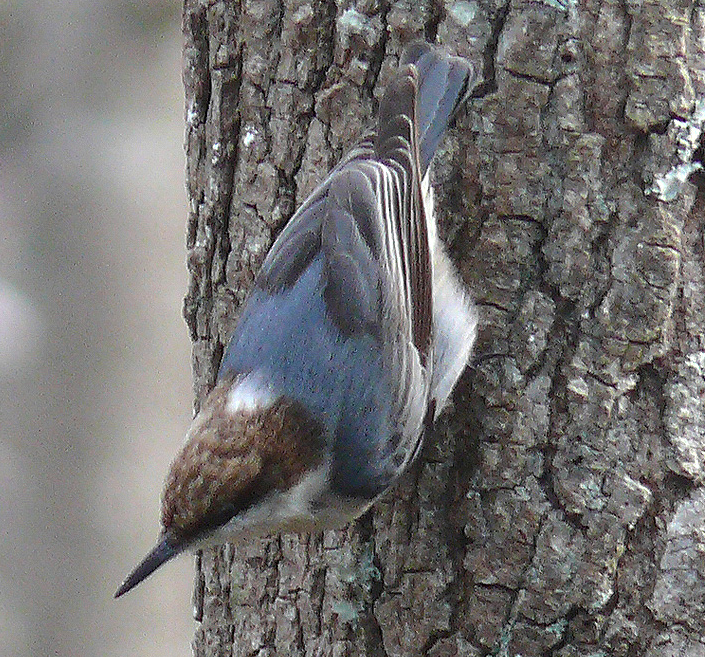 Brown-headed NuthatchSitta pusilla
- Bahama NuthatchSitta insularis
-
 Beautiful NuthatchSitta formosa
-
 Algerian NuthatchSitta ledanti
-
 Corsican NuthatchSitta whiteheadi
Compare
Questions and answers
What is the scientific name of the Red-breasted Nuthatch?
The scientific name of the Red-breasted Nuthatch is Sitta canadensis. Written with its author, the full name is Sitta canadensis Linnaeus, 1766.
Which family does the Red-breasted Nuthatch belong to?
Sitta canadensis belongs to the family Sittidae, in the order Passeriformes and the class Aves.
Where is the Red-breasted Nuthatch found?
Checklists and occurrence records place Sitta canadensis in 5 countries: United States, Canada, Saint Pierre and Miquelon, Mexico and Bermuda.
What is the conservation status of the Red-breasted Nuthatch?
The IUCN Red List category recorded for Sitta canadensis is Least Concern (LC).
How rare are Red-breasted Nuthatches?
The species is classified as Least Concern by the International Union for Conservation of Nature.[30]
What is the difference between a male and female Red-breasted Nuthatch?
Adult males have brighter orange underparts than females. Females have duller heads and paler underparts.[2]
Sources
Passages the profile rests on
- Adults have blue-grey upperparts, cinnamon underparts, a white throat and face, a black stripe through the eyes, a straight grey bill, and a black crown. Source passage: “The adult has blue-grey upperparts with cinnamon underparts, a white throat and face with a black stripe through the eyes, a straight grey bill and a black crown.” — English Wikipedia
- Adult males have brighter orange underparts than females, while females and juveniles have duller heads and paler underparts. Source passage: “Sexes are similarly plumaged, though adult males are brigher orange below, and conversely females and youngsters have duller heads and paler underparts.” — English Wikipedia
- The species has a compact body, short tail and neck, long tapered bill, and sturdy toes and claws. Source passage: “Red-breasted nuthatches are small nuthatches with compact bodies, short tails and necks, and a long tapered bill. They have very sturdy toes and claws” — animaldiversity.org
- Its outer tail feathers have dark tips and white bands. Source passage: “the tail is characterized by white bands and dark tips on the outer tail feathers.” — animaldiversity.org
- The species measures approximately 11 cm in length, has a wingspan of 22 cm, and weighs about 9.9 grams. Source passage: “measuring 4.5 in (11 cm) in length, with a wingspan of 8.5 in (22 cm) and a weight of 9.9 g (0.35 oz).” — English Wikipedia
- The average body length is 11.5 cm and average mass is 10 grams. Source passage: “They average 11.5 cm in length and have an average mass of 10 grams.” — animaldiversity.org
- The species primarily inhabits northern and subalpine conifer forests. Source passage: “it is primarily a full-time resident of northern and subalpine conifer forests” — English Wikipedia
- For breeding, it prefers mature, partly open coniferous or mixed conifer-deciduous forest stands. Source passage: “Red-breasted nuthatches prefer mature, partly open coniferous or mixed conifer-deciduous stands for breeding.” — animaldiversity.org
- Breeding habitat typically has a tall, dense canopy and a dense understory of saplings. Source passage: “They favor stands that have a tall, dense canopy and a dense understory of saplings.” — animaldiversity.org
- Ponderosa pine and incense cedar are preferred tree species, while black oak and white fir are not visited regularly. Source passage: “Researchers found that nuthatches prefer ponderosa pine and incense cedar, which both have a rough bark surface that supports a diversity of arthropods. Smooth bark species, such as black oak and white fir are not visited regularly by nuthatches.” — animaldiversity.org
- The species eats mainly insects and seeds, particularly seeds from conifers. Source passage: “It eats mainly insects and seeds, especially from conifers.” — English Wikipedia
- Its diet consists mostly of insects during summer and conifer seeds during winter. Source passage: “In the summer, it eats mostly insects, occasionally even flycatching, while in the winter, it switches to conifer seeds.” — English Wikipedia
- At bird feeders, it consumes sunflower seeds, peanut butter, and suet. Source passage: “At feeders, it will take sunflower seeds, peanut butter, and suet.” — English Wikipedia
- The species climbs down tree trunks headfirst and can move along the undersides of branches. Source passage: “It goes headfirst when climbing down. It can "walk" on the underside of branches.” — English Wikipedia
- Unlike woodpeckers and creepers, it does not use its tail as support when climbing. Source passage: “Unlike woodpeckers and creepers, it does not use its tail as a prop while climbing.” — English Wikipedia
- It generally forages alone or in pairs. Source passage: “It tends to forage singly or in pairs.” — English Wikipedia
- It wedges food into bark crevices and breaks it apart with its bill. Source passage: “It often wedges food pieces in bark crevices in order to break them up with the bill” — English Wikipedia
- Food shortages in northern regions trigger irregular southward irruptions involving unusually large numbers of birds. Source passage: “Food shortages in the north cause irruptions of red-breasted nuthatches, which are southward invasions in unusually large numbers.” — animaldiversity.org
- During breeding, pairs defend territories and may continue defending food territories during winter when resources are plentiful. Source passage: “Red-breasted nuthatches are extremely territorial during the breeding season. Pairs may even remain together throughout the winter to defend food territories if resources are plentiful.” — animaldiversity.org
- Males perform courtship displays involving raised heads and tails, drooping wings, and side-to-side swaying. Source passage: “lifting his head and tail while turning his back to her, drooping his wings, and swaying from side to side.” — English Wikipedia
- During courtship, males sing from treetops and potential nesting trees as frequently as 50 times per minute. Source passage: “During courtship, males sing up to 50 times per minute from the tops of trees and potential nest trees.” — animaldiversity.org
- The species is monogamous. Source passage: “The red-breasted nuthatch, like all nuthatches, is monogamous.” — English Wikipedia
- Breeding pairs form during winter or spring and remain together for at least a year or more. Source passage: “They form breeding pairs beginning in winter or spring, and stay together for a year or more.” — animaldiversity.org
- The nest lining includes grasses, mosses, shredded bark, roots, and plant fibers. Source passage: “Inside the cavity is a cup nest built with grasses, roots, mosses, shredded bark, and plant fibers.” — animaldiversity.org
- Females usually lay six eggs, with a documented clutch range of five to eight eggs. Source passage: “The female lays 5 to 8 (usually 6) pinkish-white eggs” — animaldiversity.org
- Eggs are pinkish-white and speckled with reddish-brown markings. Source passage: “pinkish-white eggs that are speckled with a reddish brown color.” — animaldiversity.org
- The female incubates the eggs for 12 to 13 days. Source passage: “The female incubates the eggs, which hatch after 12 to 13 days.” — animaldiversity.org
- Young birds become fully independent approximately two weeks after fledging. Source passage: “They become fully independent about 2 weeks after fledging.” — animaldiversity.org
- The species normally raises one brood per year. Source passage: “Normally, there is only one brood per year.” — English Wikipedia
- The species is classified as Least Concern by the International Union for Conservation of Nature. Source passage: “the red-breasted nuthatch is rated as a species of Least Concern by the International Union for Conservation of Nature.” — English Wikipedia
- In the Americas, the species is protected under the Migratory Bird Treaty Act of 1918. Source passage: “In the Americas, it is protected by the Migratory Bird Treaty Act of 1918.” — English Wikipedia
Data
- Catalogue of Life, 2026-10-16 XR cc by
- Global Biodiversity Information Facility CC BY 4.0
- Wikidata CC0
- GeoNames CC BY 4.0
- Wikimedia Commons per image; credit shown with each image
- Within the Catalogue of Life, this name comes from The Integrated Taxonomic Information System cc0
References
- Linné, Carl von. (1766). Systema Naturae per Regna Tria Naturae, Secundum Classes, Ordines, Genera, Species, Cum Characteribus, Differentiis, Synonymis, Locis, 12th Edition, Vol. 1. where the name was published
- Banks, R. C., R. W. McDiarmid, and A. L. Gardner. (1987). Checklist of Vertebrates of the United States, the U.S. Territories, and Canada. Resource Publication, No. 166.
- Gill, Frank, & and Minturn Wright. (2006). Birds of the World: Recommended English Names.
This species in other databases
- Catalogue of Life 4XTS9
- Wikidata Q597684
- iNaturalist 14823
- WoRMS urn:lsid:marinespecies.org:taxname:1484575
- Avibase rebnut
Page built on 28 November 2026. See how the catalog is made and all sources and licences.
Cite this page
ScientificNames.org. (2026). Sitta canadensis (Red-breasted Nuthatch). Retrieved November 28, 2026, from https://scientificnames.org/species/sitta-canadensis
“Sitta canadensis (Red-breasted Nuthatch).” ScientificNames.org, 2026, scientificnames.org/species/sitta-canadensis. Accessed 28 Nov. 2026.
ScientificNames.org. “Sitta canadensis (Red-breasted Nuthatch).” Accessed November 28, 2026. https://scientificnames.org/species/sitta-canadensis.
@misc{scientificnames_sitta_canadensis_red_breasted_nuthatch,
  author = {{ScientificNames.org}},
  title = {Sitta canadensis (Red-breasted Nuthatch)},
  year = {2026},
  url = {https://scientificnames.org/species/sitta-canadensis},
  note = {Accessed 2026-11-28}
}