Species · Birds
Corsican Nuthatch Sitta whiteheadi
The scientific name of the Corsican Nuthatch is Sitta whiteheadi. It is a species of bird in the family Sittidae (nuthatch), order Passeriformes. The name dates from 1884.
- Scientific name
- Sitta whiteheadi Sharpe, 1884
- Common name
- Corsican Nuthatch
- Genus
- Sitta
- Family
- Sittidae (Nuthatch)
- Order
- Passeriformes
- Class
- Aves
- Red List category
- VU Vulnerable
- Recorded in
- 1 country
- Name status
- accepted in the Catalogue of Life

Overview
Sitta whiteheadi is endemic to the island of Corsica in France.
Written 26 November 2026 from the sources listed below. Each statement was checked against the passage it cites; statements that could not be supported were removed.
Appearance
The Corsican Nuthatch measures 11–12 cm in length, with a wingspan of 21–22 cm and a weight of 11 to 12.6 grams. Its folded wing measures 7 cm, its tail approximately 3.5 cm, and its tarsus and beak each measure 1.6 cm.[1][2][3][4][5][6]
The species has bluish-grey upperparts and generally greyish-white underparts. Both sexes have white sides of the head and a white throat.[7][8]
Adult males have a black crown and forehead, with a black eyestripe separated from the crown by a broad, sharply defined white supercilium. Females have a crown and eyebrow line matching the grey colour of their back.[9][10][11]
The outer tail feathers are black with white spots and grey tips. The bill is short, thin and blackish-grey with a black tip; the eyes are black and the legs and toes are light brown.[12][13][14]
Juveniles have duller plumage with some brown coloration on their large coverts. The species undergoes a complete annual moult after the breeding season.[15][16]
Habitat
The Corsican Nuthatch favours Corsican pine forests interspersed with clearings. It avoids hardwood-dominated and mixed woodlands.[17][18]
Between April and October, the species generally inhabits deep valleys at elevations of 1,000–1,500 m. Its recorded elevational range extends from 750 to 1,800 m.[19][20]
Its habitat receives approximately 800–1,800 mm of annual rainfall and/or snowfall and experiences summer droughts lasting approximately three weeks to two months.[21][22]
The species is absent from forest sectors where trees have diameters below 28 cm. It is associated with forests containing large trees exceeding 16 m in height and 58 cm in diameter.[23][24]
Diet
Pine seeds constitute the main component of the Corsican Nuthatch's diet. From March to November, adult insects, insect larvae and spiders constitute the main part of its diet.[25][26]
The species also consumes small insects during summer.[27]
Behaviour
Pairs occupy territories measuring approximately three to ten hectares. Both members defend their territory against intruders of their own or other species.[28][29]
The species can move head down along branches and is rarely found on the ground. It often feeds high in Corsican pine trees.[30][31][32]
Its contact call consists of a light whistle repeated in sequences of five to six notes. The species sings fairly regularly during spring.[33][34]
Reproduction and life cycle
The breeding season occurs between April and May. The nest is constructed in the trunk of an old pine tree.[35][36]
A typical clutch contains five to six eggs. Young birds fledge 22–24 days after hatching, and sexual dimorphism becomes apparent eleven days after hatching.[37][38][39]
Conservation
The Corsican Nuthatch is threatened by the loss of nesting sites and habitat fragmentation. Its estimated population consists of approximately 2,000 individuals.[40][41]
Its population may be undergoing a moderate decline. The species is classified as vulnerable by the International Union for Conservation of Nature.[42][43]
Similar species
The Corsican Nuthatch is closely related to the Chinese Nuthatch and the Red-breasted Nuthatch. It may be confused in appearance with the Coal Tit, which has similar head markings.[44][45][46]
The Algerian Nuthatch can be distinguished by its paler underparts and the male's crown having only a black front.[47]
Classification of the Corsican Nuthatch
| Kingdom | Animalia |
|---|---|
| Phylum | Chordata |
| Subphylum | Vertebrata |
| Infraphylum | Gnathostomata |
| Parvphylum | Osteichthyes |
| Megaclass | Tetrapoda |
| Class | Aves (Bird) |
| Order | Passeriformes (Passerine) |
| Family | Sittidae (Nuthatch) |
| Genus | Sitta (Nuthatch) |
| Species | Sitta whiteheadi Sharpe, 1884 |
Where the Corsican Nuthatch is found
Checklists and occurrence records place Sitta whiteheadi in 1 country. GBIF holds 5,296 georeferenced records of it.
Countries
Regions and cities with the most records
Range as the checklists state it
Europe & Northern Asia (excluding China)
A number beside a place is its count of GBIF occurrence records. A place without a number comes from a checklist alone. Records show where a species has been observed or collected, which can include escapes and vagrants.
Common names
English
- Corsican Nuthatch
Names in 40 other languages
- Arabic
- كاسر الجوز الكورسيكي
- Basque
- Korsikar garrapo
- Breton
- Pokerig-Korsika
- Bulgarian
- Корсиканска зидарка
- Catalan
- Pica-soques cors, pica-soques de Còrsega
- Chinese
- 白頭鳾, 科西嘉䴓
- Croatian
- korzički brgljez
- Czech
- brhlík korsický
- Danish
- Korsikansk Spætmejse
- Dutch
- Corsicaanse Boomklever
- Esperanto
- korsika sito
- Estonian
- korsika puukoristaja
- Finnish
- korsikannakkeli
- French
- Sittelle corse
- German
- Korsen-Kleiber, Korsenkleiber
- Hebrew
- סיטת קורסיקה
- Hungarian
- korzikai csuszka
- Icelandic
- Taumigða
- Irish
- Cnóshnag corsacach
- Italian
- Picchio muratore corso
- Japanese
- コルシカゴジュウカラ
- Latvian
- Korsikas dzilnītis
- Lithuanian
- korsikinis bukutis
- Northern Sami
- Korsikačáihnegaccet
- Norwegian
- korsikaspettmeis
- Persian
- کمرکولی وایتهد
- Polish
- kowalik korsykanski, kowalik korsykański
- Portuguese
- Trepadeira-azul-da-córsega, trepadeira-corsa, trepadeira-da-córsega
- Russian
- Корсиканский поползень
- Serbian
- Korzikanski brgljez
- Slovak
- brhlík korzický
- Slovenian
- korziški brglez
- Spanish
- Trepador corso
- Swedish
- korsikansk nötväcka
- Turkish
- Korsika Sıvacısı, Korsika sıvacı kuşu
- Ukrainian
- повзик корсиканський
- Vietnamese
- Trèo cây Corse
- Welsh
- delor cnau Corsica
- cos
- Zittula
- glv
- Scoltan Corsickagh
Related species
-
 Eurasian NuthatchSitta europaea
-
 White-breasted NuthatchSitta carolinensis
-
 Red-breasted NuthatchSitta canadensis
-
 Pygmy NuthatchSitta pygmaea
-
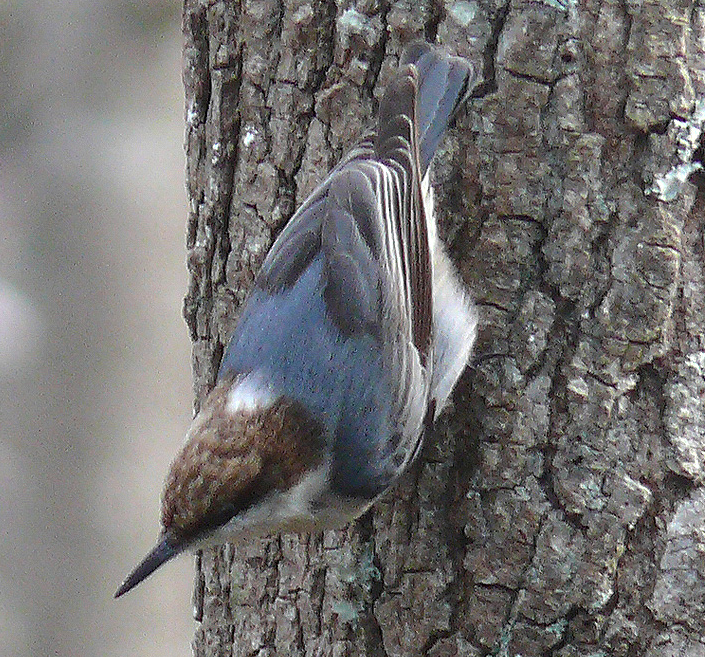 Brown-headed NuthatchSitta pusilla
- Bahama NuthatchSitta insularis
-
 Beautiful NuthatchSitta formosa
-
 Algerian NuthatchSitta ledanti
Compare
Questions and answers
What is the scientific name of the Corsican Nuthatch?
The scientific name of the Corsican Nuthatch is Sitta whiteheadi. Written with its author, the full name is Sitta whiteheadi Sharpe, 1884.
Which family does the Corsican Nuthatch belong to?
Sitta whiteheadi belongs to the family Sittidae, in the order Passeriformes and the class Aves.
Where is the Corsican Nuthatch found?
Checklists and occurrence records place Sitta whiteheadi in 1 country: France.
What is the conservation status of the Corsican Nuthatch?
The IUCN Red List category recorded for Sitta whiteheadi is Vulnerable (VU).
Sources
Passages the profile rests on
- The Corsican Nuthatch measures 11–12 cm in length. Source passage: “The Corsican nuthatch is a small bird, measuring 11–12 cm (4.3–4.7 in) long” — English Wikipedia
- Its wingspan measures 21–22 cm. Source passage: “with a wingspan of 21–22 cm (8.3–8.7 in)” — English Wikipedia
- Its weight ranges from 11 to 12.6 grams. Source passage: “and a weight of 11–12.6 grams (0.39–0.44 oz).” — English Wikipedia
- Its folded wing measures 7 cm. Source passage: “The folded wing measures 7 cm (2.8 in)” — English Wikipedia
- Its tail measures approximately 3.5 cm. Source passage: “the relatively short tail measures 3.5 cm (1.4 in)” — English Wikipedia
- Its tarsus and beak each measure 1.6 cm. Source passage: “and the tarsus and beak measure 1.6 cm (0.63 in).” — English Wikipedia
- The species has bluish-grey upperparts and generally greyish-white underparts. Source passage: “The upperparts are overall bluish grey, the belly pale greyish buff with the throat whiter.” — English Wikipedia
- Both sexes have white sides of the head and a white throat. Source passage: “In both sexes, the sides of the head as well as the throat are white” — English Wikipedia
- Adult males have a black crown and forehead. Source passage: “The male has a black crown and forehead” — English Wikipedia
- Males have a black eyestripe separated from the crown by a broad, sharply defined white supercilium. Source passage: “and a black eyestripe, separated from the crown by a broad, sharp white supercilium.” — English Wikipedia
- Females have a crown and eyebrow line matching the grey colour of their back. Source passage: “In females, the crown and eyebrow line are the same grey as the back.” — English Wikipedia
- The outer tail feathers are black with white spots and grey tips. Source passage: “The outer rectrices are black with white spots and grey tips.” — English Wikipedia
- The species has a short, thin, blackish-grey bill with a black tip. Source passage: “It is thin and blackish grey, black on its tip.” — English Wikipedia
- Its eyes are black and its legs and toes are light brown. Source passage: “The eyes are black, the legs and toes are light brown.” — English Wikipedia
- Juveniles have duller plumage with some brown coloration on their large coverts. Source passage: “As juveniles, they remain duller, with some brown on the large coverts.” — English Wikipedia
- The species undergoes a complete moult annually after the breeding season. Source passage: “The birds undergo a complete moult every year after the breeding season.” — English Wikipedia
- The species favours Corsican pine forests interspersed with clearings. Source passage: “The Corsican nuthatch favours Corsican pine (Pinus nigra var. corsicana) forests interspersed with clearings;” — English Wikipedia
- The species avoids hardwood-dominated and mixed woodlands. Source passage: “It avoids hardwood-dominated or mixed woodlands.” — English Wikipedia
- Between April and October, the species generally inhabits deep valleys at elevations of 1,000–1,500 m. Source passage: “it generally lives in deep valleys between 1,000 m (3,300 ft) and 1,500 m (4,900 ft) above sea level between April and October” — English Wikipedia
- Its recorded elevational range extends from 750 to 1,800 m. Source passage: “but can be found from 750–1,800 m (2,460–5,910 ft)” — English Wikipedia
- Its habitat experiences summer droughts lasting approximately three weeks to two months. Source passage: “habitat is fairly dry in the summer (three weeks to two months of drought)” — English Wikipedia
- Its habitat receives approximately 800–1,800 mm of annual rainfall and/or snowfall. Source passage: “total 800–1,800 mm (31–71 in) per year).” — English Wikipedia
- The species is absent from forest sectors where trees have diameters below 28 cm. Source passage: “the species is absent from sectors where trees are less than 28 cm (11 in) diameter” — English Wikipedia
- The species is associated with forests containing large trees exceeding 16 m in height and 58 cm in diameter. Source passage: “The places most likely to hold Corsican nuthatches have large trees (over 16 m (52 ft) high) and large diameter (over 58 cm (23 in)).” — English Wikipedia
- Pine seeds constitute the main component of the species' diet. Source passage: “The Corsican nuthatch consumes mainly pine seeds” — English Wikipedia
- From March to November, adult insects, insect larvae and spiders constitute the main part of its diet. Source passage: “From March to November, small arthropods (adult insects and their larvae, spiders) represent the main part of its diet;” — English Wikipedia
- The species also consumes small insects during summer. Source passage: “but also small insects in summer.” — English Wikipedia
- Pairs occupy territories measuring approximately three to ten hectares. Source passage: “on the same territory of three to ten hectares” — English Wikipedia
- Both members of a pair defend their territory against intruders of their own or other species. Source passage: “the two birds of the couple defending it from intruders, of the same species or of another.” — English Wikipedia
- The species can move head down along branches. Source passage: “the Corsican nuthatch can move head down along branches” — English Wikipedia
- The species is rarely found on the ground. Source passage: “and is rarely found on the ground.” — English Wikipedia
- The species often feeds high in Corsican pine trees. Source passage: “It often feeds high in Corsican pines” — English Wikipedia
- Its contact call consists of a light whistle repeated in sequences of five to six notes. Source passage: “The contact call is a light, whistling pu, which the bird repeats in series of five to six notes” — English Wikipedia
- The species sings fairly regularly during spring. Source passage: “sings fairly regularly in the spring” — English Wikipedia
- The breeding season occurs between April and May. Source passage: “The breeding season takes place between April and May;” — English Wikipedia
- The nest is constructed in the trunk of an old pine tree. Source passage: “the nest is placed in the trunk of an old pine” — English Wikipedia
- A typical clutch contains five to six eggs. Source passage: “and the clutch has five to six eggs.” — English Wikipedia
- Young birds fledge 22–24 days after hatching. Source passage: “The young fledge 22 to 24 days after hatching.” — English Wikipedia
- Sexual dimorphism becomes apparent eleven days after hatching. Source passage: “Sexual dimorphism appears eleven days after hatching” — English Wikipedia
- The species is threatened by the loss of nesting sites and habitat fragmentation. Source passage: “It is threatened by loss of nesting sites and habitat fragmentation” — English Wikipedia
- Its estimated population consists of approximately 2,000 individuals. Source passage: “with an estimated population size of about 2,000 individuals” — English Wikipedia
- Its population may be undergoing a moderate decline. Source passage: “possibly in moderate decline.” — English Wikipedia
- The species is classified as vulnerable by the International Union for Conservation of Nature. Source passage: “the conservation status of the Corsican nuthatch is classed as "vulnerable" by the International Union for Conservation of Nature.” — English Wikipedia
- The Corsican Nuthatch is closely related to the Chinese Nuthatch. Source passage: “The Corsican nuthatch is closely related to the Chinese nuthatch (S. villosa)” — English Wikipedia
- The Corsican Nuthatch is closely related to the Red-breasted Nuthatch. Source passage: “and the red-breasted nuthatch (S. canadensis).” — English Wikipedia
- The Corsican Nuthatch may be confused in appearance with the Coal Tit, which has similar head markings. Source passage: “it may be reminiscent of the coal tit (Periparus ater), which is common in Corsican forests and has similar markings on its head.” — English Wikipedia
- The Algerian Nuthatch can be distinguished from the Corsican Nuthatch by its paler underparts and the male's crown having only a black front. Source passage: “by its paler underparts, whitish sides of the head, and by the male's crown, which has only the black front.” — English Wikipedia
- The Corsican Nuthatch is endemic to the island of Corsica in France. Source passage: “This species is endemic to Corsica (France)” — datazone.birdlife.org
Data
- Catalogue of Life, 2026-10-16 XR cc by
- Global Biodiversity Information Facility CC BY 4.0
- Wikidata CC0
- GeoNames CC BY 4.0
- Wikimedia Commons per image; credit shown with each image
- Within the Catalogue of Life, this name comes from The Integrated Taxonomic Information System cc0
References
- Sharpe, & Richard Bowdler. (1884). On an apparently new Species of European Nuthatch. Proceedings of the Zoological Society of London, Vol. 52. where the name was published
- Gill, Frank, & and Minturn Wright. (2006). Birds of the World: Recommended English Names.
This species in other databases
Page built on 27 November 2026. See how the catalog is made and all sources and licences.
Cite this page
ScientificNames.org. (2026). Sitta whiteheadi (Corsican Nuthatch). Retrieved November 27, 2026, from https://scientificnames.org/species/sitta-whiteheadi
“Sitta whiteheadi (Corsican Nuthatch).” ScientificNames.org, 2026, scientificnames.org/species/sitta-whiteheadi. Accessed 27 Nov. 2026.
ScientificNames.org. “Sitta whiteheadi (Corsican Nuthatch).” Accessed November 27, 2026. https://scientificnames.org/species/sitta-whiteheadi.
@misc{scientificnames_sitta_whiteheadi_corsican_nuthatch,
  author = {{ScientificNames.org}},
  title = {Sitta whiteheadi (Corsican Nuthatch)},
  year = {2026},
  url = {https://scientificnames.org/species/sitta-whiteheadi},
  note = {Accessed 2026-11-27}
}