Species · Birds
White-breasted Nuthatch Sitta carolinensis
The scientific name of the White-breasted Nuthatch is Sitta carolinensis. It is a species of bird in the family Sittidae (nuthatch), order Passeriformes. The name dates from 1790.
- Scientific name
- Sitta carolinensis Latham, 1790
- Common name
- White-breasted Nuthatch
- Genus
- Sitta
- Family
- Sittidae (Nuthatch)
- Order
- Passeriformes
- Class
- Aves
- Red List category
- LC Least Concern
- Environment
- terrestrial
- Recorded in
- 4 countries
- Name status
- accepted in the Catalogue of Life

Overview
Sitta carolinensis inhabits deciduous woodlands and mixed deciduous-coniferous forests throughout much of North America. It has pale blue-gray upperparts, a black crown, white face and underparts, and a long, slightly upturned bill.
Written 26 November 2026 from the sources listed below. Each statement was checked against the passage it cites; statements that could not be supported were removed.
Appearance
Females generally have narrower black back bands, duller upperparts, and more buff-colored underparts than males. Juveniles resemble adults but have duller plumage.[1][2]
The species has a large head, short tail, short wings, a powerful bill, and strong feet. Its long, slightly upturned bill is nearly as long as its head.[3][4]
Habitat
The White-breasted Nuthatch inhabits deciduous woodlands and mixed deciduous-coniferous forests. It prefers mature hardwood forests and may require oak trees.[5][6]
The species requires mature or decaying trees containing suitable nesting cavities.[7]
Diet
The White-breasted Nuthatch is omnivorous and consumes insects and seeds. Its summer diet consists primarily of insects, whereas seeds can account for nearly 70% of its winter diet.[8][9]
Its insect prey includes caterpillars, ants, pine weevils, scale insects, and jumping plant lice. It also consumes tent caterpillars, wood borers, and leaf beetles.[10][11]
Behaviour
Outside the breeding period, individuals use tree holes or spaces behind loose bark as roosting sites. They usually roost individually, although groups of up to 29 individuals have been recorded during very cold weather.[12][13]
Reproduction and life cycle
The species forms monogamous pairs that generally remain together throughout the year until one partner dies or disappears. Pairs establish territories measuring approximately 0.1–0.15 km² in woodland and up to 0.2 km² in semi-wooded habitats.[14][15]
Females construct nests independently, generally in cavities approximately 3–18 m above the ground. They typically lay six to eight pinkish-white eggs per clutch and incubate them for approximately 12–14 days.[16][17][18][19]
Both parents feed and protect the young after hatching. The species generally raises one brood annually.[20][21]
Most breeding occurs between early May and early June, although regional breeding periods can begin in April and extend into July.[22]
Conservation
The White-breasted Nuthatch is classified as Least Concern by the International Union for Conservation of Nature. Its estimated global population is approximately ten million individuals, and the overall population appears to be increasing.[23][24][25]
Removal of dead trees can negatively affect the species by reducing available nesting cavities. The species is protected under the United States Migratory Bird Treaty Act.[26][27]
Uses
The White-breasted Nuthatch contributes to controlling insect populations during summer and helps disperse seeds of numerous plants.[28][29]
Similar species
The White-breasted Nuthatch resembles the white wagtail in plumage, although the two species are not closely related. It also resembles the white-cheeked nuthatch in appearance.[30][31]
Classification of the White-breasted Nuthatch
| Kingdom | Animalia |
|---|---|
| Phylum | Chordata |
| Subphylum | Vertebrata |
| Infraphylum | Gnathostomata |
| Parvphylum | Osteichthyes |
| Megaclass | Tetrapoda |
| Class | Aves (Bird) |
| Order | Passeriformes (Passerine) |
| Family | Sittidae (Nuthatch) |
| Genus | Sitta (Nuthatch) |
| Species | Sitta carolinensis Latham, 1790 |
Where the White-breasted Nuthatch is found
Checklists and occurrence records place Sitta carolinensis in 4 countries across North America. GBIF holds 14,204,295 georeferenced records of it.
Countries
Regions and cities with the most records
- New York, United States 1,030,631
- Pennsylvania, United States 930,435
- Ontario, Canada 856,043
- Michigan, United States 739,304
- Ohio, United States 739,035
- Massachusetts, United States 725,220
- Wisconsin, United States 680,337
- California, United States 619,648
- Virginia, United States 557,078
- Quebec, Canada 545,969
- Illinois, United States 517,628
- Maryland, United States 470,611
- Minnesota, United States 468,951
- North Carolina, United States 403,299
- Indiana, United States 378,694
- New Jersey, United States 369,706
- Arizona, United States 299,234
- Connecticut, United States 297,660
- Georgia, United States 290,434
- Colorado, United States 287,390
- Maine, United States 236,584
- Missouri, United States 232,705
- Tennessee, United States 231,093
- Vermont, United States 224,175
- McLean, United States 203,788
- Potomac, United States 202,462
- Waltham, United States 197,020
- Newton, United States 195,544
- New Hampshire, United States 193,632
- Watertown, United States 193,583
- Idylwood, United States 192,958
- Arlington, United States 189,865
- Brighton, United States 188,203
- Belmont, United States 186,461
- Lexington, United States 186,438
- West Falls Church, United States 185,412
Range as the checklists state it
Middle America
North America
A number beside a place is its count of GBIF occurrence records. A place without a number comes from a checklist alone. Records show where a species has been observed or collected, which can include escapes and vagrants.
Common names
English
- White-breasted Nuthatch
- Devil Downhead
- White-breasted Black-capped Nuthatch
Names in 35 other languages
- Bulgarian
- Белогръда зидарка
- Catalan
- Pica-soques de pit blanc, pica-soques pitblanc
- Chinese
- 白胸䴓, 白胸鳾
- Croatian
- bjeloprsi brgljez
- Czech
- brhlík běloprsý
- Danish
- Hvidbrystet Spætmejse
- Dutch
- Witborstboomklever
- Esperanto
- Karolina sito, blankbrusta sito
- Estonian
- valgepõsk-puukoristaja
- Finnish
- amerikannakkeli
- French
- Sittelle à poitrine blanche
- German
- Carolina-Kleiber, Carolinakleiber, Weißbrustkleiber
- Hungarian
- barátcsuszka
- Italian
- Picchio muratore pettobianco
- Japanese
- ムナジロゴジュウカラ, ムナジロゴジュウガラ
- Latvian
- baltkrūšu dzilnītis
- Lithuanian
- karolininis bukutis
- Norwegian
- hvitbrystspettmeis
- Persian
- کمرکولی کارولینا
- Polish
- kowalik karoliński
- Portuguese
- trepadeira-branca, trepadeira-de-peito-branco
- Russian
- Каролинский поползень
- Scottish Gaelic
- Scoltan cleeau-vane
- Serbian
- Belogrudi američki brgljez
- Slovak
- brhlík bieloprsý
- Spanish
- Bajapalos Pecho Blanco, Bajapalos enano, Sita pecho blanco, Trepador pechiblanco
- Swedish
- vitbröstad nötväcka
- Turkish
- Ak göğüslü sıvacı kuşu, Beyaz Göğüslü Sıvacı
- Ukrainian
- Повзик білогрудий, повзик каролінський
- Vietnamese
- Trèo cây ngực trắng
- Welsh
- delor cnau bronwyn
- chr
- ᏗᏪᏓᎶᎯ
- nav
- Chį́į́shghą́ʼiiłgaii
- oji
- Zhaagashkaandawens, biipiigenh
- see
- Degëödë́öhö’
Synonyms
One other scientific name has been used for this species and is now treated as a synonym of Sitta carolinensis.
- Sitta atricapilla Stone, W, 1913
Subspecies and varieties
- Sitta carolinensis aculeata (Pacific White-breasted Nuthatch) subspecies
- Sitta carolinensis alexandrae (San Pedro Nuthatch) subspecies
- Sitta carolinensis carolinensis (Carolina Nuthatch) subspecies
- Sitta carolinensis lagunae (San Lucas Nuthatch) subspecies
- Sitta carolinensis mexicana (Mexican White-breasted Nuthatch) subspecies
- Sitta carolinensis nelsoni (Cordilleran White-breasted Nuthatch) subspecies
- Sitta carolinensis tenuissima (Inyo Nuthatch) subspecies
Related species
-
 Eurasian NuthatchSitta europaea
-
 Red-breasted NuthatchSitta canadensis
-
 Pygmy NuthatchSitta pygmaea
-
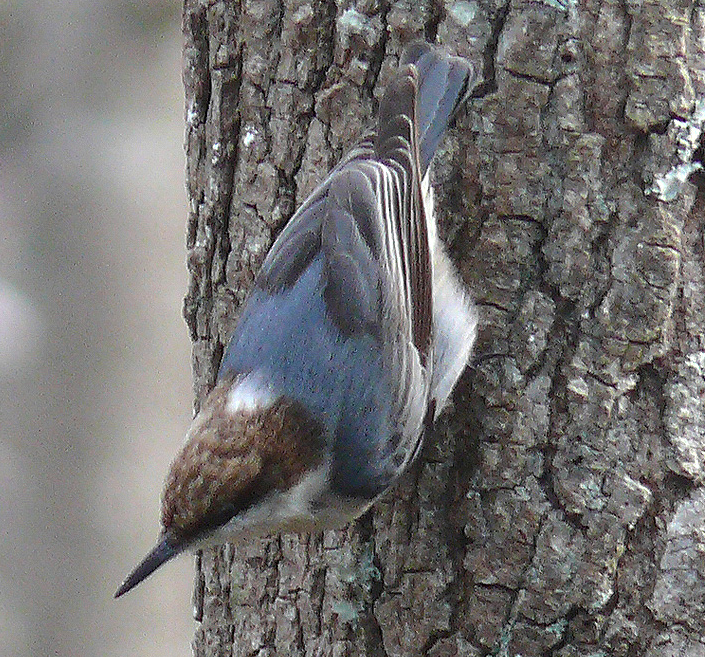 Brown-headed NuthatchSitta pusilla
- Bahama NuthatchSitta insularis
-
 Beautiful NuthatchSitta formosa
-
 Algerian NuthatchSitta ledanti
-
 Corsican NuthatchSitta whiteheadi
Compare
Questions and answers
What is the scientific name of the White-breasted Nuthatch?
The scientific name of the White-breasted Nuthatch is Sitta carolinensis. Written with its author, the full name is Sitta carolinensis Latham, 1790.
Which family does the White-breasted Nuthatch belong to?
Sitta carolinensis belongs to the family Sittidae, in the order Passeriformes and the class Aves.
Where is the White-breasted Nuthatch found?
Checklists and occurrence records place Sitta carolinensis in 4 countries: United States, Canada, Mexico and Saint Pierre and Miquelon.
What is the conservation status of the White-breasted Nuthatch?
The IUCN Red List category recorded for Sitta carolinensis is Least Concern (LC).
What other names does the White-breasted Nuthatch have?
Sitta carolinensis is also known in English as Devil Downhead and White-breasted Black-capped Nuthatch.
How rare is a White-breasted Nuthatch?
The estimated global population is approximately ten million individuals. The species is classified as Least Concern, and its overall population appears to be increasing.[23][24][25]
What food do White-breasted Nuthatch eat?
They eat insects and seeds. Their insect prey includes caterpillars, ants, pine weevils, scale insects, jumping plant lice, wood borers, and leaf beetles.[8][10][11]
Sources
Passages the profile rests on
- Females generally have narrower black back bands, duller upperparts, and more buff-colored underparts than males. Source passage: “The female has, on average, a narrower black back band, slightly duller upperparts and buffer underparts than the male.” — English Wikipedia
- Juveniles resemble adults but have duller plumage. Source passage: “Juveniles are similar to the adult, but duller plumaged.” — English Wikipedia
- The species has a large head, short tail, short wings, a powerful bill, and strong feet. Source passage: “it has a large head, short tail, short wings, a powerful bill and strong feet” — English Wikipedia
- The species has a long, slightly upturned bill that is nearly as long as its head. Source passage: “Their bills are nearly as long as their heads and are slightly upturned.” — animaldiversity.org
- The species inhabits deciduous woodlands and mixed deciduous-coniferous forests. Source passage: “White-breasted nuthatches live in deciduous woodlands and mixed deciduous and coniferous forests.” — animaldiversity.org
- The species prefers mature hardwood forests and may require oak trees. Source passage: “They prefer, older, more mature hardwood forests and may require the presence of oak trees.” — animaldiversity.org
- The species requires mature or decaying trees containing suitable nesting cavities. Source passage: “The presence of mature or decaying trees with holes suitable for nesting is essential” — English Wikipedia
- The species is omnivorous and consumes insects and seeds. Source passage: “The white-breasted nuthatch is omnivorous, eating insects and seeds.” — English Wikipedia
- Its summer diet consists primarily of insects, whereas seeds can account for nearly 70% of its winter diet. Source passage: “The diet in winter may be nearly 70% seeds, but in summer it is mainly insects.” — English Wikipedia
- Its insect prey includes caterpillars, ants, pine weevils, scale insects, and jumping plant lice. Source passage: “include caterpillars, ants, and pest species such as pine weevils, oystershell and other scale insects, and jumping plant lice.” — English Wikipedia
- The species consumes tent caterpillars, wood borers, and leaf beetles in addition to other insects. Source passage: “weevils, tent caterpillars , ants , scale insects , psyllids, wood borers, and leaf beetles .” — animaldiversity.org
- Individuals use tree holes or spaces behind loose bark as roosting sites outside the breeding period. Source passage: “This species of nuthatch roosts in tree holes or behind loose bark when not breeding” — English Wikipedia
- The species usually roosts individually, although groups of up to 29 individuals have been recorded during very cold weather. Source passage: “It usually roosts alone except in very cold weather, when up to 29 birds have been recorded together.” — English Wikipedia
- The species forms monogamous pairs that generally remain together throughout the year until one partner dies or disappears. Source passage: “White-breasted nuthatches form monogamous pairs that remain together year-round from the time of courtship and establishment of a territory until one of the pair dies or disappears.” — animaldiversity.org
- Pairs establish territories measuring approximately 0.1–0.15 km² in woodland and up to 0.2 km² in semi-wooded habitats. Source passage: “The pair establish a territory of 0.1–0.15 km2 (25–37 acres) in woodland, and up to 0.2 km2 (49 acres) in semi-wooded habitats” — English Wikipedia
- Females construct nests independently. Source passage: “Female white-breasted nuthatches build their nests alone.” — animaldiversity.org
- Nests are generally constructed in cavities approximately 3–18 m above the ground. Source passage: “White-breasted nuthatches nest in cavities from 3 to 18 meters from the ground.” — animaldiversity.org
- Females typically lay six to eight pinkish-white eggs per clutch. Source passage: “The female lays 3 to 10 (typically 6 to 8) pinkish-white eggs.” — animaldiversity.org
- Females incubate their eggs for approximately 12–14 days. Source passage: “She then incubates the eggs for 12 to 14 days” — animaldiversity.org
- Both parents feed and protect the young after hatching. Source passage: “Once the eggs have hatched, both parents feed and protect the young.” — animaldiversity.org
- The species generally raises one brood annually. Source passage: “White-breasted nuthatches raise one brood per year.” — animaldiversity.org
- Most breeding occurs between early May and early June, although regional breeding periods can begin in April and extend into July. Source passage: “Most breeding is done between early May and early June, but some populations show a range starting as early as April and even possibly going into July.” — animaldiversity.org
- The species is classified as Least Concern by the International Union for Conservation of Nature. Source passage: “the species is evaluated as least concern by the International Union for the Conservation of Nature.” — English Wikipedia
- The estimated global population is approximately ten million individuals. Source passage: “Its total population is estimated at 10 million individuals” — English Wikipedia
- The overall population appears to be increasing. Source passage: “the overall population appears to be slowly increasing.” — animaldiversity.org
- Removal of dead trees can negatively affect the species by reducing available nesting cavities. Source passage: “The removal of dead trees from forests may cause problems locally for this species because it requires cavity sites for nesting” — English Wikipedia
- The species is protected under the United States Migratory Bird Treaty Act. Source passage: “This species is protected under the U.S. Migratory Bird Act.” — animaldiversity.org
- The species contributes to controlling insect populations during summer. Source passage: “White-breasted nuthatches help to control insect populations in the summer.” — animaldiversity.org
- The species helps disperse seeds of numerous plants. Source passage: “They also disperse the seeds of many plants.” — animaldiversity.org
- The white-breasted nuthatch resembles the white wagtail in plumage despite the two species not being closely related. Source passage: “Despite not being closely related, the white-breasted nuthatch and the white wagtail are very similar in plumage.” — English Wikipedia
- The white-breasted nuthatch resembles the white-cheeked nuthatch in appearance. Source passage: “In appearance, the white-breasted nuthatch is similar to the white-cheeked nuthatch of the Himalayas” — English Wikipedia
- The species sometimes feeds on the ground and visits bird feeders for nuts, suet, and sunflower seeds. Source passage: “readily visits feeding stations for nuts, suet and sunflower seeds” — English Wikipedia
- In western North America and Mexico, the species inhabits open montane pine and oak woodlands. Source passage: “in the west and Mexico, the white-breasted nuthatch is found in open montane pine and oak woodlands” — English Wikipedia
- The species occurs throughout much of North America, including southern Canada, the continental United States, and central Mexico. Source passage: “White-breasted nuthatches reside throughout most of North America, including the continental United States, southern regions of Canada, and central Mexico.” — animaldiversity.org
Data
- Catalogue of Life, 2026-10-16 XR cc by
- Global Biodiversity Information Facility CC BY 4.0
- Wikidata CC0
- GeoNames CC BY 4.0
- Wikimedia Commons per image; credit shown with each image
- Within the Catalogue of Life, this name comes from The Integrated Taxonomic Information System cc0
References
- Latham, & Joannis. (1790). Index Ornithologicus, Sive Systema Ornithologiae; Complectens Avium Divisionem in Classes, Ordines, Genera, Species, Ipsarumque Varietates: Adjectis Synonymis, Locis, Descriptionibus, & c, Vol. 1. where the name was published
- Banks, R. C., R. W. McDiarmid, and A. L. Gardner. (1987). Checklist of Vertebrates of the United States, the U.S. Territories, and Canada. Resource Publication, No. 166.
- Gill, Frank, & and Minturn Wright. (2006). Birds of the World: Recommended English Names.
This species in other databases
- Catalogue of Life 6Z4QZ
- Wikidata Q379240
- iNaturalist 14801
- WoRMS urn:lsid:marinespecies.org:taxname:1484577
- Avibase whbnut
Page built on 28 November 2026. See how the catalog is made and all sources and licences.
Cite this page
ScientificNames.org. (2026). Sitta carolinensis (White-breasted Nuthatch). Retrieved November 28, 2026, from https://scientificnames.org/species/sitta-carolinensis
“Sitta carolinensis (White-breasted Nuthatch).” ScientificNames.org, 2026, scientificnames.org/species/sitta-carolinensis. Accessed 28 Nov. 2026.
ScientificNames.org. “Sitta carolinensis (White-breasted Nuthatch).” Accessed November 28, 2026. https://scientificnames.org/species/sitta-carolinensis.
@misc{scientificnames_sitta_carolinensis_white_breasted_nuthatch,
  author = {{ScientificNames.org}},
  title = {Sitta carolinensis (White-breasted Nuthatch)},
  year = {2026},
  url = {https://scientificnames.org/species/sitta-carolinensis},
  note = {Accessed 2026-11-28}
}