Species · Birds
Algerian Nuthatch Sitta ledanti
The scientific name of the Algerian Nuthatch is Sitta ledanti. It is a species of bird in the family Sittidae (nuthatch), order Passeriformes. The name dates from 1976.
- Scientific name
- Sitta ledanti Vielliard, 1976
- Common name
- Algerian Nuthatch
- Genus
- Sitta
- Family
- Sittidae (Nuthatch)
- Order
- Passeriformes
- Class
- Aves
- Red List category
- EN Endangered
- Recorded in
- 1 country
- Name status
- accepted in the Catalogue of Life

Overview
Sitta ledanti has bluish-grey upperparts, a light salmon-beige belly and a small white subterminal tail band bordered by beige.
Written 26 November 2026 from the sources listed below. Each statement was checked against the passage it cites; statements that could not be supported were removed.
Appearance
The Algerian Nuthatch measures between 11.5 and 12.5 cm in length and weighs approximately 18 grams. Its upperparts are bluish-grey, its belly is light salmon-beige, and its undertail coverts are grey at their base.[1][2][3][4]
The tail has a small white subterminal band bordered by beige. The species has a brown-black iris, lead-grey legs and a bluish-grey bill.[5][6]
Adult males have a black forehead and dark eyestripe separated from the crown by a prominent white supercilium. Females generally have a grey crown and eyestripe similar in colour to their back, while both sexes have white sides of the head and throat.[7][8][9]
Juveniles resemble females but have duller plumage and a less conspicuous white supercilium.[10]
Habitat
The Algerian Nuthatch inhabits oak forests at elevations between 350 and 1,120 metres. It also occurs in mixed forests containing oak and Italian maple, as well as mixed coniferous forests.[11][12]
The species occurs in forests reaching the summit of Jebel Babor at 2,004 metres. It favours humid forests containing large trees with cavities.[13][14]
Trees associated with its habitat include Algerian fir, Atlas cedar, aspen, Afares oak, cork oak and Portuguese oak. The Babor Mountains provide a cool, humid forest habitat dominated by fir and cedar.[15][16]
Diet
During summer, the Algerian Nuthatch feeds mainly on insects and spiders. Caterpillars and beetles are among the principal insects consumed.[17][18]
During winter, the species feeds on coniferous seeds. It searches for food on the trunks and branches of oak trees.[19][20]
Behaviour
The Algerian Nuthatch is sedentary. Individuals generally forage alone but may join mixed-species feeding flocks outside the breeding season.[21][22]
The species produces a nasal whistle composed of rising elements followed by a short final note. Its song consists of seven to twelve phrases lasting between two and four seconds.[23][24]
Adults produce a whispered call when an intruder is present.[25]
Reproduction and life cycle
The breeding season generally occurs between May and June at Tamentout and Mount Babor. It may begin later at higher elevations.[26][27]
The nest is constructed in a tree cavity, which may be in a dead fir tree or in an oak or cedar tree. Nests are usually positioned between four and fifteen metres above the ground, and their linings can contain wood chips and dead leaves.[28][29][30][31]
Females incubate the eggs without assistance from males, while both parents feed the young. Clutches contain three or four young.[32][33][34]
Conservation
The population is considered to be declining because of habitat reduction. Habitat destruction is identified as the principal threat to the species.[35][36]
Fires threaten the old mixed forests on Mount Babor. Cattle grazing and illegal deforestation threaten the species' habitat at Mount Babor and Tamentout.[37][38]
Classification of the Algerian Nuthatch
| Kingdom | Animalia |
|---|---|
| Phylum | Chordata |
| Subphylum | Vertebrata |
| Infraphylum | Gnathostomata |
| Parvphylum | Osteichthyes |
| Megaclass | Tetrapoda |
| Class | Aves (Bird) |
| Order | Passeriformes (Passerine) |
| Family | Sittidae (Nuthatch) |
| Genus | Sitta (Nuthatch) |
| Species | Sitta ledanti Vielliard, 1976 |
Where the Algerian Nuthatch is found
Checklists and occurrence records place Sitta ledanti in 1 country across Africa. GBIF holds 1,427 georeferenced records of it.
Countries
Regions and cities with the most records
- Fedj M’Zala, Algeria 854
- Rouached, Algeria 754
- Mila, Algeria 600
- Jijel, Algeria 590
- Babor, Algeria 276
- Sétif, Algeria 211
- District of Taher, Algeria 180
- Jijel, Algeria 129
- Béjaïa, Algeria 14
- Ali Mendjeli, Algeria 7
- Constantine, Algeria 7
- Constantine, Algeria 7
- Didouche Mourad, Algeria 7
- El Khroub, Algeria 7
- Hamma Bouziane, Algeria 7
- Aïn Smara, Algeria 6
Range as the checklists state it
Africa
A number beside a place is its count of GBIF occurrence records. A place without a number comes from a checklist alone. Records show where a species has been observed or collected, which can include escapes and vagrants.
Common names
English
- Algerian Nuthatch
- ALNU
- Kabyle Nuthatch
- Kabylian Nuthatch
- Kabylie Nuthatch
Names in 37 other languages
- Arabic
- كاسر الجوز الجزائري, كاسر الجوز القبائلي, كاسر الجوز القبلي
- Bulgarian
- Алжирска зидарка
- Catalan
- pica-soques d'Algèria
- Chinese
- 安哥拉鳾, 阿尔及利亚䴓, 阿爾及利亞鳾
- Czech
- brhlík kabylský
- Danish
- Kabyler Spætmejse, Kabyler-spætmejse
- Dutch
- Algerijnse Boomklever
- Esperanto
- Kabila sito, kabilia sito
- Estonian
- kabiili puukoristaja
- Finnish
- algeriannakkeli
- French
- Sittelle algérienne, Sittelle kabyle
- German
- Kabylen-Kleiber, Kabylenkleiber
- Hebrew
- סיטה אלג'יראית
- Hungarian
- atlasz-csuszka
- Icelandic
- Barrigða
- Irish
- Cnóshnag ailgéarach
- Italian
- Picchio muratore della Kabilia
- Japanese
- アルジェリアゴジュウカラ
- Latvian
- Alžīrijas dzilnītis
- Lithuanian
- alžyrinis bukutis
- Northern Sami
- Algeriačáihnegaccet
- Norwegian
- kabylspettmeis
- Persian
- کمرکولی الجزایری
- Polish
- kowalik algierski
- Portuguese
- Trepadeira-azul-da-argélia, trepadeira-argelina, trepadeira-da-argélia
- Russian
- Алжирский поползень
- Serbian
- Alžirski brgljez
- Slovak
- brhlík dubový
- Slovenian
- alžirski brglez
- Spanish
- Trepador de Kabilia, trepador argelino
- Swedish
- kabylnötväcka
- Turkish
- Cezayir Sıvacısı, Cezayir sıvacı kuşu
- Ukrainian
- повзик алжирський
- Vietnamese
- Trèo cây Algérie
- Welsh
- delor cnau Algeria
- kab
- Taserẓut uzumba
- mni
- ꯑꯜꯖꯦꯔꯤꯌꯥꯟ ꯅꯠꯍꯦꯠ꯭ꯆ
Related species
-
 Eurasian NuthatchSitta europaea
-
 White-breasted NuthatchSitta carolinensis
-
 Red-breasted NuthatchSitta canadensis
-
 Pygmy NuthatchSitta pygmaea
-
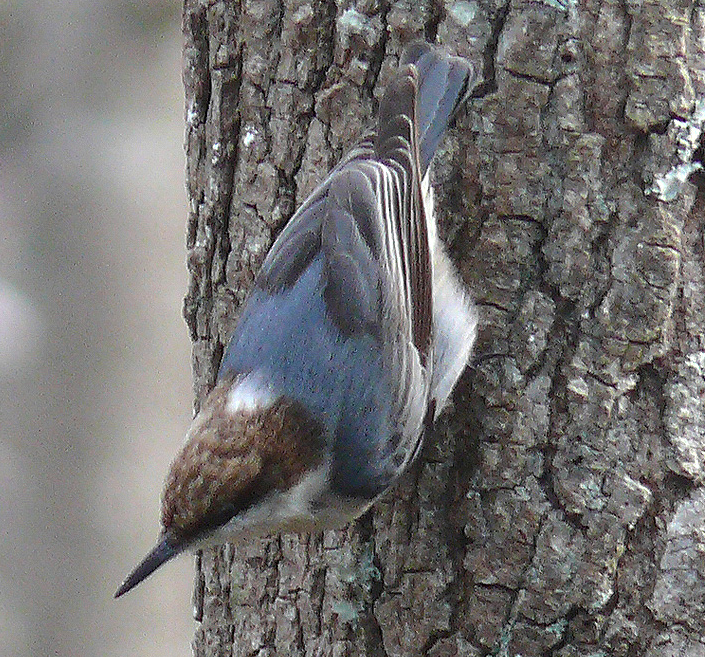 Brown-headed NuthatchSitta pusilla
- Bahama NuthatchSitta insularis
-
 Beautiful NuthatchSitta formosa
-
 Corsican NuthatchSitta whiteheadi
Compare
Questions and answers
What is the scientific name of the Algerian Nuthatch?
The scientific name of the Algerian Nuthatch is Sitta ledanti. Written with its author, the full name is Sitta ledanti Vielliard, 1976.
Which family does the Algerian Nuthatch belong to?
Sitta ledanti belongs to the family Sittidae, in the order Passeriformes and the class Aves.
Where is the Algerian Nuthatch found?
Checklists and occurrence records place Sitta ledanti in 1 country: Algeria.
What is the conservation status of the Algerian Nuthatch?
The IUCN Red List category recorded for Sitta ledanti is Endangered (EN).
What other names does the Algerian Nuthatch have?
Sitta ledanti is also known in English as ALNU, Kabyle Nuthatch, Kabylian Nuthatch and Kabylie Nuthatch.
Sources
Passages the profile rests on
- The Algerian Nuthatch measures between 11.5 and 12.5 cm in length. Source passage: “It measures between 11.5 cm (4.5 in) and 12.5 cm (4.9 in)” — English Wikipedia
- The species weighs approximately 18 grams. Source passage: “weighs about 18 grams (0.63 oz).” — English Wikipedia
- The upperparts of the Algerian Nuthatch are bluish-grey. Source passage: “The upperparts are overall bluish grey” — English Wikipedia
- The belly is light salmon-beige, while the undertail coverts are grey at their base. Source passage: “The belly is washed with light salmon-beige up to the undertail coverts; the latter are grey at their base.” — English Wikipedia
- The tail has a small white subterminal band bordered by beige. Source passage: “the tail has a small subterminal white band bordered with beige.” — English Wikipedia
- The species has a brown-black iris, lead-grey legs and a bluish-grey bill. Source passage: “The iris are brown-black, the legs lead-grey and the bill bluish-grey.” — English Wikipedia
- Adult males have a black forehead and dark eyestripe separated from the crown by a prominent white supercilium. Source passage: “The male has a black forehead and a dark eyestripe, separated from the crown by a broad, sharp white supercilium.” — English Wikipedia
- Females have a crown and eyestripe that are generally grey like their back. Source passage: “In females, the crown and eyestripe are the same grey as the back” — English Wikipedia
- Both sexes have white sides of the head and throat. Source passage: “In both sexes, the sides of the head and the throat are white.” — English Wikipedia
- Juveniles resemble females but have duller plumage and a less conspicuous white supercilium. Source passage: “The juvenile plumage is similar to that of the female, but duller and with an inconspicuous supercilium” — English Wikipedia
- The Algerian Nuthatch inhabits oak forests at elevations between 350 and 1,120 metres. Source passage: “The Algerian nuthatch lives in oak forests between 350 m (1,150 ft) and 1,120 m (3,670 ft) altitude” — English Wikipedia
- The species also inhabits mixed forests containing oak and Italian maple, as well as mixed coniferous forests. Source passage: “in mixed forests of oak, Italian maple (Acer opalus subsp. obtusatum), and mixed coniferous forests” — English Wikipedia
- The species occurs in forests reaching the summit of Jebel Babor at 2,004 metres. Source passage: “up to the 2,004 m (6,575 ft) summit of Jebel Babor.” — English Wikipedia
- The species favours humid forests containing large trees with cavities. Source passage: “It appreciates humid forests with large trees offering cavities” — English Wikipedia
- Trees associated with its habitat include Algerian fir, Atlas cedar, aspen, Afares oak, cork oak and Portuguese oak. Source passage: “including Algerian fir (Abies numidica), Atlas cedar (Cedrus atlantica), aspen (Populus tremula), Afares oak (Quercus afares), cork oak (Quercus suber) and Portuguese oak (Quercus faginea).” — English Wikipedia
- The Babor Mountains provide a cool, humid forest habitat dominated by fir and cedar. Source passage: “The Babor Mountains, dominated by fir and cedar forest, offer a cool and humid climate” — English Wikipedia
- During summer, the Algerian Nuthatch feeds mainly on insects and spiders. Source passage: “In summer, it feeds mainly on insects (mainly caterpillars and beetles) and spiders” — English Wikipedia
- Caterpillars and beetles are among the principal insects consumed during summer. Source passage: “mainly on insects (mainly caterpillars and beetles)” — English Wikipedia
- During winter, the species feeds on coniferous seeds. Source passage: “In winter, insects are scarce and the Algerian nuthatch feeds on coniferous seeds” — English Wikipedia
- The species searches for food on the trunks and branches of oak trees. Source passage: “that it finds by surveying the trunks and branches of oak trees.” — English Wikipedia
- The Algerian Nuthatch is sedentary. Source passage: “The species is sedentary” — English Wikipedia
- Individuals generally forage alone but may join mixed-species feeding flocks outside the breeding season. Source passage: “They generally feed alone, but may form mixed feeding flocks outside the breeding season.” — English Wikipedia
- The species produces a nasal whistle composed of rising elements followed by a short final note. Source passage: “The song of the Algerian nuthatch is a nasal whistle, composed of a series of rising elements, with a short final note” — English Wikipedia
- The species' song consists of seven to twelve phrases lasting between two and four seconds. Source passage: “It is a repetition of seven to twelve phrases lasting for two to four seconds.” — English Wikipedia
- Adults produce a whispered call when an intruder is present. Source passage: “Adults also use a whispered call when an intruder is present” — English Wikipedia
- The breeding season generally occurs between May and June at Tamentout and Mount Babor. Source passage: “The breeding season occurs from May to June in Tamentout and Mount Babor” — English Wikipedia
- The breeding season may begin later at higher elevations. Source passage: “at higher altitudes it may start later.” — English Wikipedia
- The nest is constructed in a tree cavity. Source passage: “The nest is built in a tree hole” — English Wikipedia
- Nests may be located in dead fir trees or cavities in oak and cedar trees. Source passage: “in a dead fir tree or in holes in an oak or cedar tree” — English Wikipedia
- Nests are usually positioned between four and fifteen metres above the ground. Source passage: “is usually placed between 4–15 m (13–49 ft) from the ground.” — English Wikipedia
- Nest linings can contain wood chips and dead leaves. Source passage: “wood chips, dead leaves” — English Wikipedia
- Females incubate the eggs without assistance from males. Source passage: “incubation is carried out by the female alone” — English Wikipedia
- Both parents feed the young. Source passage: “both parents feed the young.” — English Wikipedia
- Clutches contain three or four young. Source passage: “Clutches have three or four fledglings.” — English Wikipedia
- The species' population is considered to be declining because of habitat reduction. Source passage: “these numbers are considered to be declining due to the reduction in habitat that the species is experiencing.” — English Wikipedia
- Habitat destruction is identified as the principal threat to the species. Source passage: “The main threat to the Algerian nuthatch is the destruction of its habitat.” — English Wikipedia
- Fires threaten the old mixed forests on Mount Babor. Source passage: “Fires, in particular, are destroying the old mixed forests on the top of Mount Babor” — English Wikipedia
- Cattle grazing and illegal deforestation threaten the species' habitat at Mount Babor and Tamentout. Source passage: “Cattle grazing and illegal deforestation (Mount Babor and Tamentout) are another threat to the habitat” — English Wikipedia
Data
- Catalogue of Life, 2026-10-16 XR cc by
- Global Biodiversity Information Facility CC BY 4.0
- Wikidata CC0
- GeoNames CC BY 4.0
- Wikimedia Commons per image; credit shown with each image
- Within the Catalogue of Life, this name comes from The Integrated Taxonomic Information System cc0
References
- Vielliard, & Jacques Marie Edme. (1976). La Sitelle Kabyle. Alauda, Vol. 44. where the name was published
- Fish and Wildlife Service, U. S. (1995). Endangered and Threatened Wildlife and Plants; Addition of 30 African Birds to List of Endangered and Threatened Wildlife. Federal Register, Vol. 60, No. 8.
- Gill, Frank, & and Minturn Wright. (2006). Birds of the World: Recommended English Names.
This species in other databases
Page built on 29 November 2026. See how the catalog is made and all sources and licences.
Cite this page
ScientificNames.org. (2026). Sitta ledanti (Algerian Nuthatch). Retrieved November 29, 2026, from https://scientificnames.org/species/sitta-ledanti
“Sitta ledanti (Algerian Nuthatch).” ScientificNames.org, 2026, scientificnames.org/species/sitta-ledanti. Accessed 29 Nov. 2026.
ScientificNames.org. “Sitta ledanti (Algerian Nuthatch).” Accessed November 29, 2026. https://scientificnames.org/species/sitta-ledanti.
@misc{scientificnames_sitta_ledanti_algerian_nuthatch,
  author = {{ScientificNames.org}},
  title = {Sitta ledanti (Algerian Nuthatch)},
  year = {2026},
  url = {https://scientificnames.org/species/sitta-ledanti},
  note = {Accessed 2026-11-29}
}