Species · Birds
Beautiful Nuthatch Sitta formosa
The scientific name of the Beautiful Nuthatch is Sitta formosa. It is a species of bird in the family Sittidae (nuthatch), order Passeriformes. The name dates from 1843.
- Scientific name
- Sitta formosa Blyth, 1843
- Common name
- Beautiful Nuthatch
- Genus
- Sitta
- Family
- Sittidae (Nuthatch)
- Order
- Passeriformes
- Class
- Aves
- Red List category
- VU Vulnerable
- Recorded in
- 7 countries
- Name status
- accepted in the Catalogue of Life

Overview
Written 26 November 2026 from the sources listed below. Each statement was checked against the passage it cites; statements that could not be supported were removed.
Appearance
Fine white edges on the greater and median wing coverts form two narrow wing bars. The flight feathers are black and variably lined with pale blue.[1][2]
The eyebrow and throat are white and buff, and an irregular dark eyestripe highlights the eye. The iris is reddish-brown or dark brown, and the bill is black with a whitish tinge at the base of the lower mandible.[3][4][5][6]
The species measures approximately 16.5 cm in length. Male folded wings measure 98–109 mm and female folded wings measure 97–100 mm; male tails measure 48–60 mm and female tails measure 52–56 mm.[7][8][9][10][11]
The bill measures between 20 and 24.9 mm, and the tarsus measures 19–22 mm. The species' weight is unknown.[12][13][14]
Habitat
During warmer seasons, it generally inhabits elevations from 950 m to nearly 2,300 m. In winter, individuals have been recorded at 335 m in Sikkim.[15][16]
Diet
It searches for prey among lichens, mosses and orchids growing on tree branches.[17]
Behaviour
The species forages alone, in pairs or in small groups of four to five individuals. A gathering of 21 individuals was observed in one tree in Bhutan.[18][19]
It participates in mixed-species foraging flocks and has been observed foraging alongside Himalayan cutias and velvet-fronted nuthatches.[20][21]
The species sometimes hangs upside down for extended periods while surveying its surroundings. It forages in an unhurried manner while pecking at tree trunks and epiphytes and has been described as the most timid of nuthatches.[22][23][24]
Reproduction and life cycle
The breeding season in northeastern India occurs from April to May. The nest is generally situated between two and eight metres above the ground, commonly in holes in living or dead oak and rhododendron trees.[25][26][27]
Nest construction materials include leaves and bark held together with hair. Hair from bamboo rats is frequently used in nest construction.[28][29]
The species usually lays four to six white eggs marked with red spots. The eggs measure approximately 20.8 by 15.3 mm.[30][31]
Both sexes contribute equally to nest building and incubation. Adults undergo a complete moult after the breeding season.[32][33]
Conservation
The Beautiful Nuthatch has been classified as vulnerable by the International Union for Conservation of Nature. Its estimated residential and breeding range covers approximately 376,000 square kilometres.[34][35]
A 2001 study estimated the population at 2,500–10,000 adults and 3,500–15,000 individuals overall. The population estimates reported in the research indicated a declining population.[36][37]
Similar species
The blue nuthatch has been suggested as a possible visual comparison because of its bright blue plumage. The velvet-fronted nuthatch is another species with blue-tinted plumage mentioned as a comparison.[38][39]
The species' evolutionary position within the genus Sitta has not been established with certainty.[40]
Classification of the Beautiful Nuthatch
| Kingdom | Animalia |
|---|---|
| Phylum | Chordata |
| Subphylum | Vertebrata |
| Infraphylum | Gnathostomata |
| Parvphylum | Osteichthyes |
| Megaclass | Tetrapoda |
| Class | Aves (Bird) |
| Order | Passeriformes (Passerine) |
| Family | Sittidae (Nuthatch) |
| Genus | Sitta (Nuthatch) |
| Species | Sitta formosa Blyth, 1843 |
Where the Beautiful Nuthatch is found
Checklists and occurrence records place Sitta formosa in 7 countries across Asia. GBIF holds 2,030 georeferenced records of it.
Countries
Regions and cities with the most records
- Arunachal Pradesh, India 492
- Mongar, Bhutan 214
- Tibet, China 115
- Zhemgang District, Bhutan 83
- Sarpang District, Bhutan 51
- Samdrup Jongkhar, Bhutan 48
- Tsirang, Bhutan 41
- Yunnan, China 18
- Kachin State, Myanmar 17
- Tongsa, Bhutan 15
- Nghệ An Province, Vietnam 12
- Xiangkhoang, Laos 12
- Nagaland, India 11
- West Bengal, India 11
- Bumthang District, Bhutan 8
- Tsirang District, Bhutan 8
- Jining, India 7
- Nan, Thailand 7
- Along, India 6
- Kohima, India 6
- Assam, India 5
- Manipur, India 5
- Kālimpong, India 4
- Samtse District, Bhutan 4
- Trashigang District, Bhutan 4
- Ukhrul, India 4
- Zunheboto, India 4
- Hà Giang, Vietnam 3
Range as the checklists state it
Southern Asia
A number beside a place is its count of GBIF occurrence records. A place without a number comes from a checklist alone. Records show where a species has been observed or collected, which can include escapes and vagrants.
Common names
English
- Beautiful Nuthatch
Names in 28 other languages
- Bulgarian
- Голяма зидарка
- Catalan
- pica-soques esplèndid
- Chinese
- 丽䴓, 丽鳾, 丽, 麗鳾
- Croatian
- prugastoleđi brgljez
- Czech
- brhlík nádherný
- Danish
- Pragtspætmejse
- Dutch
- Prachtboomklever
- Esperanto
- Belega sito, bela sito
- Estonian
- safiir-puukoristaja
- Finnish
- kaunonakkeli, mustakaulusnakkeli
- French
- Sittelle superbe
- German
- Schmuckkleiber
- Hungarian
- ékszercsuszka
- Italian
- Picchio muratore magnifico
- Japanese
- ビナンゴジュウカラ, ムナジロゴジュウカラ
- Lithuanian
- puošnusis bukutis
- Norwegian
- praktspettmeis
- Polish
- kowalik wspaniały
- Portuguese
- trepadeira-formosa, trepadeira-soberba
- Russian
- Поползень-красавец, Прекрасный поползень
- Slovak
- brhlík pestrý
- Spanish
- Trepador Bello, Trepador hermoso
- Swedish
- praktnötväcka
- Thai
- นกไต่ไม้สีสวย
- Turkish
- Süslü Sıvacı
- Ukrainian
- повзик-білозір
- Vietnamese
- Trèo cây lưng đen
- Welsh
- delor cnau hardd
Related species
-
 Eurasian NuthatchSitta europaea
-
 White-breasted NuthatchSitta carolinensis
-
 Red-breasted NuthatchSitta canadensis
-
 Pygmy NuthatchSitta pygmaea
-
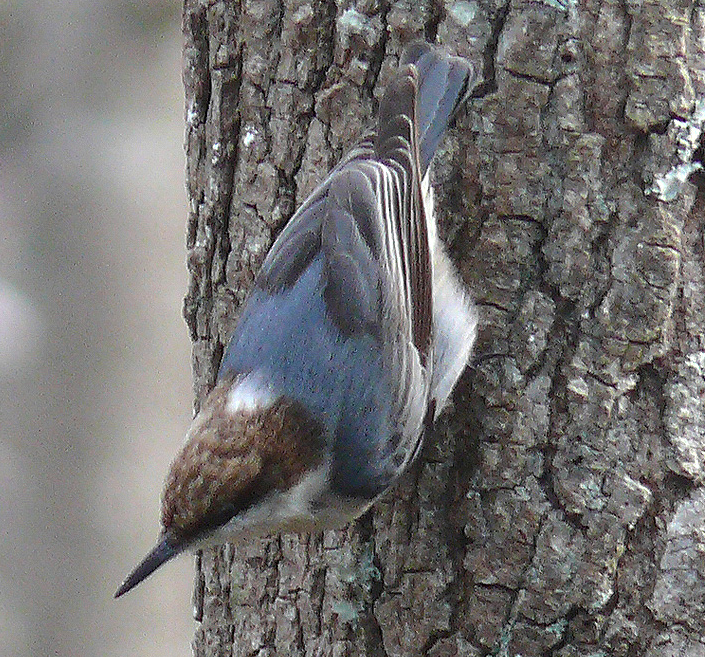 Brown-headed NuthatchSitta pusilla
- Bahama NuthatchSitta insularis
-
 Algerian NuthatchSitta ledanti
-
 Corsican NuthatchSitta whiteheadi
Compare
Questions and answers
What is the scientific name of the Beautiful Nuthatch?
The scientific name of the Beautiful Nuthatch is Sitta formosa. Written with its author, the full name is Sitta formosa Blyth, 1843.
Which family does the Beautiful Nuthatch belong to?
Sitta formosa belongs to the family Sittidae, in the order Passeriformes and the class Aves.
Where is the Beautiful Nuthatch found?
Checklists and occurrence records place Sitta formosa in 7 countries, including India, Bhutan, China, Myanmar, Vietnam and Laos.
What is the conservation status of the Beautiful Nuthatch?
The IUCN Red List category recorded for Sitta formosa is Vulnerable (VU).
Sources
Passages the profile rests on
- The greater and median wing coverts have fine white edges that form two narrow wing bars. Source passage: “The greater and medium coverts are black, finely edged with white, forming two narrow wing bars” — English Wikipedia
- The flight feathers are black and variably lined with pale blue. Source passage: “the flight feathers are black and more or less lined with pale blue.” — English Wikipedia
- The eyebrow and throat are white and buff. Source passage: “The eyebrow and throat are white and buff” — English Wikipedia
- An irregular dark eyestripe highlights the eye. Source passage: “the eye is highlighted by an irregular, dark eyestripe.” — English Wikipedia
- The iris is reddish-brown or dark brown. Source passage: “The iris is reddish-brown or dark brown” — English Wikipedia
- The bill is black with a whitish tinge at the base of the lower mandible. Source passage: “The bill is black but for a whitish tinge at the base of the lower mandible.” — English Wikipedia
- The species measures approximately 16.5 cm in length. Source passage: “measuring 16.5 cm (6.5 in) in length.” — English Wikipedia
- Male folded wings measure 98–109 mm. Source passage: “The folded wing measures 98–109 mm (3.9–4.3 in) in males” — English Wikipedia
- Female folded wings measure 97–100 mm. Source passage: “and 97–100 mm (3.8–3.9 in) in females.” — English Wikipedia
- Male tails measure 48–60 mm. Source passage: “The tail is 48–60 mm (1.9–2.4 in) in males” — English Wikipedia
- Female tails measure 52–56 mm. Source passage: “and 52–56 mm (2.0–2.2 in) in females.” — English Wikipedia
- The bill measures between 20 and 24.9 mm. Source passage: “The beak measures between 20 mm (0.79 in) and 24.9 mm (0.98 in)” — English Wikipedia
- The tarsus measures 19–22 mm. Source passage: “the tarsus is 19–22 mm (0.75–0.87 in) in length.” — English Wikipedia
- The species' weight is unknown. Source passage: “The weight is not known.” — English Wikipedia
- The species generally inhabits elevations from 950 m to nearly 2,300 m during warmer seasons. Source passage: “They usually live at altitudes of 950 m (3,120 ft) and up to nearly 2,300 m (7,500 ft) during the warm seasons” — English Wikipedia
- In winter, individuals have been recorded at 335 m in Sikkim. Source passage: “observed during winter at just 335 m (1,099 ft) in Sikkim” — English Wikipedia
- The species searches for prey among lichens, mosses and orchids growing on tree branches. Source passage: “exploring the trunks and epiphyte-covered branches (lichens, mosses, orchids)” — English Wikipedia
- The species forages alone, in pairs or in small groups of four to five individuals. Source passage: “The beautiful nuthatch forages alone, in pairs or in small groups of four to five individuals” — English Wikipedia
- A gathering of 21 individuals was observed in one tree in Bhutan. Source passage: “an unusual gathering of 21 individuals was observed in one tree in Bhutan.” — English Wikipedia
- The species participates in mixed-species foraging flocks. Source passage: “It often takes part in mixed-species foraging flocks” — English Wikipedia
- The species has been observed foraging alongside Himalayan cutias and velvet-fronted nuthatches. Source passage: “feeding with the Himalayan cutia (Cutia nipalensis) and the velvet-fronted nuthatch (Sitta frontalis)” — English Wikipedia
- The species sometimes hangs upside down for extended periods while surveying its surroundings. Source passage: “sometimes hanging upside down for an extended time surveying its surroundings.” — English Wikipedia
- The species has been described as the most timid of nuthatches. Source passage: “The bird has been described at times as the most timid of nuthatches.” — English Wikipedia
- The species forages in an unhurried manner while pecking at tree trunks and epiphytes. Source passage: “the species has been described as working "unhurriedly", as they peck at trunks, lichen and other epiphytes” — English Wikipedia
- The breeding season in northeastern India occurs from April to May. Source passage: “In the northeast of India, the breeding season is from April to May.” — English Wikipedia
- The nest is generally situated between two and eight metres above the ground. Source passage: “The nest is placed off the ground, between two and eight meters high” — English Wikipedia
- The species commonly nests in holes in living or dead oak and rhododendron trees. Source passage: “often built in a hole of a (living or dead) oak or rhododendron tree” — English Wikipedia
- Nest construction materials include leaves and bark held together with hair. Source passage: “The nests are constructed using leaves and bark, held together with hair” — English Wikipedia
- Hair from bamboo rats is frequently used in nest construction. Source passage: “often that of bamboo rats.” — English Wikipedia
- The species usually lays four to six white eggs marked with red spots. Source passage: “The bird usually lays four to six white eggs, speckled with red spots” — English Wikipedia
- The eggs measure approximately 20.8 by 15.3 mm. Source passage: “that measure 20.8 mm × 15.3 mm (0.82 in × 0.60 in).” — English Wikipedia
- Both sexes contribute equally to nest building and incubation. Source passage: “Beautiful nuthatch sexes are reported to share equally in nest building and incubation duties.” — English Wikipedia
- Adults undergo a complete moult after the breeding season. Source passage: “Adults perform a complete moult after the breeding season” — English Wikipedia
- The estimated residential and breeding range covers approximately 376,000 square kilometres. Source passage: “Its residential and breeding range is estimated to cover 376,000 km2 (145,000 sq mi).” — English Wikipedia
- The species has been classified as vulnerable by the International Union for Conservation of Nature. Source passage: “The species has been classified as vulnerable by the International Union for Conservation of Nature (IUCN).” — English Wikipedia
- A 2001 study estimated the population at 2,500–10,000 adults and 3,500–15,000 individuals overall. Source passage: “Research conducted in 2001 indicated a population comprising 2,500 to 10,000 adults, and between 3,500 and 15,000 total individuals” — English Wikipedia
- The population estimates reported in the 2001 research indicated a declining population. Source passage: “these numbers are in decline.” — English Wikipedia
- The blue nuthatch has been suggested as a possible visual comparison because of its bright blue plumage. Source passage: “The bright blue colour of its plumage invites a comparison to the blue nuthatch (S. azurea)” — English Wikipedia
- The velvet-fronted nuthatch is another species with blue-tinted plumage mentioned as a comparison. Source passage: “or other blue-tinted nuthatch species such as the velvet-fronted nuthatch (S. frontalis)” — English Wikipedia
- The species' evolutionary position within the genus Sitta has not been established with certainty. Source passage: “The position of the beautiful nuthatch within the genus was not established with certainty” — English Wikipedia
Data
- Catalogue of Life, 2026-10-16 XR cc by
- Global Biodiversity Information Facility CC BY 4.0
- Wikidata CC0
- GeoNames CC BY 4.0
- Wikimedia Commons per image; credit shown with each image
- Within the Catalogue of Life, this name comes from The Integrated Taxonomic Information System cc0
References
- Blyth, & Edward. (1843). Mr Blyth’s report for December Meeting, 1842, with Addenda subsequently appended. The Journal of the Asiatic Society of Bengal, Vol. 12, No. 143. where the name was published
- Gill, Frank, & and Minturn Wright. (2006). Birds of the World: Recommended English Names.
This species in other databases
Page built on 26 November 2026. See how the catalog is made and all sources and licences.
Cite this page
ScientificNames.org. (2026). Sitta formosa (Beautiful Nuthatch). Retrieved November 26, 2026, from https://scientificnames.org/species/sitta-formosa
“Sitta formosa (Beautiful Nuthatch).” ScientificNames.org, 2026, scientificnames.org/species/sitta-formosa. Accessed 26 Nov. 2026.
ScientificNames.org. “Sitta formosa (Beautiful Nuthatch).” Accessed November 26, 2026. https://scientificnames.org/species/sitta-formosa.
@misc{scientificnames_sitta_formosa_beautiful_nuthatch,
  author = {{ScientificNames.org}},
  title = {Sitta formosa (Beautiful Nuthatch)},
  year = {2026},
  url = {https://scientificnames.org/species/sitta-formosa},
  note = {Accessed 2026-11-26}
}