Species · Birds
Bahama Nuthatch Sitta insularis
The scientific name of the Bahama Nuthatch is Sitta insularis. It is a species of bird in the family Sittidae (nuthatch), order Passeriformes. The name dates from 1931.
- Scientific name
- Sitta insularis J. Bond, 1931
- Common name
- Bahama Nuthatch
- Genus
- Sitta
- Family
- Sittidae (Nuthatch)
- Order
- Passeriformes
- Class
- Aves
- Red List category
- CR Critically Endangered
- Recorded in
- 1 country
- Name status
- accepted in the Catalogue of Life
Overview
The species is endemic to Grand Bahama Island in the Bahamas, where it inhabits pineyards.
Written 26 November 2026 from the sources listed below. Each statement was checked against the passage it cites; statements that could not be supported were removed.
Habitat
The Bahama Nuthatch inhabits pineyards on Grand Bahama Island. It is active in the crowns of pine trees.[1][2][3]
Almost all of Grand Bahama's pine forest was logged during the 1950s, although some portions subsequently regenerated.[4]
Late Pleistocene fossil remains have been described from Abaco and Long Island. The species probably occupied a wider area of the Bahamas before becoming restricted to Grand Bahama during the Holocene.[5][6]
Hurricane Dorian caused saltwater flooding in the species' pineyard habitat. Saltwater intrusion threatened the standing pine trees in the area where the species was last observed.[7][8]
Conservation
The Bahama Nuthatch is officially classified as Critically Endangered. It is described as extremely rare and possibly extinct.[9][10]
The species is threatened by habitat destruction, habitat degradation, fires and hurricane damage. Invasive corn snakes, raccoons, house sparrows and common starlings may also have contributed to its decline.[11][12]
The species was reported as locally common in surveys conducted in 1969 and 1978. Only two individuals were detected during extensive surveys in 1993.[13][14]
A 2004 estimate placed the population at 1,800 individuals, although its authors acknowledged that the estimate was overly optimistic. A survey in 2007 recorded approximately 23 individuals.[15][16]
Observations made since the 2000s have been restricted to Lucaya Estates or its surrounding area. Monthly surveys and four days of intensive surveys in January 2018 failed to detect the species, although surveys during spring and summer 2018 produced a small number of sightings.[17][18][19]
Two individuals were recorded together during at least one sighting in 2018. Hurricane Dorian in 2019 may have eliminated the Bahama Nuthatch population.[20][21]
A 2020 IUCN post-hurricane assessment considered the species potentially extant, with a maximum population of approximately 50 individuals. The actual population could be substantially smaller than 50 individuals.[22][23]
Extensive surveys are needed to confirm whether the Bahama Nuthatch survives. The IUCN Red List most recently assessed the species in 2020.[24][25]
Classification of the Bahama Nuthatch
| Kingdom | Animalia |
|---|---|
| Phylum | Chordata |
| Subphylum | Vertebrata |
| Infraphylum | Gnathostomata |
| Parvphylum | Osteichthyes |
| Megaclass | Tetrapoda |
| Class | Aves (Bird) |
| Order | Passeriformes (Passerine) |
| Family | Sittidae (Nuthatch) |
| Genus | Sitta (Nuthatch) |
| Species | Sitta insularis J. Bond, 1931 |
Where the Bahama Nuthatch is found
Checklists and occurrence records place Sitta insularis in 1 country across North America. GBIF holds 69 georeferenced records of it.
Countries
Regions and cities with the most records
Range as the checklists state it
Caribbean
A number beside a place is its count of GBIF occurrence records. A place without a number comes from a checklist alone. Records show where a species has been observed or collected, which can include escapes and vagrants.
Common names
English
- Bahama Nuthatch
Names in 19 other languages
- Chinese
- 巴哈马䴓
- Croatian
- bahamski brgljez
- Danish
- Bahama Spætmejse
- Dutch
- Bahamaboomklever
- Esperanto
- bahama sito
- Finnish
- Bahamannakkeli
- French
- Sittelle des Bahamas
- German
- Bahamakleiber
- Japanese
- バハマゴジュウカラ
- Lithuanian
- Bahaminis bukutis
- Norwegian
- furuspettmeis
- Polish
- bahamski, kowalik bahamski
- Portuguese
- trepadeira-baamense, trepadeira-das-Bahamas, trepadeira-das-baamas
- Russian
- Багамский поползень
- Slovak
- brhlík bahamský
- Spanish
- Trepador Bahameño, Trepador de las Bahamas
- Swedish
- bahamanötväcka
- Turkish
- Bahama Sıvacısı
- Ukrainian
- повзик багамський
Synonyms
One other scientific name has been used for this species and is now treated as a synonym of Sitta insularis.
- Sitta pusilla insularis J. Bond, 1931
Related species
-
 Eurasian NuthatchSitta europaea
-
 White-breasted NuthatchSitta carolinensis
-
 Red-breasted NuthatchSitta canadensis
-
 Pygmy NuthatchSitta pygmaea
-
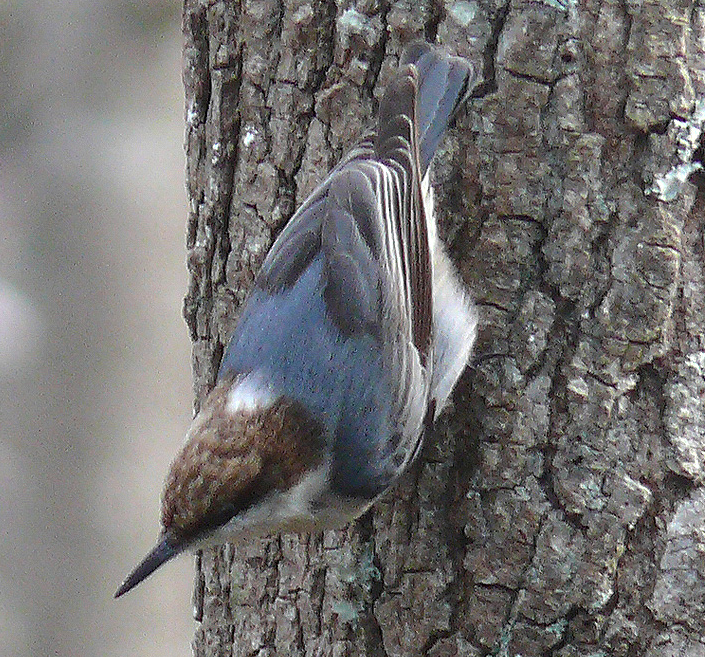 Brown-headed NuthatchSitta pusilla
-
 Beautiful NuthatchSitta formosa
-
 Algerian NuthatchSitta ledanti
-
 Corsican NuthatchSitta whiteheadi
Compare
Questions and answers
What is the scientific name of the Bahama Nuthatch?
The scientific name of the Bahama Nuthatch is Sitta insularis. Written with its author, the full name is Sitta insularis J. Bond, 1931.
Which family does the Bahama Nuthatch belong to?
Sitta insularis belongs to the family Sittidae, in the order Passeriformes and the class Aves.
Where is the Bahama Nuthatch found?
Checklists and occurrence records place Sitta insularis in 1 country: Bahamas.
What is the conservation status of the Bahama Nuthatch?
The IUCN Red List category recorded for Sitta insularis is Critically Endangered (CR).
Sources
Passages the profile rests on
- The Bahama Nuthatch is endemic to Grand Bahama Island in the Bahamas. Source passage: “The Bahama nuthatch (Sitta insularis) is a nuthatch species endemic to the pineyards of Grand Bahama island in the Bahamas.” — English Wikipedia
- The species inhabits pineyards on Grand Bahama Island. Source passage: “endemic to the pineyards of Grand Bahama island in the Bahamas.” — English Wikipedia
- The Bahama Nuthatch is active in the crowns of pine trees. Source passage: “Active in crowns of pines” — ebird.org
- Almost all of Grand Bahama's pine forest was logged during the 1950s, although some portions subsequently regenerated. Source passage: “Almost all of the pine forest on Grand Bahama was logged in the 1950s but portions have since regenerated” — English Wikipedia
- Late Pleistocene fossil remains of the species have been described from Abaco and Long Island. Source passage: “late Pleistocene fossil remains of S. insularis from Abaco and Long Island have since been described” — English Wikipedia
- The species probably occupied a wider area of the Bahamas before becoming restricted to Grand Bahama during the Holocene. Source passage: “it likely had a much wider distribution across the Bahamas until for unknown reasons, it was restricted to Grand Bahama by the Holocene.” — English Wikipedia
- Hurricane Dorian caused saltwater flooding in the species' pineyard habitat. Source passage: “especially the historically significant destruction and saltwater flooding of the pineyards from the lingering Category 5 storm.” — English Wikipedia
- Saltwater intrusion following Hurricane Dorian threatened the standing pine trees in the area where the species was last observed. Source passage: “the area in which the birds were last seen still had standing pines but had experienced saltwater intrusion, which could kill the trees over a period of time” — English Wikipedia
- The Bahama Nuthatch is officially classified as Critically Endangered. Source passage: “It is officially considered critically endangered and is very likely extinct.” — English Wikipedia
- The species is described as extremely rare and possibly extinct. Source passage: “though now extremely rare and possibly extinct.” — ebird.org
- The species is threatened by habitat destruction, habitat degradation, fires and hurricane damage. Source passage: “it is highly threatened by habitat destruction and degradation, fires, and hurricane damage.” — English Wikipedia
- Invasive corn snakes, raccoons, house sparrows and common starlings may have contributed to the species' decline. Source passage: “Invasive species such as the corn snake (Pantherophis guttatus), raccoon (Procyon lotor), house sparrows (Passer domesticus) and common starlings (Sturnus vulgaris) may have also played a role in its decline.” — English Wikipedia
- The species was reported as locally common in surveys conducted in 1969 and 1978. Source passage: “the species was reported as locally common in surveys in 1969 and 1978.” — English Wikipedia
- Only two Bahama Nuthatches were detected during extensive surveys in 1993. Source passage: “only 2 individuals were detected in extensive 1993 surveys” — English Wikipedia
- A 2004 estimate placed the population at 1,800 individuals, although its authors acknowledged that the estimate was overly optimistic. Source passage: “A 2004 estimated that 1,800 individuals existed, but it was admitted by the authors that this was an overly optimistic number” — English Wikipedia
- A survey in 2007 recorded approximately 23 individuals. Source passage: “a 2007 survey only found about 23 individuals.” — English Wikipedia
- Observations made since the 2000s have been restricted to Lucaya Estates or its surrounding area. Source passage: “All observations since the 2000s have been in or around a patch of private land known as Lucaya Estates.” — English Wikipedia
- Monthly surveys and four days of intensive surveys in January 2018 failed to detect the species. Source passage: “monthly surveys by a local bird guide and 4 days of intensive surveys in January 2018 failed to find any birds” — English Wikipedia
- Surveys conducted during spring and summer 2018 produced a small number of sightings. Source passage: “extensive surveys in the spring and summer of 2018, which resulted in a small number of sightings” — English Wikipedia
- Two individuals were recorded together during at least one sighting in 2018. Source passage: “including one in which two birds were found.” — English Wikipedia
- Hurricane Dorian in 2019 may have eliminated the Bahama Nuthatch population. Source passage: “The destructive effects of Hurricane Dorian in 2019 may have killed off the Bahama nuthatch population” — English Wikipedia
- A 2020 IUCN post-hurricane assessment considered the species potentially extant, with a maximum population of approximately 50 individuals. Source passage: “still entertains the probability of the species being extant, although likely having a maximum population size of only 50 individuals” — English Wikipedia
- The 2020 assessment indicated that the actual population could be substantially smaller than 50 individuals. Source passage: “and likely well below that” — English Wikipedia
- Extensive surveys are needed to confirm whether the Bahama Nuthatch survives. Source passage: “indicates that extensive surveys for the species will be needed to confirm its status.” — English Wikipedia
- The IUCN Red List most recently assessed the Bahama Nuthatch in 2020. Source passage: “Bahama Nuthatch Sitta insularis has most recently been assessed for The IUCN Red List of Threatened Species in 2020.” — iucnredlist.org
Data
- Catalogue of Life, 2026-10-16 XR cc by
- Global Biodiversity Information Facility CC BY 4.0
- Wikidata CC0
- GeoNames CC BY 4.0
- Within the Catalogue of Life, this name comes from The Integrated Taxonomic Information System cc0
This species in other databases
Page built on 27 November 2026. See how the catalog is made and all sources and licences.
Cite this page
ScientificNames.org. (2026). Sitta insularis (Bahama Nuthatch). Retrieved November 27, 2026, from https://scientificnames.org/species/sitta-insularis
“Sitta insularis (Bahama Nuthatch).” ScientificNames.org, 2026, scientificnames.org/species/sitta-insularis. Accessed 27 Nov. 2026.
ScientificNames.org. “Sitta insularis (Bahama Nuthatch).” Accessed November 27, 2026. https://scientificnames.org/species/sitta-insularis.
@misc{scientificnames_sitta_insularis_bahama_nuthatch,
  author = {{ScientificNames.org}},
  title = {Sitta insularis (Bahama Nuthatch)},
  year = {2026},
  url = {https://scientificnames.org/species/sitta-insularis},
  note = {Accessed 2026-11-27}
}