Species · Birds
Krüper's Nuthatch Sitta krueperi
The scientific name of the Krüper's Nuthatch is Sitta krueperi. It is a species of bird in the family Sittidae (nuthatch), order Passeriformes. The name dates from 1863.
- Scientific name
- Sitta krueperi Pelzeln, 1863
- Common name
- Krüper's Nuthatch
- Genus
- Sitta
- Family
- Sittidae (Nuthatch)
- Order
- Passeriformes
- Class
- Aves
- Red List category
- LC Least Concern
- Recorded in
- 4 countries
- Name status
- accepted in the Catalogue of Life

Overview
Sitta krueperi occurs predominantly in Turkey, with a range extending to southern Georgia and the Greek island of Lesbos. It is distinguished by a black crown, a white eyebrow and a prominent rusty crescent-shaped breast patch.
Written 26 November 2026 from the sources listed below. Each statement was checked against the passage it cites; statements that could not be supported were removed.
Appearance
Krüper's Nuthatch measures 12.5 centimetres in length. Adult males weigh between 10 and 14.3 grams.[1][2]
The upperparts are blue-grey, with a black front crown in adults of both sexes. A white supercilium lies above a black eyestripe.[3][4]
Adult males have blue-grey to pale-grey underparts, while females have paler, buff-coloured underparts. Both sexes have a large reddish crescent-shaped breast patch.[5][6]
The undertail is rufous with white tips, and the undertail coverts are rusty. The iris is dark cinnamon or brown, and the legs are grey-brown or dark grey.[7][8][9][10]
Juvenile plumage is duller than adult plumage and lacks the black crown. The juvenile's russet breast patch is less prominent than that of adults.[11][12]
Habitat
Krüper's Nuthatch inhabits temperate coniferous forests from sea level to approximately 2,000 metres, locally reaching 2,500 metres. In Turkey, it mainly occurs at elevations between 1,000 and 1,600 metres.[13][14]
In the Caucasus, it prefers spruce forests between 1,000 and 2,000 metres. It also inhabits juniper vegetation at higher elevations.[15][16]
Diet
During the breeding season, Krüper's Nuthatch feeds mainly on insects. In autumn and winter, it consumes seeds of pine and other conifers.[17][18]
It extracts conifer seeds from cone scales using its bill. It stores food in caches that remain useful when moisture closes pine cones.[19][20]
The young are fed beetles, insect larvae, lepidoptera and earthworms.[21]
Behaviour
During the breeding season, Krüper's Nuthatch lives alone or in pairs, and pairs remain with their young. In autumn, individuals occur in groups of two to five birds.[22][23]
The species sometimes joins mixed-species foraging flocks. It can forage in bushes, feed on the ground and catch insects in flight.[24][25][26]
Krüper's Nuthatch is sedentary but undertakes some dispersal after breeding. Some individuals move from higher elevations to mixed or deciduous forests during winter.[27][28]
Reproduction and life cycle
In Turkey, the breeding season extends from mid-March to mid-May. The species produces one brood per year.[29][30]
The female usually lays four to seven eggs, most commonly five or six. The eggs are creamy white with small red or purplish spots and speckles, and measure approximately 17 by 13 millimetres.[31][32][33]
Incubation lasts between 12 and 17 days and is performed exclusively by the female. Both parents participate in feeding the young, which typically fledge between 15 and 19 days of age.[34][35][36]
Classification of the Krüper's Nuthatch
| Kingdom | Animalia |
|---|---|
| Phylum | Chordata |
| Subphylum | Vertebrata |
| Infraphylum | Gnathostomata |
| Parvphylum | Osteichthyes |
| Megaclass | Tetrapoda |
| Class | Aves (Bird) |
| Order | Passeriformes (Passerine) |
| Family | Sittidae (Nuthatch) |
| Genus | Sitta (Nuthatch) |
| Species | Sitta krueperi Pelzeln, 1863 |
Where the Krüper's Nuthatch is found
Checklists and occurrence records place Sitta krueperi in 4 countries. GBIF holds 7,995 georeferenced records of it.
Countries
Regions and cities with the most records
- Antalya, Turkey 925
- Krasnodar Krai, Russia 453
- Batumi, Georgia 418
- Kobuleti, Georgia 413
- Muğla, Turkey 411
- Mersin, Turkey 325
- Adygeya Republic, Russia 311
- Ankara, Turkey 287
- Canakkale, Turkey 287
- Denizli, Turkey 252
- Bolu, Turkey 242
- Tbilisi, Georgia 237
- Bursa Province, Turkey 231
- İzmir Province, Turkey 230
- Merkezefendi, Turkey 224
- Denizli, Turkey 210
- Kvemo Kartli, Georgia 209
- Bursa, Turkey 207
- Gürsu, Turkey 195
- Kestel, Turkey 194
- Kızılcahamam, Turkey 165
- Adana, Turkey 159
- Ortaca, Turkey 140
- Balıkesir, Turkey 138
- Samtskhe-Javakheti, Georgia 133
- Dalaman, Turkey 126
- Aydın, Turkey 125
- Mytilene, Greece 123
- Sarigerme, Turkey 122
- Gerede, Turkey 116
- Sarayköy, Turkey 107
- Eskişehir, Turkey 106
- Beykonak, Turkey 101
- İzmir, Turkey 100
- Karşıyaka, Turkey 98
- Karabağlar, Turkey 95
Range as the checklists state it
Europe & Northern Asia (excluding China)
A number beside a place is its count of GBIF occurrence records. A place without a number comes from a checklist alone. Records show where a species has been observed or collected, which can include escapes and vagrants.
Common names
English
- Krüper's Nuthatch
- Krueper's Nuthatch
- Krüper's Nuthatch
Names in 41 other languages
- Arabic
- كاسر الجوز الكروبرز
- Basque
- Turkiar garrapo
- Breton
- Pokerig-Krüper
- Bulgarian
- Черноглава зидарка
- Catalan
- pica-soques de Krüper
- Chinese
- 克氏䴓, 克氏鳾, 克魯氏鳾
- Czech
- brhlík turecký
- Danish
- Krüpers Spætmejse, Krüper´ Spætmejse
- Dutch
- Turkse Boomklever
- Esperanto
- turkia sito
- Estonian
- punapugu-puukoristaja
- Finnish
- punarintanakkeli
- French
- Sittelle de Krüper
- German
- Türken-Kleiber, Türkenkleiber
- Greek
- Πευκοτσοπανάκος
- Hebrew
- סיטה אדומת-חזה
- Hungarian
- török csuszka
- Icelandic
- Barkigða
- Irish
- cnóshnag Turcach
- Italian
- Picchio muratore di Krueper, Picchio muratore di Krüper
- Japanese
- ムナオビゴジュウカラ
- Latvian
- sarkankrūšu dzilnītis
- Lithuanian
- rusvakrūtis bukutis
- Northern Sami
- Ruksesraddečáihnegaccet
- Norwegian
- tyrkerspettmeis
- Persian
- کمرکولی کروپر
- Polish
- kowalik turecki
- Portuguese
- Trepadeira-azul-do-levante, trepadeira-do-levante, trepadeira-turca
- Russian
- Рыжегрудый поползень, Черноголовый поползень
- Scottish Gaelic
- Scoltan Turkagh
- Serbian
- Turski brgljez
- Slovak
- brhlík červenoprsý
- Slovenian
- turški brglez
- Spanish
- Trepador de Krüper
- Swedish
- Krüpers nötväcka
- Turkish
- Anadolu Sıvacısı, Küçük Sıvacı Kuşu
- Ukrainian
- повзик рудоволий
- Vietnamese
- Trèo cây Krüper
- Welsh
- delor cnau Krüper
- chm
- Шим вуян цуня
- kbd
- КъэбцӀацӀэжьэгъуху
Synonyms
One other scientific name has been used for this species and is now treated as a synonym of Sitta krueperi.
- Sitta krüperi Pelzeln, A, 1863
Related species
-
 Eurasian NuthatchSitta europaea
-
 White-breasted NuthatchSitta carolinensis
-
 Red-breasted NuthatchSitta canadensis
-
 Pygmy NuthatchSitta pygmaea
-
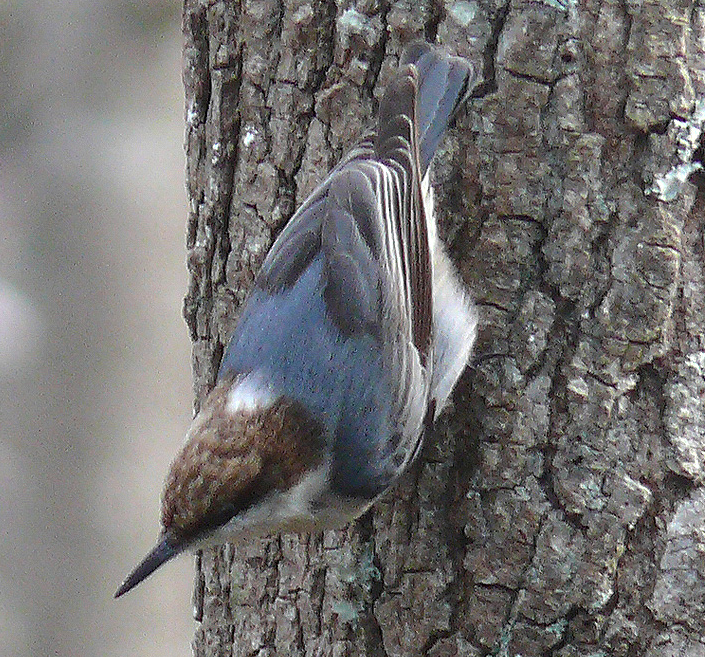 Brown-headed NuthatchSitta pusilla
- Bahama NuthatchSitta insularis
-
 Beautiful NuthatchSitta formosa
-
 Algerian NuthatchSitta ledanti
Compare
Questions and answers
What is the scientific name of the Krüper's Nuthatch?
The scientific name of the Krüper's Nuthatch is Sitta krueperi. Written with its author, the full name is Sitta krueperi Pelzeln, 1863.
Which family does the Krüper's Nuthatch belong to?
Sitta krueperi belongs to the family Sittidae, in the order Passeriformes and the class Aves.
Where is the Krüper's Nuthatch found?
Checklists and occurrence records place Sitta krueperi in 4 countries: Turkey, Greece, Georgia and Russia.
What is the conservation status of the Krüper's Nuthatch?
The IUCN Red List category recorded for Sitta krueperi is Least Concern (LC).
What other names does the Krüper's Nuthatch have?
Sitta krueperi is also known in English as Krueper's Nuthatch and Krüper's Nuthatch.
Sources
Passages the profile rests on
- The species measures 12.5 centimetres in length. Source passage: “measuring 12.5 centimetres (4.9 in) in length.” — English Wikipedia
- Adult males weigh between 10 and 14.3 grams. Source passage: “The adult male weighs 10–14.3 grams (0.35–0.50 oz).” — English Wikipedia
- The upperparts are blue-grey, with a black front crown in adults of both sexes. Source passage: “The upperparts are blue-grey with a black front crown in adults of both sexes” — English Wikipedia
- The species has a white supercilium above a black eyestripe. Source passage: “The supercilium is white and underlined by a black eyestripe” — English Wikipedia
- Adult males have blue-grey to pale-grey underparts, while females have paler, buff-coloured underparts. Source passage: “The female underparts are paler and buff, while the male is blue-grey to pale grey.” — English Wikipedia
- The breast has a large reddish patch shaped like a crescent. Source passage: “with a large reddish patch on the crescent-shaped breast.” — English Wikipedia
- The undertail is rufous with white tips. Source passage: “the undertail is rufous, with white tips.” — English Wikipedia
- The bird has a dark cinnamon or brown iris. Source passage: “the iris is dark cinnamon or brown” — English Wikipedia
- The legs are grey-brown or dark grey. Source passage: “The legs are grey-brown or dark grey.” — English Wikipedia
- The species has prominent rusty undertail coverts. Source passage: “prominent rusty breast patch and undertail coverts.” — ebird.org
- The juvenile plumage is duller than adult plumage and lacks the black crown. Source passage: “having much duller plumage and lacking the black crown” — English Wikipedia
- The juvenile's russet breast patch is less prominent than that of adults. Source passage: “Its russet pectoral patch is much less marked” — English Wikipedia
- The species inhabits temperate coniferous forests from sea level to approximately 2,000 metres, locally reaching 2,500 metres. Source passage: “Krüper's nuthatch lives in temperate coniferous forests from sea level up to around 2,000 m altitude, locally to the tree line at 2,500 m.” — English Wikipedia
- In Turkey, the species mainly inhabits elevations between 1,000 and 1,600 metres. Source passage: “In Turkey, it lives mainly between 1,000 m and 1,600 m” — English Wikipedia
- In the Caucasus, the species prefers spruce forests between 1,000 and 2,000 metres. Source passage: “In the Caucasus, it prefers spruce forests between 1,000 m and 2,000 m” — English Wikipedia
- The species also inhabits juniper vegetation at higher elevations. Source passage: “At higher altitudes, it can live among junipers (Juniperus).” — English Wikipedia
- The species feeds mainly on insects during the breeding season. Source passage: “It feeds mainly on insects during the breeding season” — English Wikipedia
- During autumn and winter, it consumes seeds of pine and other conifers. Source passage: “in autumn and winter, it consumes seeds of pine and other conifers.” — English Wikipedia
- The species extracts conifer seeds from cone scales using its bill. Source passage: “conifer seeds are extracted from cone scales with the bill” — English Wikipedia
- It stores food in caches that remain useful when moisture closes pine cones. Source passage: “Krüper's nuthatch also makes food caches that can be used when moisture closes the pine cones” — English Wikipedia
- The young are fed beetles, insect larvae, lepidoptera and earthworms. Source passage: “The young are mainly fed on beetles, insect larvae, lepidoptera, and earthworms.” — English Wikipedia
- During the breeding season, the species lives alone or in pairs, and pairs remain with their young. Source passage: “The Krüper's nuthatch lives alone or in pairs during the breeding season, and the pair stays with their young.” — English Wikipedia
- In autumn, individuals occur in groups of two to five birds. Source passage: “In autumn, it is observed in groups of two to five individuals” — English Wikipedia
- The species sometimes joins mixed-species foraging flocks. Source passage: “sometimes taking part in mixed-species foraging flocks.” — English Wikipedia
- The species can forage in bushes and feed on the ground. Source passage: “It can forage in bushes, and even feed on the ground.” — English Wikipedia
- It sometimes catches insects in flight. Source passage: “Insects are gleaned along branches, or caught in flight” — English Wikipedia
- The species is sedentary but undertakes some dispersal after breeding. Source passage: “Krüper's nuthatch is sedentary, but undertakes some dispersal after the breeding season.” — English Wikipedia
- Some individuals move from higher elevations to mixed or deciduous forests during winter. Source passage: “moving down from the high ground in winter to mixed or deciduous forests.” — English Wikipedia
- In Turkey, the breeding season extends from mid-March to mid-May. Source passage: “The breeding season takes place from mid-March to mid-May in Turkey” — English Wikipedia
- The species produces one brood per year. Source passage: “There is only one brood per year.” — English Wikipedia
- The female usually lays four to seven eggs, most commonly five or six. Source passage: “lays four to seven eggs, usually five or six” — English Wikipedia
- The eggs are creamy white with small red or purplish spots and speckles. Source passage: “creamy white with small red or purplish spots and speckles” — English Wikipedia
- The eggs measure approximately 17 by 13 millimetres. Source passage: “measuring 17 mm × 13 mm (0.67 in × 0.51 in)” — English Wikipedia
- Incubation lasts between 12 and 17 days and is performed exclusively by the female. Source passage: “Incubation lasts 12 to 17 days and is performed by the female alone” — English Wikipedia
- Both parents participate in feeding the young. Source passage: “both parents take part in the feeding.” — English Wikipedia
- Young birds typically fledge between 15 and 19 days of age. Source passage: “On average, four young are fledged at 15–19 days of age.” — English Wikipedia
- The species occurs predominantly in Turkey, including western Anatolia, the Taurus Mountains and the Black Sea coast. Source passage: “where it is common in western Anatolia, and where it also lives along the Mediterranean coast in the Taurus Mountains and along the Black Sea coast” — English Wikipedia
- Its range extends eastward to southern Georgia. Source passage: “as far east as southern Georgia.” — English Wikipedia
- The species also occurs on the Greek island of Lesbos. Source passage: “It also lives on the Greek island of Lesbos” — English Wikipedia
Data
- Catalogue of Life, 2026-10-16 XR cc by
- Global Biodiversity Information Facility CC BY 4.0
- Wikidata CC0
- GeoNames CC BY 4.0
- Wikimedia Commons per image; credit shown with each image
- Within the Catalogue of Life, this name comes from The Integrated Taxonomic Information System cc0
References
- von Pelzeln, & August. (1863). Über zwei von Dr. Krüper zu Smyrna gesammelte Vogelarten. Sitzungsberichte Der Kaiserlichen Akademie Der Wissenschaften. Mathematisch-Naturwissenschaftliche Classe, Vol. 48. where the name was published
- Gill, Frank, & and Minturn Wright. (2006). Birds of the World: Recommended English Names.
This species in other databases
Page built on 28 November 2026. See how the catalog is made and all sources and licences.
Cite this page
ScientificNames.org. (2026). Sitta krueperi (Krüper's Nuthatch). Retrieved November 28, 2026, from https://scientificnames.org/species/sitta-krueperi
“Sitta krueperi (Krüper's Nuthatch).” ScientificNames.org, 2026, scientificnames.org/species/sitta-krueperi. Accessed 28 Nov. 2026.
ScientificNames.org. “Sitta krueperi (Krüper's Nuthatch).” Accessed November 28, 2026. https://scientificnames.org/species/sitta-krueperi.
@misc{scientificnames_sitta_krueperi_krupers_nuthatch,
  author = {{ScientificNames.org}},
  title = {Sitta krueperi (Krüper's Nuthatch)},
  year = {2026},
  url = {https://scientificnames.org/species/sitta-krueperi},
  note = {Accessed 2026-11-28}
}