Species · Birds
Giant Nuthatch Sitta magna
The scientific name of the Giant Nuthatch is Sitta magna. It is a species of bird in the family Sittidae (nuthatch), order Passeriformes. The name dates from 1876.
- Scientific name
- Sitta magna R. G. Wardlaw-Ramsay, 1876
- Common name
- Giant Nuthatch
- Genus
- Sitta
- Family
- Sittidae (Nuthatch)
- Order
- Passeriformes
- Class
- Aves
- Red List category
- EN Endangered
- Recorded in
- 3 countries
- Name status
- accepted in the Catalogue of Life

Overview
The Giant Nuthatch (Sitta magna) is a bird in the family Sittidae, order Passeriformes and class Aves. It measures 19.5 cm in length and frequently forages upside down.
Written 26 November 2026 from the sources listed below. Each statement was checked against the passage it cites; statements that could not be supported were removed.
Appearance
The upperparts are dark bluish-grey, with a lighter grey crown, nape and upper mantle. These areas may show varying degrees of black streaking, and two thick black eyestripes extend from the crown to the top of the mantle.[1][2][3]
The underparts are light grey, with almost white cheeks and throat and a belly variably washed with cinnamon. The undertail coverts are rufous with large white spots.[4][5]
The iris is brown or hazel. The bill is black, with approximately half of the lower mandible lighter in colour.[6][7]
The female has less contrast between the nape and lower mantle than the male. Juveniles resemble females but have duller eye features and greyer upperparts.[8][9]
Habitat
The Giant Nuthatch primarily inhabits pine forests. In Thailand, it occurs among oak and chestnut forests where mature Benguet pines grow frequently along ridge tops.[10][11]
In China, it inhabits forests at elevations generally exceeding 1,000 m and reaching at least 3,350 m. In Myanmar, it has been recorded between 1,220 and 1,830 m, and in Thailand between 1,200 and 1,800 m.[12][13][14]
Diet
The Giant Nuthatch feeds on berries and arthropods. Its recorded arthropod prey includes beetles, lepidoptera and ants.[15][16]
Behaviour
The species frequently forages upside down and generally searches for food alone or in pairs, usually in pine trees. It usually explores tree trunks and large branches, but has also been observed searching thinner branches for insects.[17][18][19][20]
Its short-distance flight is generally straight, with whirring wingbeats. Its calls include three rough notes repeated rapidly, while its song may consist of clear whistling or tinkling notes repeated at irregular intervals.[21][22][23]
Reproduction and life cycle
The Giant Nuthatch nests in naturally occurring holes in tree trunks. A nest discovered in southern Shan State on 4 April 1933 contained three half-feathered young.[24][25]
A nest discovered in north-western Thailand on 8 April 1983 contained three hatchlings. A nest reported in Thailand in 1998 was found in a Benguet pine trunk at the end of March.[26][27]
Conservation
The estimated global population comprises 1,500–3,800 individuals, including 1,000–2,499 mature individuals.[28][29]
Habitat destruction caused by logging is a major threat to the species. In Thailand, much of its habitat is threatened by conversion for cultivation and firewood collection.[30][31]
Similar species
The chestnut-vented nuthatch can be confused with the Giant Nuthatch but has reddish flanks and a smaller black eyestripe. The Yunnan nuthatch shares some habitats with the Giant Nuthatch in southern Yunnan but is considerably smaller.[32][33]
Uses
BirdLife International recommends further research into the species' distribution, population numbers and habitat.[34]
Classification of the Giant Nuthatch
| Kingdom | Animalia |
|---|---|
| Phylum | Chordata |
| Subphylum | Vertebrata |
| Infraphylum | Gnathostomata |
| Parvphylum | Osteichthyes |
| Megaclass | Tetrapoda |
| Class | Aves (Bird) |
| Order | Passeriformes (Passerine) |
| Family | Sittidae (Nuthatch) |
| Genus | Sitta (Nuthatch) |
| Species | Sitta magna R. G. Wardlaw-Ramsay, 1876 |
Where the Giant Nuthatch is found
Checklists and occurrence records place Sitta magna in 3 countries across Asia. GBIF holds 2,448 georeferenced records of it.
Countries
Regions and cities with the most records
- Chiang Mai, Thailand 2,096
- Yunnan, China 174
- Chuxiong, China 155
- Shan State, Myanmar 127
- Mae Hong Son, Thailand 17
- Pangtara, Myanmar 5
- Lampang, Thailand 3
- Sichuan, China 3
- Xindian, China 3
Range as the checklists state it
Southern Asia
A number beside a place is its count of GBIF occurrence records. A place without a number comes from a checklist alone. Records show where a species has been observed or collected, which can include escapes and vagrants.
Common names
English
- Giant Nuthatch
Names in 28 other languages
- Bulgarian
- Гигантска зидарка
- Catalan
- pica-soques gegant
- Chinese
- 巨䴓, 巨鳾, 巨
- Croatian
- veliki brgljez
- Czech
- brhlík velký
- Danish
- Kæmpespætmejse
- Dutch
- Reuzenboomklever
- Esperanto
- giganta sito
- Estonian
- suur-puukoristaja
- Finnish
- isonakkeli
- French
- Sittelle géante
- German
- Riesenkleiber
- Hungarian
- óriáscsuszka
- Italian
- Picchio muratore gigante
- Japanese
- オニゴジュウカラ
- Lithuanian
- milžiniškasis bukutis
- Norwegian
- kjempespettmeis
- Polish
- kowalik wielki
- Portuguese
- trepadeira-gigante
- Russian
- Поползень-великан
- Slovak
- brhlík veľký
- Spanish
- Trepador gigante
- Swedish
- jättenötväcka
- Thai
- นกไต่ไม้ใหญ่
- Turkish
- Büyük Sıvacı
- Ukrainian
- повзик гігантський
- Vietnamese
- Trèo cây lớn
- Welsh
- delor cnau mawr
Subspecies and varieties
- Sitta magna ligea subspecies
- Sitta magna magna subspecies
Related species
-
 Eurasian NuthatchSitta europaea
-
 White-breasted NuthatchSitta carolinensis
-
 Red-breasted NuthatchSitta canadensis
-
 Pygmy NuthatchSitta pygmaea
-
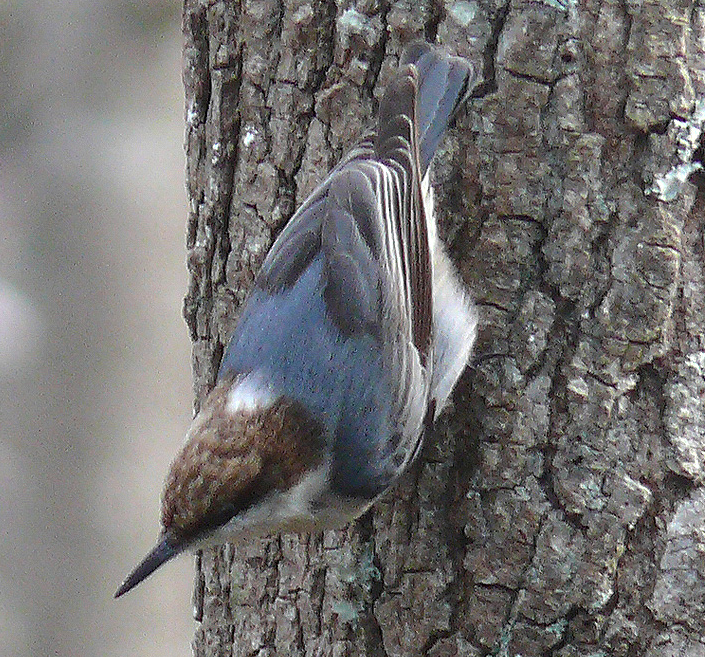 Brown-headed NuthatchSitta pusilla
- Bahama NuthatchSitta insularis
-
 Beautiful NuthatchSitta formosa
-
 Algerian NuthatchSitta ledanti
Compare
Questions and answers
What is the scientific name of the Giant Nuthatch?
The scientific name of the Giant Nuthatch is Sitta magna. Written with its author, the full name is Sitta magna R. G. Wardlaw-Ramsay, 1876.
Which family does the Giant Nuthatch belong to?
Sitta magna belongs to the family Sittidae, in the order Passeriformes and the class Aves.
Where is the Giant Nuthatch found?
Checklists and occurrence records place Sitta magna in 3 countries: Thailand, China and Myanmar.
What is the conservation status of the Giant Nuthatch?
The IUCN Red List category recorded for Sitta magna is Endangered (EN).
What bird looks like a large nuthatch?
The chestnut-vented nuthatch can be confused with the Giant Nuthatch, but it has reddish flanks and a smaller black eyestripe.[32]
What is the Latin name for the nuthatch?
The Latin name of the Giant Nuthatch is Sitta magna. It was described under this binomial name in 1876.[35]
Sources
Passages the profile rests on
- The upperparts are dark bluish-grey, with a lighter grey crown, nape and upper mantle. Source passage: “The upperparts are dark bluish-grey, with the crown, nape, and upper mantle much lighter grey” — English Wikipedia
- The crown, nape and upper mantle may show varying degrees of black streaking. Source passage: “and somewhat streaked with black, varyingly between individuals, regardless of sex.” — English Wikipedia
- Two thick black eyestripes extend from the crown to the top of the mantle. Source passage: “two thick black eyestripes that extend to the top of the mantle” — English Wikipedia
- The underparts are light grey, with almost white cheeks and throat and a belly variably washed with cinnamon. Source passage: “The underparts are light grey, with almost white cheeks and throat, and the belly is more or less washed with cinnamon.” — English Wikipedia
- The undertail coverts are rufous and have large white spots. Source passage: “The undertail coverts are rufous, with large white spots.” — English Wikipedia
- The iris is brown or hazel. Source passage: “The iris is brown or hazel” — English Wikipedia
- The bill is black, with approximately half of the lower mandible lighter in colour. Source passage: “the bill is black, with half of the lower mandible lighter, bluish white or bluish lilac.” — English Wikipedia
- The female has less contrast between the nape and lower mantle than the male. Source passage: “the bottom of the mantle is lighter than in the male, providing less contrast with the nape.” — English Wikipedia
- Juveniles resemble females but have duller eye features and greyer upperparts. Source passage: “The juvenile resembles the females, but has the crown mealy, the upper parts are more grey than blue, and the eye features are duller.” — English Wikipedia
- The species primarily inhabits pine forests. Source passage: “The giant nuthatch mainly appreciates pine forests” — English Wikipedia
- In Thailand, it occurs among oak and chestnut forests where mature Benguet pines grow frequently along ridge tops. Source passage: “In Thailand, it is found in the middle of oak and chestnut forests, among which mature large Benguet pine are frequent on the ridge tops.” — English Wikipedia
- In China, the species inhabits forests at elevations generally exceeding 1,000 m and reaching at least 3,350 m. Source passage: “in China, it generally inhabits forests well above 1,000 m (3,280 ft), up to at least 3,350 m (10,990 ft)” — English Wikipedia
- In Myanmar, it has been recorded at elevations between 1,220 and 1,830 m. Source passage: “in Myanmar, it is reported from 1,220 m (4,000 ft) to 1,830 m (6,000 ft)” — English Wikipedia
- In Thailand, it has been recorded at elevations between 1,200 and 1,800 m. Source passage: “in Thailand from 1,200 m (3,940 ft) to 1,800 m (5,910 ft).” — English Wikipedia
- The species feeds on berries and arthropods. Source passage: “the diet consisted of berries and arthropods” — English Wikipedia
- Its recorded arthropod prey includes beetles, lepidoptera and ants. Source passage: “such as beetles, lepidoptera and ants.” — English Wikipedia
- The species frequently forages upside down. Source passage: “particularly frequently putting itself upside down” — English Wikipedia
- It generally searches for food alone or in pairs, usually in pine trees. Source passage: “This nuthatch usually searches alone or in pairs, usually in pines.” — English Wikipedia
- It usually explores tree trunks and large branches when foraging. Source passage: “It usually explores the trunk and large branches” — English Wikipedia
- It has also been observed searching thinner branches for insects. Source passage: “but it has also been observed foraging on thinner branches for insects.” — English Wikipedia
- Its short-distance flight is generally straight, with whirring wingbeats. Source passage: “It usually flies straight over short distances, with whirring wingbeats” — English Wikipedia
- Its calls include three rough notes repeated rapidly. Source passage: “that consists of three rough notes repeated quickly” — English Wikipedia
- Its song may consist of clear whistling or tinkling notes repeated at irregular intervals. Source passage: “The song could be a clear, whistling or tinkling sound in kip or keep, repeated at irregular intervals” — English Wikipedia
- The species nests in naturally occurring holes in tree trunks. Source passage: “It was located in a naturally occurring hole in the trunk of a tree” — English Wikipedia
- A nest discovered in southern Shan State on 4 April 1933 contained three half-feathered young. Source passage: “On 4 April 1933, a nest was found in southern Shan State with three young, half-feathered.” — English Wikipedia
- A nest discovered in north-western Thailand on 8 April 1983 contained three hatchlings. Source passage: “On 8 April 1983, another nest containing 3 hatchlings was found in north-western Thailand.” — English Wikipedia
- A nest reported in Thailand in 1998 was found in a Benguet pine trunk at the end of March. Source passage: “In 1998, another nest was reported in Thailand, found at the end of March in the trunk of a Benguet pine” — English Wikipedia
- The estimated global population comprises 1,500–3,800 individuals. Source passage: “The global population comprises 1,500–3,800 individuals in total” — English Wikipedia
- The estimated global population includes 1,000–2,499 mature individuals. Source passage: “of which 1,000–2,499 individuals are mature.” — English Wikipedia
- Habitat destruction caused by logging is a major threat to the species. Source passage: “logging for pine resin and firewood remains a major cause of the destruction of old trees.” — English Wikipedia
- In Thailand, much of the species' habitat is threatened by conversion for cultivation and firewood collection. Source passage: “where most of its habitat is subject to destruction for cultivation and for firewood” — English Wikipedia
- The chestnut-vented nuthatch can be confused with the Giant Nuthatch but has reddish flanks and a smaller black eyestripe. Source passage: “has reddish flanks, much smaller black eyestripe” — English Wikipedia
- The Yunnan nuthatch shares some habitats with the Giant Nuthatch in southern Yunnan but is considerably smaller. Source passage: “can occur in the same habitats as the Giant Nuthatch in southern Yunnan, but is much smaller” — English Wikipedia
- BirdLife International recommends further research into the species' distribution, population numbers and habitat. Source passage: “BirdLife International proposes further study of the exact distribution of the giant nuthatch, its numbers, and its habitat” — English Wikipedia
- The species was described in 1876 under the binomial name Sitta magna. Source passage: “The giant nuthatch was described in 1876 under its current binomial name Sitta magna” — English Wikipedia
Data
- Catalogue of Life, 2026-10-16 XR cc by
- Global Biodiversity Information Facility CC BY 4.0
- Wikidata CC0
- GeoNames CC BY 4.0
- Wikimedia Commons per image; credit shown with each image
- Within the Catalogue of Life, this name comes from The Integrated Taxonomic Information System cc0
References
- Wardlaw-Ramsay, & Robert George. (1876). On an undescribed Species of Nuthatch and another Bird from Karen-nee. Proceedings of the Zoological Society of London, Vol. 44. where the name was published
- Gill, Frank, & and Minturn Wright. (2006). Birds of the World: Recommended English Names.
This species in other databases
Page built on 28 November 2026. See how the catalog is made and all sources and licences.
Cite this page
ScientificNames.org. (2026). Sitta magna (Giant Nuthatch). Retrieved November 28, 2026, from https://scientificnames.org/species/sitta-magna
“Sitta magna (Giant Nuthatch).” ScientificNames.org, 2026, scientificnames.org/species/sitta-magna. Accessed 28 Nov. 2026.
ScientificNames.org. “Sitta magna (Giant Nuthatch).” Accessed November 28, 2026. https://scientificnames.org/species/sitta-magna.
@misc{scientificnames_sitta_magna_giant_nuthatch,
  author = {{ScientificNames.org}},
  title = {Sitta magna (Giant Nuthatch)},
  year = {2026},
  url = {https://scientificnames.org/species/sitta-magna},
  note = {Accessed 2026-11-28}
}