Species · Birds
Chestnut-vented Nuthatch Sitta nagaensis
The scientific name of the Chestnut-vented Nuthatch is Sitta nagaensis. It is a species of bird in the family Sittidae (nuthatch), order Passeriformes. The name dates from 1874.
- Scientific name
- Sitta nagaensis Godwin-Austen, 1874
- Common name
- Chestnut-vented Nuthatch
- Genus
- Sitta
- Family
- Sittidae (Nuthatch)
- Order
- Passeriformes
- Class
- Aves
- Red List category
- LC Least Concern
- Recorded in
- 6 countries
- Name status
- accepted in the Catalogue of Life

Overview
The Chestnut-vented Nuthatch (Sitta nagaensis Godwin-Austen, 1874) is a bird in the family Sittidae, order Passeriformes and class Aves. It inhabits forests in India, Myanmar, Thailand, China, Vietnam and Laos. It is distinguished by uniformly blue-grey upperparts, pale grey underparts and dark brick-red rear flanks.
Written 26 November 2026 from the sources listed below. Each statement was checked against the passage it cites; statements that could not be supported were removed.
Appearance
The Chestnut-vented Nuthatch measures 12.5–14 cm in length. Its upperparts are uniformly blue-grey from the crown to the tail, and a prominent black loral stripe extends towards the base of the wing.[1][2][3]
Its underparts are pale grey with varying degrees of buff coloration. Dark brick-red rear flanks contrast strongly with the remaining underparts.[4][5]
The species does not exhibit pronounced sexual dimorphism. Adult males have deeper brick-red rear flanks than females, whose flanks are rufous.[6][7]
Juveniles have more buff-coloured plumage than adults with worn feathers. The iris ranges from brown to dark brown.[8][9]
The bill is greyish-black to blackish, sometimes with a slate-grey or blue-grey base. The legs can be dark brown, greenish or blue-grey.[10][11]
Habitat
The species mainly inhabits evergreen forests in upland areas. It also occupies pine patches growing on dry ridges within evergreen forests and occurs locally in deciduous forests in northeastern India.[12][13][14]
In northeastern Myanmar, it inhabits Quercus subsericea oak forests and alder groves. In Yunnan, it occurs in spruce, fir and rhododendron forests, while in Sichuan it also occupies poplar and walnut forests.[15][16][17]
The species inhabits both broadleaf and coniferous forests.[18]
Diet
The species probably feeds on small arthropods and seeds.[19]
Behaviour
The Chestnut-vented Nuthatch generally lives alone or in pairs. Outside the breeding season, it joins mixed-species foraging flocks.[20][21]
During winter, it associates with tits, bushtits, woodpeckers, alcippes and minlas. It frequently searches for food on the ground, rocks, old stumps and trees.[22][23]
Reproduction and life cycle
The breeding season in Thailand generally runs from March to May and in India from March to June. In eastern Myanmar, breeding generally occurs from April to early June.[24][25][26]
The nest is constructed in a tree hole or stump at approximately 10 m above the ground. Its floor is lined with bark pieces and moss and topped with hair.[27][28]
The species lays clutches containing two to five eggs. Eggs of the S. n. nagaensis subspecies average 18.6 × 13.8 mm and are white with red dots on a mottled reddish-purple background.[29][30][31]
The species may use mud to reduce the entrance of its nesting cavity.[32]
Conservation
The species' population is declining because of habitat destruction and fragmentation. It is classified as Least Concern by the International Union for Conservation of Nature.[33][34]
A climate-change modelling study predicted a distribution decrease of 15.9–17.4% between the 2040s and 2069.[35]
Similar species
The Chestnut-vented Nuthatch is closely related to the Eurasian Nuthatch and Kashmir Nuthatch.[36]
Classification of the Chestnut-vented Nuthatch
| Kingdom | Animalia |
|---|---|
| Phylum | Chordata |
| Subphylum | Vertebrata |
| Infraphylum | Gnathostomata |
| Parvphylum | Osteichthyes |
| Megaclass | Tetrapoda |
| Class | Aves (Bird) |
| Order | Passeriformes (Passerine) |
| Family | Sittidae (Nuthatch) |
| Genus | Sitta (Nuthatch) |
| Species | Sitta nagaensis Godwin-Austen, 1874 |
Where the Chestnut-vented Nuthatch is found
Checklists and occurrence records place Sitta nagaensis in 6 countries across Asia. GBIF holds 11,654 georeferenced records of it.
Countries
Regions and cities with the most records
- Chiang Mai, Thailand 4,202
- Yunnan, China 3,044
- Lam Dong, Vietnam 2,004
- Ðà Lạt, Vietnam 1,813
- Đưc Trọng, Vietnam 672
- Sichuan, China 543
- Chin State, Myanmar 407
- Beihai, China 403
- Kunming, China 402
- Majie, China 398
- Tengyue, China 311
- Zhonghe, China 309
- Jietou, China 308
- Hehua, China 305
- Shan State, Myanmar 268
- Tibet, China 261
- Nagaland, India 189
- Chuxiong, China 178
- Dali Old Town, China 171
- Kohima, India 170
- Yinqiao Zhen, China 170
- Dali, China 169
- Haidong Zhen, China 168
- Wanqiao Zhen, China 168
- Anning, China 147
- Qushi, China 116
- Mazhan, China 92
- Shangri-La, China 80
- Lao Cai, Vietnam 68
- Mu-se, Myanmar 63
- Mengmao, China 62
- Zhangfeng, China 55
- Fengyi, China 52
- Bayi, China 50
- Nyingchi, China 50
- Huangshan, China 44
Range as the checklists state it
Southern Asia
A number beside a place is its count of GBIF occurrence records. A place without a number comes from a checklist alone. Records show where a species has been observed or collected, which can include escapes and vagrants.
Common names
English
- Chestnut-vented Nuthatch
Names in 28 other languages
- Bulgarian
- Нагайска зидарка
- Catalan
- pica-soques dels monts Naga
- Chinese
- 栗臀䴓, 栗臀鳾, 栗臀
- Croatian
- kestenjastoboki brgljez
- Czech
- brhlík nagaský
- Danish
- Højlands Spætmejse
- Dutch
- Kastanjebuikboomklever
- Esperanto
- nagaa sito
- Estonian
- kagu-puukoristaja
- Finnish
- assaminnakkeli
- French
- Sittelle des Naga
- German
- Bergkleiber, Rostflankenkleiber
- Hungarian
- gesztenyebarnahasú csuszka
- Italian
- Picchio muratore culcastano
- Japanese
- ミナミゴジュウカラ
- Latvian
- bērdibena dzilnītis
- Lithuanian
- rudauodegis bukutis
- Norwegian
- gråbrystspettmeis
- Polish
- kowalik tybetański
- Portuguese
- trepadeira-de-barriga-cinzenta, trepadeira-dos-naga
- Russian
- Каштановобокий поползень
- Slovak
- brhlík tehlovoboký
- Spanish
- Trepador Barriga Ceniza, Trepador de las Naga
- Swedish
- naganötväcka
- Thai
- นกไต่ไม้โคนหางสีน้ำตาล, นกไต่ไม้ใต้โคนหางสีน้ำตาล
- Turkish
- Naga Sıvacısı
- Ukrainian
- повзик тибетський
- Vietnamese
- Trèo cây bụng hung
Synonyms
One other scientific name has been used for this species and is now treated as a synonym of Sitta nagaensis.
- Sitta europaea nagaensis Godwin-Austen, HH, 1874
Subspecies and varieties
- Sitta nagaensis grisiventris subspecies
- Sitta nagaensis montium subspecies
- Sitta nagaensis nagaensis subspecies
Related species
-
 Eurasian NuthatchSitta europaea
-
 White-breasted NuthatchSitta carolinensis
-
 Red-breasted NuthatchSitta canadensis
-
 Pygmy NuthatchSitta pygmaea
-
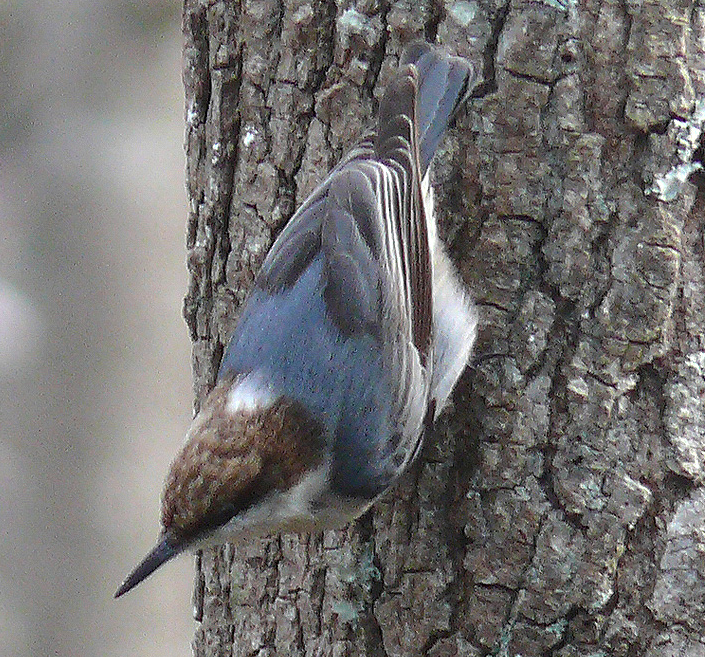 Brown-headed NuthatchSitta pusilla
- Bahama NuthatchSitta insularis
-
 Beautiful NuthatchSitta formosa
-
 Algerian NuthatchSitta ledanti
Compare
Questions and answers
What is the scientific name of the Chestnut-vented Nuthatch?
The scientific name of the Chestnut-vented Nuthatch is Sitta nagaensis. Written with its author, the full name is Sitta nagaensis Godwin-Austen, 1874.
Which family does the Chestnut-vented Nuthatch belong to?
Sitta nagaensis belongs to the family Sittidae, in the order Passeriformes and the class Aves.
Where is the Chestnut-vented Nuthatch found?
Checklists and occurrence records place Sitta nagaensis in 6 countries: Thailand, China, Vietnam, India, Myanmar and Laos.
What is the conservation status of the Chestnut-vented Nuthatch?
The IUCN Red List category recorded for Sitta nagaensis is Least Concern (LC).
What is a interesting fact about the nuthatch?
The Chestnut-vented Nuthatch may use mud to reduce the entrance of its nesting cavity.[32]
What is a nuthatch's favorite food?
The Chestnut-vented Nuthatch probably feeds on small arthropods and seeds.[19]
Where do nuthatches nest?
The Chestnut-vented Nuthatch constructs its nest in a tree hole or stump at approximately 10 m above the ground.[27]
Sources
Passages the profile rests on
- The Chestnut-vented Nuthatch measures 12.5–14 cm in length. Source passage: “measuring 12.5–14 cm (4.9–5.5 in) in length.” — English Wikipedia
- The upperparts are uniformly blue-grey from the crown to the tail. Source passage: “The upperparts are a solid blue-grey from crown to tail” — English Wikipedia
- The bird has a prominent black loral stripe extending towards the base of the wing. Source passage: “with a marked black loral line extending to the base of the wing.” — English Wikipedia
- Its underparts are pale grey with varying degrees of buff coloration. Source passage: “The underparts are pale grey, more or less tinted buff-tinged depending on the subspecies or the wear of the plumage;” — English Wikipedia
- Its dark brick-red rear flanks contrast strongly with the remaining underparts. Source passage: “the dark brick-red back flanks contrast strongly with the rest of the underparts.” — English Wikipedia
- The species does not exhibit pronounced sexual dimorphism. Source passage: “The species does not show marked sexual dimorphism.” — English Wikipedia
- Adult males have deeper brick-red rear flanks than females, whose flanks are rufous. Source passage: “The male's rear flanks are deep brick-red, deeper and less orange than the undertail coverts, whereas the female's flanks are rufous” — English Wikipedia
- Juveniles have more buff-coloured plumage than adults with worn feathers. Source passage: “juveniles are more buff than adults with worn plumage.” — English Wikipedia
- Its iris ranges from brown to dark brown. Source passage: “The iris is brown to dark brown” — English Wikipedia
- Its bill is greyish-black to blackish, sometimes with a slate-grey or blue-grey base. Source passage: “the bill is greyish-black to blackish with the base of the lower mandible (and sometimes the base of the upper) slate-grey or blue-grey.” — English Wikipedia
- Its legs can be dark brown, greenish or blue-grey. Source passage: “The legs are dark brown, greenish or blue-grey” — English Wikipedia
- The species mainly inhabits evergreen forests in upland areas. Source passage: “The chestnut-vented nuthatch usually inhabits evergreen forests of the uplands” — English Wikipedia
- It also occupies pine patches growing on dry ridges within evergreen forests. Source passage: “or forests and pine patches growing on dry ridges in the middle of evergreen forests.” — English Wikipedia
- The species occurs locally in deciduous forests in northeastern India. Source passage: “Locally, it also occurs in deciduous forests in northeastern India” — English Wikipedia
- In northeastern Myanmar, it inhabits Quercus subsericea oak forests and alder groves. Source passage: “in Quercus subsericea oak forests and alder groves in northeastern Myanmar” — English Wikipedia
- In Yunnan, the species occurs in spruce, fir and rhododendron forests. Source passage: “spruce forests (Picea sp.), fir forests (Abies sp.) or rhododendron stands in Yunnan” — English Wikipedia
- The species also occurs in poplar and walnut forests in Sichuan. Source passage: “poplar (Populus sp.) and walnut (Juglans sp.) in Sichuan.” — English Wikipedia
- The species inhabits both broadleaf and coniferous forests. Source passage: “Inhabits both broadleaf and coniferous forests.” — ebird.org
- The species probably feeds on small arthropods and seeds. Source passage: “the species probably feeds on small arthropods and seeds.” — English Wikipedia
- The Chestnut-vented Nuthatch generally lives alone or in pairs. Source passage: “The chestnut-vented nuthatch generally lives alone or in pairs” — English Wikipedia
- Outside the breeding season, the species joins mixed-species foraging flocks. Source passage: “but joins mixed-species foraging flocks outside of the breeding season.” — English Wikipedia
- During winter, it associates with tits, bushtits, woodpeckers, alcippes and minlas. Source passage: “In winter, it can thus be observed in the company of different species of tits (Paridae) such as the yellow-cheeked tit (Maclolophus spilonotus), bushtits, woodpeckers, alcippes, and minlas.” — English Wikipedia
- The species frequently searches for food on the ground, rocks, old stumps and trees. Source passage: “The chestnut-vented nuthatch often forages for food on the ground, on rocks, old stumps, or in trees.” — English Wikipedia
- The breeding season in Thailand generally runs from March to May. Source passage: “it generally takes place in Thailand from March to May” — English Wikipedia
- In India, the breeding season generally extends from March to June. Source passage: “March to June for India” — English Wikipedia
- In eastern Myanmar, breeding generally occurs from April to early June. Source passage: “April to early June for eastern Myanmar” — English Wikipedia
- The species' nest is constructed in a tree hole or stump at approximately 10 m above the ground. Source passage: “It is located at a height of about 10 m (390 in) in the hole of a tree, or in a stump.” — English Wikipedia
- The nest floor is lined with bark pieces and moss and topped with hair. Source passage: “The bottom of the nest is lined with pieces of bark and moss and topped with hair.” — English Wikipedia
- The species lays clutches containing two to five eggs. Source passage: “Two to five eggs are laid” — English Wikipedia
- Eggs of the S. n. nagaensis subspecies average 18.6 × 13.8 mm. Source passage: “averaging 18.6 mm × 13.8 mm (0.73 in × 0.54 in) in S. n. nagaensis” — English Wikipedia
- The eggs are white with red dots on a mottled reddish-purple background. Source passage: “They are white, with red dots on a mottled reddish-purple background” — English Wikipedia
- The species may use mud to reduce the entrance of its nesting cavity. Source passage: “may line the entrance of a cavity with mud to reduce the opening” — English Wikipedia
- The species' population is declining because of habitat destruction and fragmentation. Source passage: “The population of the chestnut-vented nuthatch is declining due to habitat destruction and fragmentation” — English Wikipedia
- The species is classified as Least Concern by the International Union for Conservation of Nature. Source passage: “the species is generally common throughout its range. For these reasons, the chestnut-vented nuthatch is considered to be of least concern by the International Union for the Conservation of Nature.” — English Wikipedia
- A climate-change modelling study predicted a distribution decrease of 15.9–17.4% between the 2040s and 2069. Source passage: “It predicted that the chestnut-vented nuthatch could see its distribution decrease between the 2040s and 2069 by 15.9 to 17.4%.” — English Wikipedia
- The species is closely related to the Eurasian Nuthatch and Kashmir Nuthatch. Source passage: “the chestnut-vented nuthatch is closely related to the Eurasian nuthatch (S. europaea) and the Kashmir nuthatch (S. cashmirensis).” — English Wikipedia
Data
- Catalogue of Life, 2026-10-16 XR cc by
- Global Biodiversity Information Facility CC BY 4.0
- Wikidata CC0
- GeoNames CC BY 4.0
- Wikimedia Commons per image; credit shown with each image
- Within the Catalogue of Life, this name comes from The Integrated Taxonomic Information System cc0
References
- Godwin-Austen, & Henry Haversham. (1874). Descriptions of 10 new Birds from the Naga Hills and Munipur Valley, North Bast Frontier of Bengal. Proceedings of the Zoological Society of London, Vol. 42. where the name was published
- Gill, Frank, & and Minturn Wright. (2006). Birds of the World: Recommended English Names.
This species in other databases
Page built on 29 November 2026. See how the catalog is made and all sources and licences.
Cite this page
ScientificNames.org. (2026). Sitta nagaensis (Chestnut-vented Nuthatch). Retrieved November 29, 2026, from https://scientificnames.org/species/sitta-nagaensis
“Sitta nagaensis (Chestnut-vented Nuthatch).” ScientificNames.org, 2026, scientificnames.org/species/sitta-nagaensis. Accessed 29 Nov. 2026.
ScientificNames.org. “Sitta nagaensis (Chestnut-vented Nuthatch).” Accessed November 29, 2026. https://scientificnames.org/species/sitta-nagaensis.
@misc{scientificnames_sitta_nagaensis_chestnut_vented_nuthatch,
  author = {{ScientificNames.org}},
  title = {Sitta nagaensis (Chestnut-vented Nuthatch)},
  year = {2026},
  url = {https://scientificnames.org/species/sitta-nagaensis},
  note = {Accessed 2026-11-29}
}