Species · Birds
White-browed Nuthatch Sitta victoriae
The scientific name of the White-browed Nuthatch is Sitta victoriae. It is a species of bird in the family Sittidae (nuthatch), order Passeriformes. The name dates from 1904.
- Scientific name
- Sitta victoriae Rippon, 1904
- Common name
- White-browed Nuthatch
- Genus
- Sitta
- Family
- Sittidae (Nuthatch)
- Order
- Passeriformes
- Class
- Aves
- Red List category
- EN Endangered
- Recorded in
- 1 country
- Name status
- accepted in the Catalogue of Life

Overview
Sitta victoriae is endemic to western Myanmar, with its principal known location at Nat Ma Taung in the southern Chin Hills. It has dull bluish-grey upperparts, a white forehead and eyebrows, and an orange belly.
Written 26 November 2026 from the sources listed below. Each statement was checked against the passage it cites; statements that could not be supported were removed.
Appearance
The White-browed Nuthatch measures 11.5 cm in length. Its tail measures 36–37 mm, its beak 15–16 mm and its tarsus 14–16 mm. Male folded wings measure 68–73 mm, while female folded wings measure 67–69 mm.[1][2][3][4][5][6]
Its upperparts are dull bluish-grey. The throat and lower chest are white, the belly is orange, and the underside and undertail are light red, with darker flanks.[7][8][9]
It has a white forehead, eyebrows and lore, with a black line behind the eye that thickens toward the nape. Its cheeks are white with orange coloration on the back of each cheek.[10][11][12]
Its bill is black at the tip and otherwise slate grey. Its thighs are grey, and its legs are dull yellowish-brown or olive-brown. Juveniles have lighter orange-red flanks than adults, and the species does not exhibit sexual dimorphism.[13][14][15][16]
Habitat
The White-browed Nuthatch inhabits old oak forests at high elevations, generally above 2,600 m. It occurs in lichen-covered old oak forests of the alpine level rather than pure pine forests.[17][18]
Its habitat consists mainly of Quercus semecarpifolia oaks supporting epiphytic plants, lichens, mosses, orchids and ferns.[19]
The species is endemic to western Myanmar. Its principal known location is Nat Ma Taung in the southern Chin Hills of Myanmar, and it has also been recorded near Mindat, approximately 22 km northwest of Nat Ma Taung.[20][21][22]
It has been recorded at approximately 3,070 m elevation on Nat Ma Taung. Historical specimens were collected between 2,285 and 2,745 m elevation.[23][24]
Diet
The White-browed Nuthatch feeds on small insects found among epiphytes growing on oaks and in bark hollows. It frequently forages on Quercus semecarpifolia.[25][26]
It also forages on Rhododendron arboreum. Additional foraging trees include Lyonia ovalifolia, Lithocarpus dealbatus, Pinus kesiya and Alnus nepalensis.[27][28]
Behaviour
The White-browed Nuthatch is usually observed alone or in pairs. It generally searches for food on outer branches but also forages on inner branches and tree trunks.[29][30]
Reproduction and life cycle
Three nests were observed between mid-March and early April 2002. Two were situated in cavities in internal branches of Quercus semecarpifolia trees at heights of 4 m and 10 m, while the third was located in the trunk of a Rhododendron arboreum at a height of 6 m.[31][32][33]
The female alone excavated the first nest observed. Its entrance was not sealed with clay.[34][35]
Females appear to be responsible for feeding the young. Three flocks containing two fledged young each were observed in April.[36][37]
Conservation
The White-browed Nuthatch is classified as endangered by the International Union for Conservation of Nature. Its estimated population comprises 2,500–10,000 mature individuals, with an estimated total population of 3,500–15,000 individuals.[38][39][40]
The species faces threats from trapping and fires in Nat Ma Taung. Forest clearance and habitat degradation have affected its habitat at elevations up to 2,500 m.[41][42]
The species is legally protected under a Myanmar wildlife conservation law enacted in 1994. Its estimated geographic range covers 820 km².[43][44]
Similar species
The White-browed Nuthatch can be confused with the White-tailed Nuthatch. Its white supercilium distinguishes it from that species.[45][46]
Classification of the White-browed Nuthatch
| Kingdom | Animalia |
|---|---|
| Phylum | Chordata |
| Subphylum | Vertebrata |
| Infraphylum | Gnathostomata |
| Parvphylum | Osteichthyes |
| Megaclass | Tetrapoda |
| Class | Aves (Bird) |
| Order | Passeriformes (Passerine) |
| Family | Sittidae (Nuthatch) |
| Genus | Sitta (Nuthatch) |
| Species | Sitta victoriae Rippon, 1904 |
Where the White-browed Nuthatch is found
Checklists and occurrence records place Sitta victoriae in 1 country across Asia. GBIF holds 352 georeferenced records of it.
Countries
Regions and cities with the most records
Range as the checklists state it
Southern Asia
A number beside a place is its count of GBIF occurrence records. A place without a number comes from a checklist alone. Records show where a species has been observed or collected, which can include escapes and vagrants.
Common names
English
- White-browed Nuthatch
Names in 29 other languages
- Bulgarian
- Беловежда зидарка
- Burmese
- မျက်ခုံးဖြူငှက်ပြာခြောက်
- Catalan
- pica-soques de Birmània
- Chinese
- 白眉䴓, 白額鳾
- Croatian
- burmanski brgljez
- Czech
- brhlík barmský
- Danish
- Burma Spætmejse
- Dutch
- Witbrauwboomklever
- Esperanto
- viktoria sito
- Estonian
- chini puukoristaja
- Finnish
- burmannakkeli
- French
- Sittelle du Victoria
- German
- Weißbrauenkleiber
- Hungarian
- barnásfehér csuszka
- Italian
- Picchio muratore cigliabianche
- Japanese
- マミジロゴジュウカラ
- Lithuanian
- baltabruvis bukutis
- Norwegian
- Burmaspettmeis, hvitbrynspettmeis
- Polish
- kowalik białobrewy
- Portuguese
- trepadeira-birmanesa, trepadeira-dos-chim
- Russian
- Белобровый поползень
- Serbian
- Brgljez sa belom obrvom
- Slovak
- brhlík hrdzavosluchý
- Spanish
- Trapador birmano, Trepador birmano, Trepador de Victoria
- Swedish
- burmanötväcka, victorianötväcka
- Turkish
- Ak Kaşlı Sıvacı
- Ukrainian
- повзик білобровий
- Vietnamese
- Trèo cây mày trắng
- Welsh
- delor cnau aeliog
Related species
-
 Eurasian NuthatchSitta europaea
-
 White-breasted NuthatchSitta carolinensis
-
 Red-breasted NuthatchSitta canadensis
-
 Pygmy NuthatchSitta pygmaea
-
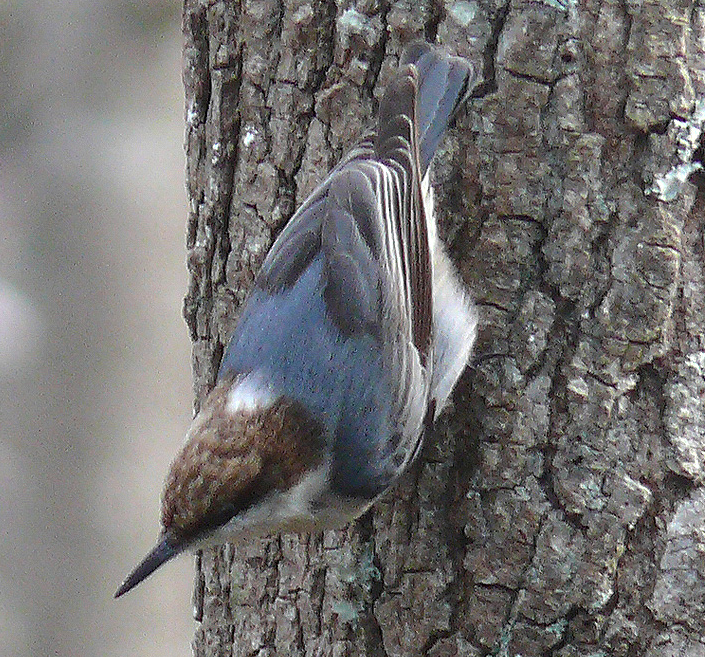 Brown-headed NuthatchSitta pusilla
- Bahama NuthatchSitta insularis
-
 Beautiful NuthatchSitta formosa
-
 Algerian NuthatchSitta ledanti
Compare
Questions and answers
What is the scientific name of the White-browed Nuthatch?
The scientific name of the White-browed Nuthatch is Sitta victoriae. Written with its author, the full name is Sitta victoriae Rippon, 1904.
Which family does the White-browed Nuthatch belong to?
Sitta victoriae belongs to the family Sittidae, in the order Passeriformes and the class Aves.
Where is the White-browed Nuthatch found?
Checklists and occurrence records place Sitta victoriae in 1 country: Myanmar.
What is the conservation status of the White-browed Nuthatch?
The IUCN Red List category recorded for Sitta victoriae is Endangered (EN).
What is the diet of a nuthatch?
The White-browed Nuthatch feeds on small insects found among epiphytes growing on oaks and in bark hollows. It frequently forages on Quercus semecarpifolia and also uses Rhododendron arboreum, Lyonia ovalifolia, Lithocarpus dealbatus, Pinus kesiya and Alnus nepalensis.[25][26][27][28]
Sources
Passages the profile rests on
- The White-browed Nuthatch measures 11.5 cm in length. Source passage: “measuring 11.5 cm (4.5 in) in length” — English Wikipedia
- Male folded wings measure 68–73 mm. Source passage: “The folded wing measures 68–73 mm (2.7–2.9 in) for the male” — English Wikipedia
- Female folded wings measure 67–69 mm. Source passage: “67–69 mm (2.6–2.7 in) for the female” — English Wikipedia
- Its tail measures 36–37 mm in length. Source passage: “The tail is 36–37 mm (1.4–1.5 in)” — English Wikipedia
- Its beak measures 15–16 mm in length. Source passage: “the beak is 15–16 mm (0.59–0.63 in)” — English Wikipedia
- Its tarsus measures 14–16 mm. Source passage: “the tarsus is 14–16 mm (0.55–0.63 in)” — English Wikipedia
- The upperparts are dull bluish-grey. Source passage: “The upperparts are dull bluish-grey.” — English Wikipedia
- Its throat and lower chest are white, while its belly is orange. Source passage: “The underparts are white from the throat and lower chest, but the belly is orange” — English Wikipedia
- Its underside and undertail are light red, while its flanks are darker. Source passage: “with the underside and undertail light red and the flanks darker.” — English Wikipedia
- It has a white forehead, eyebrows and lore. Source passage: “It has a white forehead, eyebrows, and lore” — English Wikipedia
- A black line behind the eye thickens toward the nape. Source passage: “a black line at the back of the eye, thickening backwards on the nape.” — English Wikipedia
- Its cheeks are white, with orange coloration on the back of each cheek. Source passage: “The cheeks are as white as the throat but the back of the cheek is orange” — English Wikipedia
- Its bill is black at the tip and otherwise slate grey. Source passage: “The bill is black at the tip and slate grey otherwise” — English Wikipedia
- Its thighs are grey and its legs are dull yellowish-brown or olive-brown. Source passage: “The thighs are grey, and the legs are dull, yellowish-brown, or olive-brown.” — English Wikipedia
- Juveniles have lighter orange-red flanks than adults. Source passage: “the juveniles could be distinguished by the lighter orange-red flanks.” — English Wikipedia
- The species does not exhibit sexual dimorphism. Source passage: “No sexual dimorphism was found” — English Wikipedia
- The species inhabits old oak forests at high elevations, generally above 2,600 m. Source passage: “It inhabits old oak groves at high elevations, generally above 2,600 m (8,500 ft).” — English Wikipedia
- It occurs in lichen-covered old oak forests of the alpine level rather than pure pine forests. Source passage: “The white-browed nuthatch avoids the pure pine forests of Pinus kesiya and is found instead in lichen-covered old oak forests of the alpine level.” — English Wikipedia
- Its habitat consists mainly of Quercus semecarpifolia oaks supporting epiphytic plants, lichens, mosses, orchids and ferns. Source passage: “The white-browed nuthatch habitat consists mainly of Quercus semecarpifolia oaks, covered with epiphytic plants, lichens, mosses, orchids, and ferns.” — English Wikipedia
- The species is endemic to western Myanmar. Source passage: “The white-browed nuthatch is endemic to western Myanmar.” — English Wikipedia
- Its principal known location is Nat Ma Taung in the southern Chin Hills of Myanmar. Source passage: “It is currently found on Nat Ma Taung in the southern part of the Chin Hills” — English Wikipedia
- The species has also been recorded near Mindat, approximately 22 km northwest of Nat Ma Taung. Source passage: “and 22 km (14 mi) further northwest in the spring of 1995 near Mindat.” — English Wikipedia
- The species has been recorded at approximately 3,070 m elevation on Nat Ma Taung. Source passage: “at nearly 3,070 m (10,070 ft)” — English Wikipedia
- Historical specimens were collected between 2,285 and 2,745 m elevation. Source passage: “Rippon reported that he collected six birds between 2,285–2,745 m (7,497–9,006 ft) altitude” — English Wikipedia
- The species feeds on small insects found among epiphytes growing on oaks and in bark hollows. Source passage: “It feeds on small insects which it usually finds in the epiphytes growing on the oaks, or in hollows in the bark.” — English Wikipedia
- It frequently forages on Quercus semecarpifolia. Source passage: “The plant species prospected are Quercus semecarpifolia half the time” — English Wikipedia
- It also forages on Rhododendron arboreum. Source passage: “but Rhododendron arboreum is also exploited” — English Wikipedia
- Its additional foraging trees include Lyonia ovalifolia, Lithocarpus dealbatus, Pinus kesiya and Alnus nepalensis. Source passage: “as well as, to a lesser extent, Lyonia ovalifolia, Lithocarpus dealbatus, Pinus kesiya, and Alnus nepalensis.” — English Wikipedia
- The species is usually observed alone or in pairs. Source passage: “The nuthatch is usually seen alone or in pairs.” — English Wikipedia
- It generally searches for food on outer branches but also forages on inner branches and tree trunks. Source passage: “It generally explores the outer branches, but can also prospect on the branches more inside the tree or on the trunk.” — English Wikipedia
- Three nests were observed between mid-March and early April 2002. Source passage: “observed three nests between mid-March and early April in 2002.” — English Wikipedia
- Two observed nests were situated in cavities in internal branches of Quercus semecarpifolia trees at heights of 4 m and 10 m. Source passage: “Two of the nests were located in the cavity of an internal branch in a Quercus semecarpifolia, 4 m (13 ft) and 10 m (33 ft) high” — English Wikipedia
- A third observed nest was located in the trunk of a Rhododendron arboreum at a height of 6 m. Source passage: “the third was placed in the trunk of a Rhododendron arboreum, 6 m (20 ft) high.” — English Wikipedia
- The female alone excavated the first nest observed. Source passage: “The first nest cited was dug by the female alone” — English Wikipedia
- The entrance of the first observed nest was not sealed with clay. Source passage: “its entrance was not walled up with clay” — English Wikipedia
- Females appear to be responsible for feeding the young. Source passage: “Only females seem to feed the young.” — English Wikipedia
- Three flocks containing two fledged young each were observed in April. Source passage: “In April, three flocks were observed, each with two fledged young.” — English Wikipedia
- The species is classified as endangered by the International Union for Conservation of Nature. Source passage: “the species is considered endangered by the International Union for the Conservation of Nature.” — English Wikipedia
- Its estimated population comprises 2,500–10,000 mature individuals. Source passage: “indicate a population of 2,500 to 10,000 mature individuals” — English Wikipedia
- Its estimated total population is 3,500–15,000 individuals. Source passage: “for a total of 3,500 to 15,000 individuals.” — English Wikipedia
- The species faces threats from trapping and fires in Nat Ma Taung. Source passage: “and trapping and fires are adding to the threats to the species.” — English Wikipedia
- Forest clearance and habitat degradation have affected its habitat at elevations up to 2,500 m. Source passage: “the forest has been completely cleared up to 2,000 m (6,600 ft), and the remaining habitats at 2,000–2,500 m (6,600–8,200 ft) are severely degraded.” — English Wikipedia
- The species is legally protected under a Myanmar wildlife conservation law enacted in 1994. Source passage: “The species is legally protected by a 1994 Myanmar law (Protection of Wildlife and Conservation of Natural Areas Law)” — English Wikipedia
- Its estimated geographic range covers 820 km². Source passage: “The range is estimated at 820 km2 (320 sq mi) by BirdLife International.” — English Wikipedia
- The White-browed Nuthatch can be confused with the White-tailed Nuthatch. Source passage: “The white-browed nuthatch can be confused with the white-tailed nuthatch” — English Wikipedia
- Its white supercilium distinguishes it from the White-tailed Nuthatch. Source passage: “Its white supercilium makes it easy to distinguish it from the white-tailed nuthatch (S. himalayensis)” — English Wikipedia
Data
- Catalogue of Life, 2026-10-16 XR cc by
- Global Biodiversity Information Facility CC BY 4.0
- Wikidata CC0
- GeoNames CC BY 4.0
- Wikimedia Commons per image; credit shown with each image
- Within the Catalogue of Life, this name comes from The Integrated Taxonomic Information System cc0
References
- Rippon, & George. (1904). Bulletin of the British Ornithologists’ Club, Vol. 14, No. 107. where the name was published
- Gill, Frank, & and Minturn Wright. (2006). Birds of the World: Recommended English Names.
This species in other databases
Page built on 29 November 2026. See how the catalog is made and all sources and licences.
Cite this page
ScientificNames.org. (2026). Sitta victoriae (White-browed Nuthatch). Retrieved November 29, 2026, from https://scientificnames.org/species/sitta-victoriae
“Sitta victoriae (White-browed Nuthatch).” ScientificNames.org, 2026, scientificnames.org/species/sitta-victoriae. Accessed 29 Nov. 2026.
ScientificNames.org. “Sitta victoriae (White-browed Nuthatch).” Accessed November 29, 2026. https://scientificnames.org/species/sitta-victoriae.
@misc{scientificnames_sitta_victoriae_white_browed_nuthatch,
  author = {{ScientificNames.org}},
  title = {Sitta victoriae (White-browed Nuthatch)},
  year = {2026},
  url = {https://scientificnames.org/species/sitta-victoriae},
  note = {Accessed 2026-11-29}
}